Chamberlain Cottage // 1940

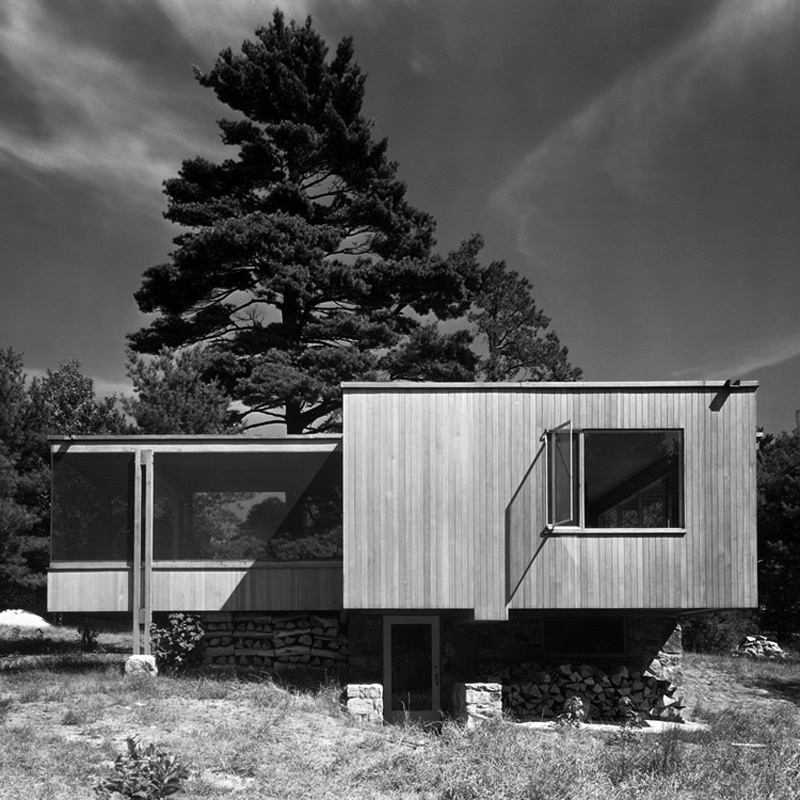
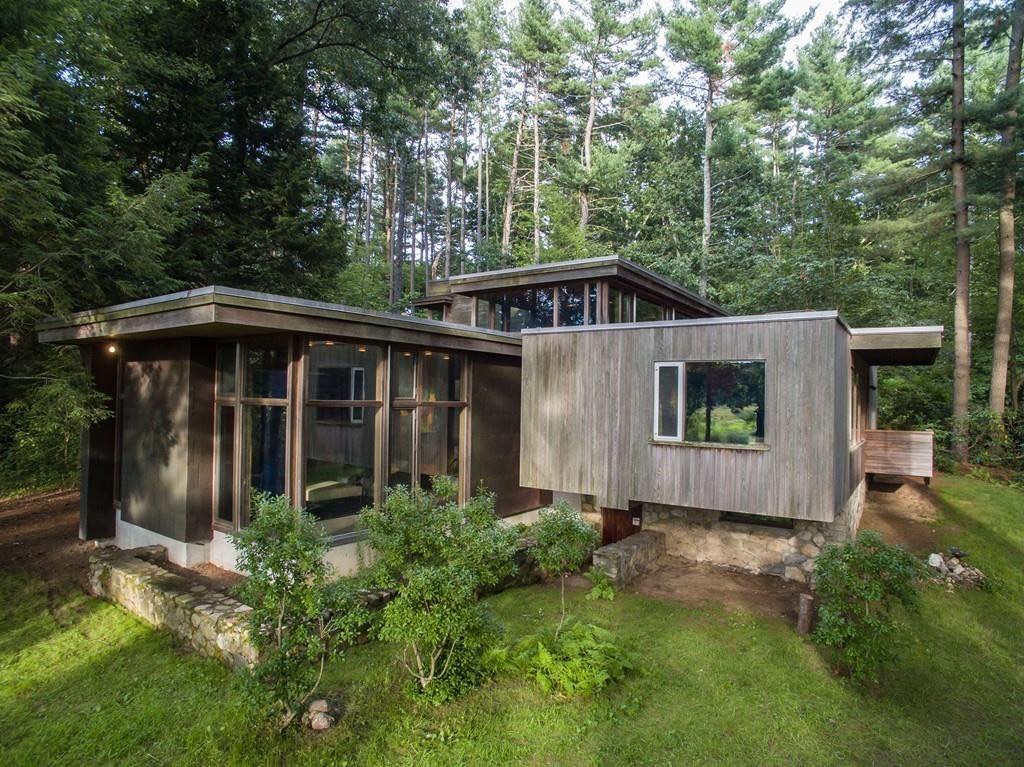
Nestled into the forests of Wayland, Massachusetts, one of the most significant examples of early Modernist architecture, the Chamberlain Cottage, represents the European Bauhaus style adapted to the American landscape and New England vernacular. Designed in 1940 and completed in 1941, the house was commissioned by Harvard Economics professor, Henry Chamberlain and his wife, Margareth, as a weekend retreat from Cambridge. Professor Chamberlain commissioned Marcel Breuer and his mentor, Walter Gropius, then Dean of the Harvard Graduate School of Design, to design a home with a specific request for a screened porch similar to Gropius’ residence in nearby Lincoln. For the Chamberlain Cottage, the design responds to the uneven terrain and the potential for river flooding by two distinct parts: a grounded stone base and a cantilevered wooden volume above. The lower stone level functioned as a foundation while providing storage for a canoe and housing a fireplace that extends vertically through the structure; with the upper wooden volume containing living spaces. Despite its compact size for weekend visits, the upper level is well planned and includes a living space, kitchen, a single bedroom, and the porch. Due to its small scale and siting, the one-bedroom cottage was not easily adaptable for modern living. After falling into disrepair in the 1980s and ’90s, the home was purchased by architects Sidney R. Bowen and Angela Watson, who expanded the structure over the course of a decade to its current size of 3,742 square feet. It has been occupied and lovingly maintained by later owners. It remains a private residence.

Lyman Park Offices // 1959

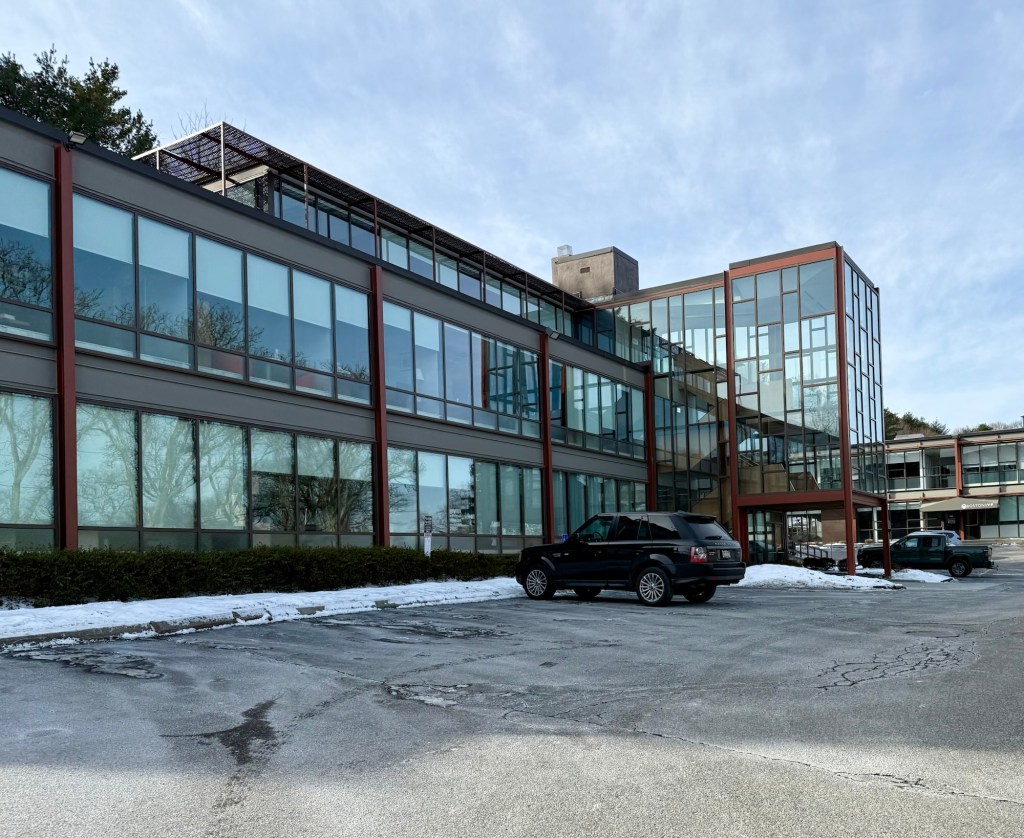
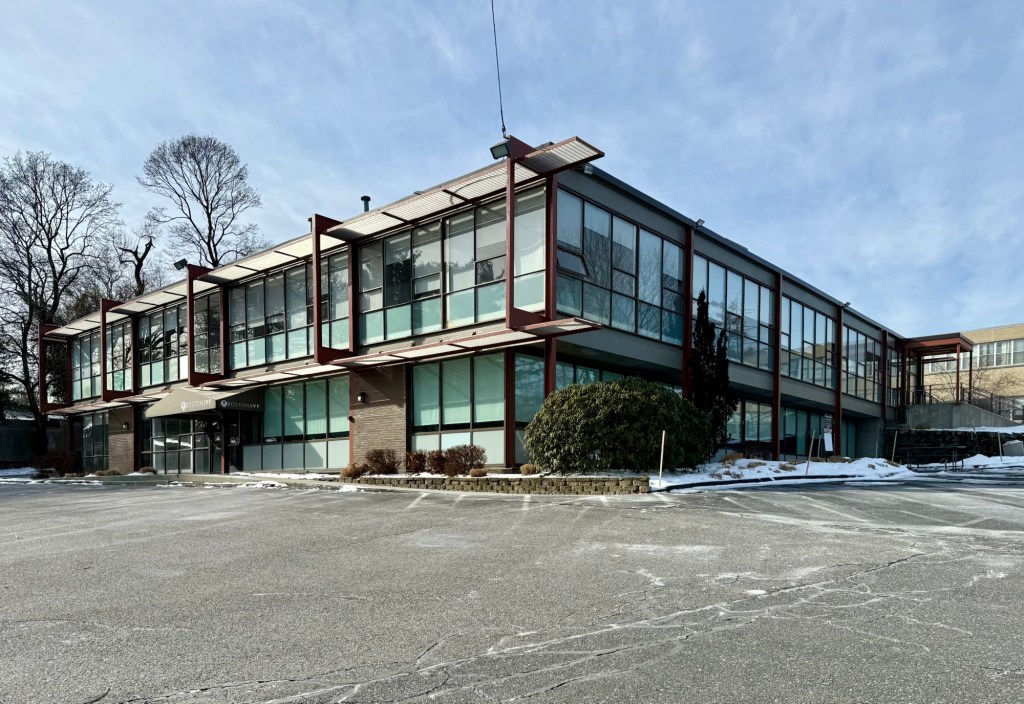
Mid-Century Modern commercial architecture is often maligned for its car-centric and unadorned designs, but the Lyman Park Offices on Boylston Street in Brookline, Massachusetts, are some of the finest office buildings constructed in Brookline in the 20th century. The two office buildings were built on the site of the Theodore Lyman estate and were built at a time Brookline saw rapid commercialization along the Boylston Street corridor. Designed by the firm of Salsberg & LeBlanc, the Lyman Park Offices are landmark examples of the International style in the commercial form in Brookline. Built of steel and glass, the buildings exhibit spandrels above each floor level, enhancing the strong horizontal emphasis of the design.

Alumnae Memorial Library – Elms College // 1973

Located just north of and in stark contrast to the ornate Neo-Gothic 1932 Administration Building of Elms College, the school’s main library building showcases how much architecture styles changed in just 40 years. The college’s library was long in the main Administration building, but was outgrown in the latter half of the 20th century. The two-story steel and cast-concrete library building was built in 1973 with exterior details in red brick and concrete, a nod to the historic materials of the older campus buildings. Unapologetically Modern, and somewhat Brutalist, the building has complex geometry of sunken voids and solid sections, broken up by a horizontal band of windows with concrete fins to mitigate sunlight. The building was designed by Boston architects, Carroll & Greenfield, and recently celebrated its 50th anniversary.

Federal Reserve Bank of Boston // 1972

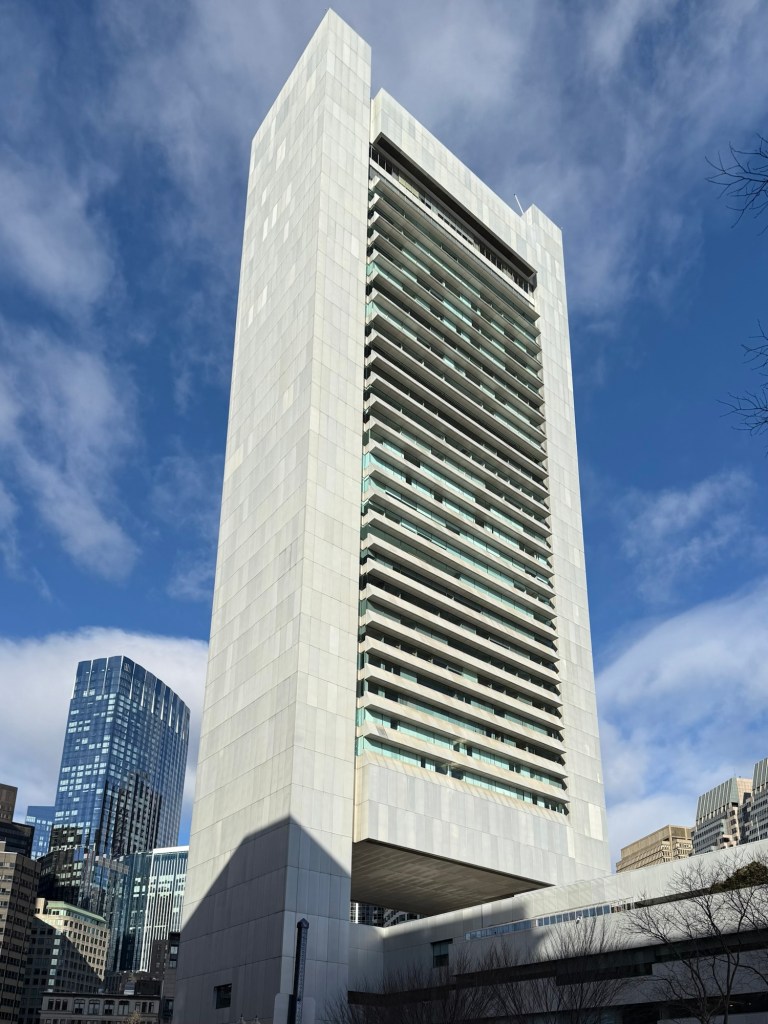
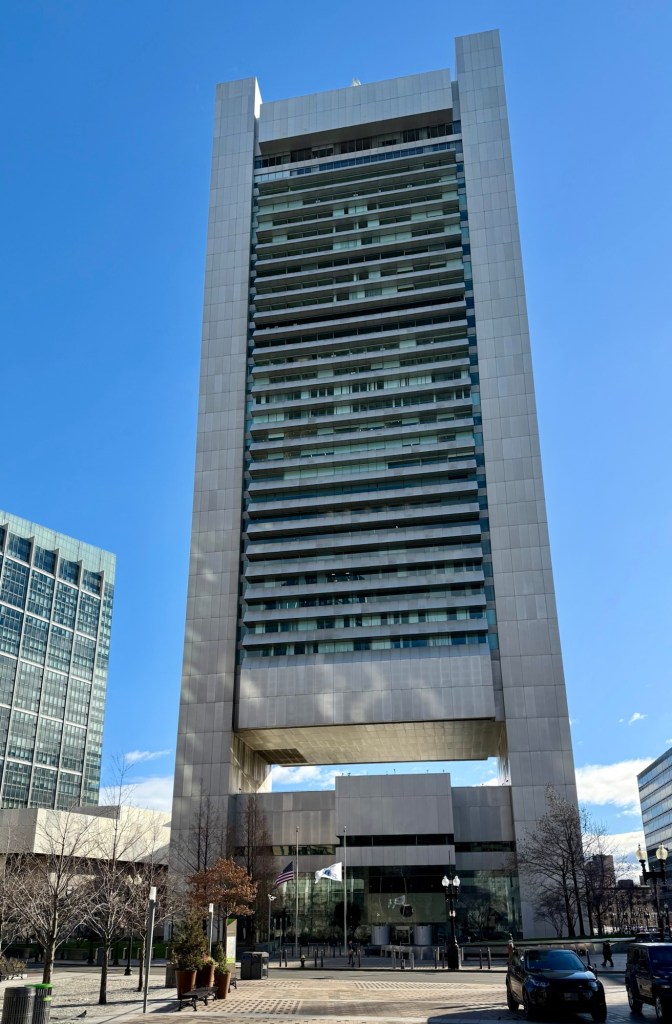
Established by Congress in 1913, the Federal Reserve System is the nation’s quasi-public central bank. Its primary functions are to set monetary policy, supervise and regulate banking institutions, maintain a stable financial system, and provide financial services to the U.S. government, the public, and domestic and international financial institutions. Organized in 1914, the Federal Reserve Bank of Boston is one of 12 district banks across the country and serves the six New England states. Construction for the Boston Reserve’s Renaissance revival bank was begun in 1920 and finished in 1922, but was outgrown in the second half of the 20th century. The original building would be landmarked and is now known as the Langham, a luxury hotel. Planning began on a newer office and a site was acquired on waterfront land cleared from Urban Renewal in the late 1960s. The current building was constructed between 1972 and
1974, and occupied by the bank in 1977. Designed by the firm Hugh Stubbins & Associates, the complex occupies a full city block, with the 32-story tower and a 4-story section serving as the bulk of the mass. A 600-ton major steel structure called a “truss” marks the beginning of the tower’s offices above the breezeway. The exterior is natural anodized aluminum, which acts as a curtain wall and weatherproof facing. The aluminum spandrels or “eye-brows” shade the building interior from the sun in the summertime and allow more sunlight in the winter months. Love it or hate it, this building is extremely significant architecturally for its Modern design and materiality, and for its engineering. It has become a visual landmark and anchor into Boston’s dense Downtown.

Lincoln Street Garage // 1956

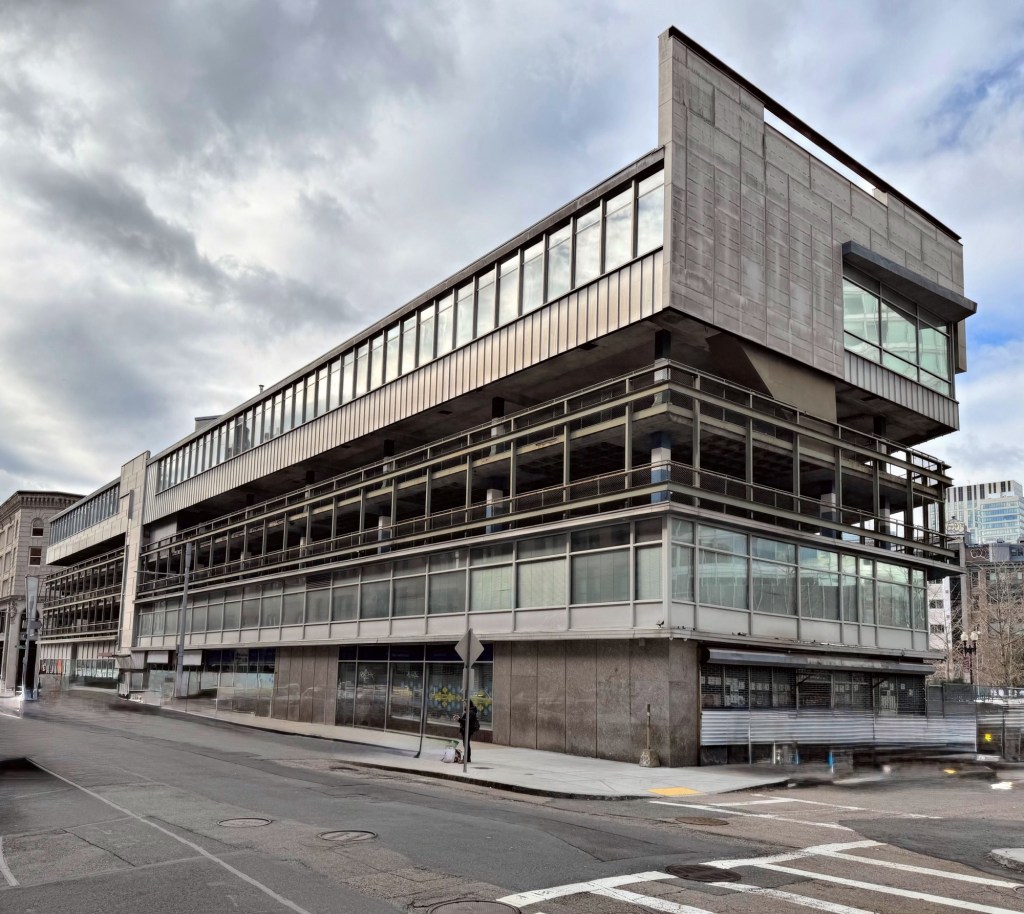
Few buildings in Boston showcase the evolution of its neighborhood (or bring out the architectural critics) quite as well as the Lincoln Street Garage in the Leather District of Boston. This Post-WWII mixed use building was originally constructed in 1956, on the former site of the United States Hotel (1839), one of the first major hotels in the nation, which was razed in 1930. The original building was designed by architect Archie Riskin, and stood three stories high with parking on half of the second floor and on the 3rd floor and roof. A fifth floor of office space was designed and constructed by 1959 also by Riskin. Due to its site at the edge of a historic commercial/industrial district and adjacent to the Central Artery, a raised highway that snaked its way through Downtown Boston, the building was minimally visible and faded away to obscurity until the late 1990s when the highway was buried under the city as part of the “Big Dig”. The open scar and subsequent re-greening of much of the former highway spaces necessitated the owners to re-work the building, due to its newfound gateway presence into the neighborhood. Brian Healey Architects renovated the building, adding an additional floor of offices and reworked facades. The result is a Post-war mixed-use hodgepodge of a building that expresses its use visually on each floor in a no-nonsense way, making it a unique urban building. Additionally the building has long been rented to small businesses, almost all Asian-owned with direct ties to the Chinatown and Leather District neighborhoods. Recent plans have been approved for a new office tower on the site and supported by preservation groups stating that “the existing garage is historically significant or beneficial to the neighborhood”, but to me, the further erasure of quirky buildings for more out-of-context developments is not the way to go.

Stone & Webster Office Building // 1975

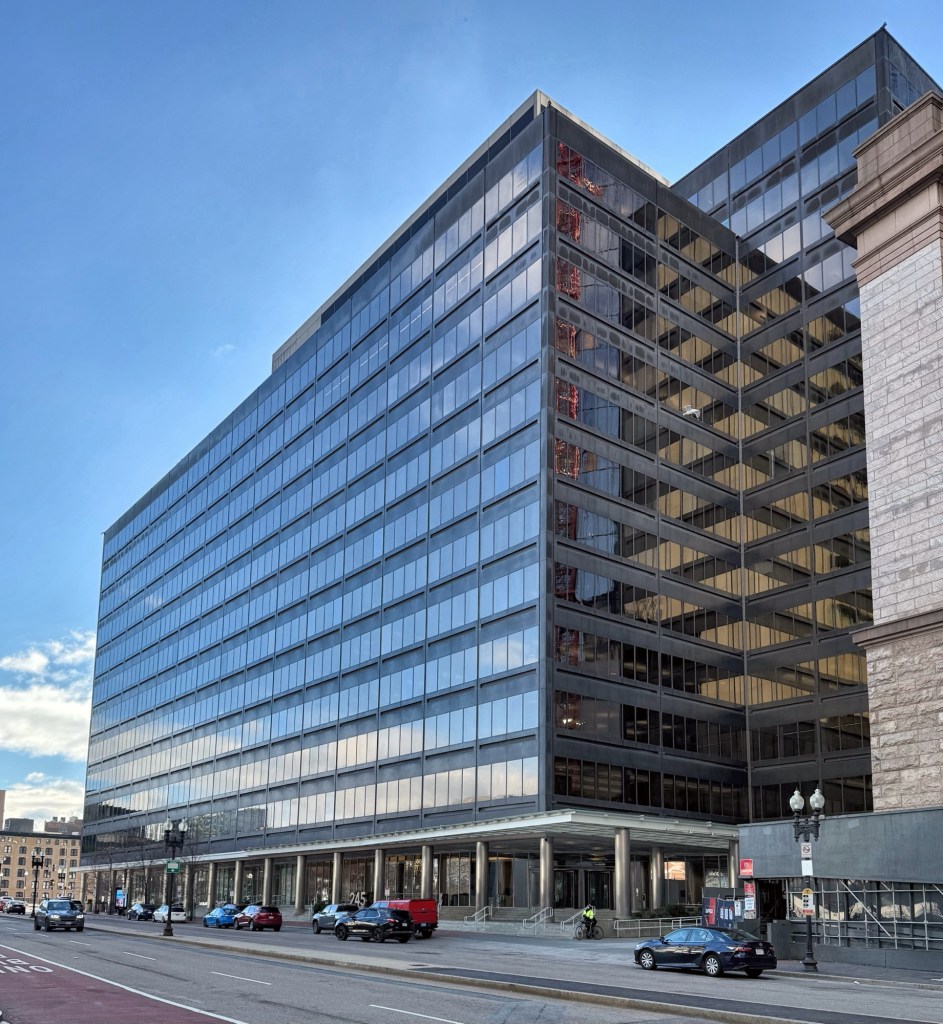
Stone & Webster, established in 1893 by MIT graduates Charles Stone and Edwin Webster, was a national leader in electrification and power generation, and provided services in engineering, construction, environmental remediation, infrastructure, and plant operation for industrial clients. After the Boston Redevelopment Authority acquired and demolished sections of South Station for redevelopment, Stone & Webster decided to relocate their offices to this new site. Los Angeles-based architectural firm Welton Becket & Associates, designed the office building in a late International-style, which serves as a counter to the masonry and classically designed, South Station nearby. The steel frame with metal and glass skin and boxy form are effective at delineating the building from its neighbor, but is not pedestrian-friendly at the ground level as the raised ground floor is lined at the sidewalk by concrete steps. The building is now largely leased to Fidelity Investments.

Forest House // 1975

Photo courtesy of Bohlin Cywinski Jackson

While Cornwall, Connecticut is known for its 19th century architecture, there are some amazing Mid-Century Modern houses hidden away on forested lots there. This is the Eric and Anne Bohlin House (aka Forest House) designed by architect Peter Bohlin of Bohlin Cywinski Jackson for his parents as a summer retreat. The residence was completed in 1975 and sited between dense evergreens and bright deciduous woodland in a sparsely developed part of town. Camouflaged among the trees, the green-stained exterior hovers above a boulder-strewn landscape, resting on concrete piers, with large windows to take advantage of the glorious forest views. This is a great example of high-quality, site-specific house designs, which are becoming a rarity in recent years.

Former Newton Savings Bank Building // 1962

Opened in 1962 as the Newton Savings Bank, this unique Mid-20th century Modern banking structure showcases the forms and materials not conceived in previous decades. The building is located on the Newton Centre Green, adjacent to the former Newton Centre Methodist Episcopal Church, and provides a sharp contrast between the stone building in the Romanesque style and more contemporary forms. The bank was designed by Bastille and Halsey Associates, established in 1953 by partners, Robert Adams Bastille and William Ashbaugh Halsey. Now occupied by a Citizens Bank with professional offices also inside, the building exhibits precast concrete “zipper” banding between floors that are broken up by solid brick masses in the facade. What do you think of these corporate modern buildings?

Temple Beth Israel, Danielson // 1955

Temple Beth Israel is a unique, Mid-Century Modern former synagogue, that can be found in the village of Danielson, in the town of Killingly, Connecticut. Ground was broken on the temple in 1951 and the foundation and basement were completed soon-after. Funding was tight and the building remained unfinished for years. During the first years that the congregation used the unfinished synagogue, while continually striving for additional funds to complete the building. A congregation member Mary Riseman’ s son William Riseman, an architect, designed the building and the Riseman family donated the fieldstone for the building from a quarry on their farm. The building was eventually completed in 1961, ten years after its ground-breaking ceremony, with young, recently graduated architect, Maurice Finegold as designer of the interior of the main floor sanctuary and more, completing the project. The congregation, a blend of Orthodox and Conservative adherents, was generally served by itinerant rabbis, often religious students. Dwindling membership forced the congregation to merge with another in nearby Putnam, and the building was eventually sold. A secular preservation society was organized to keep it, which has transformed it into a cultural and historical center, dedicated to preserving the history of the Jewish experience in the area.

Second Church of Christ, Scientist, Roxbury // 1915

Breaking ground in 1915, this early Modern church building must have turned heads when it was being built in Roxbury! In October, 1907, a fine lot of land with a house on it, at the corner of Elm Hill Avenue and Howland Street, was purchased for eighteen thousand dollars by a group of Christian Science followers. In October, 1911, a building committee of five was elected by the church, and by the summer of 1914 the building fund had made such satisfactory growth that ground was broken and work for the new structure begun in September. The congregation hired the illustrious architectural firm of Shepley, Rutan, and Coolidge to design the edifice of classic and imposing design. Constructed of gray tapestry brick with limestone trimmings, the auditorium seated upwards of one thousand members, under the dome roof. Today, the building is occupied by Grace Church of All Nations.