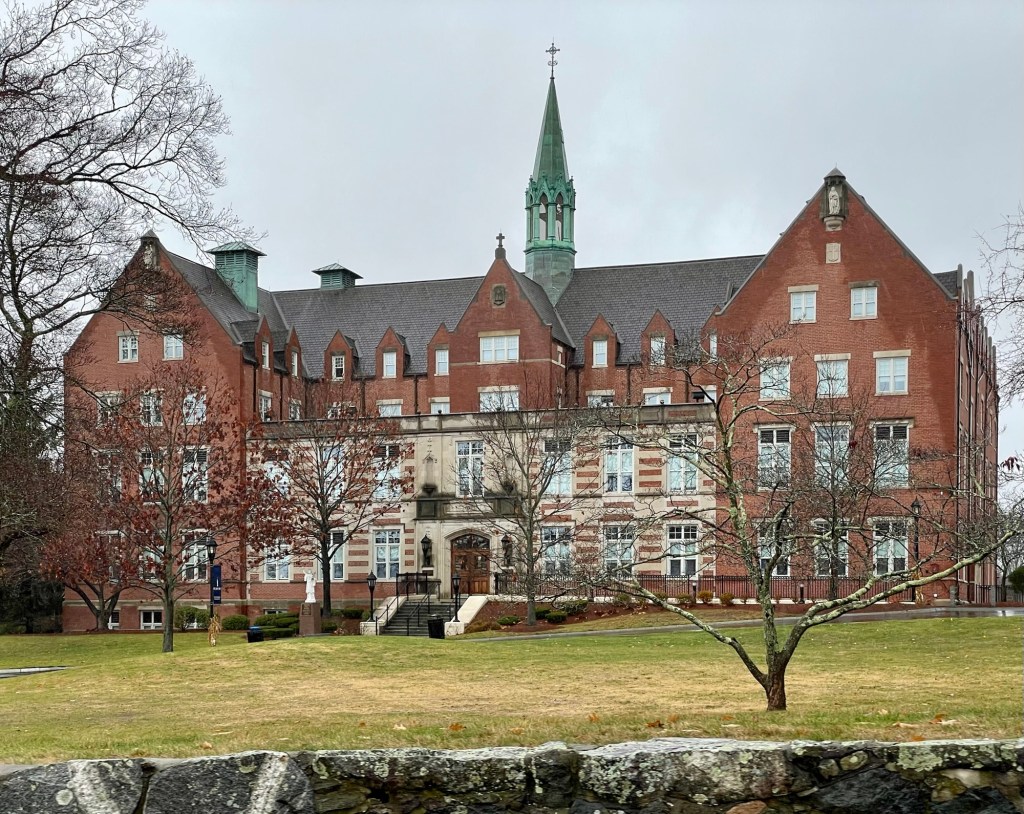
Xavier Hall was built between 1910-11 on the campus of St. John’s Prep School in Danvers, Massachusetts. The building was constructed by the Xaverian Brothers as classrooms as the first purpose-built structure in what would become a large campus. The Neo-Gothic Revival style building was sited adjacent to Porphyry Hall, an 1880 estate house that the new school purchased in 1891, which was later expanded by the addition of a rear chapel. Edward T. P. Graham, an architect best known for his design of Roman Catholic churches and associated buildings, was hired to design the stately structure built of brick and limestone.
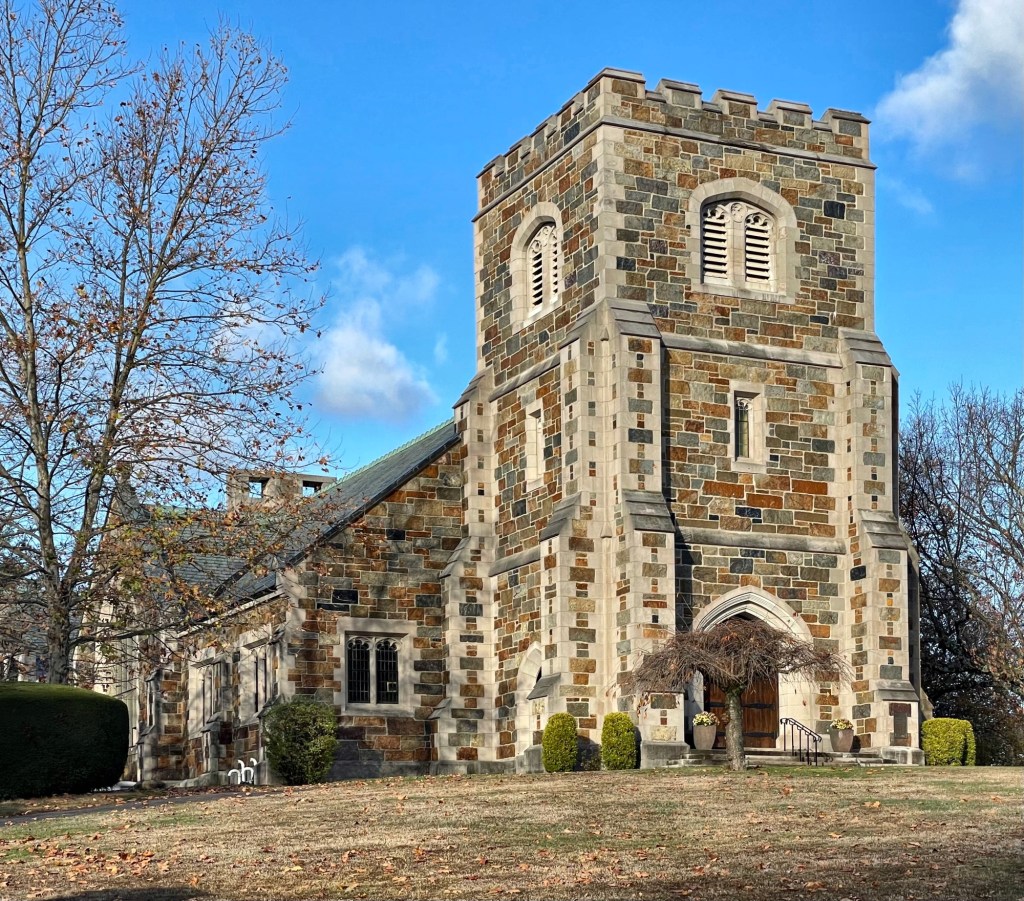
The former First Congregational Church (now the Greek Evangelical Church of Boston) of Newton Center, Newton, is a landmark example of the Neo-Gothic architectural style for a church building. Built in 1904, the structure resembles an English village church in the form of a Roman Cross with short trancepts. The structure is constructed of Quincy granite and was designed by the architectural firm of Shepley, Rutan & Coolidge. The First Congregational Church of Newton was originally established in 1664 as a parish church when Newton was still a part of Cambridge (then known as Newtowne). The parish has had six meeting houses built by the Congregation, with the last four on this site. Seeing dwindling membership in the mid-20th century, First Church in Newton dissolved in 1972, after more than 300 years of service to the Newton community. Luckily, the newly formed Greek Evangelical Church of Boston would buy the church that same year and has maintained the significant edifice ever-since!
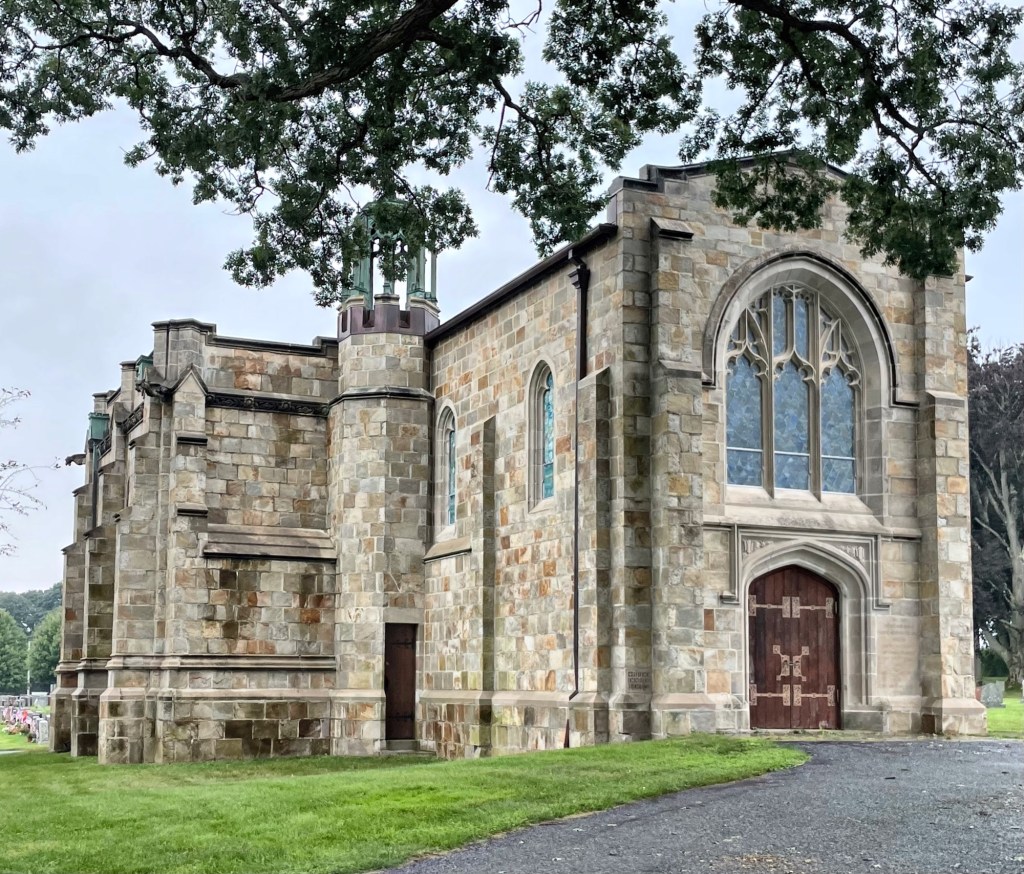
Tucked away in Highland Cemetery, a typical looking cemetery in Norwood, Massachusetts, you will find a masterpiece chapel designed by one of the great architects of the Arts & Crafts movement. The Highland Cemetery was established in 1880 becoming the town’s second and primary burial ground. The town’s first burial ground was the Old Parish Cemetery which is located in the center of town on a 3/4-acre hill and because of its limited size and the difficult terrain; there was no room for growth. The rapidly developing town required a second cemetery and laid out Highland View on the outskirts of the village. In 1903, the Chapel of St. Gabriel the Archangel, also known as the Day Memorial Chapel, was erected at the center of the cemetery. The Chapel, which also acts as a mausoleum, was donated to the town by Lewis and Anna Smith Day in memory of their parents. Their only stipulation was that the chapel be available for use free of charge for any resident who desired to do so, no matter their religion or race. Esteemed architect Ralph Adams Cram designed the chapel in the Neo Gothic Revival style. Fred Holland Day, a renowned photographer and publisher, was the only child born to Lewis and Anna and he was a close friend of Ralph Adams Cram and Bertram Grosvenor Goodhue, likely leading to their commission here in Norwood. F. Holland Day lived in a Tudor mansion in town, modified from his childhood home. The Cemetery Chapel remains a seminal building for its genre and time.
Norwood Town Hall represents the achievement of landscape architect Arthur A. Shurtleff and local financier, George Willet, to transform the village center of Norwood, Massachusetts from a sleepy rural village to a thriving commercial and cultural center of town. Plans for the municipal building began as early as 1919, with this building serving as both a town hall and memorial to the Norwood men who died in all previous wars. The building would not be completed until 1928. Designed by Norwood architect, William Upham, the building is a landmark example of the Neo-Gothic Revival style and its main feature, the 110-foot bell-tower which houses a 50-bell carillon, towers over the town common.
On Hillhouse Avenue, one of the finest streets in New Haven, you will find a great collection of historic homes and large institutional landmarks. Adjacent to St. Mary’s Roman Catholic Church, the Sheffield Scientific School of Yale College built this structure, the Mason Laboratory between 1910-1911 for Mechanical Engineering and related departments. The building was designed by architect Charles C. Haight, who was responsible for a number of other Neo-Gothic buildings at Yale. The limestone building properly holds the streetedge and blends in well with its surroundings.
Located next to the St. Mary’s Roman Catholic Church on Hillhouse Avenue in New Haven, Connecticut, you will find one of the finest Neo-Gothic style buildings in the city that was not built by Yale University. This structure was constructed in 1907 as the Priory for the Catholic Church next door. Historically, the church had been under the care of the Dominican friars of the Province of St. Joseph, based in New York City, and the church needed a residence for the friars (a Priory). Due to dwindling attendance at churches all over the country, area churches were consolidated under the Hartford Archdiocese, who replaced the friar residents of this building with Dioscesan priests in late 2021.
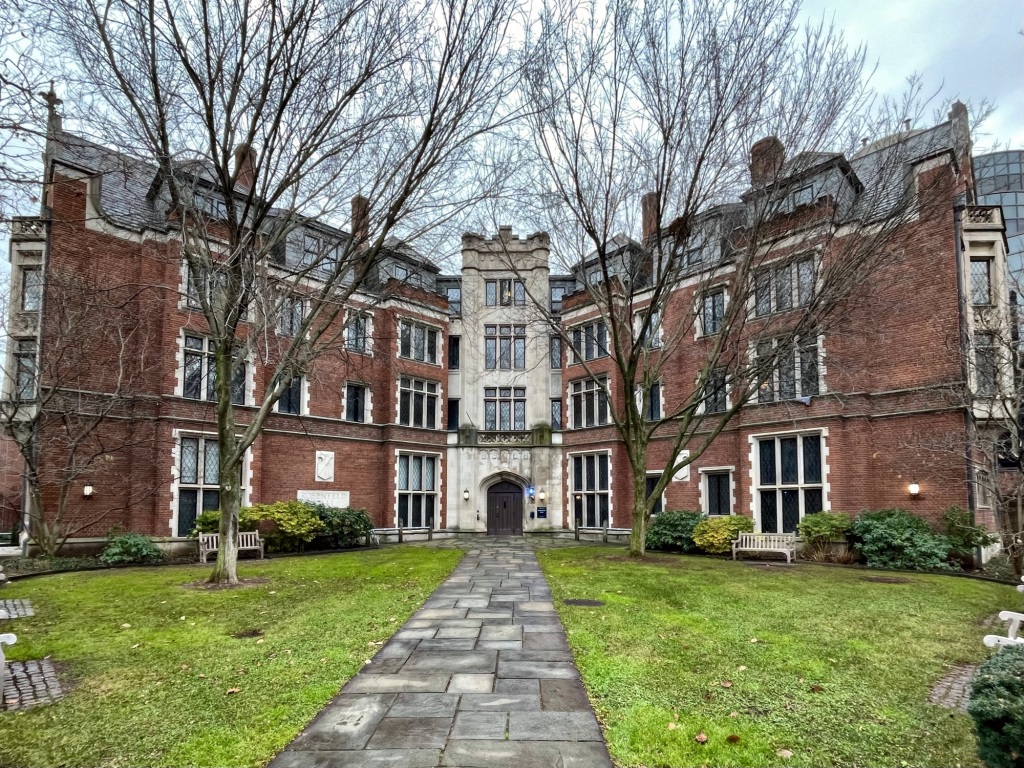
St. Elmo Society at Yale was founded in 1889 as a chapter of the national fraternity Delta Phi, and it is today one of the “ancient eight consortium” of secret societies at the university. The society’s original building was erected in 1895 and provided housing, meeting spaces, a library, smoking room, and other recreational spaces for the members. Just over a decade later, the group’s increasing wealth and membership necessitated a larger building. This building, named St. Elmo Hall was designed by architect Kenneth MacKenzie Murchison in an Elizabethan style and built in 1912 for the society, replacing its former residence hall. The society saw dwindling funding and during World War II, St. Elmo Hall became a convalescent hospital for soldiers who were out of the hospital but still need observation. After WWII, the group began leasing some rooms out to Yale University, who eventually purchased the building in 1962, renaming it Rosenfeld Hall after Richard Rosenfeld ’63. The L-shaped building is sited opening up to the corner lot and is Neo-Gothic in style, likely drawing inspiration from Yale’s established Gothic stylistic influence.
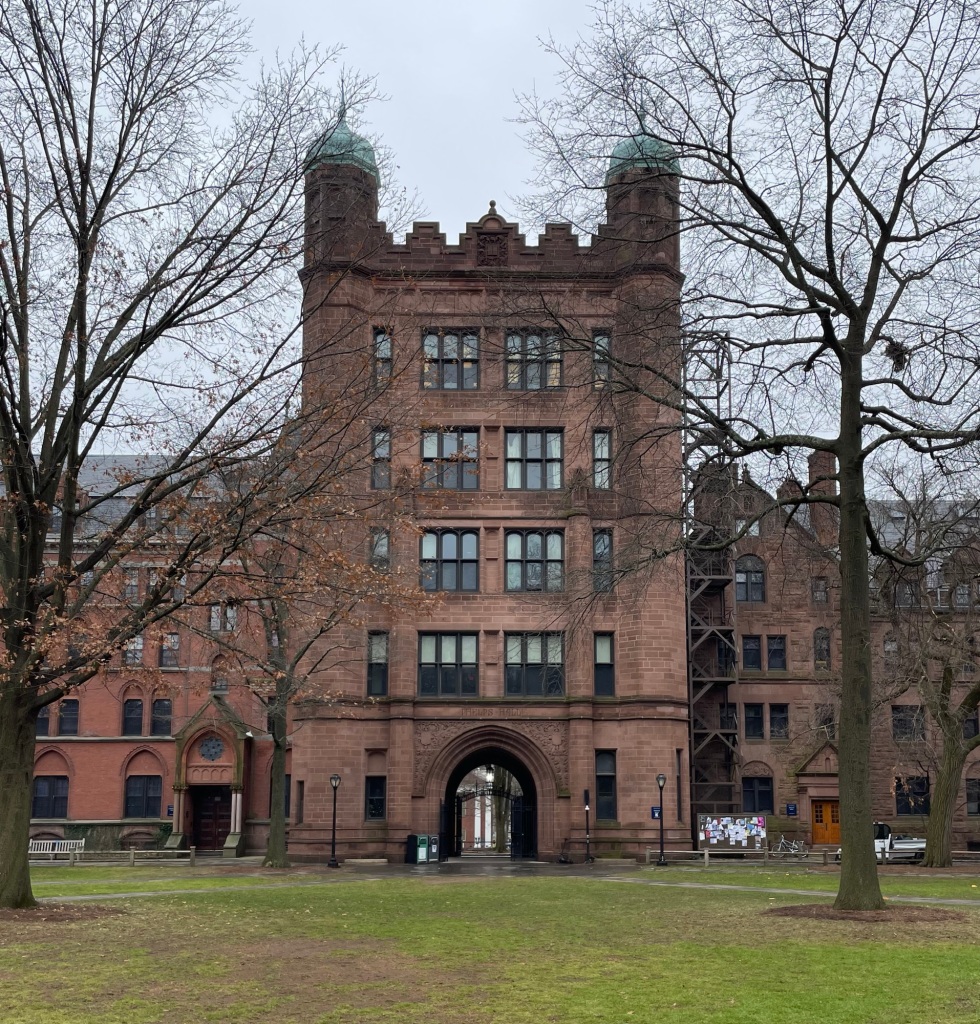
After Lawrance and Welch halls (previous two posts) were built on the eastern edge of Yale’s Old Campus, there was a small space between the two that needed to be enclosed to provide a true cloister for students, shielding them from the noise and ever-developing Downtown of New Haven. Architect Charles C. Haight designed the new hall to resemble a medieval gatehouse. The simple, tall rectangular mass has octagonal towers at each corner with copper domes on top and a crenelated parapet resembling an old English castle spanning between them. On the ground floor is the Phelps Gate, the main entrance to the Old Campus from the east. Its namesake was the late William Walter Phelps, an 1860 Yale graduate who served as a Congressman and as ambassador to Germany and Austria-Hungary. The building holds an important role in the annual commencement ceremonies, which begin in the New Haven Green and pass through to the Old Campus through this gateway.
One of my (many) favorite buildings at Yale University is Bingham Hall, a monumental and landmark example of the Collegiate Gothic architecture style. Built in 1928, replacing the 1888 Osborn Hall (last post), Bingham Hall was constructed as an inward-facing freshman dormitory by architect, Walter B. Chambers, who had just overseen the completion of his first building at Yale, the Colonial Revival style McClellan Hall. Built of Longmeadow brownstone, Bingham Hall largely constructed from funds donated by the children of Charles W. Bingham (Yale, 1868), a Cleveland based businessman. The building stands five stories with a massive nine-story corner tower and helped solidify Yale’s iconic Collegiate Gothic architecture for the future buildings and growth as well.
Like many other buildings on campus, Vanderbilt Hall is named for its wealthy sponsors, but its foundation is one of family tragedy. One of Yale’s stunning Collegiate Gothic structures, the building is named after William Henry Vanderbilt II (1870-1892), who attended Yale in the early 1890s. William contracted typhoid fever from a water pump while touring the western United States and died during his junior year. His father, railroad tycoon Cornelius Vanderbilt, constructed Vanderbilt Hall in 1894 as a memorial to his son and donated it to the University. The highly prized Vanderbilt room, which is located above the archway, is apparently one of the finest residential spaces on the campus. Architect Charles C. Haight designed the building which enclosed the southern edge of the yard, created a gateway, and is one of the early architectural statement pieces for the campus in the Collegiate Gothic style. Haight would receive later commissions at Yale based on his work on Vanderbilt Hall.




 Buildings of New England