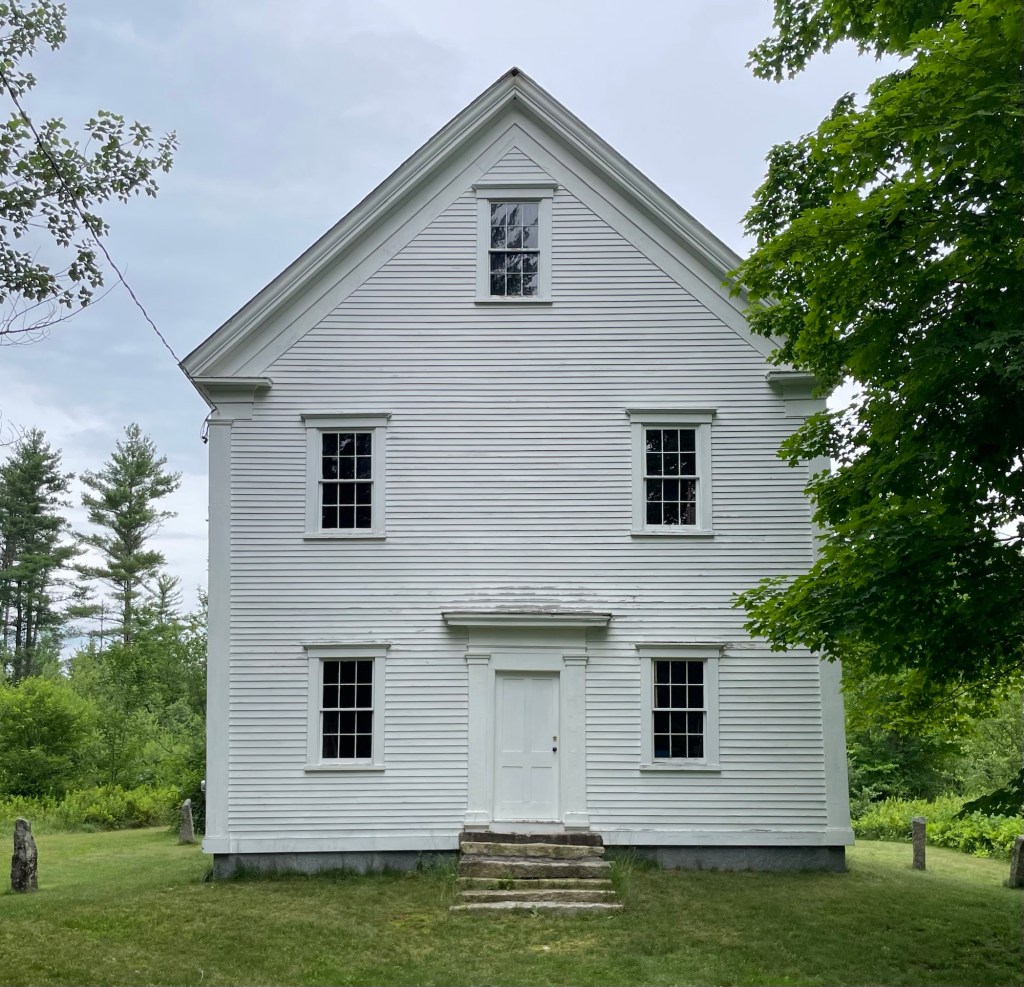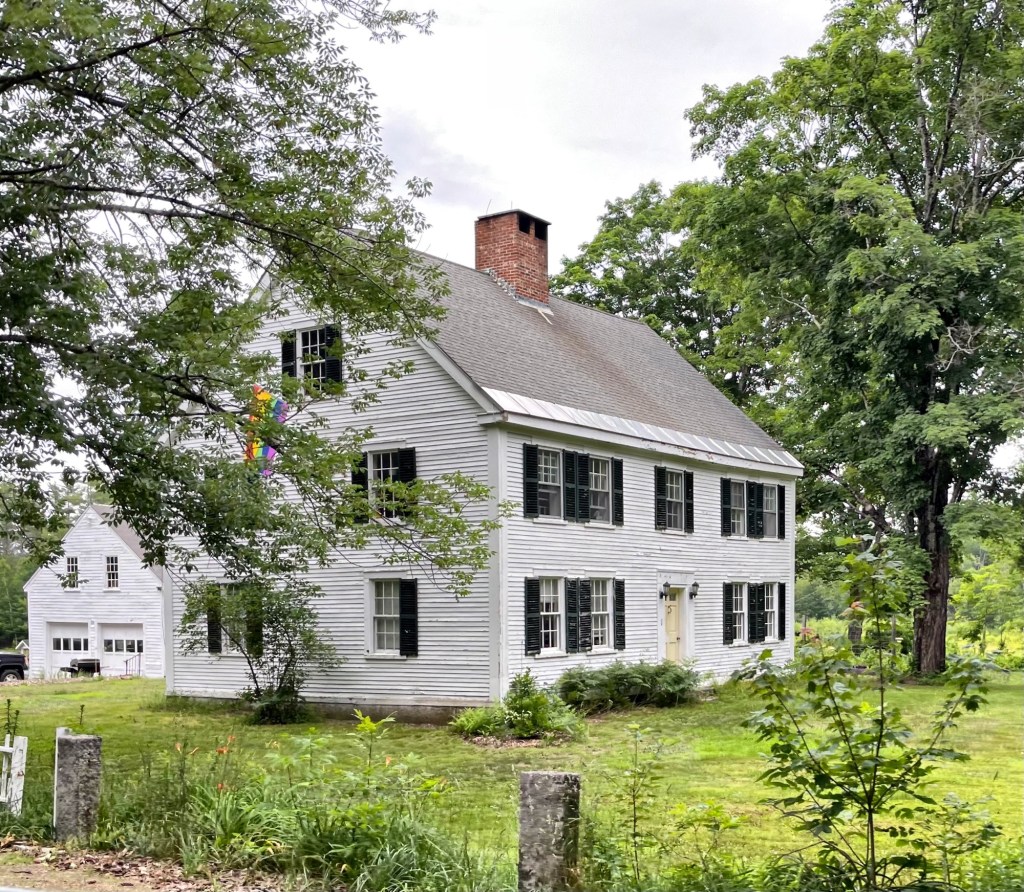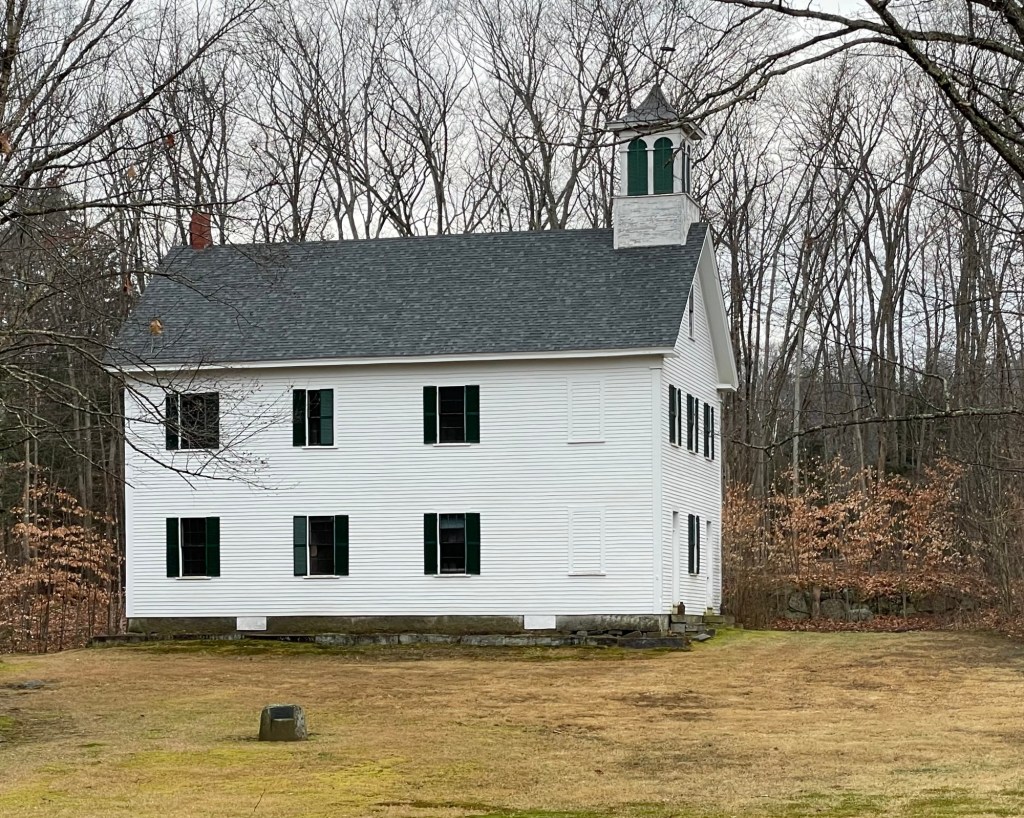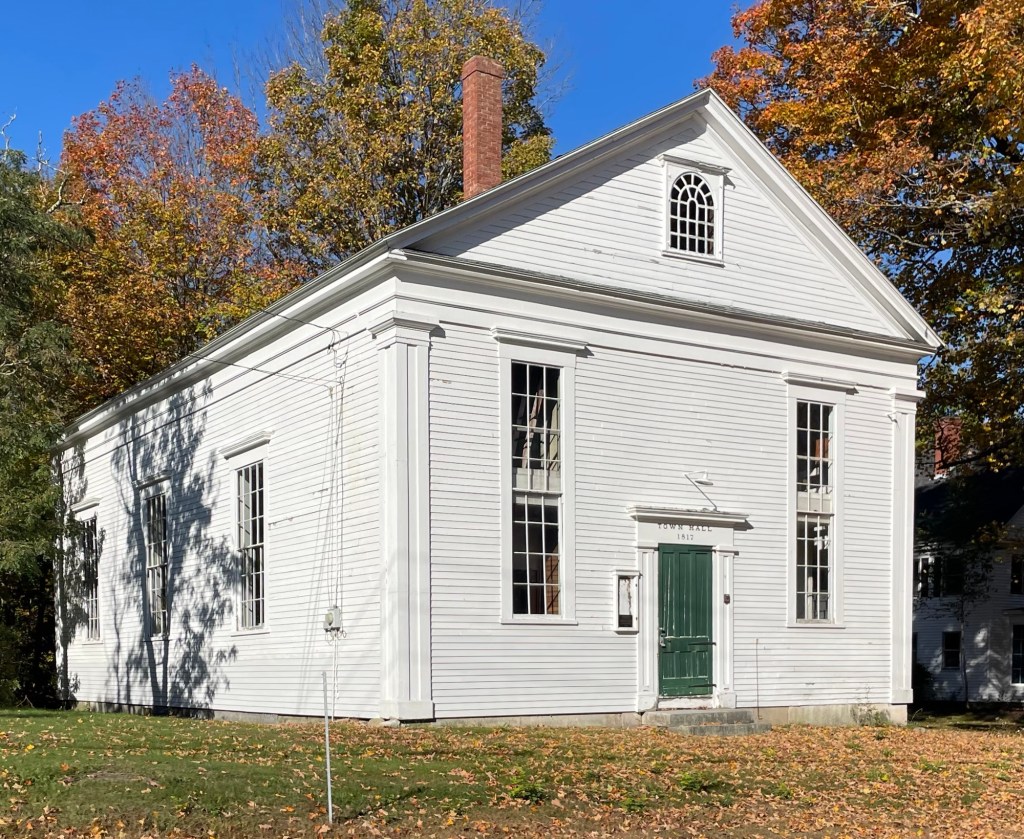
Old New Ipswich Town Hall // 1817

New Ipswich, New Hampshire, is a town that oozes New England charm! Winding back roads are lined with Colonial-era homes and buildings, lovingly maintained by stewards and neighbors to create the quintessential small town feeling. New Ipswich was granted in 1735 to 60 inhabitants of Ipswich, Massachusetts, where the name is derived, by colonial Governor Jonathan Belcher and the General Court of Massachusetts. European settlement began here in 1738, when Abijah Foster arrived to the area with his wife and infant daughter. At the center of town, a new Town Hall was built in 1817 as a combination town hall and private academy with funds provided by the town government and by the trustees of New Ipswich Academy. The building was constructed under the direction of Deacon Nathaniel Gould, using materials salvaged from a disused meetinghouse of 1770. The arched gable window is reputed to have been taken from the meeting house, as are twisted balusters on the gallery stairway inside. As completed in 1817, the building had a full second floor which provided the academy with a lecture room, a small library, and a laboratory, but that was taken over by 1869 when the Town renovated the building, removing a tower and belfry, and occupied the second floor spaces. The building is still owned by the town, and is used occasionally for civic functions, with town offices in a mundane, newer building a short distance away.
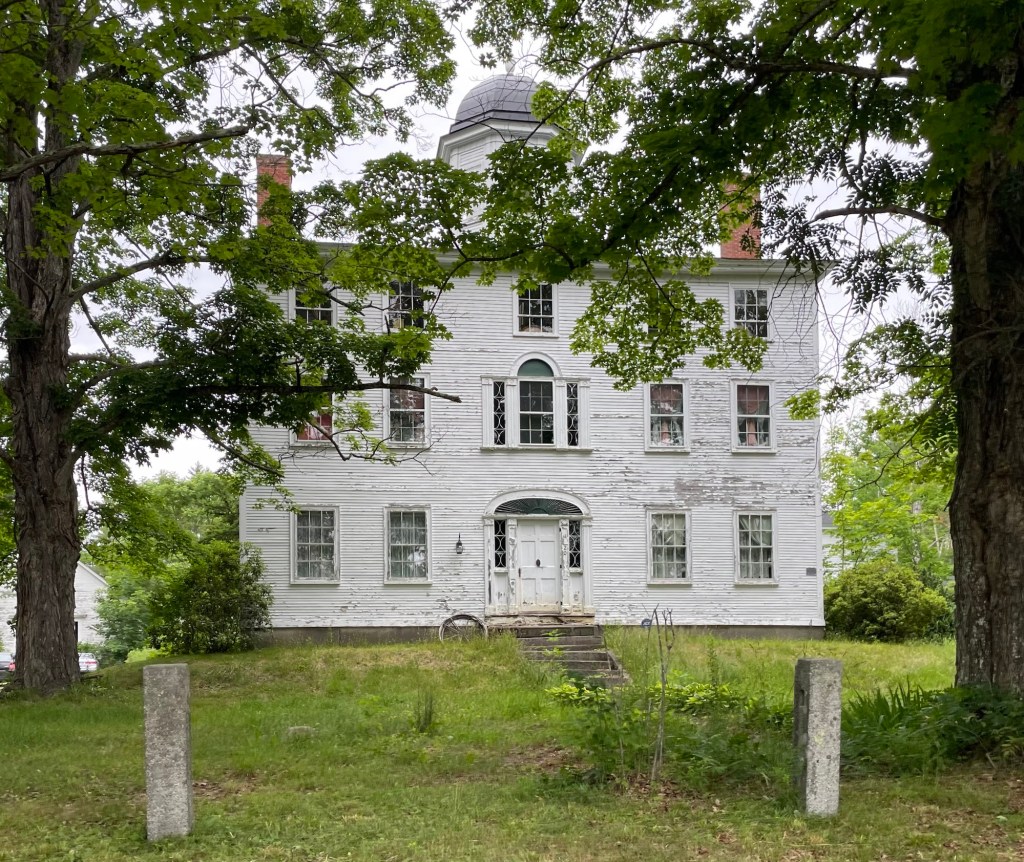
Lord Mansion // 1822

Isaac Lord (1772-1838) was born in Maine, but would spend much of his time transforming the small town of Effingham, New Hampshire. Isaac married the love of his life, Susanna Leavitt in Exeter in 1793 and the couple moved to Effingham, living and working in a tavern he built. Isaac prospered as an innkeeper, merchant, farmer, and entrepreneur, becoming Effingham’s wealthiest citizen, making the village he owned buildings to be called Lord’s Hill in his name. From 1818 to 1822, Isaac and Susanna lived in Portland, but he was ridiculed for “having money but no culture”. Growing tired of the city, he decided to return to Effingham. Mrs. Lord found the village too quiet and longed for the social life to be had in Portland, Maine. To convince his wife to remain with him, Isaac promised her a mansion that rivaled the homes in wealthy seaports like Portland and Portsmouth and began working on his mansion in Effingham in 1822. After years, the massive estate was completed, but Susanna remained in Portland. A heartbroken Isaac moved into the large mansion and continued business until his death in 1838. The Isaac Lord House consists of a three-story main block with a grand cupola on its roof and a three story ell to its rear. Stables and a carriage house are also on the lot today. I would do anything to see the inside of this beauty!

Effingham Academy // 1819

The small town of Effingham, New Hampshire, is the home to the state’s first Normal School. This building was originally constructed in 1819 as a vernacular, Federal period academy for the youth in the rural town of Effingham on land formerly owned by wealthy resident Isaac Lord. A normal school for the training of teachers was established on the school building’s second floor in 1830 with James W. Bradbury, a Bowdoin College graduate, to head it. Bradbury, later a United States Senator, took the position only on condition that it should be for the instruction and training of teachers, a novel idea at the time. The school, like many small academy buildings of the period, eventually closed. The building is now managed by the Effingham Historical Society.

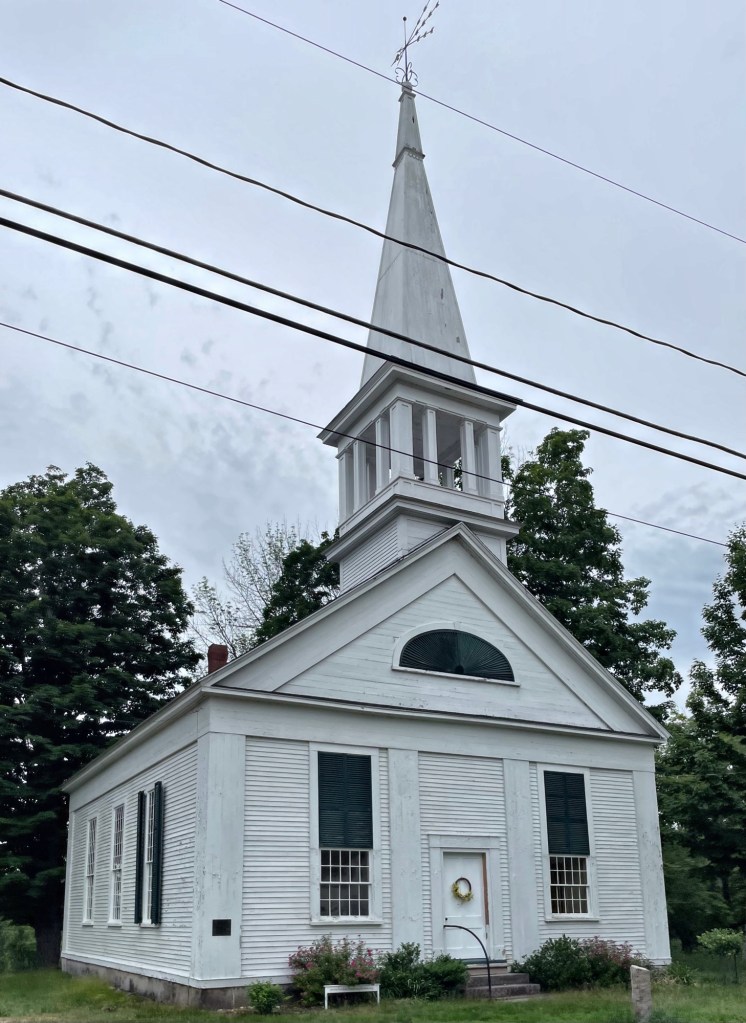
Old Effingham Meetinghouse // c.1800

The location of the Effingham meetinghouse in New Hampshire was a controversial question in the 1790’s, with the villages of Lord’s Hill and Drake’s Corner both vying for the town’s most important public building. After several votes and repeals of votes, the Town’s voters in 1798, chose a committee of hopefully disinterested men from other towns and instructed them to settle on the location. The committee recommended Lord’s Hill, and in June, the Town voted to accept that location. The contract for the meetinghouse was awarded to Isaac Lord, a local landowner and operator of a tavern and store, who promptly erected the building the same year. In its original form, the building had the traditional meetinghouse plan, with its main entry in the long southeast side and a belfry at the northeast end. In 1845, the meetinghouse, by then the property of the Congregational Church, was thoroughly remodeled in the Greek Revival style, what we see preserved today.

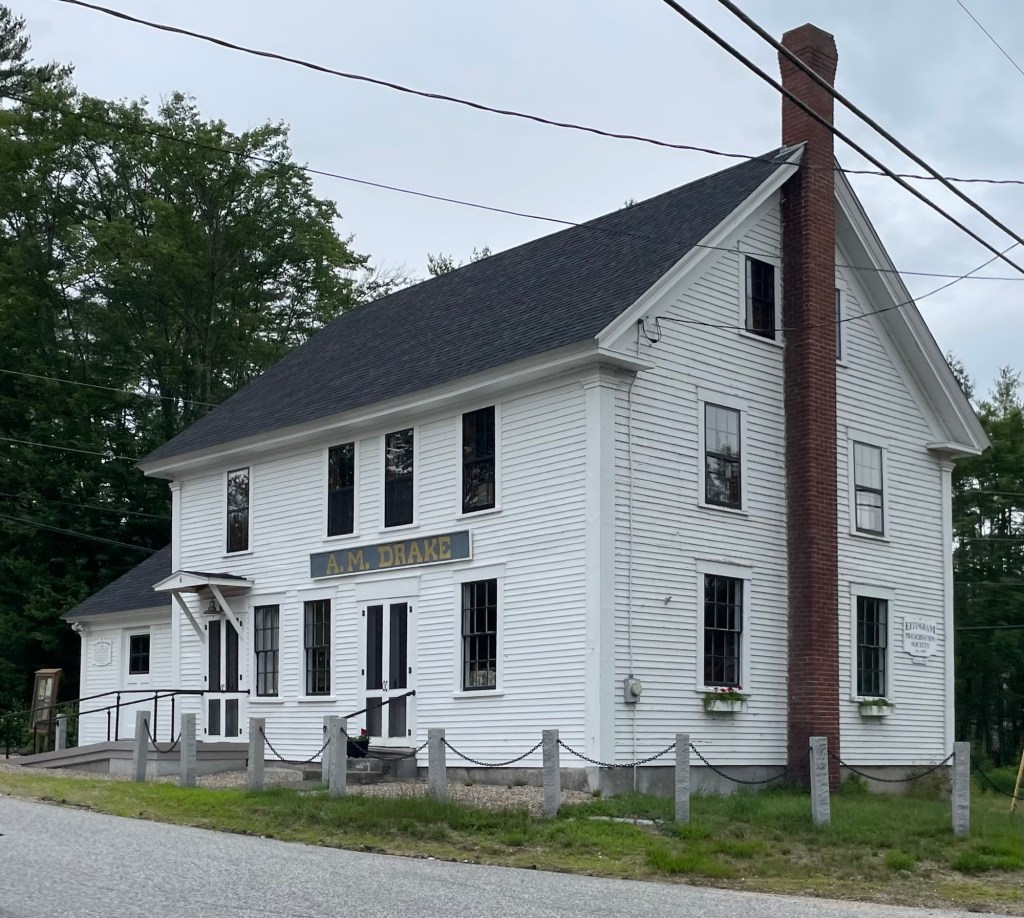
Drake Store // c.1816

The Drake Store is a vernacular, early 19th century commercial building located in the center of Effingham, New Hampshire. According to local sources, the building was erected around 1816 by Weare Drake, an original settler of the town at age 78, and his 23-year-old grandson, Thomas Parsons Drake. The store sold provisions and was home to a post office, when Thomas Drake served as the town’s postmaster. Within a few years, the store fell into disuse and the building was fitted up as an academy known as the Carroll Literary Institute. Due to insufficient enrollment, in the 1850’s, it was again occupied as a store by Alexander Mellen Drake (hence the sign) and changed hands several times before being purchased by Grange No. 313 in 1913, operating as a grange hall for local farmers. The building was given by the Grange to the Town in 1994 and purchased from the Town for $1 by the Preservation Society in 2002. The Preservation Society has been restoring the building through capital campaigns and grants and the old store shines once again!

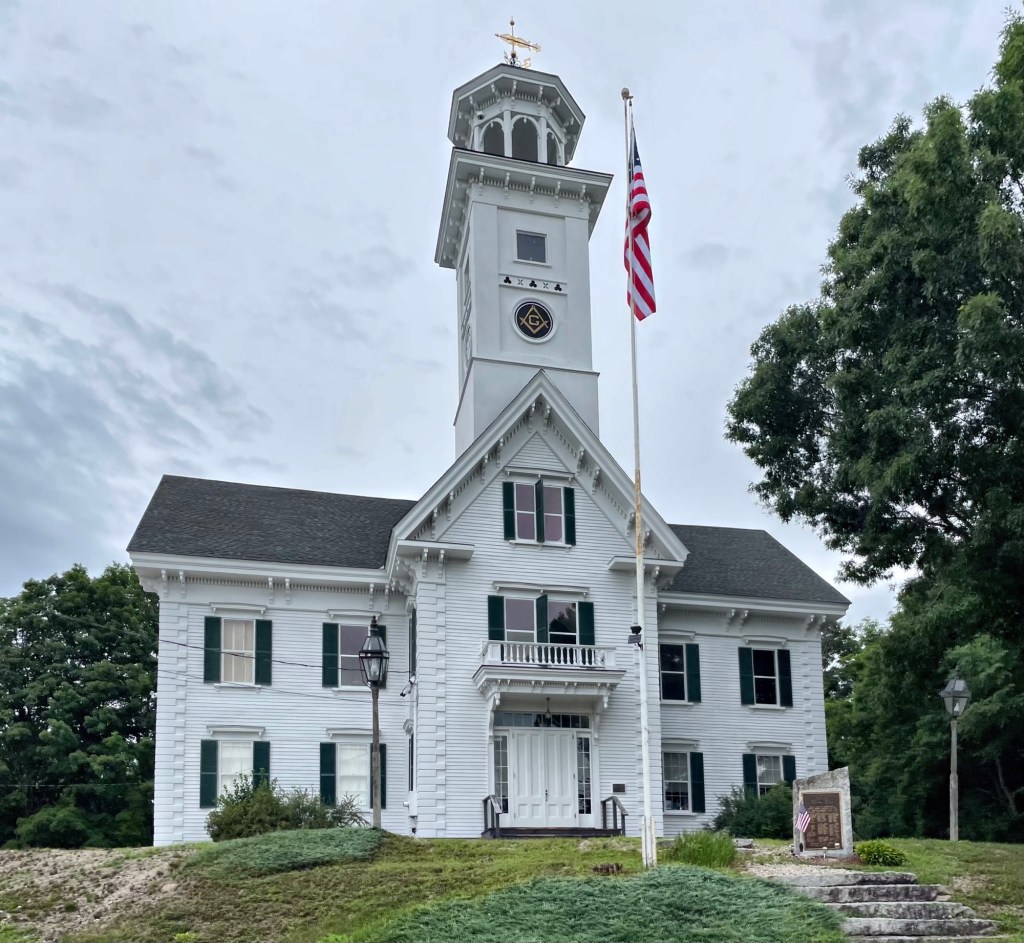
New England Masonic Charitable Institute // 1858

The New England Masonic Charitable Institute building is located in Center Effingham, New Hampshire, and is among the rural town’s most impressive structures. The structure was built in 1858 by the Charter Oak Lodge No. 58 of Free and Accepted Masons as a school to educate orphans of Masonic members, but they also admitted local students. It is the only known school building purposely constructed by Masons in the United States. Classes were conducted from 1861 to roughly 1882 with students boarding with local families. The impressive Italianate style building is dominated by a six-story bell tower supporting an octagonal cupola, and exhibits many architectural details including the corner quoins, paired eave brackets, and dentilled cornice. Charter Oak Lodge No. 58 sold the building to the Town of Effingham in 1891 for one dollar but retained rights to the second floor temple room in perpetuity. The walls and ceilings of the Lodge’s temple space are covered with trompe l’oeil murals attributed to Massachusetts painter Philip A. Butler. Images of classic sculptures, architectural details and Masonic symbols, including the All-Seeing Eye, are incorporated into the paintings. Heavily water-damaged in the late 1980s, they have since been restored. The building remains occupied by the Effingham Public Library, what a library building for a town of just 1,700 residents!

Dearborn-Keay House // c.1772

The town of Effingham, New Hampshire, was settled by members of the Leavitt family of HamptonNew Hampshire, led by Captain John Leavitt. From them the settlement first took the name “Leavitt’s Town”. In 1749, the land here was officially granted by Governor Benning Wentworth, and he renamed it “Effingham” for the Howard family, who were Earls of Effingham in England and who were related to the Wentworths by marriage. The town was incorporated in 1778, six years after this house was built. This is the Dearborn-Keay House, a 1772 Colonial home in Effingham, built by Benjamin Dearborn, who was an early settler of the area from Hampton, New Hampshire. The homestead was enlarged by his nephew Asahel Dearborn in the early 1790s, giving the home its present appearance. After later ownership in the Dearborn Family, the property was purchased by Cyrus Keay, who would die in the home in 1894. The property remained in the ownership of the Keay family for many years more.

Stone Memorial Building // 1896

Designed by New Hampshire architect William Butterfield in 1896, the Stone Memorial building in Central Weare is a significant example of a Neo-Classical style structure in a village setting. The building was constructed with money donated by Joseph Stone in honor of his father, Phineas J. Stone, who was born in Weare and moved to Charlestown, MA, later serving as its seventh Mayor. The building would “provide suitable room for a public town library” and a room for memorials to the Civil War soldiers who fought and died for the Union. When the town hall burned, offices there were relocated to this building. Eventually, the library and town offices left this small building, and it has since been home to the Weare Historical Society.

Clinton Grove Academy // 1874

Clinton Grove Academy of Weare, New Hampshire was the first Quaker seminary in the state when it was founded in 1834 by Moses Cartland (1805–1863). Moses Cartland was a Quaker abolitionist who served as the first Principal of the school and for fourteen years after. He later would move to Lee, NH, and aided those who escaped slavery in the south, sheltering them and assisting them on their way north to Canada. The original Academy here served as a private high school and included a classroom building, boarding house, barn and sheds. Students came from as far away as Ontario, Nova Scotia, Minnesota and Texas to study here under Mr. Cartland. In 1872, the Academy complex burned. It was quickly rebuilt as one structure here, in 1874. This building served as a district school until the 1930s. Today, it looks like the building is largely vacant, anyone know what its purpose is?

Weare Town House // 1837

Weare, New Hampshire has a pretty cool history. Located at the northern edge of Hillsborough County, the land presently known as Weare was granted to veterans of the Canadian wars in 1735 by Governor Jonathan Belcher, who named it “Beverly-Canada” after many of the veteran’s hometown, Beverly, Massachusetts. After various disputes over the settlement and naming of the town, it became known as “Weare’s Town” before being incorporated by Governor Benning Wentworth in 1764 as Weare, after Meshech Weare, who served as the town’s first clerk and later went on to become New Hampshire’s first Governor. The town grew slowly during the 18th and 19th centuries around five major villages, with farmland and forests connecting them. Near the geographic center of town, this Town House was built in 1837 to be a government and religious center of the town. Originally, town meetings were held on the first floor and the Universalist Church met on the second floor and the local high school was installed on the second floor in 1919. The building remains the town offices with event space for rent inside today. The building is a great example of a vernacular Greek/Gothic Revival town house of the period with a two-stage tower with pinnacles at the corners of each stage and a louvered belfry at the bell.