Derby Cottage // c.1848

Located off Touro Park in Newport, you may be surprised to find an early Gothic Revival style cottage obscured from view by the towering stone Channing Memorial Church. Newport has so many hidden treasures! Very little is written about this cottage, but it appears to have been built c.1848 for Richard Crowninshield Derby (1777-1854) of the famous Derby Family of Salem, Massachusetts. Richard Derby would move to Philadelphia and split his time between there, Boston, and his newly built summer cottage in Newport, Rhode Island. He did not get to fully appreciate the home as he died in 1854. The Gothic Revival cottage was inherited by his widow, Louisa S. Bomford Derby until her death and later by the couple’s two children (from both of their first marriages), Richard Catton Derby and Louisa Lincoln Lear Eyre, the mother of famed architect Wilson Eyre. The property was eventually sold by the half-siblings and the site became home to the 1880 Channing Memorial Church, which now dominates the site. Luckily for us, the cottage was spared and moved to the extreme rear of the lot and converted to the parish hall for the church.

Castoff-Swinburne House // c.1840

This stunning house located in Newport, Rhode Island, was constructed in the Greek Revival style circa 1840 for Henry Castoff (1803‐1879). His house was one of several dwellings built in the Greek Revival style at that time in the area surrounding Touro Park. Henry was a merchant who dealt in goods from the Indies. In 1868, Henry sold this house at 115 Pelham Street to Robert P. Berry, a local dentist and inventor. Dr. Berry’s heirs sold the property in 1890 to William J. Swinburne (1822‐1897) a former soldier, coal merchant, and Mayor of Newport (1855‐1856). After Swinburne’s death in 1897, the home passed by will to his daughter Elizabeth, who never married. Elizabeth resided in the house until her death in 1918. Under the terms of her will, the home was deeded to the Newport Civic League, who established the Swinburne School there, a school for women for the study of household arts and domestic sciences. The school opened in the 1920s. The Swinburne School operated until 2002, when it was dissolved by the Newport Civic League. The contents of the building were sold at public auction and the school records were deeded to the Newport Historical Society. The building itself was purchased by a Brian O’Neill, who restored it to a single‐family dwelling.

Littlefield-Van Zandt House // 1836

In the late 1830s, Captain Augustus Littlefield (1803-1878) purchased a house lot on Pelham Street in Newport, Rhode Island and commissioned housewright John Ladd to design and build his new residence. Littlefield reportedly asked his Ladd to design an “authentic copy of an Italian Villa” he had seen during a trip in southern Italy. The result is a more traditional Greek Revival, temple-front house with a portico supported by four monumental columns with capitals that combine Corinthian and Egyptian lotus motifs. The minimal Italian Villa detail can be seen in the bracketed cornice and in the pediment. Built around 1836, the house remained in Littlefield’s possession until his death in 1878. The property was purchased by Charles C. Van Zandt, attorney and later the 34th Governor of Rhode Island. Gov. Van Zandt died in 1894 and was interred at Island Cemetery in Newport. The Littlefield-Van Zandt House remains a significant early, high-style Greek Revival house in the state and one with a great state of preservation.

Cornè House // 1822

What does this house and the tomato have in common? Keep reading to find out!

Michele Felice Cornè (1752-1845) grew up in Naples Italy and became disillusioned with the Napoleonic Wars. After the French occupation of Naples in 1799, he fled and was brought to the United States on the ship Mount Vernon, commanded by Elias Hasket Derby Jr., and settled in Salem, Massachusetts. Cornè moved to Boston in 1807 and lived and worked there until 1822 when he moved to Newport, Rhode Island, purchasing a property containing a barn. Cornè either had the barn renovated into this 1822 house or built the Federal period house from its timbers. Here, Cornè would paint many maritime scenes as murals in homes and businesses. However, his true contribution to his adopted country was convincing his neighbors to eat the tomato. While in Newport, it is reputed that Cornè introduced the tomato into the American diet. In early 19th century New England tomatoes were thought to be deadly poison. Cornè was accustomed to eating tomatoes in his native land and would regularly eat them without ill effect and, thus, allayed the fears of the residents of his adopted country. Today, the popularity of the tomato in American cuisine can be credited (in part) to Cornè and his love for the tomato.

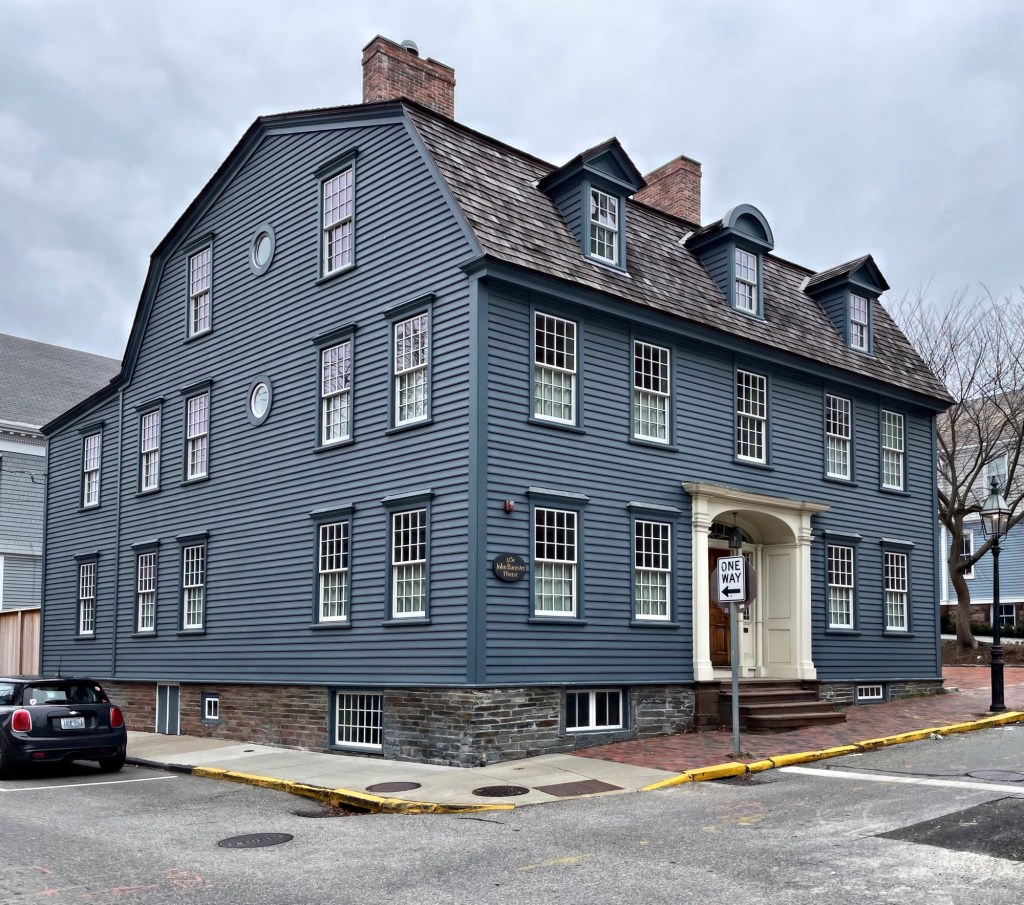
John Banister House // 1751

This deep, gambrel-roofed house is among my favorites in Newport. The house was built in 1751 for John Banister (1707-1767), a Boston-born merchant who moved to Newport in 1736, marrying Hermoine Pelham (1718-1765), a granddaughter of Gov. Benedict Arnold, that next year. Banister quickly established himself as a leading Newport merchant, trading with England, the West Indies, engaging in privateering and the slave trade. In 1752, he held one of the last public slave auctions in Rhode Island at his store, describing them in advertisements as “the finest cargo of slaves ever brought into New England”. The couple also built a country estate in Middletown, Rhode Island. John and Hermione had two sons, John and Thomas, who grew up in this home. John inherited the house after his father’s death in 1767, but the two brothers would soon find themselves on opposite sides of the battle for independence. Thomas was a loyalist, and even enlisted in the British army during the occupation of Newport, while John supported American independence. In retaliation for his patriot views, the occupying British forces seized this house, along with John’s farm in nearby Middletown. The house became the headquarters of General Richard Prescott during the occupation, although John later reclaimed his property following the British evacuation of Newport in 1779. The house has a later Federal entry, but otherwise is one of the best-preserved Colonial homes in Newport. It is a single-family home.

Harkness House // c.1730

The award for the cutest house in Newport goes to this c.1730 beauty on Green Street! This charming Georgian cape house sits just one-and-a-half stories tall under a squat gambrel roof. The house was originally located at the corner of Thames Street and was moved at least twice until it was placed on its present site by the Newport Restoration Foundation, after they acquired it in 1983, restoring it soon after. The center-hall house has just two rooms on each floor with a central staircase and chimney. The small dormers add some light to the second floor without compromising the historic and architectural integrity of the cottage.

Bowen-Newton-Tobin House // c.1825

Who would have ever imagined that the Federal and Second Empire architectural styles could work so well together?! This is the Bowen-Tobin House on Spring Street in Newport, Rhode Island. The house was originally built around 1825 by Stephen Bowen as a typical two-story Federal style house with five-bay facade and entry with pedimented fanlight above. The property and it remained in the Bowen Family until 1892, when it was sold by his heirs to Mary Bailey Newton, the wife of Dudley Newton, a prominent local architect who designed dozens of summer cottages for wealthy residents in Newport. Dudley Newton “modernized” this house, adding a towered mansard roof, bracketed cornice, new two-over-two windows, and a full-length front porch wrapping around the side. The couple later moved the house, which was formerly set back behind a front garden, to the side and at the sidewalk to lay out Green Place (originally Bowen Ct.) and house lots behind this home, removing the front porch in the process. The house was later sold to the Tobin Family.

Joseph Cottrell House // 1843

The Joseph Cottrell House on Spring Street in Newport is a handsome, two-story, Greek Revival style house with flushboard siding and a traditional pilastered recessed center entry. What really stands out about this home is the two-story rounded corner bay which is finished with columned porches (since enclosed) which were likely added in the second half of the 19th century. Cottrell worked as a ship-builder in Newport, likely constructing the house and later addition himself. Developers today would never!

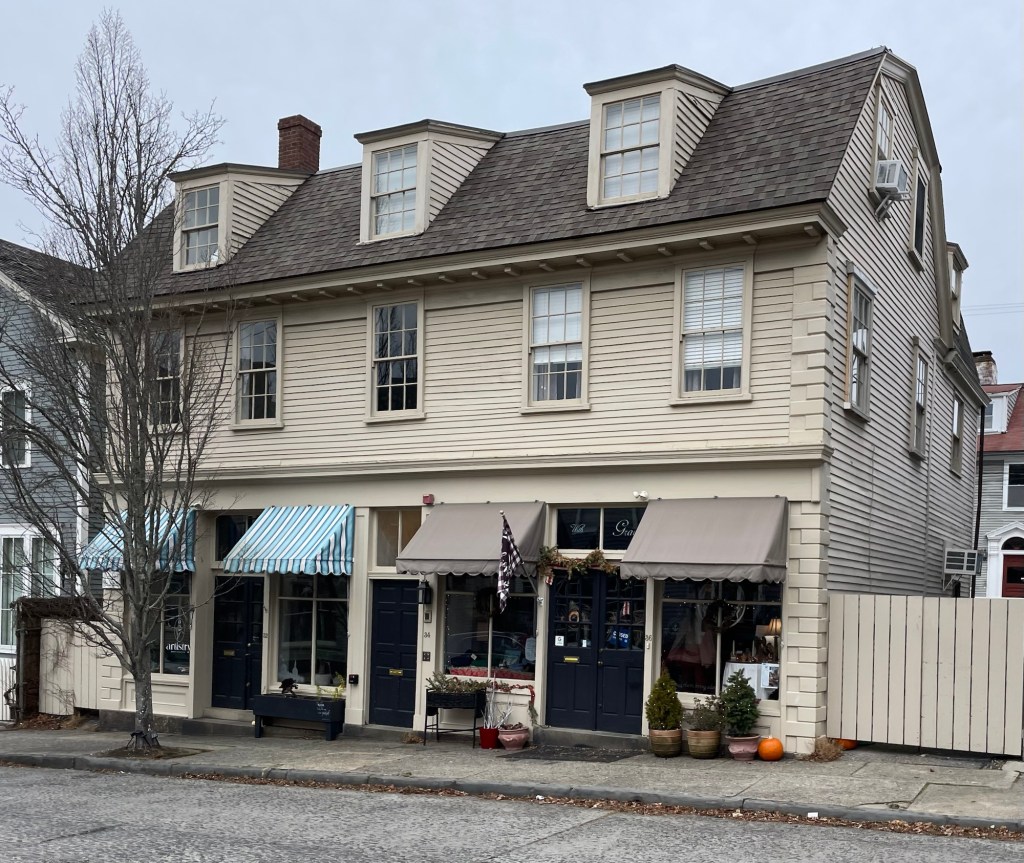
Cahoone-Yates Double House // c.1763

James Cahoone (1727-1814) and Stephen Yates built this stunning double-house on Green Street in Newport around 1763. Both James and Stephen worked as painters in town, and built this house together, each living in one half (Cahoone must have paid a little more because his “half” was a little larger). The Georgian style double-house eventually suffered from neglect and like several other Colonial-era buildings in Newport, its future was uncertain. Luckily, the Newport Restoration Foundation stepped in and purchased the property in 1968, restoring the houses in 1974, complete with a paint color even Cahoone and Yates would love!

Captain Caleb Godfrey House // c.1740

In Newport, Rhode Island, you can find that even the more regular-looking historic buildings often hold an interesting (and sometimes troubling) past. Little information was available on this Georgian-era house, but I did some digging and turned up a lot. Rhode Island and Newport specifically had been a hub of trade going back to its founding by white settlers. Even though it was the smallest of the colonies, the great majority of slave ships leaving British North America came from Rhode Island ports. Historian Christy Clark-Pujara, in her book Dark Work, The Business of Slavery in Rhode Island, indicates that during “the colonial period in total, Rhode Island sent 514 slave ships to the coast of West Africa, while the rest of the colonies sent just 189.” Captain Caleb Godfrey, who owned this home on Franklin Street in Newport, was a sea captain and hired by wealthy merchants to pick up slaves in West Africa and bring them back to the British colonies. In 1754, Samuel and William Vernon of Newport hired Caleb to take their ship, “Hare“, taking captives from Sierra Leone and embarking them from South Carolina. Godfrey left Sierra Leone with 84 slaves aboard, but 16 died on the 10-week voyage or soon after the ship arrived in Charleston, their bodies were dumped at night into the sea. In South Carolina, a prominent slave dealer named Henry Laurens handled the sale of African captives from the Hare, placing an advertisement to attract the attention of local rice planters. Godfrey’s Newport home is a visual reminder on New England’s direct ties to the enslavement of African people and how the colonies benefited financially from this terrible trade.