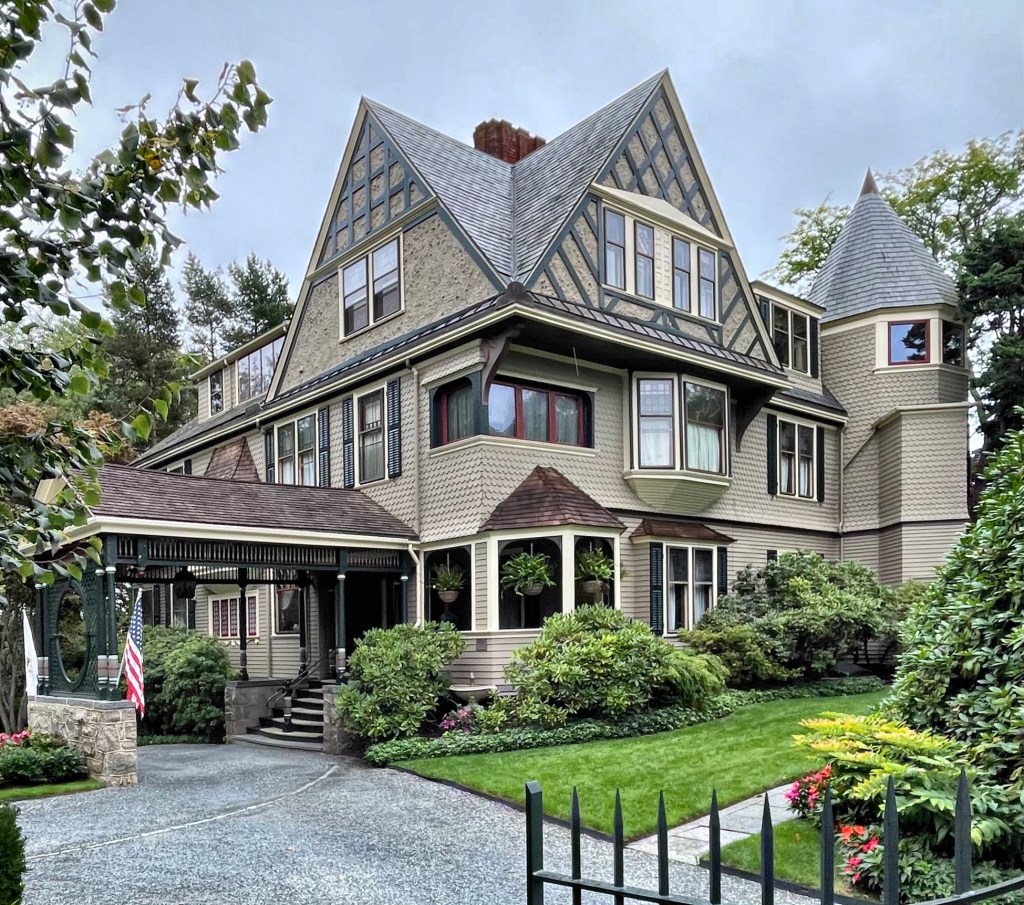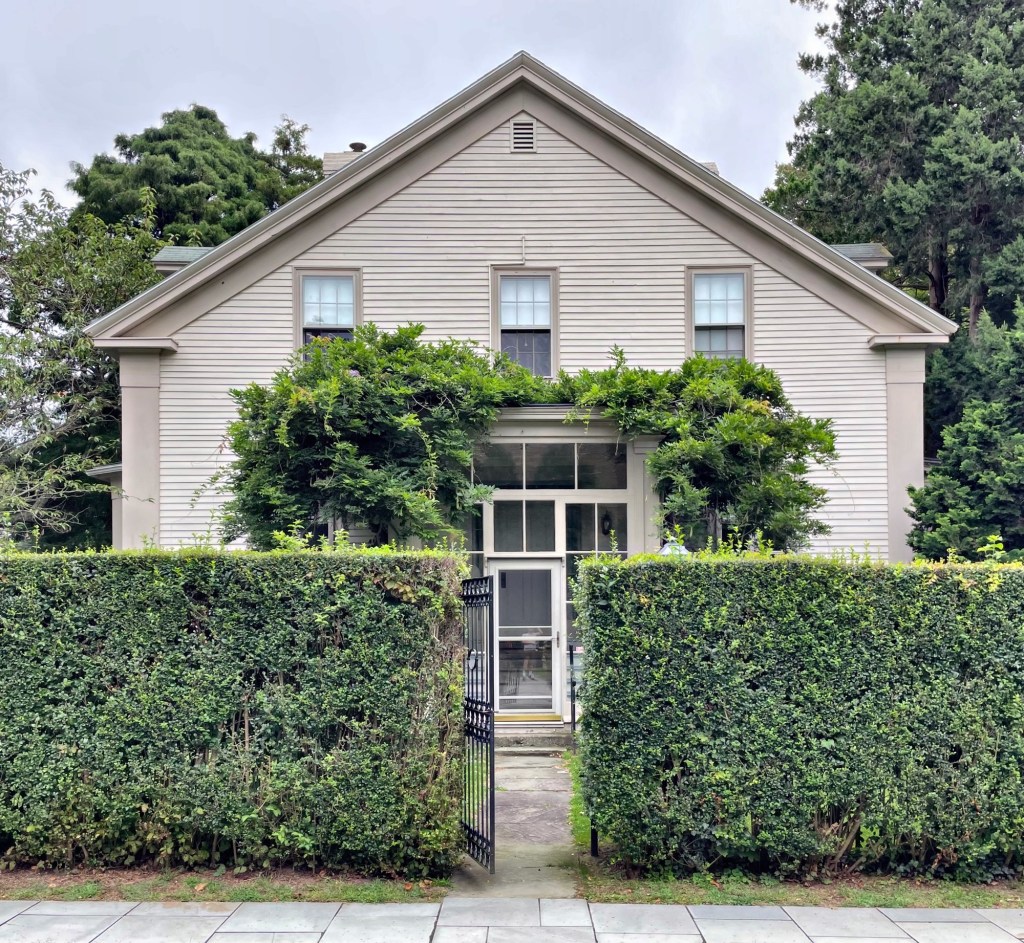
LaFarge Cottage // c.1845

Even the less ornate and grand summer cottages of Newport can have interesting histories! This c.1845 Greek Revival cottage sits on Sunnyside Place and is best-known as the summer home of nationally significant painter, muralist, and stained-glass master John LaFarge (1835-1910), active in the lively late 19th-early 20th-century Newport art scene. John LaFarge’s wife, Margaret Mason Perry LaFarge (1839-1925), was the granddaughter of Commodore Oliver Hazard Perry, and was a native of Newport, seemingly providing the connection between her husband and lucrative stained glass commissions for many Newport and New York buildings. LaFarge is arguably best known for his innovative, opalescent stained glass windows, which was later stolen and adapted by Louis Comfort Tiffany. The LaFarge Cottage was possibly moved to this site and renovated, adding the glazed entry.
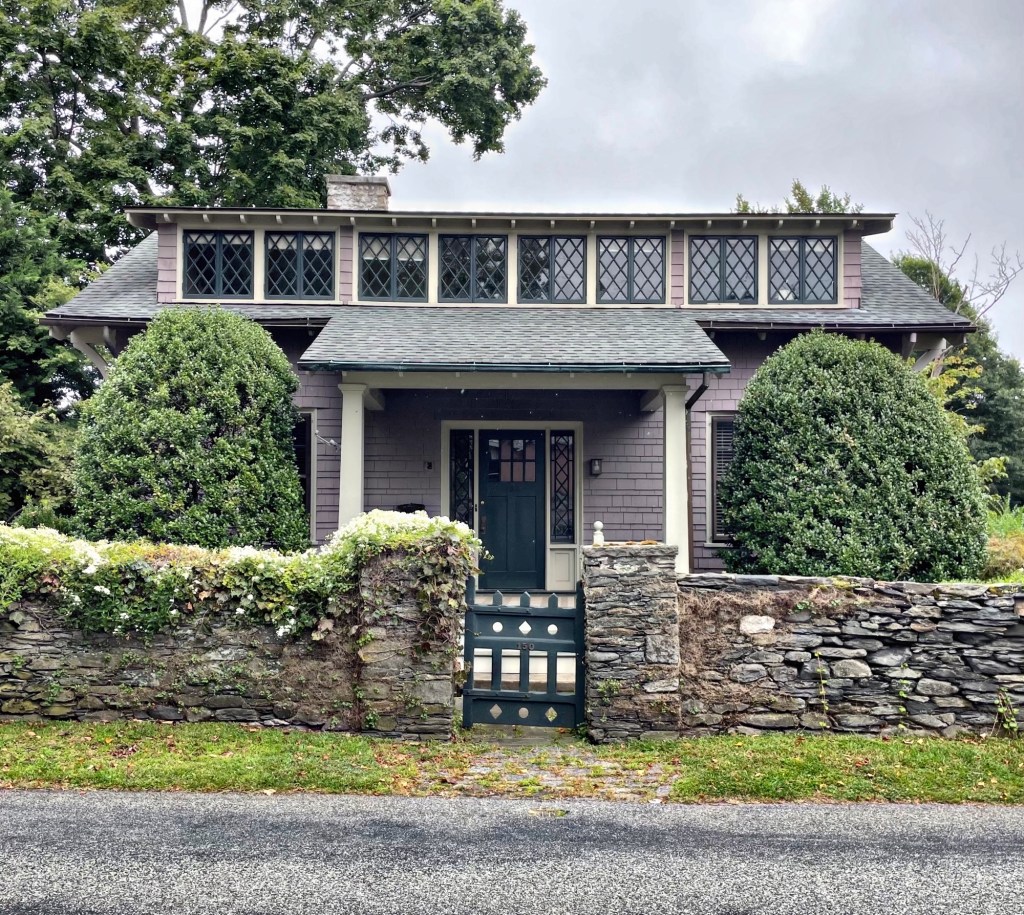
Maud Howe Elliott Bungalow // c.1912

This shingled Craftsman bungalow on Rhode Island Avenue in Newport was built in the 1910s for Maud Howe Elliott (1854-1948), a Pulitzer prize winning author and active member in Newport’s art scene and her artist husband, John Elliott. Maud Howe was born at the Perkins School for the Blind in Boston, founded by her father, Samuel Gridley Howe. Her mother was the author and abolitionist Julia Ward Howe. In 1887, she married English artist John Elliott. John is known for his epic Symbolist murals including working alongside his friend and colleague John Singer Sargent to provide murals for the Boston Public library, and a mural at the Smithsonian Museum of Natural History. In Newport, Maud became a founding member of the Newport Art Association, and served as its secretary from 1912 to 1942. She also took part in the suffrage movement as she was greatly influenced by her mother’s ideas and convictions about women’s role in society and particularly so in terms of women’s suffrage. She fought passionately for women to be liberated from the societal expectations and roles determined to them by male dominated society. This was her home in Newport until her death in 1948.

Maple Shade Cottage // 1871

“Maple Shade” is a historic, Second Empire style summer cottage located at 1 Red Cross Avenue in Newport, Rhode Island. The house was built in 1871 from plans by George C. Mason, a prominent local architect who designed many summer homes for summer residents in the late 19th century. He even lived in a home adjacent to this house! Maple Shade was built for John Doughty Ogden and his second wife, Mary C. Moore. John originally married Mary’s older sister Margaret, but remarried after Margaret’s death in 1845. The house gained attention again in 1934, when it served as the venue for the wedding reception of John Jacob Astor VI and Ellen Tuck French, then owned by Donald O. Macrae. The house, like many other former estates in Newport, has since been converted into condominiums, but retains its architectural grandeur and presence in town.

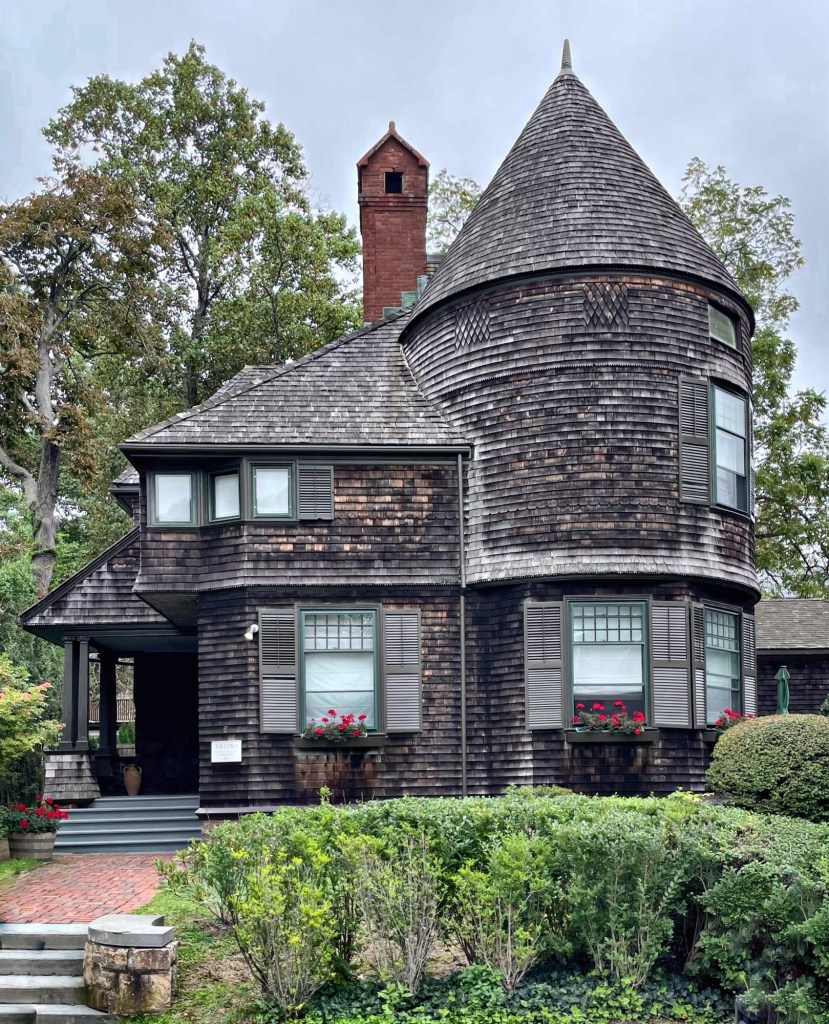
“Villino” // 1882

“Villino” was built in 1882 for $7,553, as a summer residence for Ms. Frances L. Skinner, a widow of the late Reverend Thomas Skinner. “Villino” was the work of the young firm of McKim, Mead & White, and it is one of the firm’s many Shingle style buildings, but one of the most compact. The asymmetrical 2½-story Shingle Style cottage sits atop a granite foundation with continuous shingles above. The entrance porch is tucked into the building mass on the side and its prominent tower with conical roof. The house is sited well into the landscape and unlike many other summer “cottages” the name Villino which is Italian for cottage, actually fits!


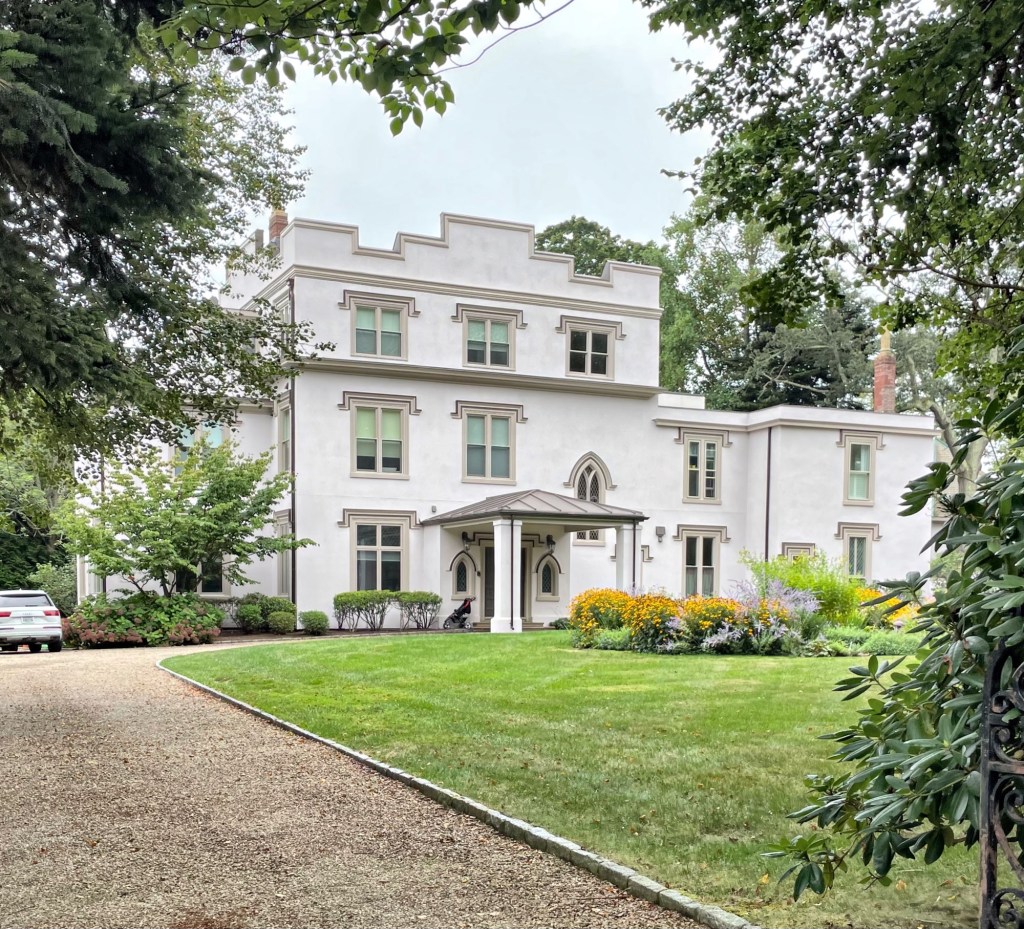
Tudor Lodge // c.1850

A rambling Gothic Revival style house in the mode of the picturesque Gothic estates in England, can be found tucked away in Newport, Rhode Island. This is Tudor Lodge, a stuccoed summer “cottage” notable for its stucco siding, moulding over all the windows, broad crenellated parapets, and a hip-roof porte-cochère in front of the principal entrance. The house was supposedly originally built as a summer residence for Nicholas Redwood Easton around 1850. After his death, the property was purchased by members of the Gibbs (Gibbes) Family, who owned much of the land in this part of town, giving nearby Gibbs Avenue its name. The property was purchased around 1900 by William Rogers Morgan, a New York City banker, who greatly remodeled and named the estate, Tudor Lodge, giving the house its present appearance. The estate was converted to four condominium units in 1980.

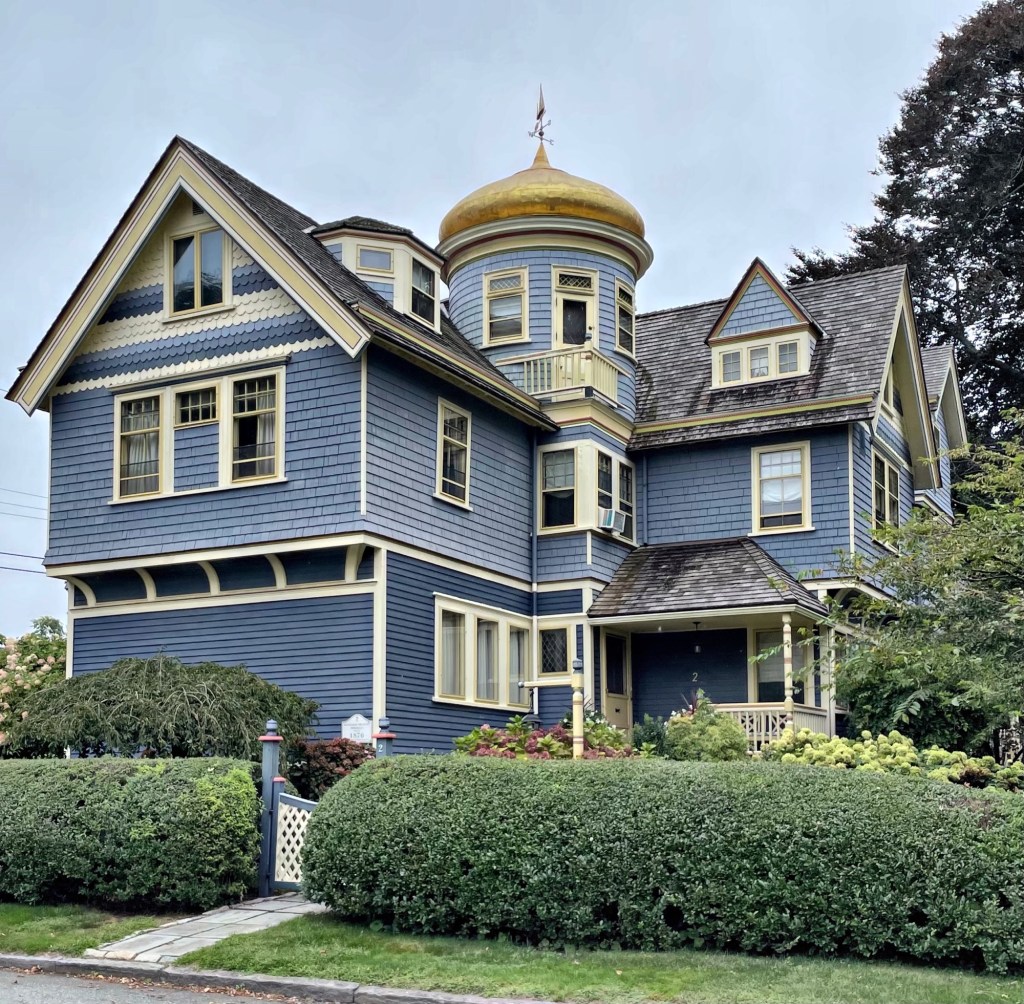
Katherine Prescott Wormeley House // 1876

The Katherine Prescott Wormeley House is an eclectic and eye-catching Queen Anne architectural landmark on Red Cross Avenue in Newport, Rhode Island. Boston-based Katherine P. Wormeley (1830-1908), a native of England, served as a nurse for the Union Army during the Civil War and was one of the best-known translators of French literature into English. She built this double-house at a cost of $7,000 and rented another unit in the home for additional income. The Wormeley House is one of Charles Follen McKim’s early, independent works after working in the office of H. H. Richardson but before forming his own firm with William Rutherford Mead in 1877. Just years after she moved in, Ms. Wormeley in 1882, hired McKim, who was now under the firm, McKim, Mead & White to update and enlarge the home. By 1893, Wormeley had moved to New Hampshire and sold the house to Elizabeth Cabot Hayden and Dr. David Hyslop Hayden. The golden onion dome roof at the tower is a real treat!

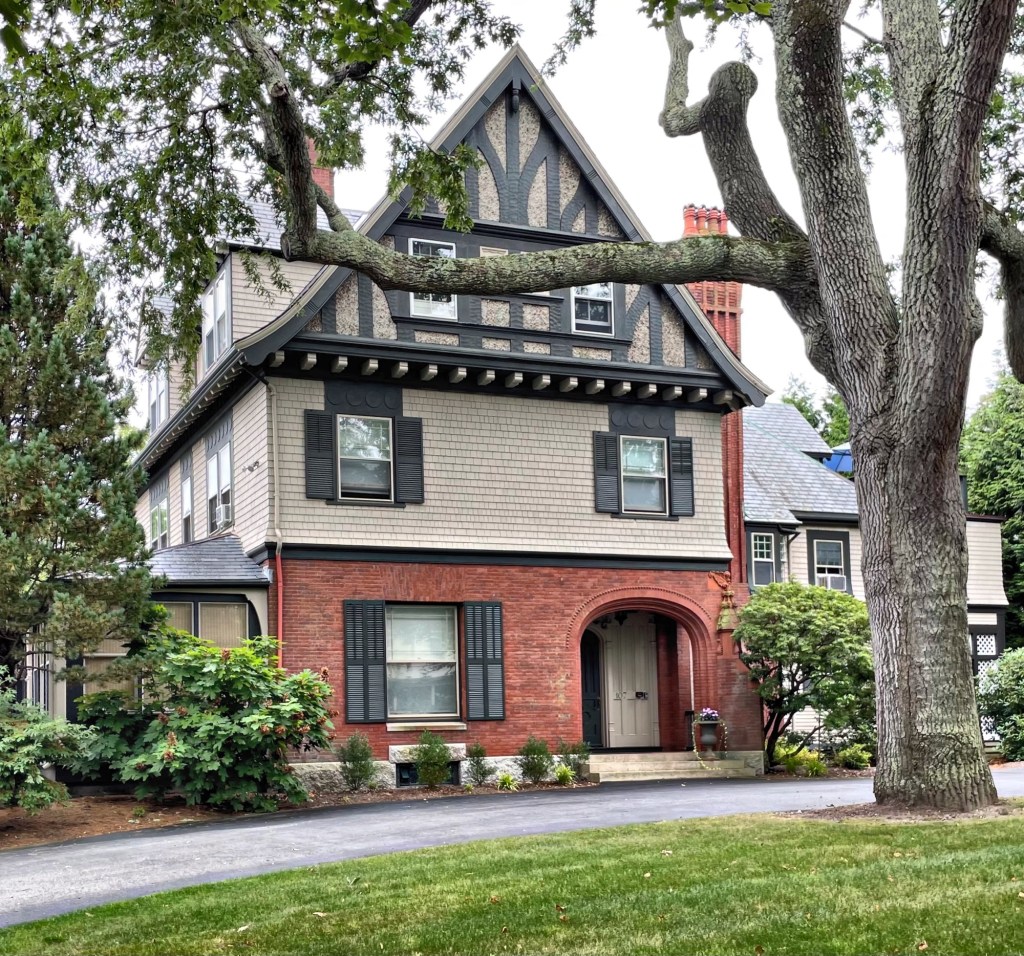
Oakwold Cottage // 1883

Oakwold, a stunning Queen Anne residence on Old Beach Road in Newport, Rhode Island was supposedly built on speculation and purchased by Augustus Jay (1850-1919). Mr. Jay was born in Washington, D. C., the son of Peter Augustus Jay and Josephine Pearson Jay. Augustus Jay graduated from Harvard College in 1871 and from the Columbia Law School in 1876, and worked as a diplomat. His wife was Emily Astor Kane (1854–1932), a daughter of DeLancey Kane and Louisa Dorothea (née Langdon) Kane. Emily was a descendant of John Jacob Astor. The “cottage” was named Oakwold, and was designed by architect Clarence Sumner Luce, who designed many summer residences in Newport, and specialized in the Queen Anne style. Particularly noteworthy in the design of Oakwold are the brick first floor with entrance within a recessed arched opening and pebble-dashed and half-timbered gable ends.

Rosevale // 1876

“Rosevale” was built in 1876 as a summer residence in Newport, Rhode Island, for couple, Grace Sears Rives and William Cabell Rives. Grace was the daughter of David Sears of Boston, who developed the Longwood neighborhood of Brookline; and William was the son of William C. Rives Sr., a Virginia congressman and Senator. The High Victorian Gothic mansion was designed by the Boston architectural firm of Peabody & Stearns who formed their practice just years earlier. The house was enlarged in 1881 by architect George Champlin Mason, Sr. The stonework of the lancet windows, the large octagonal tower, and the carved moldings give the relatively boxy home a more ecclesiastical feeling. The estate retains its original siting, at the middle of a large lot between Red Cross and Rhode Island avenues, which has thus far resisted infill housing on the estate. For years, Rosevale has been occupied as a funeral home, but it appears to have sold a couple years ago.

Bethshan Cottage // 1884

Bethshan Cottage is one of Newport’s (many) “hidden” gems that gets far too little attention from publications! Located on Gibbs Avenue, down the block from Eveherdee and William Barton Rogers‘ summer cottage, “Morningside”, Bethshan was built in 1884 on land purchased by Major Theodore Kane Gibbs. Theodore was the son of William C. Gibbs, the 10th Governor of Rhode Island, and served in the Union Army during the American Civil War, mustering out as a Major in 1870. Newport-based architect Dudley Newton designed this cottage for Gibbs, which blends nearly every major architectural style of the late 19th century under one, beautiful gambrel roof. The red granite stone walls, red brick trim, red fish-scale slate roof, even the rust-colored mortar, all work together to create a lovely composition, unlike anything else seen in Newport. According to Newport’s Assessor, the house is presently an apartment house.

Eveherdee Cottage // c.1889

This Queen Anne style “cottage” is located on Gibbs Avenue, one of the lesser-visited streets for house-stalking in Newport, Rhode Island, but wow is she something! The summer cottage here was built by 1890 for Ogden Hoffman Burrows, a merchant who went into business with his father and brother in San Francisco, shipping goods from East Asia to America. He purchased two adjacent lots here on Gibbs Avenue in 1884 and 1889, having this house built as a summer residence, where he could mingle with other wealthy neighbors. The Queen Anne style house was reportedly designed by local architect, John Dixon Johnston, who incorporated all the hallmarks of the style: varied siding types and materials, turned post porte-cochere, applied ornament, and complex, asymmetrical form. Burrows would sell this house by the turn of the 20th century. Later owners, Herbert E. Stride and Daisy Thompson Stride, who would reside here with Daisy’s mother, Eve. The Stride’s named the home “Eveherdee” an amalgamation of their individual names: Eve (Eveline), Her (Herbert), and Dee (Daisy). The home was most recently owned by television producer, Vin Di Bona, who restored the house to its grandeur we see today.