Katherine Prescott Wormeley House // 1876

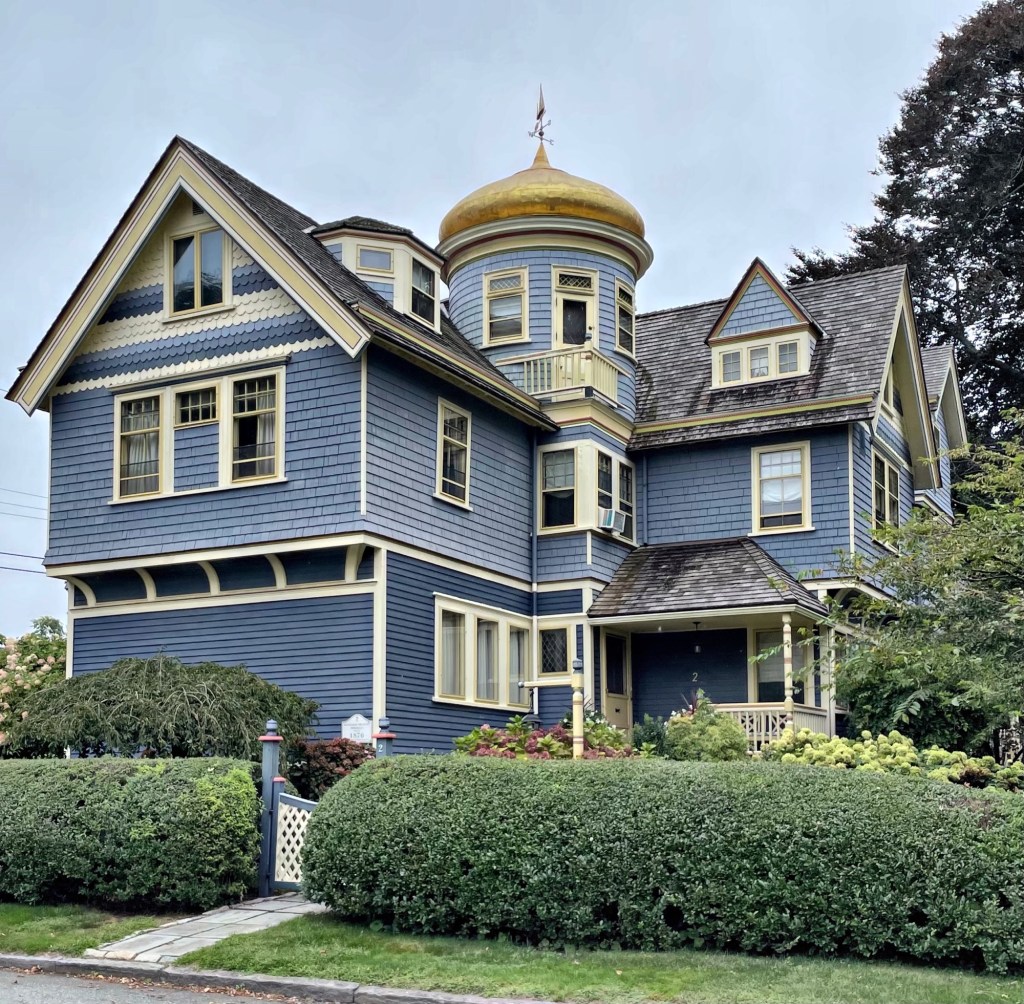
The Katherine Prescott Wormeley House is an eclectic and eye-catching Queen Anne architectural landmark on Red Cross Avenue in Newport, Rhode Island. Boston-based Katherine P. Wormeley (1830-1908), a native of England, served as a nurse for the Union Army during the Civil War and was one of the best-known translators of French literature into English. She built this double-house at a cost of $7,000 and rented another unit in the home for additional income. The Wormeley House is one of Charles Follen McKim’s early, independent works after working in the office of H. H. Richardson but before forming his own firm with William Rutherford Mead in 1877. Just years after she moved in, Ms. Wormeley in 1882, hired McKim, who was now under the firm, McKim, Mead & White to update and enlarge the home. By 1893, Wormeley had moved to New Hampshire and sold the house to Elizabeth Cabot Hayden and Dr. David Hyslop Hayden. The golden onion dome roof at the tower is a real treat!
Oakwold Cottage // 1883

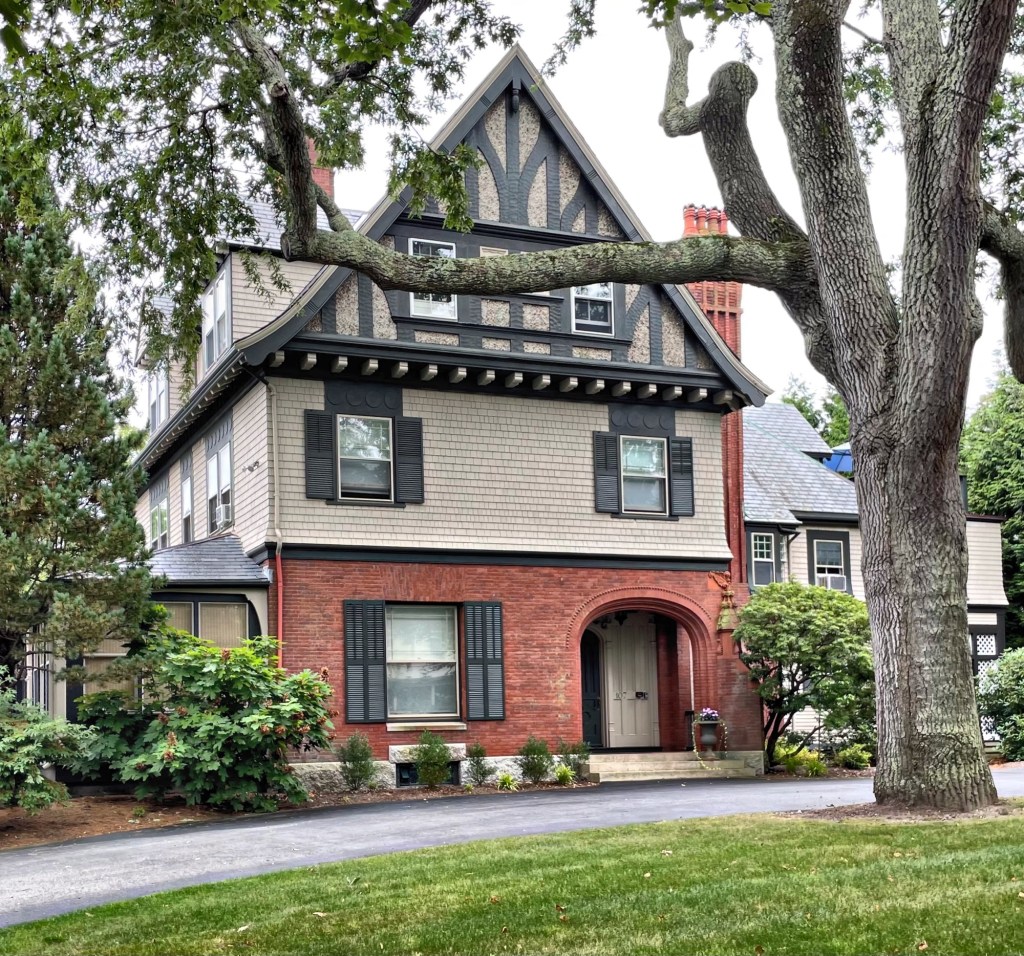
Oakwold, a stunning Queen Anne residence on Old Beach Road in Newport, Rhode Island was supposedly built on speculation and purchased by Augustus Jay (1850-1919). Mr. Jay was born in Washington, D. C., the son of Peter Augustus Jay and Josephine Pearson Jay. Augustus Jay graduated from Harvard College in 1871 and from the Columbia Law School in 1876, and worked as a diplomat. His wife was Emily Astor Kane (1854–1932), a daughter of DeLancey Kane and Louisa Dorothea (née Langdon) Kane. Emily was a descendant of John Jacob Astor. The “cottage” was named Oakwold, and was designed by architect Clarence Sumner Luce, who designed many summer residences in Newport, and specialized in the Queen Anne style. Particularly noteworthy in the design of Oakwold are the brick first floor with entrance within a recessed arched opening and pebble-dashed and half-timbered gable ends.

Bethshan Cottage // 1884

Bethshan Cottage is one of Newport’s (many) “hidden” gems that gets far too little attention from publications! Located on Gibbs Avenue, down the block from Eveherdee and William Barton Rogers‘ summer cottage, “Morningside”, Bethshan was built in 1884 on land purchased by Major Theodore Kane Gibbs. Theodore was the son of William C. Gibbs, the 10th Governor of Rhode Island, and served in the Union Army during the American Civil War, mustering out as a Major in 1870. Newport-based architect Dudley Newton designed this cottage for Gibbs, which blends nearly every major architectural style of the late 19th century under one, beautiful gambrel roof. The red granite stone walls, red brick trim, red fish-scale slate roof, even the rust-colored mortar, all work together to create a lovely composition, unlike anything else seen in Newport. According to Newport’s Assessor, the house is presently an apartment house.

Bay Crest Cottage // c.1850

Located across from the Winthrop-Eckley Double House on Corne Street, this gorgeous Italianate style summer cottage is a perfect blending of stature and whimsy. The house was built around 1850 and owned by Charles B. Peckham. Built in the Italianate style, the symmetrical house stands three-stories with covered side entrances divided by a projecting two-story bay. The house exhibits broad, overhanging eaves and paired and ganged round arched windows. The property was known as “Bay Crest” and remains one of the unsung landmarks of the 1850s in Newport.

Winthrop-Eckley Double House // c.1855

Newport has no shortage of amazing architecture. From the grand Gilded Age mansions along the coast to the pre-Revolutionary Colonial houses, there are always new buildings to stumble upon and learn about. This charming stone double-house on Corne Street was built in the mid-19th century and had two owners by the 1870s, John Winthrop (1809-1886) and Julia Ann Eckley (1800-1874), a widow, who owned the smaller side. The stone cottage sits atop a raised basement with bold stone quoins at the corners. Dormers with delicate wood trim are at the roofline with the detail reflected in the porch on the Winthrop half. This double-house is one of the many “hidden” treasures in Newport’s warren of narrow streets.

Edgar-Wolfe-Moore House // 1864

At the head of Touro Park, this large home has stood since it was built in 1864 for Daniel Edgar of New York, who made it his summer home for eight seasons. It was designed by noted local architect, George Champlin Mason in the Italianate style and included a broad veranda, brackets, and other intricate details. In 1872, Edgar sold the property to Catherine Lorillard Wolfe, who occupied the house until 1883 when her property “Vinland” was completed on Ochre Point Avenue. In 1948, the house was purchased by Cornelius C. Moore, who remodeled the exterior in 1949-1950, removing its Italianate trim and replacing it with Neo-Federal detail we see today. The house was most-recently in use as the Touro Park Inn, but was recently purchased and is a single-family home.

“Park Gate” Cottage // 1879

“Park Gate” Cottage sits on Bellevue Avenue near Touro Park in Newport, Rhode Island and is one of many summer “cottages” for wealthy summer residents. The home replaced the Atlantic House, a large summer hotel formerly on the site. The wood-frame dwelling was designed by Newport architect George Champlin Mason for Seth Bunker Stitt of Philadelphia and constructed in 1879. Mason’s design for “Park Gate” includes many features typical of the Queen Anne style including the asymmetrical facades, wrap-around front porch, tower, and even the small details like dentils, spindle work and balustrades. The house was later purchased by Newport Lodge #104 of the Benevolent and Protective Order of the Elks in 1920, who own the building to this day.

Atlantic House Hotel // 1844-1877

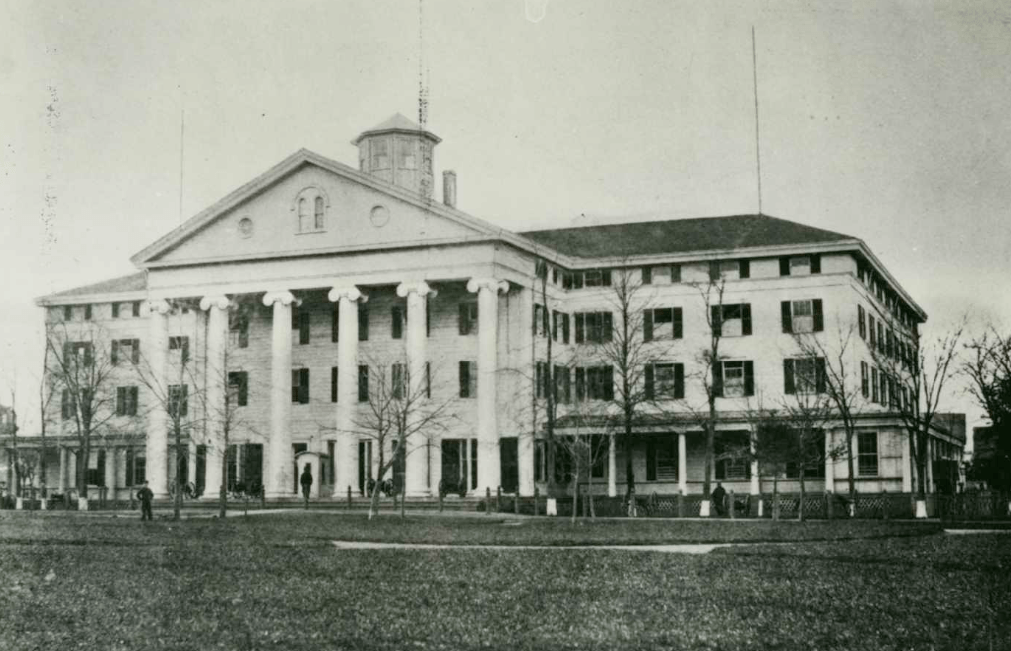
Prior to the present Park Gate Cottage at the corner of Bellevue and Pelham streets in Newport, this was the location of the stunning Atlantic House Hotel. Proprietor William T. Potter purchased this land in 1844 and built the Atlantic House Hotel, a massive Greek Revival style structure designed by Rhode Island architect Russell Warren. The Atlantic House faced Touro Park and the Old Mill and took the form of a large temple with a central two-story Ionic portico and hipped roof side wings. The building was constructed of wood and clad with smooth finish siding that was scored to resemble granite blocks to give it more stature. During the Civil War, the Atlantic House was home to the U.S. Naval Academy (1861-1865) when it was moved here to protect it from attack by the confederate forces at its location in Annapolis, Maryland. After the war, the Navy returned to Newport to establish three major facilities–the United States Naval Torpedo Station, the Naval Training Station and the Naval War College. The aged hotel saw dwindling numbers of visitors as newer, modern hotels were built after the Civil War. The hotel was demolished in 1877, just 33 years after completion, to make way for the Park Gate Cottage presently on the site.

Gardner House // c.1847

This perfect Greek Revival style house sits on Pelham Street in Newport, overlooking Touro Park and the iconic Newport Tower/Old Mill. Built around 1847 for Captain Robinson Gardner, the house exhibits flushboard siding, a heavy portico with wrought iron balcony over the door, and entablature with corner pilasters, all hallmarks of the style. The home became known as “White House” and has likely been painted white for much of its history.

Smith-Cottrell House // 1887

Located next to the Channing Memorial Church and the Derby Cottage on Pelham Street, this Queen Anne style cottage stands as a significant Victorian era residence on the street dominated by Greek Revival homes. Built in 1878 for a William H. Smith for his residence and office. The home is an excellent example of the Queen Anne style with asymmetrical form and massing, complex roofline with multiple gables and towers, varied siding, and intricate millwork. By the early 20th century, the property was owned by John and Mary Cottrell, and later purchased by the Channing Memorial Church as “Channing House”.