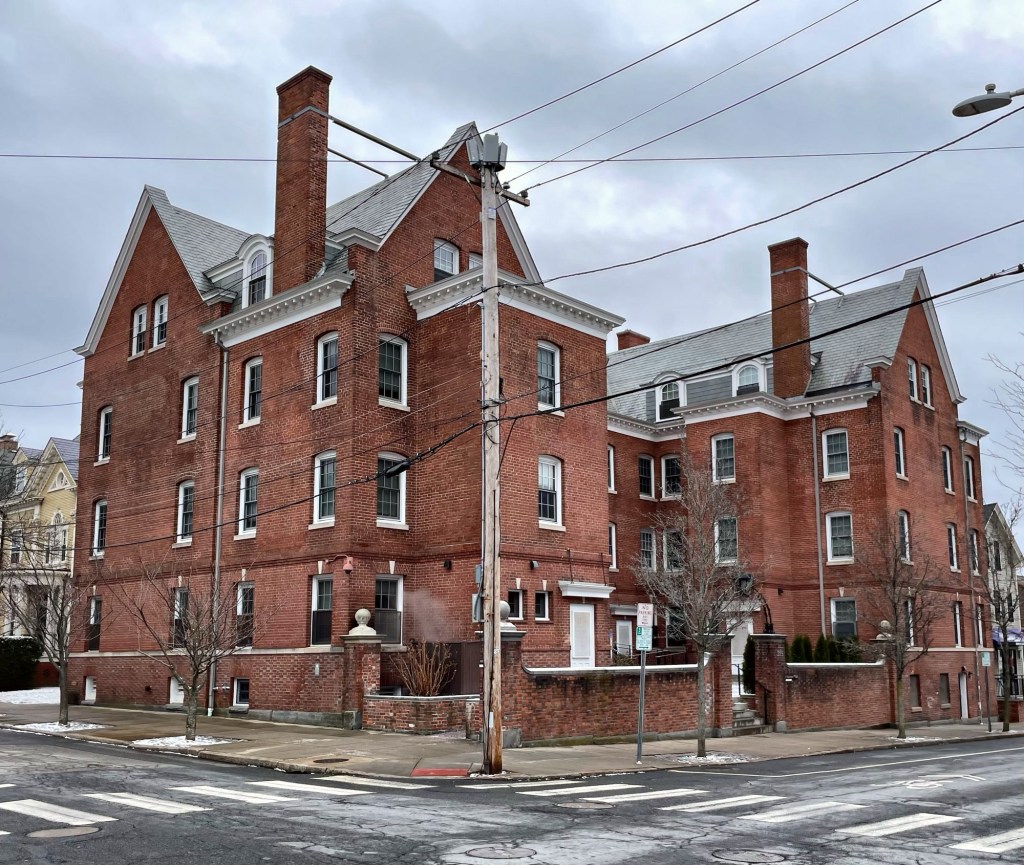
Newport Telephone Building // c.1897

Before the days of virtual meetings, texting, and calls by cellphone, residents of towns and cities all over New England needed central telephone exchanges to connect them to those who they were trying to reach. Telephone exchange buildings were typically located in downtown areas and were often architectural statement-pieces by telephone companies. This example in Newport, Rhode Island, is located just behind Trinity Church and was designed around 1897 by the firm of Perkins & Betton of Boston. The building is constructed of brick (now painted) with terracotta trim details, which really pop. The oversized Palladian window with arch, pilasters, and cornice are all terracotta installed by the Waldo Brothers, contractors. The building was converted to residential use and was sold for $2.5 Million in 2020.

Trinity Church, Newport // 1725

Trinity Church in Newport, Rhode Island is one of the largest extant 18th century churches in New England, and founded in 1698, it is the oldest Episcopal parish in the state. Built in 1725, the Georgian style church was built just as the influence of Sir Christopher Wren’s churches reached the colonies, about a quarter century after his work had come to dominate ecclesiastical design in London. Trinity is the second major church built in the original colonies influenced by Wren, following Old North Church in Boston’s North End (1723). Stylistically, both churches are similar, with the notable difference in material (Old North in brick and Trinity Church in clapboard). Local builder Richard Munday, is credited with the design of Trinity Church. By the late 19th and early 20th centuries, many members of the Vanderbilt family and other wealthy residents attended sermons here when summering in Newport. When Newport was undergoing Urban Renewal in the mid-20th century, Queen Anne Square (the park which fronts the church) was created in the 1970s to establish a town common in a city which had never truly had one. “Early” buildings in the area to be bulldozed for the common were moved to other sites to enhance the “colonial” rehabilitation of the area around the harbor, making this one of the few examples of urban renewal having a positive impact on a city.

Richard E. Edwards House // 1981

The Colonial era has had a grip on New England residential design since the 1700s, with each subsequent “revival” showcasing the character-defining features in bold new ways. With this house on College Hill in Providence, Rhode Island, the architect, Friedrich St. Florian, blended traditional Colonial Revival residential design with the flair and quirkiness that comes with the Post-Modern style, popular in the 1980s. The house is five bays wide at the facade with a central projecting bay at the entrance. Post-Modernism takes architectural precedence and turns it on its head, with quirky takes on features and larger proportions. The Edwards House exhibits decorative stone lintels, a Classically inspired entry with pilasters, and a very large cupola at the roof. What do you think of this house? I feel it works well for the neighborhood as it is contextual to the surrounding Colonial-era and Colonial Revival style residences while clearly being of the late 20th century.

Dike-Harkness House // 1854

One of the most stunning Italianate style homes in Providence is this stately beauty which is located on Prospect Street. The house was built in 1854 on land sold from Oscar to Henry A. Dike (Dyke), a shoe manufacturer, who erected this stately residence for his family, who only remained there until the early 1860s when it was sold. The home was built on one lot, facing a second house lot, and not the street like many other residences. The property changed hands many times during and soon after the American Civil War, until 1870, when it was purchased by Albert Harkness (1822-1907), a Brown University Classics professor. It was in Professor Harkness’ ownership that the southern house lot was landscaped from plans by Frederick Law Olmsted‘s firm in 1887. The house, which recently sold in 2022, is well-preserved from its massive brackets to the oversized belvedere at the roof!

Henry Samuel Sprague House // 1902

Colonial Revival houses just exude New England charm! This house in Providence’s East Side/College Hill neighborhood was built at the turn of the 20th century in 1902 for Henry Samuel Sprague, a Providence grain dealer, for $15,000. Mr. Sprague clearly did well for himself financially as he could afford a house lot on one of the city’s most beloved streets, Prospect Street. The large mansion has many architectural details which stand out including contrasting brick and shingle on the first and second floors, a massive projecting portico covering a prominent entry, bold fluted pilasters at the center bay, and three pedimented dormers at the slate roof. Inside, this old house has some amazing woodwork and details too!

Meehan Auditorium – Brown University // 1962

Across from the new Nelson Fitness Center at Brown University in Providence, Rhode Island,Meehan Auditorium is an excellent example of a 1960s institutional athletic facility. The auditorium was dedicated at the Brown-Princeton hockey game on January 6, 1962 and was named after George V. Meehan, donor of half a million dollars for its construction. The new facility filled the need for a skating rink and large auditorium for indoor functions, specifically for ice skating and hockey and was the first building of the new athletic plant at Aldrich-Dexter Field east of the campus. The building was designed by Perry, Shaw, Hepburn & Dean, a prominent firm who designed many collegiate buildings in the 20th century, all over New England.

Smith Owen Mansion // 1861

You honestly cannot beat Providence when it comes to brick Italianate mansions… The Smith Owen Mansion on College Hill was built in 1861 for jeweler and silversmith Smith Owen (1809-1889) and is one of the finest homes in a neighborhood full of historically and architecturally significant properties. Mr. Owen was in business with his brother George, and they manufactured and sold some of the best jewelery in the region, largely from their commercial block downtown (featured here previously). He hired Alpheus C. Morse and Alfred Stone, local architects who furnished the plans for the colossal home. Owen lived here until his death, which occurred less than a week after his wife’s passing. His daughter Lydia Dexter Owen Beckwith (1850-1947) inherited the property and lived here with her family until her death. It was under Lydia’s ownership that the Colonial Revival entrance details were added with projecting vestibule with columns and urns and central fan transom. It is really something special!

William Binney House // 1859

Another of Providence’s stunning monumental Italianate mansions on College Hill is this, the William Binney House, which was built in 1859 from plans by local architect Alpheus C. Morse. In the mode of an Italian Renaissance palace, it features a strong, symmetrical facade, molded string course, classic trim detail at the windows and doors in brownstone, and a shallow hip roof. The original owner, William Binney (1825-1909) was born in Philadelphia and became a prominent attorney and became involved on various boards, building more wealth. Additionally, he was elected as member of the Rhode Island Assembly and the Providence City Council continuously 1857 to 1874. The house’s rear ell and wooden bay would provide sweeping views to Downtown Providence even today from the aptly named Prospect Street.

First Church of Christ Scientist, Providence // 1906

One of the most stunning and monumental buildings in Providence is this building, a church which pretty closely resembles the Rhode Island State House! Christian Scientists in Providence began to hold informal services in 1889 and received a charter from the state legislature in 1895. Construction started on this church, the First Church of Christ, Scientist in 1906 from plans by local architect Howard Hoppin who roughly modeled the building after the congregation’s Mother Church in Boston. The Classical Revival building is capped by a copper hemispherical dome supported by a colonnade of Corinthian columns. The main block of the structure at the street is fairly modest, possibly due to the residential character of its surroundings.

Alumnae Hall – Pembroke College – Brown University // 1926

It’s not often that a building has not one, but three distinct and beautifully designed facades. Lucky for us, the 1926 Alumnae Hall at Pembroke College (now Brown University), fits the bill! Alumnae Hall on the Pembroke Campus was dedicated in October 1927 with funds for the building raised through the efforts of the Alumnae Association with Stephen O. Metcalf would duplicate all gifts of students and alumnae. The campaign continued until 1926, when the $50,000 contributed by the students and the $150,000 contributed by the alumnae, together with Mr. Metcalf’s matching funds, were deemed sufficient to start the building. The cornerstone was laid in May 1926 with the Boston architectural firm of Andrews, Jones, Biscoe and Whitmore as architects, who designed the building in the Colonial Revival style. Alumnae Hall, built of brick with limestone trim, was designed to accommodate the social and religious activities of the Women’s College. Its main entrance is a balustraded stone terrace on the campus leading to an auditorium on the main floor, the various sections create a visually stunning complex of wings and facades built into the landscape.