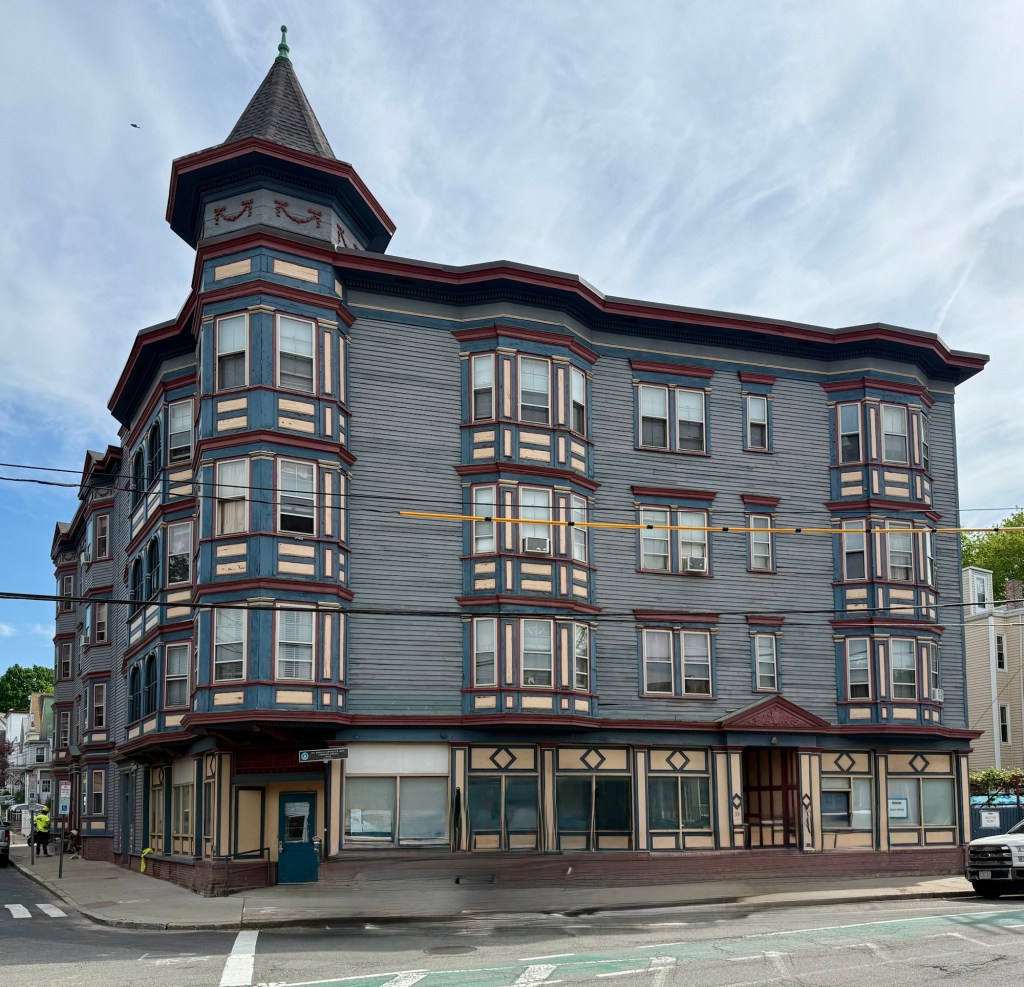
The Richmond Block on Bow Street in Union Square, Somerville, is a historic and architecturally significant mixed use building. Constructed in 1892 as one of the substantial wood-frame buildings in the western section of Union Square, the Richmond was designed by architect Aaron Gould for Mr. Charles Drouet, who developed the Drouet Block, a historic flatiron building just years later. Designed in the Queen Anne style, this building is noteworthy for its corner tower, octagonal oriel bay windows, sleeping porches on the side facade, and polychromatic color scheme to highlight the many architectural details on the block.
It is not always the architect-designed, high-style buildings that give a place character. The North End is a neighborhood almost entirely built of working-class tenement housing, but its density, immigrant history, and vernacular, make it one of the most visited and unique in the city. Michael Slattery, an Irish-born teamster, and his son, William, a grocer, developed this handsome block of tenement housing on North Margin Street in the North End neighborhood of Boston. The row of apartments stands out for its elevated design elements, including the projecting metal oriels with decorative wreath and swag motifs, arched openings, and brick corbeling at the cornice. The apartments here were rented by the Slattery family until the mid-1920s when the buildings were sold to Italian-Americans who continued to rent the buildings to lower-income residents. There is something about the North End’s vernacular that is so charming.
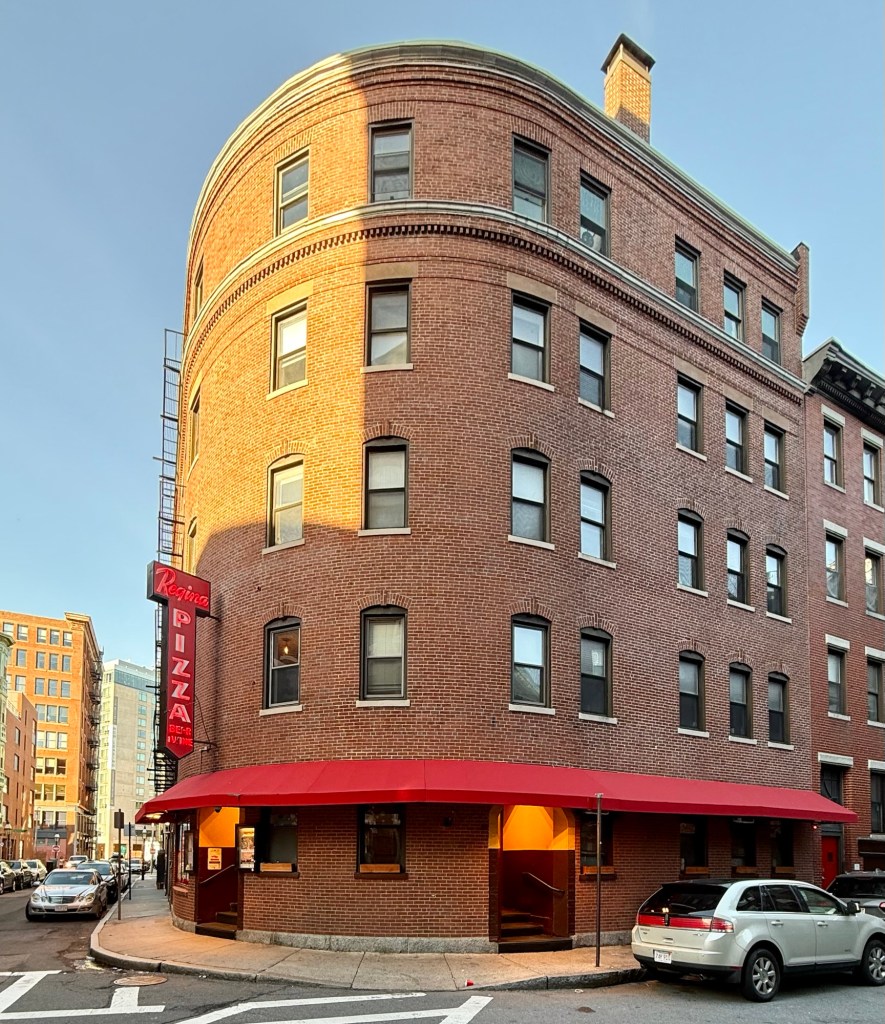
What is your favorite pizzeria in the Boston area? For many, it is likely to be Regina Pizzeria, but specifically this location in Boston’s North End. The building was originally constructed in 1886 for the Boston Cooperative Building Company, a charitable organization which built and rented tenement housing for low-income residents in the city. Many recently arrived immigrants would have lived in the building and paid a nominal rent, giving them the opportunity to work and grow their savings to move into better, more permanent housing. The Association was incorporated in 1871 and its original stockholders represented the financial elite of Boston. As a result of their financial backing, the association was able to hire the white-shoe architectural firm of Cabot & Chandler to design this tenement block in 1886. While not ornate, the building fits within the late 19th century vernacular of brick tenements of the North End. The building is now best known as the home to Regina Pizza, which was founded in 1926 by Luigi D’Auria, who was born in Campania, Italy, who purchased the building around that time. Regina Pizza (translated to “Queen Pizza” in Italian), was sold to the Polcari family in 1956, who have operated the restaurant since. The pizzeria with its prominent blade sign is one of the best landmarks in the North End.
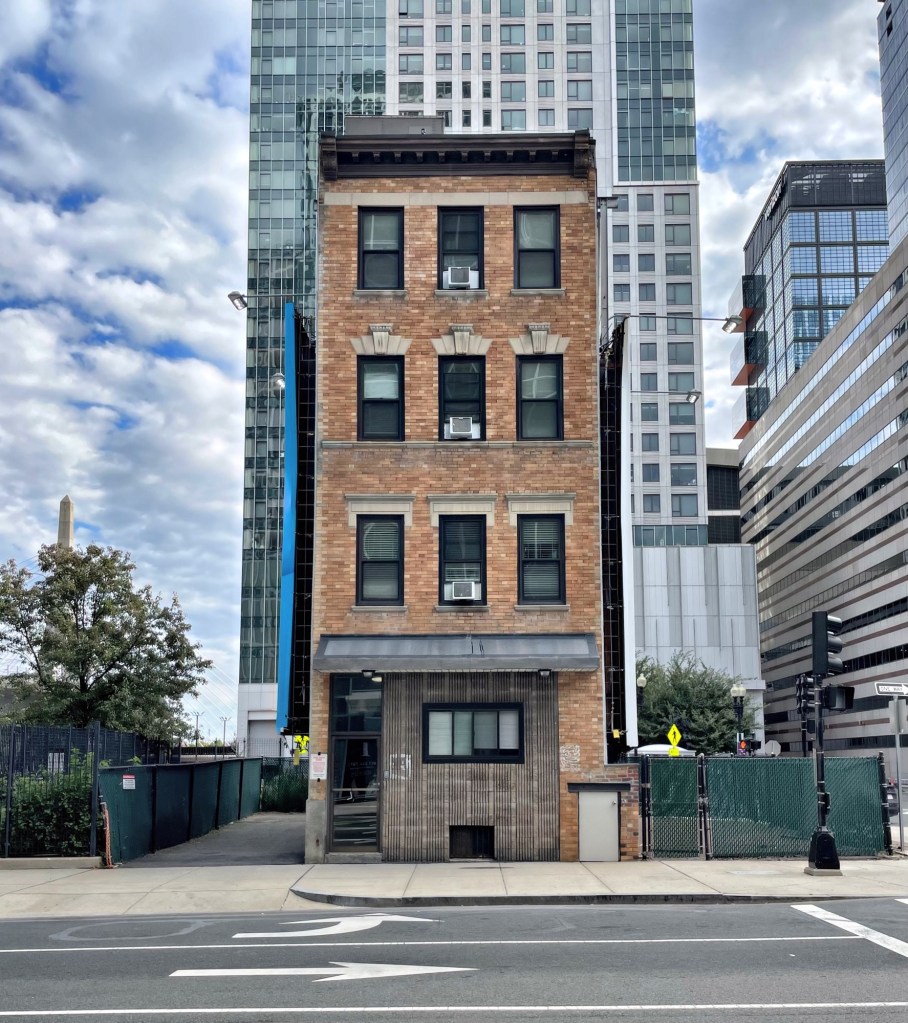
Originally built in the 1870s, and largely remodeled in the early 1900s, this charming building has been known locally as “The Last Tenement” of the old West End of Boston. Once part of an unbroken a row of 30 brick tenements along the east side of Lowell Street, this building typified much of the West End of Boston, a vibrant and dynamic immigrant neighborhood. Dwarfed by larger, modern apartment towers and highway off-ramps, this stand-alone building is a survivor, and should really be preserved! Here is a little history on The Last Tenement that I found. The building was originally built as a three-story residence just after the Civil War by furniture dealer, George M. Rogers. The building was rented to four families in the 1880 census, showing the diversity of the region with 20 people residing in the building of Irish, English, and German-Jewish backgrounds. At the turn of the century, an elevated rail line was laid out down Lowell Street. After WWII, the neighborhood would see a terrible demise, that has been widely told. City leaders effectively considered the vibrant immigrant neighborhood a slum, and in an effort to redevelop it to bring back middle-class families (and their tax dollars) handed much of the neighborhood to developers to start over, with little more than lip service for the displaced. This building, now with an address of 42 Lomasney Way, was occupied for some time by “Skinny” Kazonis, a low-level Mafia associate of the Angiulo Brothers, which was a leading gang in the North End until the Winter Hill Gang decided to run rackets in the area. The property sold, and residential units have been rented and the building maintained, with the assistance of a billboard for additional income for the owner. The Last Tenement showcases the strength and resilience of the old West End and will hopefully remain as a reminder of the vibrant neighborhood that was razed and replaced with mediocrity.
This charming Federal period dwelling in Mansfield, Massachusetts, was built around 1830 by Solomon Pratt and his brother-in-law, Elkanah Bates as a boarding house for the workers at their nearby cotton mill. The duplex was historically split down the middle with a unit on each side, accessed by the shared center stairhall. Local lore states that the Irish immigrant families who lived in this property reported that there were “supernatural” noises in the house, which frightened the occupants, they would tell friends it was “thundering in the castle”, giving the property the nickname, Thunder Castle.
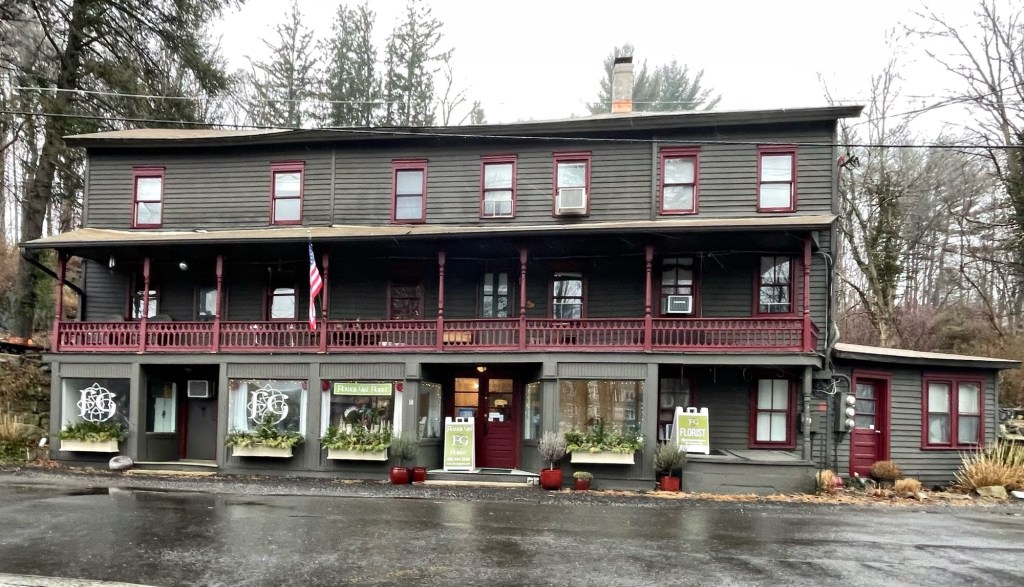
The Branchville Railroad Tenement in Ridgefield, Connecticut was built in three phases between around 1853 and 1905 and is one of the towns significant vernacular landmarks. Its earliest incarnation was as a storage facility for the railroad station, to which two stories of residences were added to houses workers on the railroad. Following completion of the railroad, the building was converted into a hotel in 1880, at which time the two-story porch was built and the interior was redecorated. This was apparently an unsuccessful venture, and in 1905 it was converted to a saloon and multifamily residence. Today, the old railroad tenement is home to a small business with housing above.
The three-decker is a commonly found housing type in New England’s urban industrial cities. These buildings are typically of light-framed, wood construction, where each floor usually consists of a single apartment, and frequently, originally, extended families lived in two, or all three floors. These were affordable housing, largely built by and for first- or second-generation immigrant families who could build a home and rent the other two units to family or friends to offset the steep cost of a mortgage. These three buildings were constructed around 1895 by David Sullivan, a cabinet-maker in North Adams, Massachusetts. They are all Queen Anne in style with applied stickwork, gabled roofs, and multi-story porches. Housing like this is what keeps so many New England towns and cities (relatively) affordable with increased density without sacrificing character or charm.
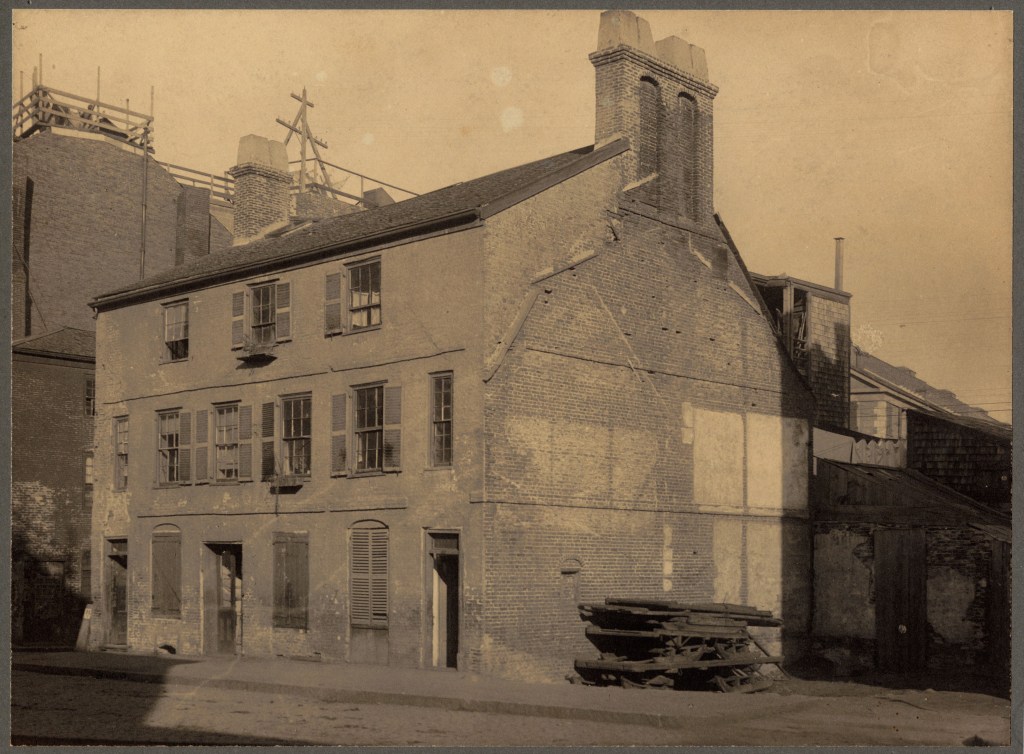
One of the finest First Period Houses to have been built in New England was this brick mansion, formerly on North Street in Boston’s North End. On December 29, 1674, John Paine conveyed his property including a dwelling house to William Downe his new son-in-law. It is unclear when the house was built, but it was completed by the time of sale to William. Luckily, the house was constructed of brick, which likely saved it from the Fire of 1676. In later centuries, the building was converted to commercial use. After the Civil War, the property was owned by the Tremere Family, who rented out commercial space and held tenements in the floors above (the third floor was added, filling in the space between the two end chimneys which were added in the early-19th century. The property was razed in 1896 for the present tenement building on the site.
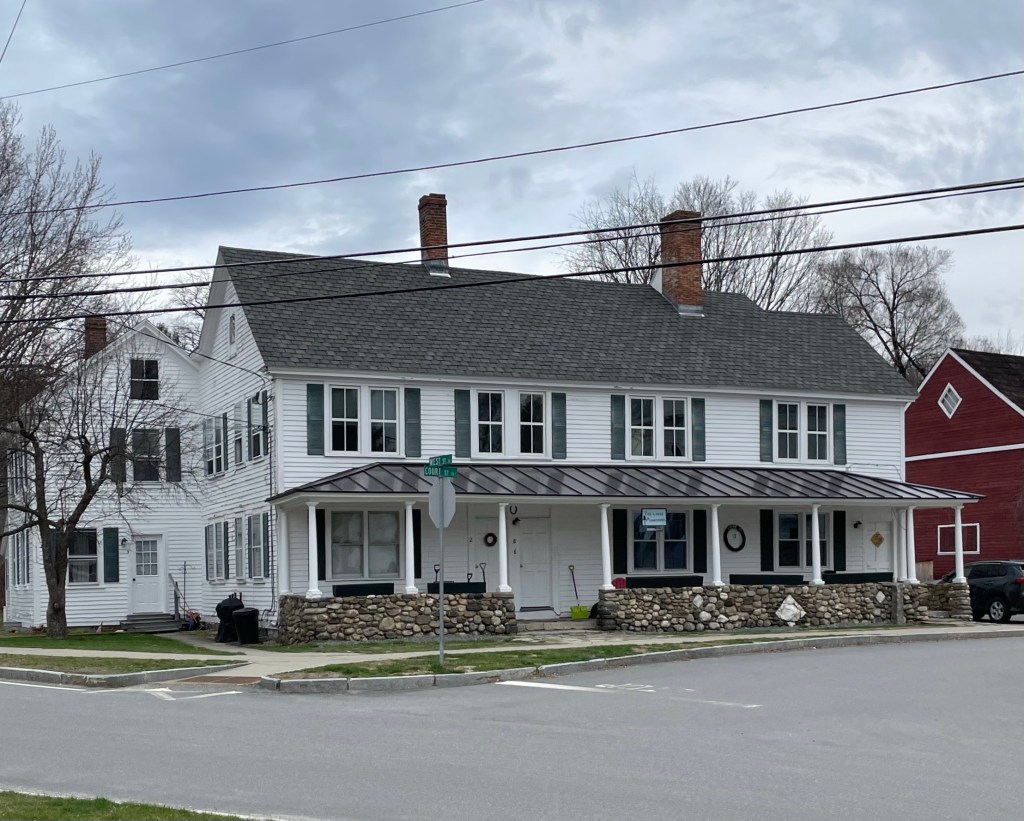
Constructed circa 1830 for Anthony Jones, this clapboard building in Newfane, Vermont originally contained tenements and was called the “long building” during the nineteenth century. Around the turn of the 20th century, a federal judge acquired the building and some of its rooms were used as offices during sessions of the county courthouse across the street. Subsequently, the local Odd Fellows Group (I.O.O.F.) occupied a hall on the second story, and for a half century after 1910, part of the first story served as Newfane’s telephone exchange. In 1971, the building was converted to apartments and has remained so since that time.



 Buildings of New England