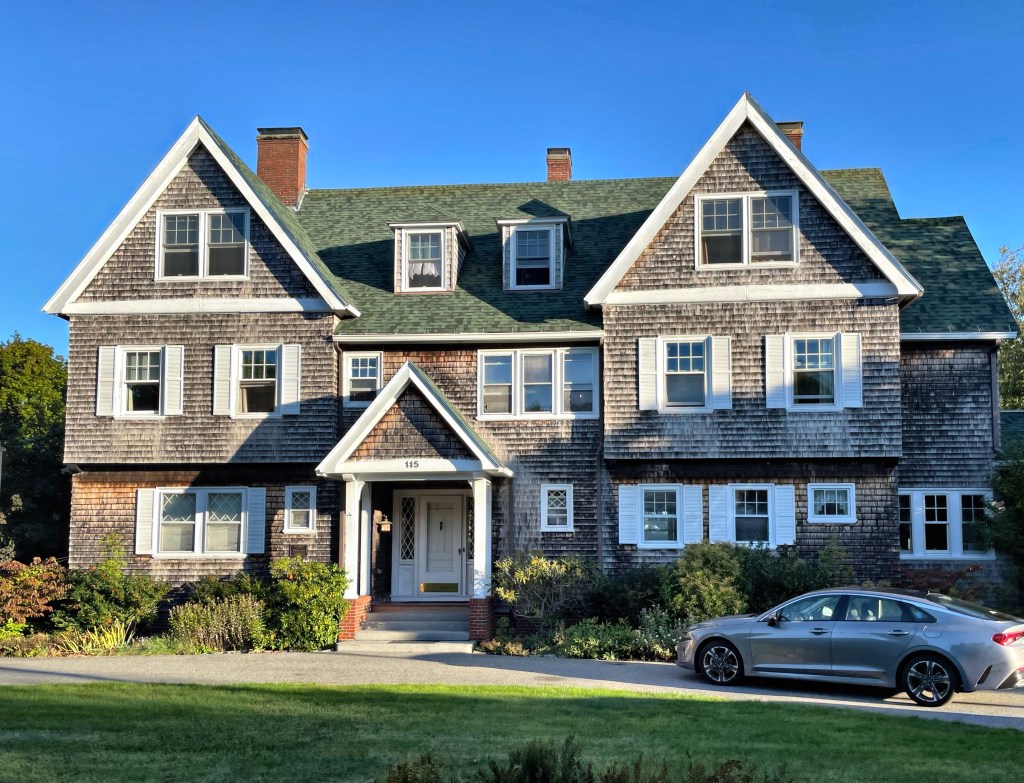
Sunset Cottage was designed by local architect Milton Stratton and cost $20,000. The cottage was constructed for New Yorker Gertrude Stevens Rice, a decade after the death of her husband William. She and her husband formerly resided at The Tides, a home nearby, but she decided to construct a new home to summer at with her sister. The shingled home originally had half-timbering in the gables, but other than that, looks almost identical to when it was built 110 years ago!
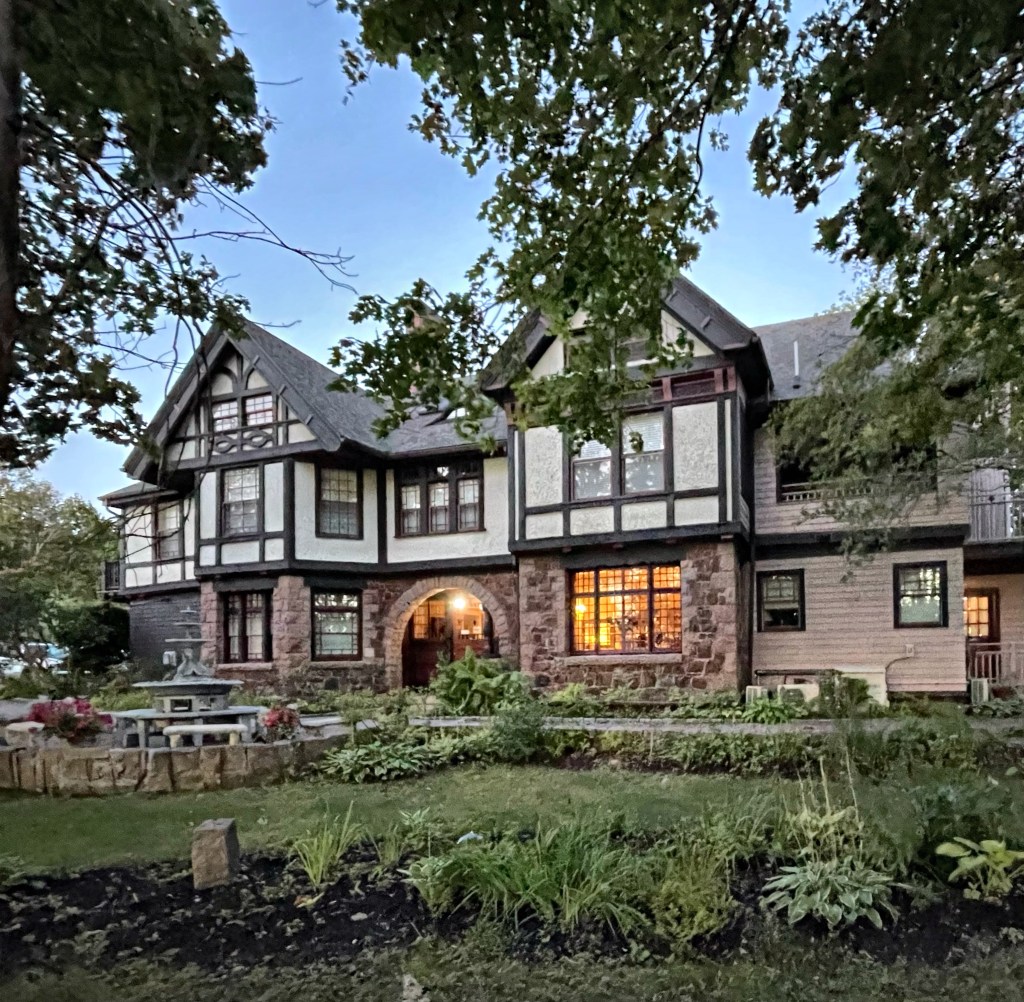
It’s Tudor Tuesday so I have to share one of the great Tudor Revival cottages in Bar Harbor, Maine, “The Poplars” (because any good summer cottage needs a name)! The cottage was built in 1899-1900 for Lewis A. Roberts, a retired book publisher from Boston, who purchased the lot which contained a summer cottage and stable, razing both. He hired the local firm of Goddard & Hunt, an architect/builder duo who worked on many projects in the village. The Tudor Revival cottage was only occupied in the summer months by Roberts and his family as the home was not winterized at the time. The cottage was built of wood and rough stucco work with rough timber trimmings all hallmarks of the Tudor style. The home was later known as the Stratford House, and became an inn until just a couple years ago. It was recently listed for sale and has 13 bedrooms and 13 bathrooms!
One of the earlier summer cottages in Bar Harbor is Ullikana, a Queen Anne style cottage, verging on Tudor Revival style. The cottage was built in 1885 for Alpheus Hardy (1815-1887) a trader in Boston. Hardy gained his wealth in shipping. He got his start by buying a small and fast ship that could make the voyage to the Mediterranean and back so quickly that he and his other investors captured much of the fruit importing business. His company would grow to have over 15 ships going as far as China. Hardy hired the Boston architectural firm of Cummings & Sears to design a new summer cottage in Bar Harbor, Maine, an ever-growing rival to Newport. He could only enjoy the cottage for two years, when in 1887, while cutting coupons, he dropped the scissors, the sharp points piercing his leg. Blood poisoning followed and death resulted. The summer cottage was owned by his family as a rental cottage for a number of years until it was purchased by the Maine Central Railroad, and rented to the recently widowed Princess Miguel de Bragança of Portugal, the former Anita Rhinelander Stewart. The cottage is now an inn.
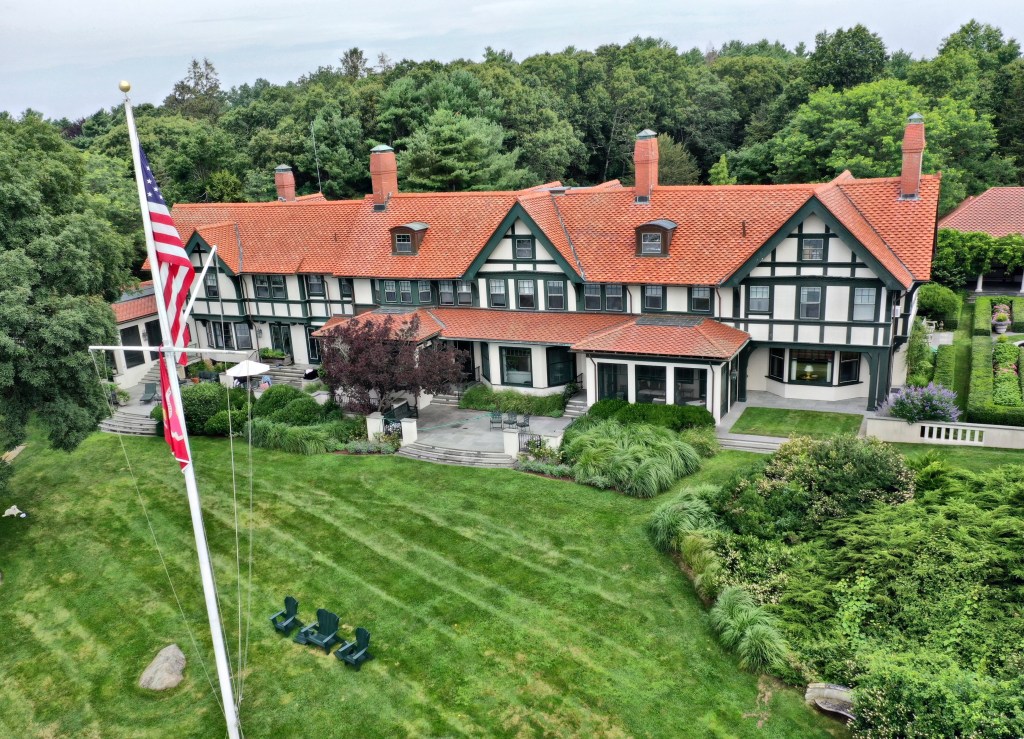
One of the most grand Summer estates on the coast in Marion, MA, is “Fair Oaks”, a 1903 Tudor Revival mansion across the Sippican Harbor from the village. Horace B. Shepard was the president of the Shepard and Morse Lumber Company, which was headquartered in Downtown Boston. The company was a wholesale dealer in all kinds of lumber including: white pine, spruce, hemlock, North Carolina pine, yellow pine, poplar, and various oaks. Given Shepard’s line of work he not surprisingly called his summer estate “Fair Oaks”, and his house’s building materials were undoubtedly supplied by his company. He appears to have hired Charles Allerton Coolidge, who lived nearby in his own summer cottage (featured previously) to design the Tudor mansion. The “cottage” is almost 13,000 sq.ft. and has 11 bedrooms, 9.5 bathrooms. Wow!
Another of the handful of original structures extant on the Seaside Sanatorium campus in Waterford, Connecticut, is this gorgeous Tudor Revival style duplex constructed for medical staff housing. Like the Main Building and Nurse’s Residence, this duplex is credited as a design by the great Cass Gilbert. While the building was constructed after Gilbert’s death in 1934, the plans were likely all drawn up at the time the Maher (main) building was in 1933. The duplex residences feature a symmetrical facade with two main entranceways, located in slightly projecting pavilions, and are set within basket-arched openings, detailed with alternating brick and granite voussoirs. There are three-part windows above the doors which project from the wall plane and have cross-braced faux balustrades of wood below. Identical sun porches are recessed at either end of the house. The small associated garage to the immediate northeast has a simple design, but one that reflects the style of the houses. Like the other buildings on the campus, this structure is vacant and is slowly rotting away. So sad to see.
Next to the Maher Building at Seaside Sanatorium, the Nurse’s Residence building (1935) sits in the same sad state but retains a lot of its architectural character and charm. The Nurse’s Residence was built for… you guessed it, housing for the nurses who worked at the Seaside Sanatorium and treated the young children with Tuberculosis. Like the main building, this structure was designed by famed architect Cass Gilbert in the Tudor Revival style. In designing the buildings, Gilbert met the requirements of the sanatorium to have a self-contained hospital for the children and a large separate dormitory for the nursing staff, but adapted an essentially domestic architectural style to de-institutionalize their appearance through the use of applied, decorative detail and an extraordinary wealth of materials. The Nurse’s Residence is constructed of brick and is capped with a polychrome slate roof which is lined by 15 dormers on each slope, alternating in size. The end gables, which are similar to those of the main building and in surprisingly decent condition given the circumstances, are covered with decorative tile and add a punch of architectural intrigue. Oh too see these buildings restored one day…
One of the most entrancing and clearly haunted places in Connecticut is the Seaside Sanatorium on the coast of Waterford, CT. It’s founding dates back to the early 1900s, when tuberculosis killed 252 of every 100,000 people living in the state, making it the leading killer in the state early in the century. When Connecticut Tuberculosis Commission members, including Chairman Dr. Stephen J. Maher, a New Haven physician, began hearing of success in Europe with exposure not only to ocean air, but to strong sunlight, they began pushing for a new location in Connecticut to treat children with tuberculosis. The first Seaside was established in Niantic in 1918, which was outgrown, and a newer, modern facility on the coast was needed. The State found a site on the coast of Waterford and hired world-renowned architect Cass Gilbert to design the complex in the Tudor Revival style, a departure from the Colonial or Classic Revival styles favored at the time for such projects. When the facility opened, children would spend as much time as possible exposed to the sun’s rays as part of their treatment here. They played sports, took lessons, ate, read, and played music outside year-round, either on the beach, the lawns, or the three levels of south-facing porches. By the early to mid-1950s, tuberculosis became curable with antibiotics that required limited bed rest and could be given in a regular hospital setting. After its use as a TB facility ceased, the state re-opened Seaside as a hospital for people with mental illness, which too closed in the 1990s. The massive campus has sat vacant since, rotting away as a State Park. Apparently the State has been looking for a developer to revitalize the campus as a hotel or other use, but sadly, nothing has materialized.
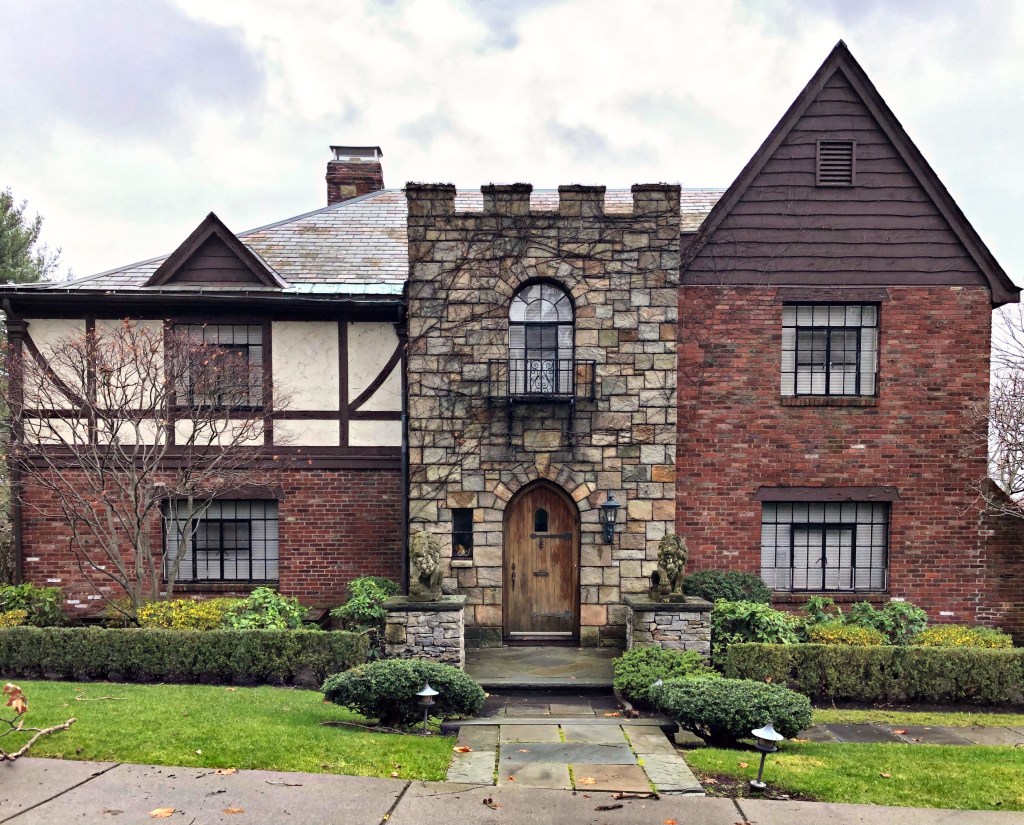
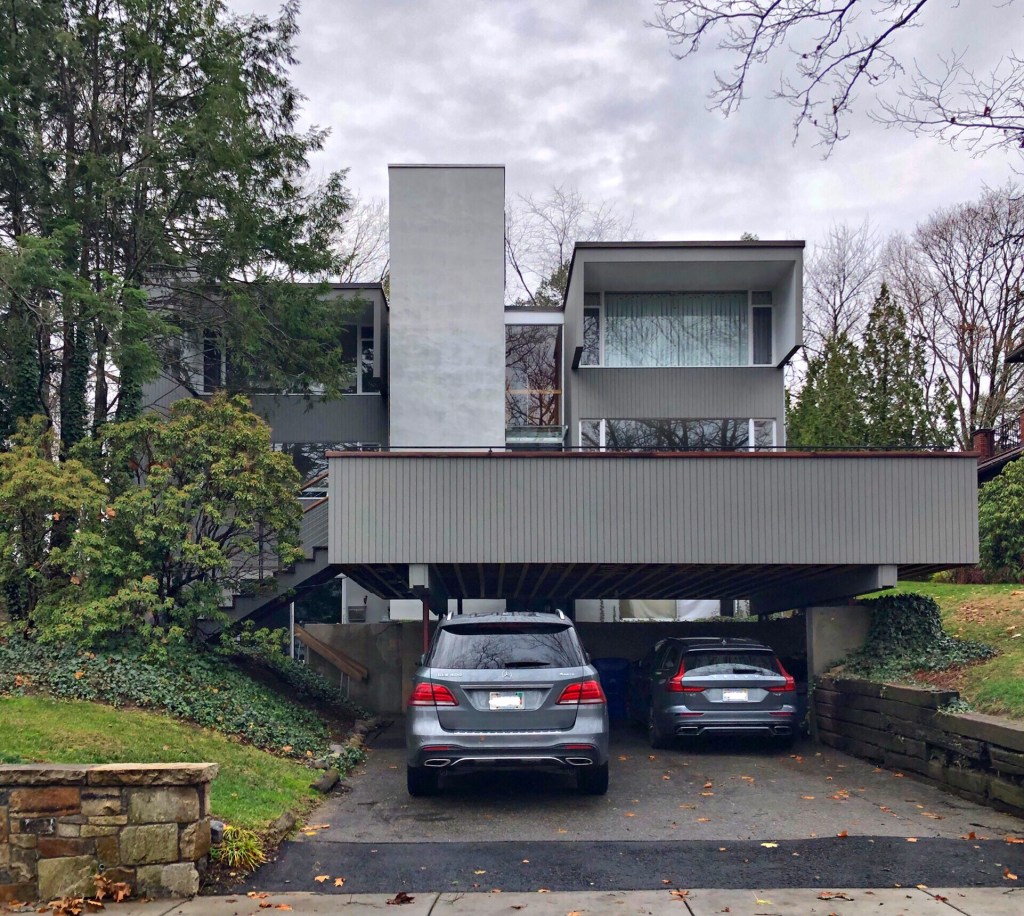
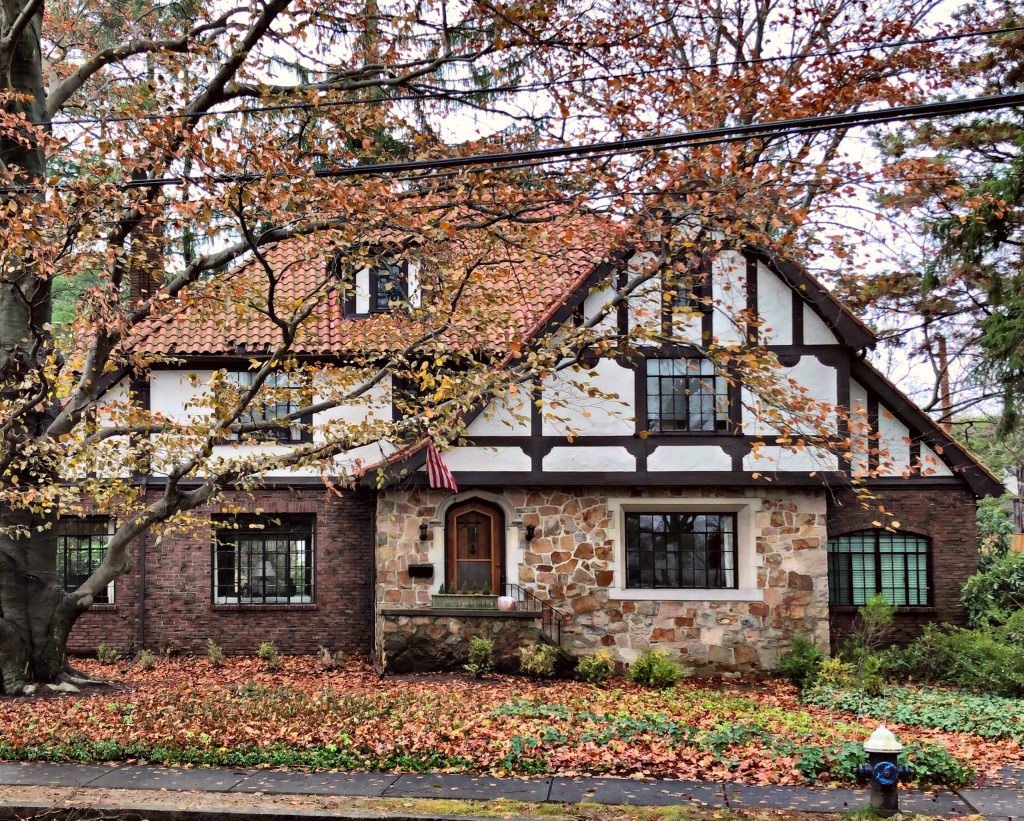
Located across the street from each other in Brookline, the Pastan Houses are an excellent example of how architectural tastes can change from one generation to another. The William Pastan House was constructed in 1936, and is Tudor Revival in style. The home has a projecting square entry tower with castellated roofline and interesting mixture of materials and textures. The first owner, William Pastan raised his family in the home, attending the synagogue a couple blocks away. By 1963, Pastan’s son, Harvey became a successful engineer and built a home near his parents for his own family, though in a very different aesthetic. The Modern home features boxy forms, prominent covered parking spaces, and expanses of glass.
Which house would you prefer, William’s (1936) or Harvey’s (1963)?
Residential architecture of the early decades of the 20th century is among my favorites as the Tudor Revival movement took off and was sometimes mixed with other revival styles at the time, creating really unique homes. The Glacy House in South Brookline, MA was built in 1930 as one of the earlier homes in the Walnut Hill development. It was likely designed and built by Walter L. Fernandez, a contractor who appears to have design-built a handful of spec homes to help get the neighborhood’s development going in the early stages. This home was originally occupied by George and Mary Glacy. George later worked as Vice President of the Boston & Maine Railroad, though he later got into legal trouble for hiring companies for railroad projects where he had financial interests, becoming indicted in an antitrust case by a Federal grand jury. The home features a first floor constructed of stone and brick with half-timbering on the floor above. The building is topped by a terracotta red tile roof, which is fairly uncommon for the region.
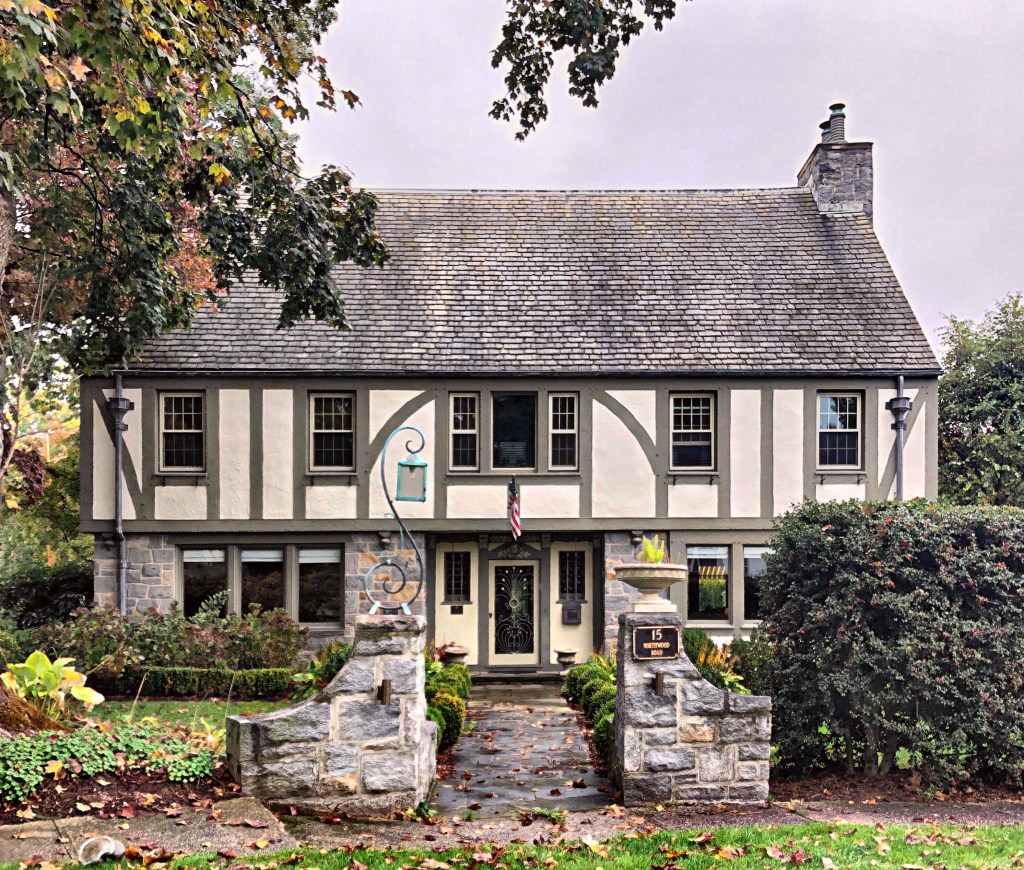
Herbert Almon Chaffee and Irma Chaffee had this Tudor home built by 1931 for their family in Fairfield, Connecticut. Mr. Chaffee was the Vice President and Assistant Treasurer of the City Savings Bank of nearby Bridgeport. Chaffee also at that time worked as Vice President of the A.W. Burritt Company, a lumber mill that produced building supplies and also operated as a real estate company that bought land and constructed on it. The home he had built clearly showcased the company’s work and features hallmarks of the English Tudor Revival style, with half-timbering, slate roof, and jettying (upper floor slightly overhanging the first).



 Buildings of New England