Elijah Emerson Double House // 1884

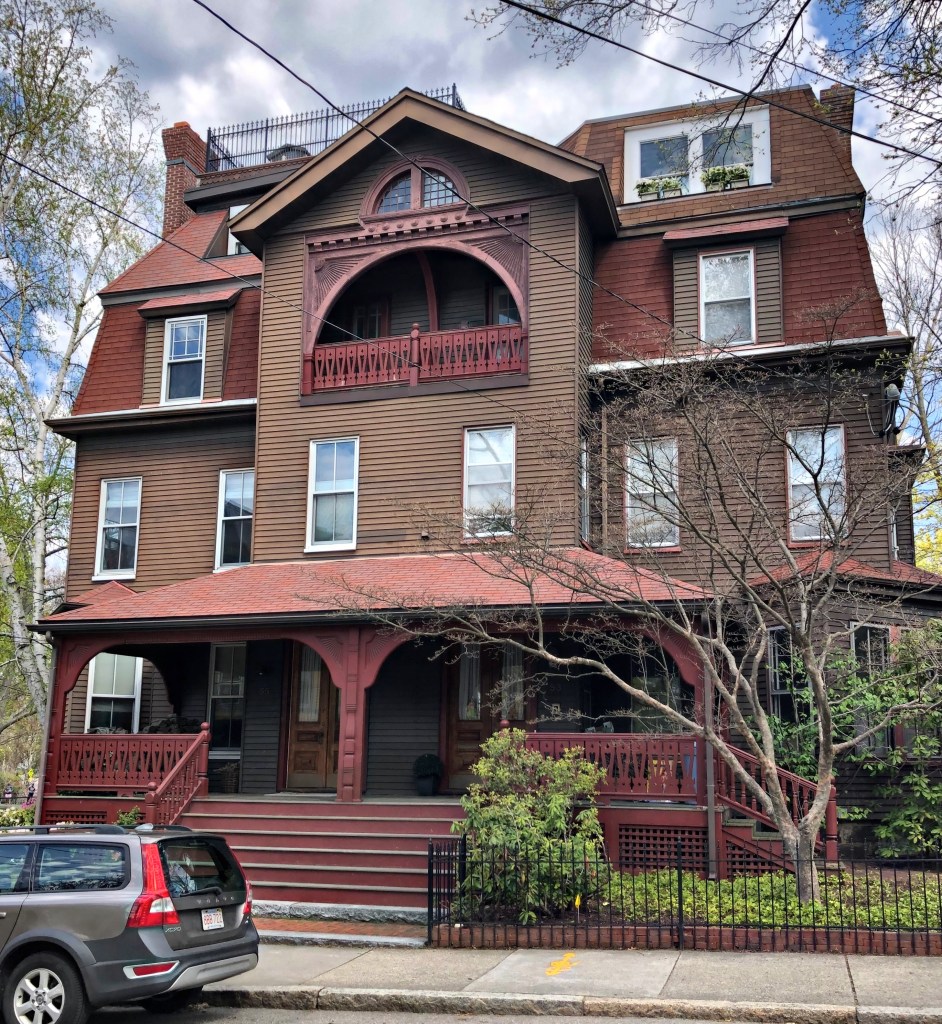
Brookline Village is full of amazing double houses (or duplexes) built in the late 19th century. Many feature Queen Anne detailing and are architecturally striking with porches, complex rooflines, and trim details. This example was built in 1884 by Elijah Emerson, who had an estate nearby. His house was originally located where the park, Emerson Garden is located, but it was moved across the street. He had this double house built and rented it out to middle-class families who flocked to the neighborhood for the ease of access to Downtown Boston, while maintaining a bucolic feel (why many still today move to Brookline). Even though it is covered in aluminum siding today, the original wood clapboards and trim likely are waiting underneath to be revealed someday. But for today, we can gawk at the original details that are visible, including the semi-circular window, recessed porch with decorative balustrade, and porch with original entry doors.

George Carpenter House // 1885

While many lots in Brookline village in the final decades of the 19th century were being redeveloped as duplexes, three-deckers, and apartment houses, some property owners still wanted single-family living. In 1885, George Carpenter had this home in the village built from plans by well-known architect Obed F. Smith, who designed many Victorian-era homes in Boston’s Back Bay and around the region. George Carpenter worked in Downtown Boston as an agent for the Massachusetts Mutual Life Insurance Company. The house features some Stick style elements seen in the porch spindles and carved brackets.

Hoar House // 1891

This house in West Acton is the last in this batch of Queen Anne style Victorian houses I’ll feature in the village. The dwelling was built in 1891 for a 31-year-old John Sherman Hoar, Jr. (1860-1954) and his new wife Minnie R. Hart. John was a master carpenter and built many of the Queen Anne style homes on Windsor Street and later Colonial Revival and Craftsman homes in the 1890s and 1900s himself. This was his own property which once included a workshop where he cut and manufactured many homes on the street. Today, the Hoar House has a cheery pink color scheme (which while not historically appropriate) brought a smile to my face when strolling by!

Arthur Blanchard House // 1892

I do not feature enough Queen Anne style buildings on my account, as penance, I present this beautiful example of the style with a painted lady color scheme! Located on Windsor Avenue in West Acton, Massachusetts, this house was built in 1892 and has all the hallmarks of the Queen Anne style. The use of varied siding materials and forms, asymmetrical form, applied ornament, and large five-sided tower capped by a conical slate roof with weathervane. The home was built for Arthur F. Blanchard, a local businessman who operated an apple farm and marketing business opened by his father. Mr. Blanchard was a philanthropist in town and used his wealth to enhance his hometown by funding the Blanchard Auditorium at the Acton High School (1925) and was a benefactor of the West Acton Women’s Club in 1925. He and his son, Webster, also founded the Blanchard Foundation in town in 1946, an organization which funded and sponsored educational projects for the community.

Oliver Mead Mansion // c.1870

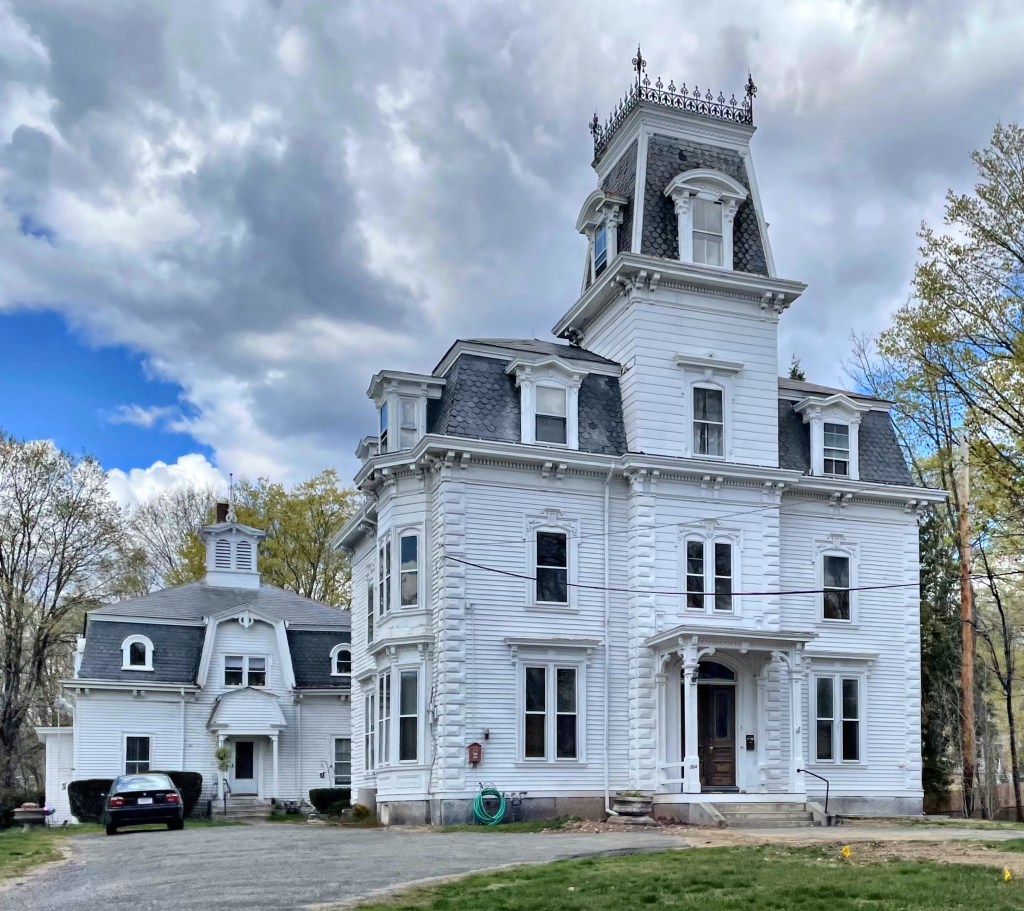
Acton, Massachusetts is one of the more underrated Massachusetts towns for great old buildings, many of which are well-preserved and taken care of by their owners. The Oliver Mead Mansion in West Acton Village is among the largest in this part of town and is a stellar example of the Second Empire style. The house and adjacent carriage house was built around 1870 for Oliver Mead (1823-1912), who co-owned the A. O. W. Mead Company with his two brothers, a successful produce marketing company where they sold poultry, eggs, cheese, fruit, and other goods from farms in Acton and Boxborough to their shop on Market Street in Downtown Boston. The company did well, and Oliver and his brother Adelbert built matching mansions in West Acton after the Civil War and business picked up. The house exhibits a central projecting tower bordered by quoins and topped by a mansard roof with iron cresting on top. The original carriage house remains in a great state of preservation as well. The Adelbert House and Carriage house nextdoor were demolished in the 1950s for the fire station on the site.

Sawyer Mansion // 1863 & 1914

Originally built in the Carpenter Gothic style in 1863, the Sawyer-Gillett Mansion in Whitingham, Vermont, is the highest-style house in town today. Indistinguishable from its Civil War-era original construction, the house was greatly expanded and altered into an elaborate take on Queen Anne / Shingle styles in 1914. The house was originally constructed by John W. Sawyer, but it was his son, Lincoln H. Sawyer who renovated the house and etched his name “L.H. Sawyer” on the glass of the new front door. The updated house style reflects a nostalgic Victorian preference by the owner, who sawed all the trim and materials on site at the family sawmill. It was recently sold and is now a B&B!

Wheeler-Jillson Store // c.1905

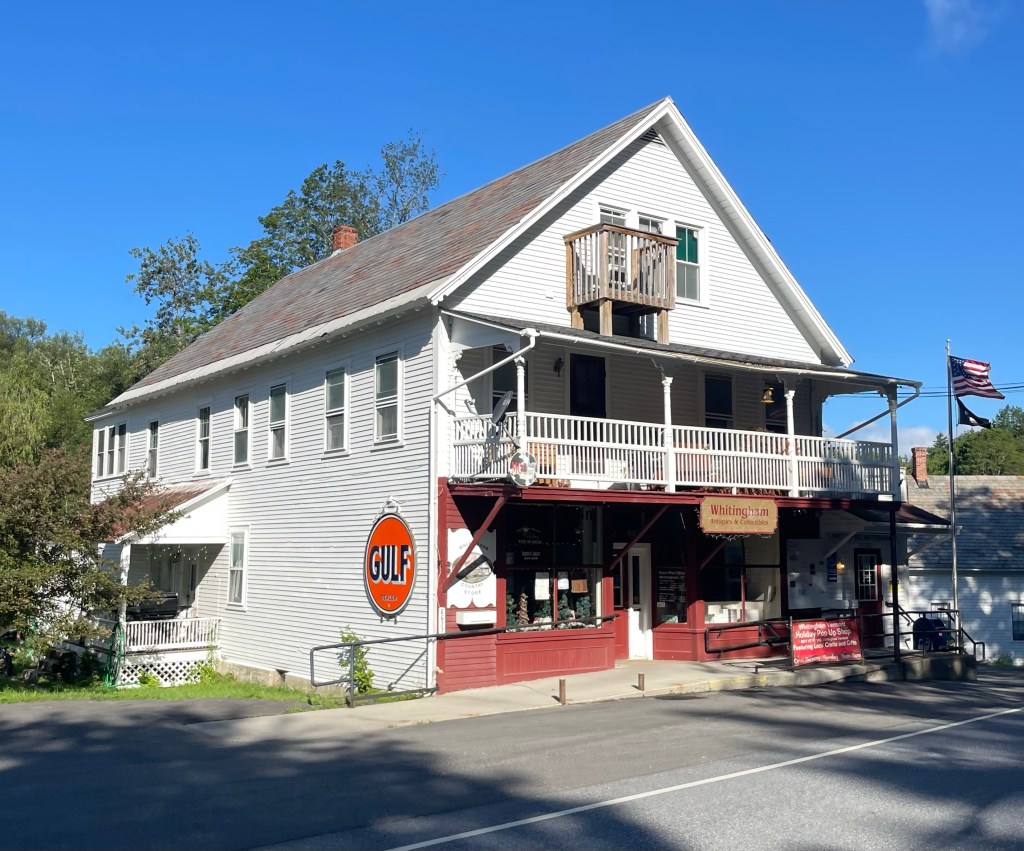
To me, Vermont is synonymous with Vernacular architecture. The state obviously has high-style and architect-designed buildings all over, but the character of the state (to me) is based around local builders, local materials, and local traditions. The patchwork of towns and villages in Vermont all have one thing in common, at least one general store. These buildings serve as an informal meeting place or community center where residents and visitors alike can hear the local gossip and events taking place. The general store in Whitingham, Vermont is located in the middle of the village, perfect for stopping in. The building was constructed in the first decade of the 20th century, replacing a former hotel/tavern on the site. The late-folk Victorian style store exhibits some decorative columns and storefronts, likely produced at one of the working lumber mills in town at the time. The store was originally built by Arthur and Carl Wheeler as the “Wheeler Brothers Store” but after 15 years changed hands and became the “F.W. Jillson & Son Store”. Since then, the Jillson’s opened up an antique store in the building which serves as a multi-use facility (collectively as a country store). Keep it local Vermont!

Franklin Street Fire Station // 1886

When your town grows organically without zoning, fire prevention becomes even more important to the preservation and protection of the town. Before paid firemen worked for the town, volunteers would either be stationed or rush to the aid of those in trouble via these neighborhood stations. The Franklin Street Firehouse in Marblehead, Massachusetts, was constructed in 1886 by local contractors Ramsdell Brothers replacing the former on the same site with plans drawn by Nathan P. Sanborn. The station was built to house a horse-drawn handtub and the horses were stabled nearby. The wood-frame structure blends Second Empire and Stick style detailing elegantly and is one of my favorite old buildings in Marblehead.

Lorenzo and Mary Hawkins House // c.1870

Another of the charming mini mansard cottages in Stoneham, Massachusetts is this home, the Lorenzo and Mary Hawkins House. The home was built for Lorenzo D. Hawkins and his wife, Mary around 1870. Lorenzo worked as a shoe and elevator manufacturer in town and in Downtown Boston. The house is a two-story wood-frame structure with irregular massing. It has the classic mansard roof, an ornately decorated entry porch, heavily bracketed cornice, and round-arch windows in its dormers and front bay.

E. A. Durgin House // 1870

Would you just look at this house?! Massachusetts may have the most Second Empire/Mansard style houses in the United States, but some really stand out. This home in Stoneham, Massachusetts was built around 1870 for local shoe dealer Erastus A. Durgin. The mini mansard home is pretty typical besides the prominent square tower with a steeply pitched gable roof that stands over the entrance. Charming!