Old Brooklyn Savings Bank // 1928

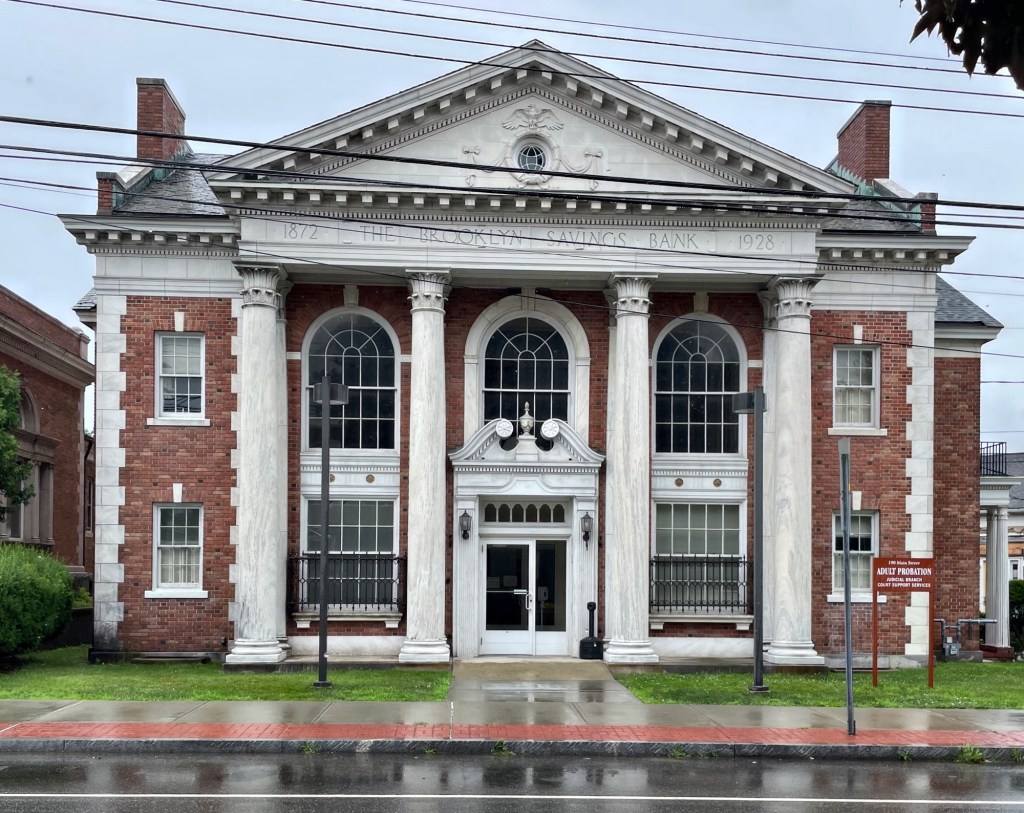
One of the most intact and architecturally significant buildings in Killingly is this stunning example of a bank built in the Georgian Revival style. Located on Main Street in the village of Danielson, the former Brooklyn Savings Bank was designed by the New Haven-based architectural firm of Norton & Townsend for the Brooklyn Savings Bank, which was founded in the adjacent town, Brooklyn, in 1872. The bank relocated to the economic center of the two towns, Danielson, in 1915, later building this landmark bank structure as its primary facility. The two-story bank is covered in red brick with elaborate limestone and marble trim and detailing, showcasing the wealth and stability of the banking institution for potential members. The façade features a two-story pedimented pavilion, round arched windows, and an elaborate swans neck pediment over the door. The structure has been very well-preserved in its nearly 100 year existence and now appears to be the home of a state judicial court.  

James Roope House // 1916

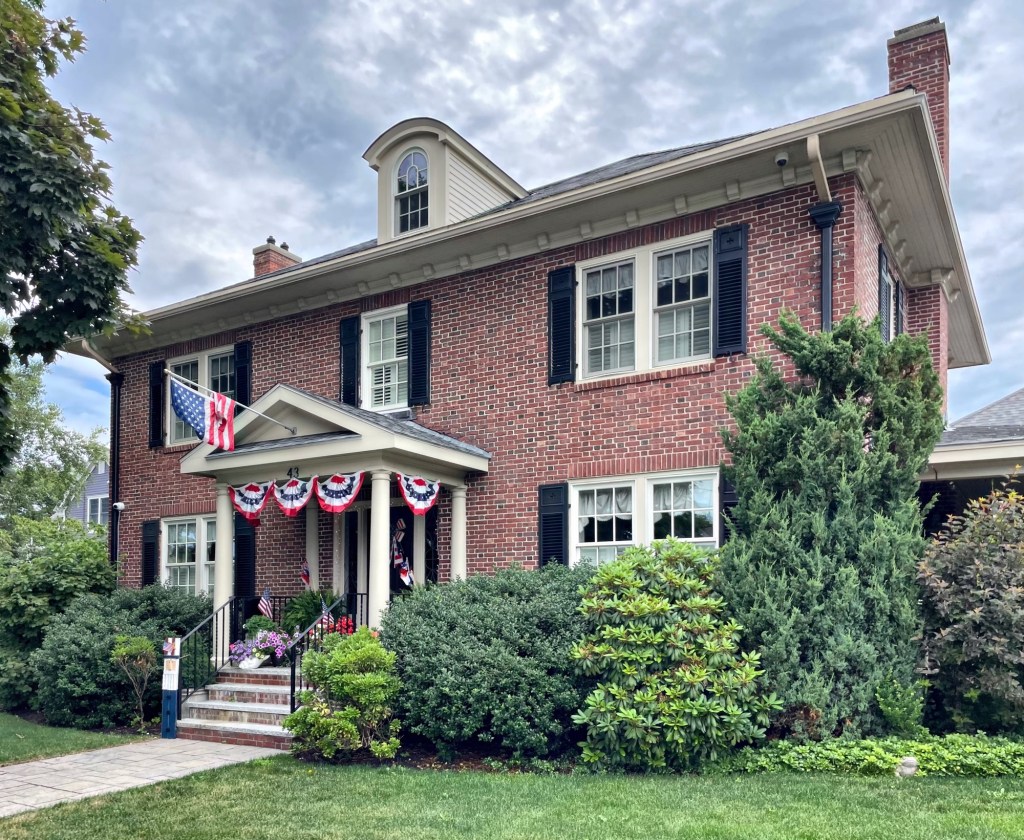
The only historic brick residence located in the charming Salem Willows neighborhood of Salem, Massachusetts is this stately Colonial Revival house at the corner of Bay View and Juniper avenues. The brick dwelling was constructed in 1916 for James Roope, President and Treasurer of the Salem Lumber Company. Designed by Boston architect, Gordon Robb, it is two stories high, with a shallow hipped roof. The central entry has leaded sidelights and a pedimented porch with trellises at the sides.

Rockport Opera House // 1891

Built in 1891, the historic Rockport Opera House is located in the heart of Rockport Village overlooking picturesque mid-coast Maine harbor. The Opera House here was actually first built as a multi-purpose Town Hall and library by a F. E. Gilkey, possibly a local builder. Over the years, the Colonial Revival style building has also served as a town meeting space, theater, concert hall, and Y.M.C.A., complete with a basketball court and bowling alley. In the 1970s, the building had deteriorated such that the Town considered selling it or tearing it down. The women of the Rockport Garden Club led the effort to save and restore the building. An outpouring of local support and a grant from the Maine Commission of the Arts and Humanities enabled the building to be revitalized as the Rockport Opera House. The significant structure continues to host the annual town meeting and regularly hosts town committee and other public meetings.  It is also the home venue of the Bay Chamber Concerts, as well as other musical events, theater performances, wedding receptions, conferences, and other private functions. Preservation at its finest!

Wightman-Pope House // 1910

In 1910, Ralph Linder Pope (1887-1966) graduated from MIT and later became Chairman of the Board of Directors of the Northwestern Leather Co., Boston. He married Elizabeth S. Wightman two years earlier and her father, George Wightman, purchased a house lot near his own 1902 mansion in the Longwood section of Brookline, Massachusetts and had this brick residence built in 1910 for the new couple. Mr. Wightman commissioned the famed architectural firm of Shepley, Rutan & Coolidge to design his daughter’s home in the Colonial Revival style.

Phinney-Bigelow House // c.1899

Before the turn of the 20th century, William L. and Elizabeth G. Phinney purchased a narrow house lot at the corner of Hawes and Chatham streets in the desirable Longwood neighborhood of Brookline. They then retained the young architect Thomas Marriott James, to design this massive Federal Revival style mansion. After William died in 1911, Elizabeth remained in the house until 1920, when it sold to C. Willard Bigelow a wool dealer and his wife, Ruth. The Phinney-Bigelow House is an exemplary Federal Revival style house on a narrow lot which takes full advantage of its boxy form. The slightly asymmetrical facade with Palladian window, limestone trimmings, and bold entrance are all great additions to the design.

McInnis House // 1901

Located next door to Ms. Matchett’s house on Chatham Street in the suburban Longwood neighborhood of Brookline, Massachusetts, you will find this very unique example of a Colonial Revival style single-family home. Built by 1901 for lawyer Edwin G. McInnis (sometime spelled McInnes) and his wife, Mabel, the house is high-style Colonial Revival with symmetrical facade, rustication, two-story Corinthian pilasters framing the bays, Palladian window, and Federal style entry with fanlight transom. No records of the architect could be located sadly.

Sarah Bennett Matchett House // 1905

In 1905, Sarah A. Bennett Matchett (1833-1910), a widow, purchased a desirable house lot in the Longwood section of Brookline, Massachusetts. She inherited a large fortune upon the passing of her husband, William F. Matchett (1832-1901), who was the long time treasurer of the Boston and Roxbury Mill Corporation. The couple had no children, but she watched over her nieces and nephews following her brother’s death. Ms. Matchett hired architects Arthur Everett and Samuel Mead to design a large Colonial Revival style home on the lot, which was then built in 1905. Upon her death in 1910, she willed each of her four nieces and nephews $25,000 (roughly $800,000 (a piece) adjusted for inflation to today. She also willed $200,000 to Harvard College and funds to Massachusetts General Hospital and the Massachusetts Society for the Prevention of Cruelty to Animals. After her death, her Brookline residence was inherited by her eldest niece, Helen Maud (Bennett) Richardson and has been lovingly maintained over 110 years later!

Benjamin Green House // 1927

Located on Beech Road overlooking the “village common” of Longwood Mall, this 1920s Georgian Revival mansion showcases the curb appeal and perfect siting of suburban houses of the period . The home was built in 1927 for Benjamin Green, a real estate dealer and his family. The Green’s hired architect Harry Morton Ramsay, a noted area architect who specialized in suburban single-family homes of this period, to design the Georgian Revival style home. The brick residence features a symmetrical facade, half-round portico with Corinthian columns, round arched first floor and dormer windows, and decorative brickwork.

George G. Quincy House // 1909

If you love Colonial Revival style homes, the Longwood neighborhood in Brookline is a must-visit area to stroll around! This house is tucked away in the neighborhood and was a treat to stumble upon. This large home was designed by the underappreciated architect, James Templeton Kelley for a George G. Quincy. The Colonial Revival style dwelling is actually built of wood with a brick veneer and has an open pedimented entry with fanlight and transom surround. The round-headed windows on the first floor are especially notable.

Pope-Gardner-Robbins House // c.1870

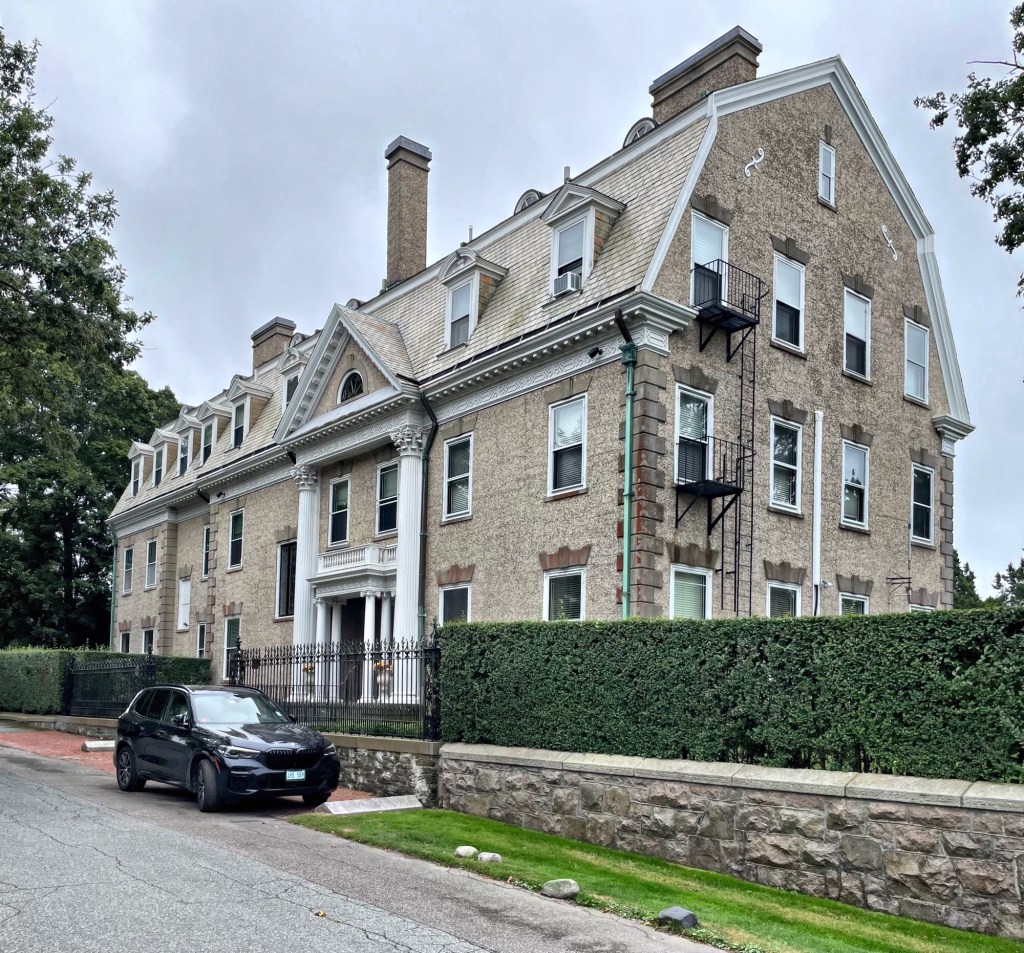
Historians date the bones of this house in the Longwood section of Brookline, Massachusetts to the 1870s (or earlier), but its present appearance is definitely from the early 20th century. This is the Pope-Gardner-Robbins House on Colchester Street, a lovely span of stucco-sided homes in one of my favorite neighborhoods in the Boston area. An early (1874) map of the area shows this was the home of T. B. Pope, and later purchased by Harrison and Laura Gardner, husband and wife. Harrison Gardner was a founder (and served as treasurer) of the Boston Red Stockings of the new National Association of Professional Base Ball Players (NABBP). The Red Stockings eventually became the Boston Braves baseball team and are now the Atlanta Braves. The multi-lot property was likely rented by Gardner for supplemental income and was eventually sold to Annette R. Robbins, who seemingly had this home renovated in the 1920s and others nearby built or renovated as well. The house is today an excellent (and fairly uncommon) example of a Colonial Revival style house with stucco siding.