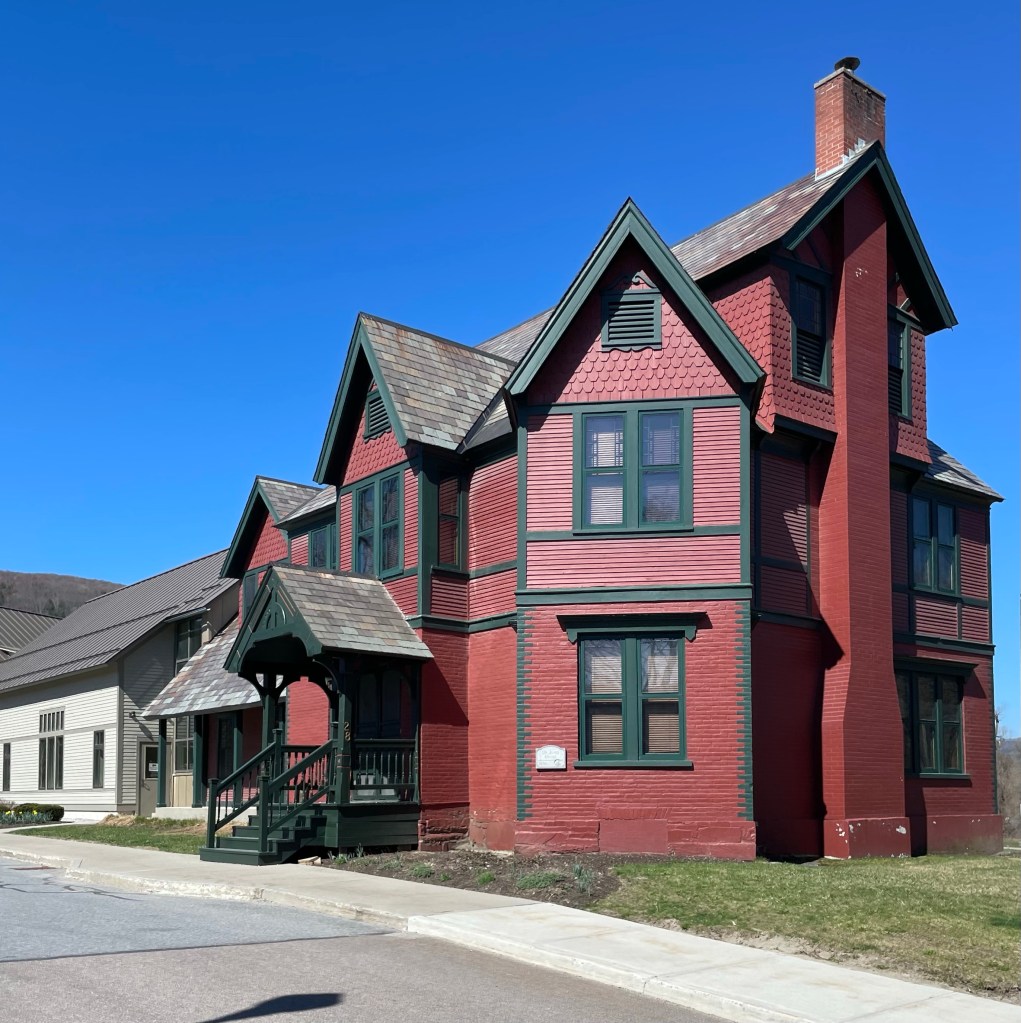
Dr. Henry Janes House – Waterbury Municipal Center // c.1890

Probably best known for being in charge of all the military hospitals in the Gettysburg area after the bloodiest battle of the Civil War, Waterbury, Vermont native, Dr. Henry Janes (1832-1915) had a decorated career and gave much to his country and hometown. Janes attended local schools before enrolling at St. Johnsbury Academy, later graduating from New York City’s College of Physicians and Surgeons in 1855. After a few years working in NY and MA, he moved back to Waterbury to take up a private practice. This was disrupted by the Civil War where he was a major surgeon on the front lines and had over 250 surgeons under his command. After returning home from the war, Dr. Janes was involved in politics and business, and had a home built in town. According to local historians, this present home of Janes was built in 1890, but it definitely could date to the 1870s with Stick style features. Upon his death, the Dr. Janes home was gifted to the town for use as a public library. When Tropical Storm Irene hit the region in 2011, the town offices were destroyed and Vermont Integrated Architecture was hired to expand the Janes House adding space for town offices, meeting space, a modern library and to reconfigure the historic home for the Waterbury Historical Society. Everything about this is perfect, down to the paint colors!
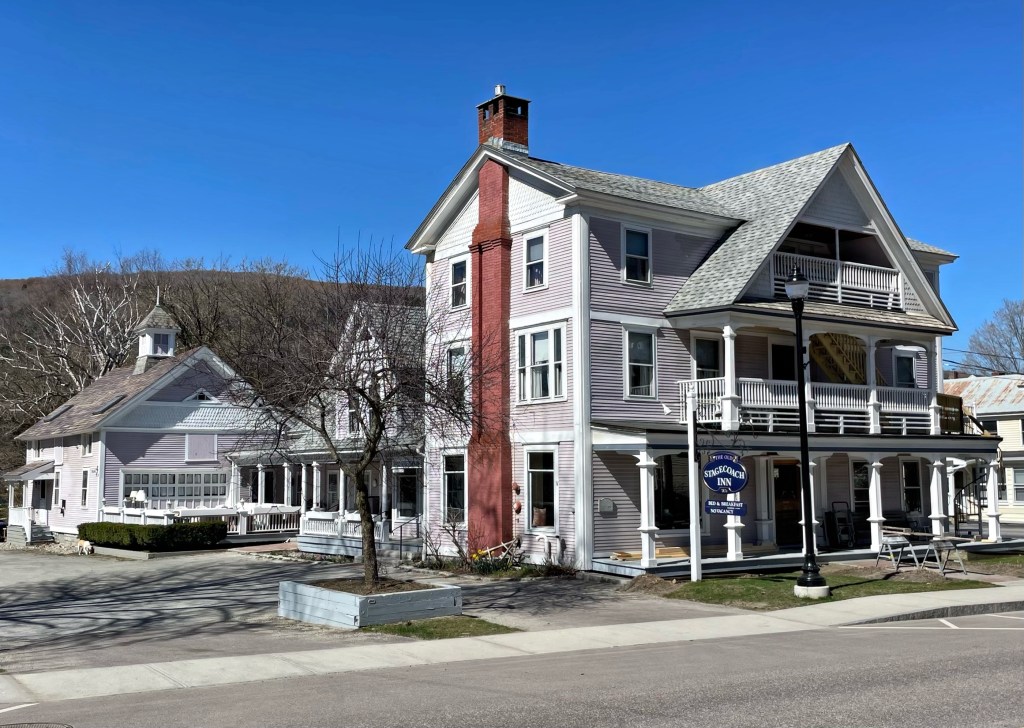
Stagecoach Inn // 1826

Built by the Carpenter brothers in Waterbury, who also designed and built the neighboring Congregational Church (last post), this large structure was a stagecoach stop on the road to Stowe for much of the nineteenth century. Briefly, the Inn served as a private residence for Albert and Annette “Nettie” Spencer. Nettie grew up in Waterbury and married Albert who owned rubber factories in Ohio and invested in real estate in Burlington. At one time, the Spencers’ residences included their Waterbury house, a suite at the Waldorf Astoria in New York City, a house in Newport, an apartment in Paris, as well as one in London. Albert died in London, and Nettie continued living in Waterbury until her death in 1947, approaching 100 years of age. Within a year, the property was sold and the owners reopened the main house as a sort of boarding house. The property was restored and operates today as the Old Stagecoach Inn.

Roswell B. Fitch House // c.1850

Roswell Burrows Fitch (1833-1908) was born in the seaside village of Noank to parents Elisha and Mary P. Fitch. At twelve years of age he commenced to be self-supporting, and from then until he was fourteen, occupied a clerkship in a general store in town. In his teens, summers were spent aboard ships fishing for a livelihood, and his winters attending school. Upon completing his education, he became clerk in a store, and was afterwards engaged to assume the management of a union store which was erected for the special purpose of being placed under his charge. The store, located on Main Street in Noank, was eventually fully purchased by Fitch, and he did well financially. He may have had this house built or merely bought it years after it was built in the mid-19th century. When he sold his business in 1890, he “Victorianized” the classically designed Greek Revival style house with Queen Anne embellishments. The renovations in 1890 included an octagonal tower, an elaborate porch, a two-door entry likely replaced the sidelights and transom, brackets and applied decoration at the gable and cornice, and a Palladian window which was a Colonial-inspired addition. Hodge-podge or eclectic houses are some of the most fun!

Former Noank Methodist Church // 1902

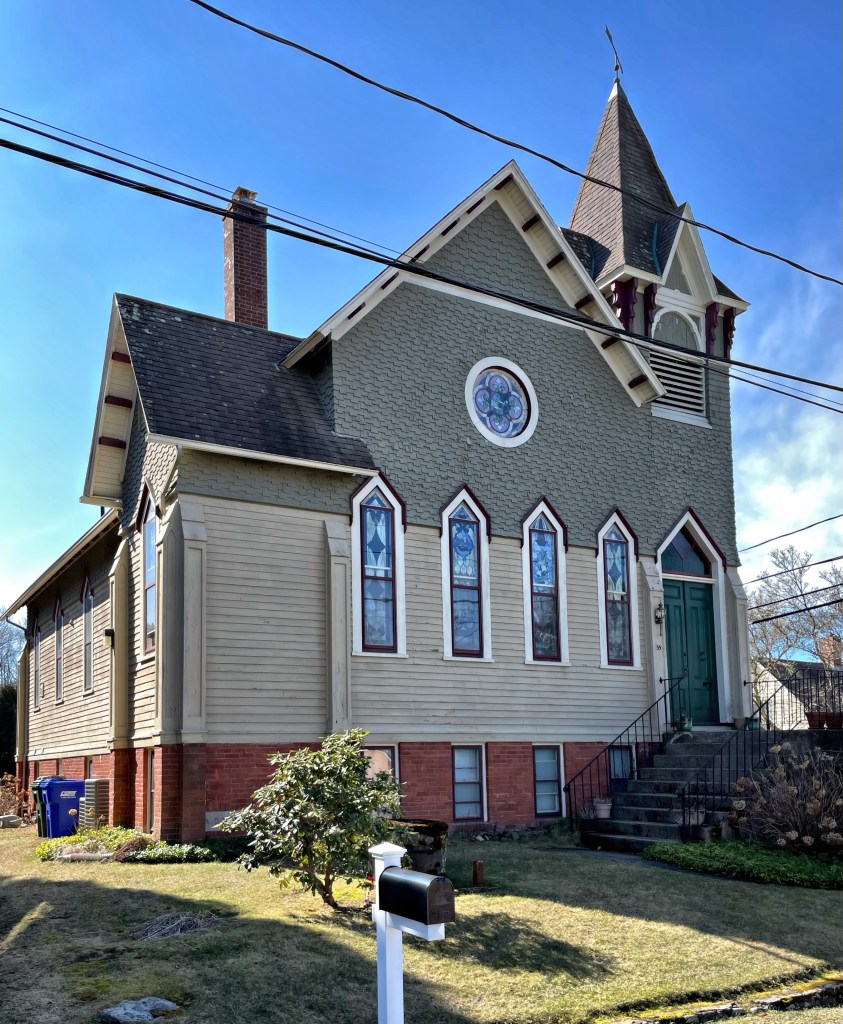
Adaptive reuse of old buildings always makes me so happy to see! Besides the obvious benefit of preserving an old building which contributes to the history and character of an area, there are clear environmental benefits to renovating older buildings for new uses when older uses are no longer viable. In 1902, the village of Noank was bustling with workers in the shipyards, many of whom attended or hoped to attend religious services close to home rather than travelling to adjacent towns. As a result, the local Methodist church-goers had this building constructed. Architecturally, the building is a hodge-podge of styles with interesting lancet windows as a nod to the Gothic style, shingle and clapboard siding which reads Queen Anne. The Noank Methodist Church merged with the Groton Methodist Church to form Christ United Methodist Church, which moved to a new building in 1972. The former church was converted into a residence. Preservation wins!

Pembroke Hall – Brown University // 1896

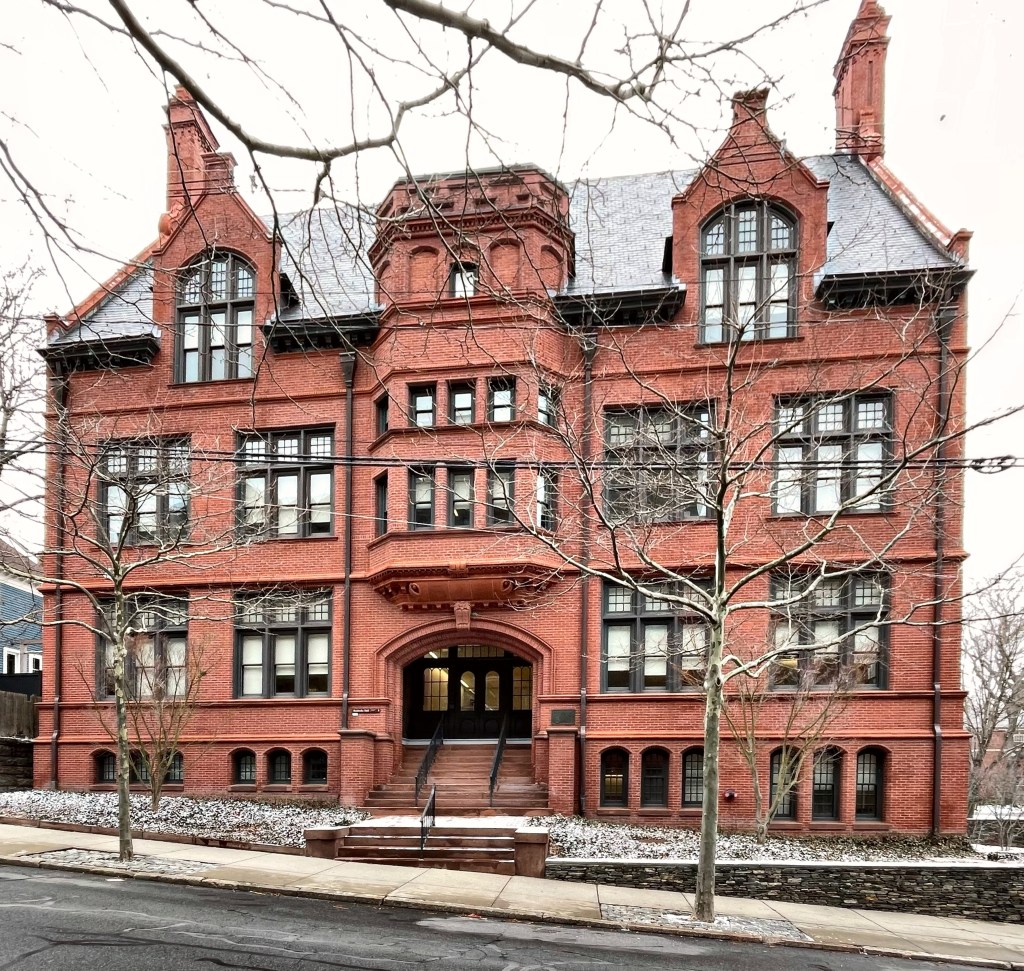
Brown University from its founding in 1764 until 1891 never admitted women. Brown’s all-male student body was first challenged in 1874, when the university received an application from a woman (who to this day is still unnamed). The Advisory and Executive committees decided that admitting women at the time was not a good proposal, but they continued to revisit the matter annually until 1888, when they began work to establish a separate women’s college affiliated with Brown. After similar institutions like Radcliffe (affiliated with Harvard) and Barnard College (affiliated with Columbia) were established in 1879 and 1889 respectively, Brown had a blueprint for how to operated the new women’s college. Professors at Brown would work alongside women educators and taught many of the the same courses to men as they did for female students. Pembroke Hall was the first building for Pembroke College and was built in 1896 from plans by local firm Stone, Carpenter and Willson in the Elizabethan Revival style. The building was designed to be multi-purpose with administrative offices, classrooms, reception rooms, and a library in the attic. Pembroke College was officially merged with Brown University in 1971, which was long overdue. The building is one of the finest on Brown’s now co-educational Ivy-league campus.

The Atherton // c.1890

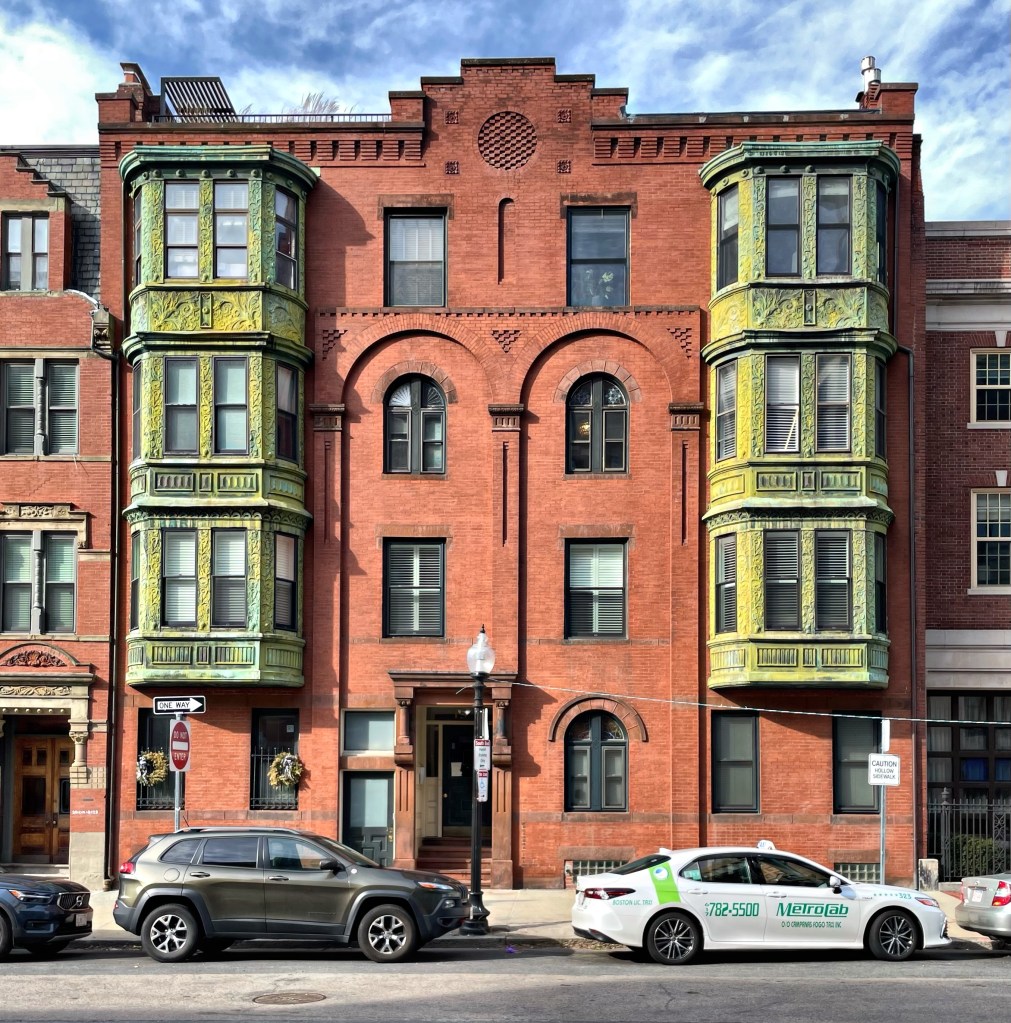
About ten years after the nearby Carlisle building (last post) was completed by owner Jonas Gerlusha Smith (1817-1893), he began construction on another large, apartment hotel next door. He again retained architect Arthur Vinal, who was acting City Architect for the City of Boston to furnish the plans on the building, which would be attached to the older portion which fronts Gray Street behind. The building is extremely well-preserved and has some stunning metal bays with decorative details which really pop!

The Carlisle // 1880

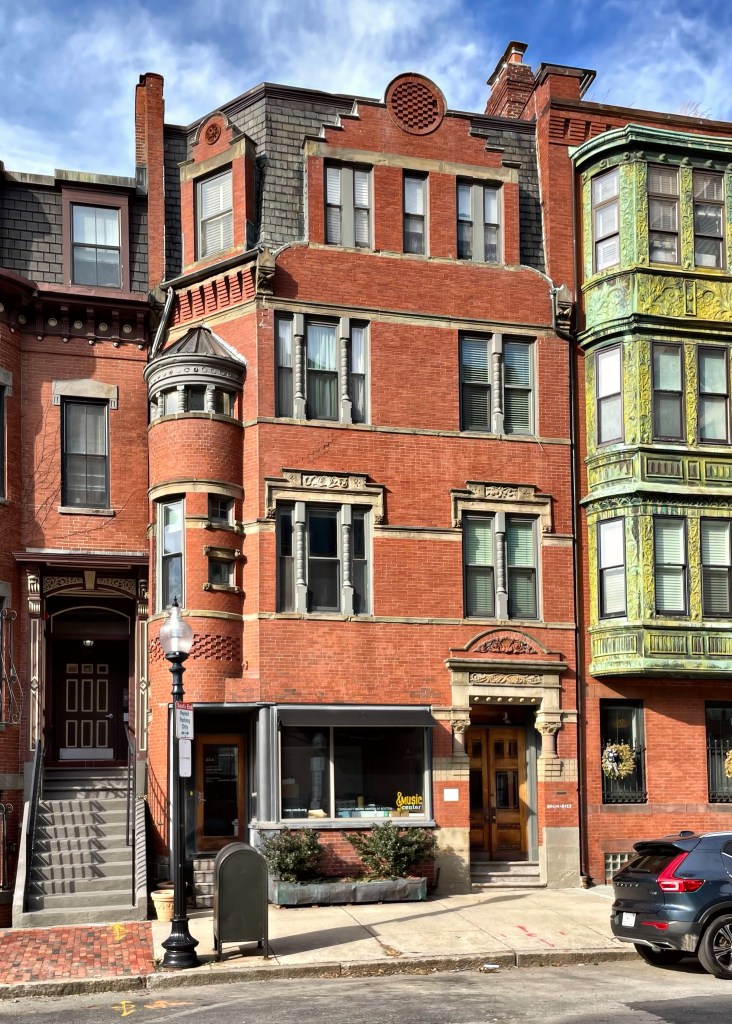
In 1880, Jonas Gerlusha Smith (1817-1893) received a permit to erect a multi-family apartment building on Warren Avenue in present-day South End. The lot was close to his personal residence at 13 Warren Avenue and would have been easy to maintain and oversee tenants in the building. Mr. Smith hired 26-year-old architect Arthur H. Vinal, who furnished the plans for the handsome Queen Anne building. Vinal would later become the City Architect of Boston from 1884 to 1887, designing the High Service Building at the Chestnut Hill Reservoir just seven years after this building. By the late 1880s, the building was known as The Carlisle and it remained in the Smith family holdings under Walter Edward Clifton Smith until the 1930s. Walter attended the Cambridge Episcopal Theological School and later worked at various churches in the Boston area, serving as pastor in his later years. He lived on Follen Street in Cambridge while he held the Carlisle for additional income. Under new ownership in 1950, a retail storefront was added to the first floor which was occupied as a florist for some years. In 1979, after years of deferred maintenance, the property was purchased by Louis G. Manzo and his son David W. Manzo, who meticulously restored the building over time into the time-capsule that it is today!

Harrishof Houses // 1899 & 1900

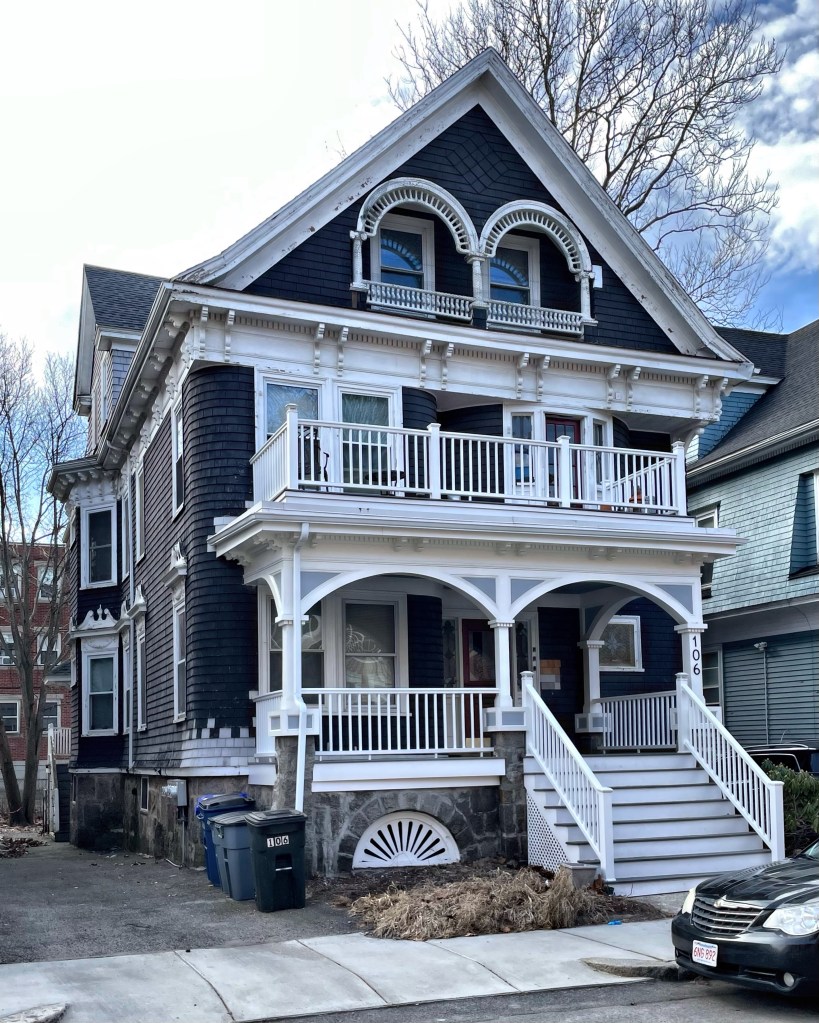
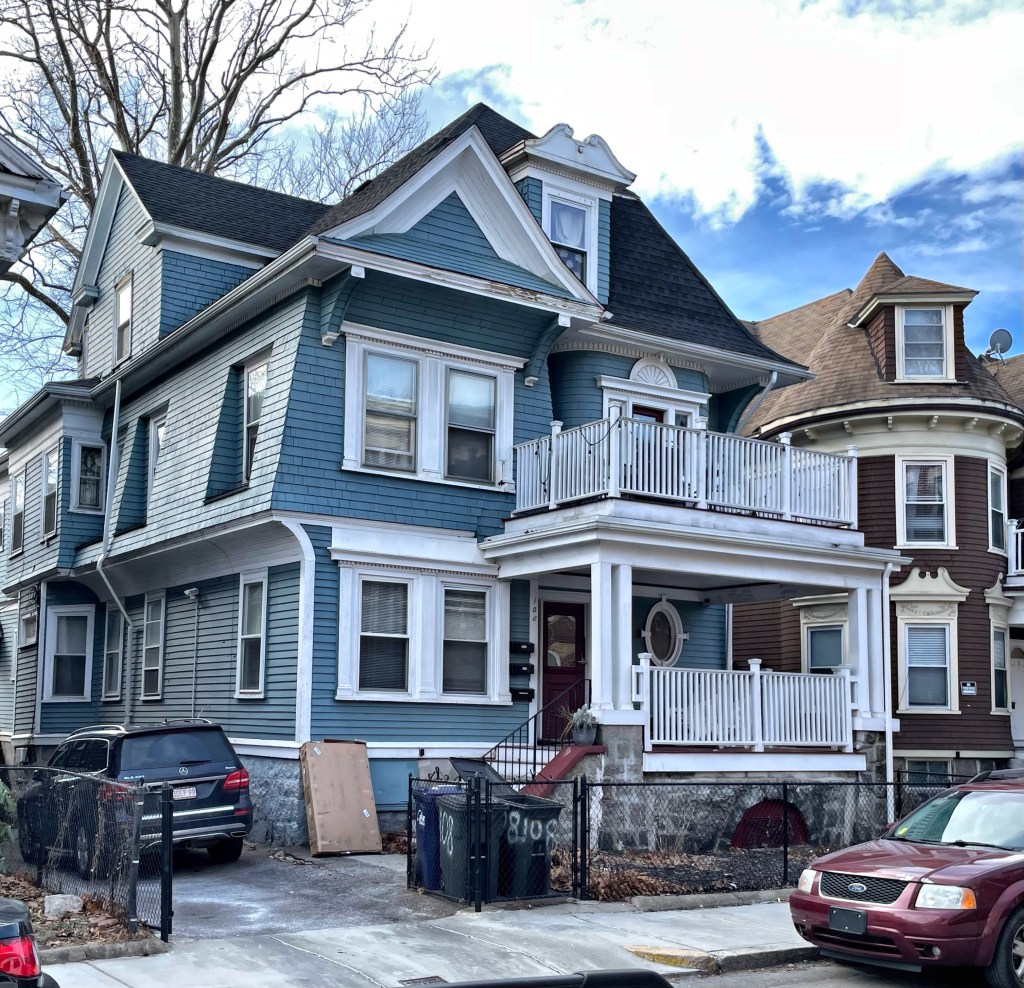
I think I found it… My favorite street in Roxbury. Harrishof Street is a surviving streetscape that shows the beauty and potential of the Washington Park district of Roxbury, a surviving span of houses that dodged the wrecking ball during a period of Urban Renewal. This section of the street runs a stone’s throw from the ruins of the 1857 Horatio Harris Villa (featured previously) and was laid out by Horatio’s heirs who developed the former sprawling estate into multi-family housing, to cash in on suburbanization caused at the turn of the 20th century thanks to electric trolley lines in the neighborhood. The development is credited to Alexander Colin Chisholm (1868-1941), a Canadian-born architect and developer who grew up in Roxbury. He specialized in small residential enclaves of similar houses, including these houses on Harrishof Street, and later on Elm Hill Park. The two-family houses blend Queen Anne and Colonial Revival styles in such a fun way that pushes the boundaries of academic architecture. The houses on the street are all slightly different and have had varied alterations over time, but this is a great candidate for a historic district!

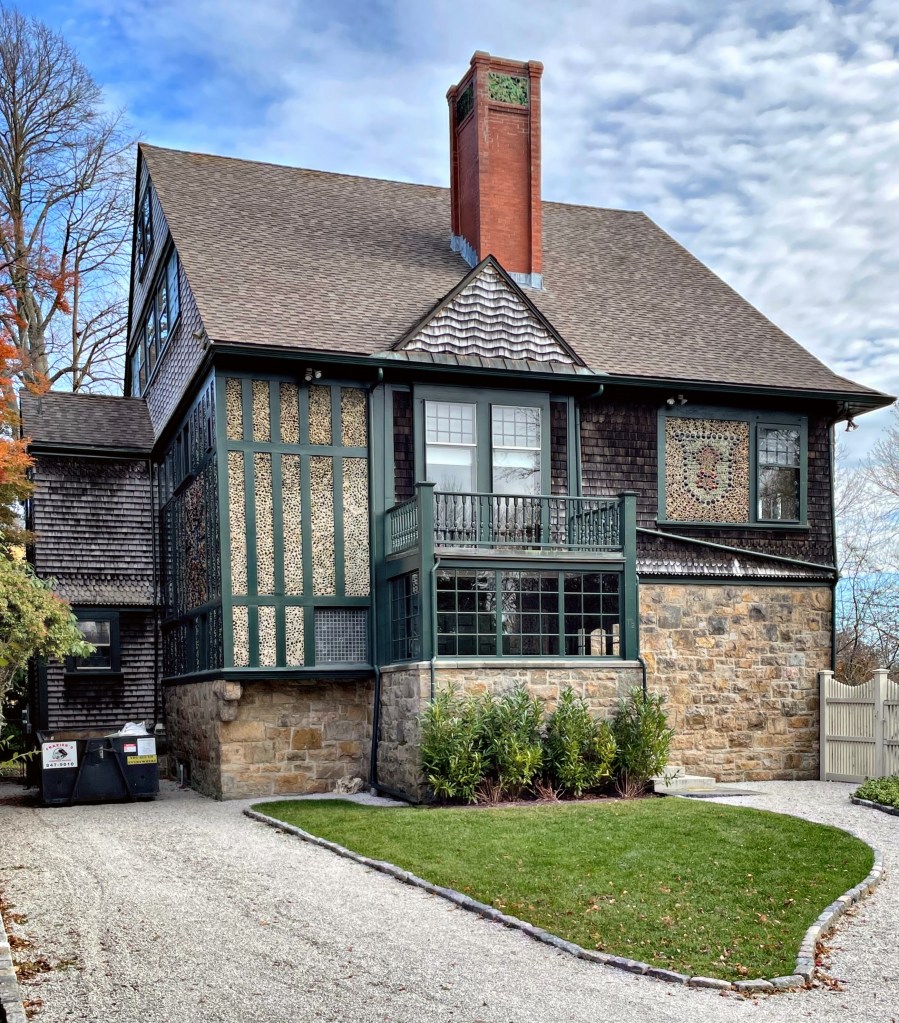
Samuel P. Tilton Cottage // 1880

One of the most well-designed and least-pretentious summer cottages in Newport is this charming dwelling on a dead end street. The Samuel P. Tilton Cottage was designed in 1880 by the prestigious firm of McKim, Mead & White as an idiosyncratic blending of Queen Anne and Shingle architectural styles. Mr. Tilton was a milliner (maker and seller of women’s hats) with stores in Boston and Paris, France. He had this cottage built to summer close to the nation’s wealthiest, likely marketing some hats at elaborate Gilded Age events. The facade is assertively Queen Anne with its massing and decorative panels, with shingled side elevation seemingly sprouting from the earth. The architectural terminology for these unique decorative panels is “sgraffito” where here, cement or plaster siding is set and adorned with shells, pebbles, colored glass, and pieces of coal into a cartouche design. The house is one of the finest in Newport, and shows that bigger isn’t always better!

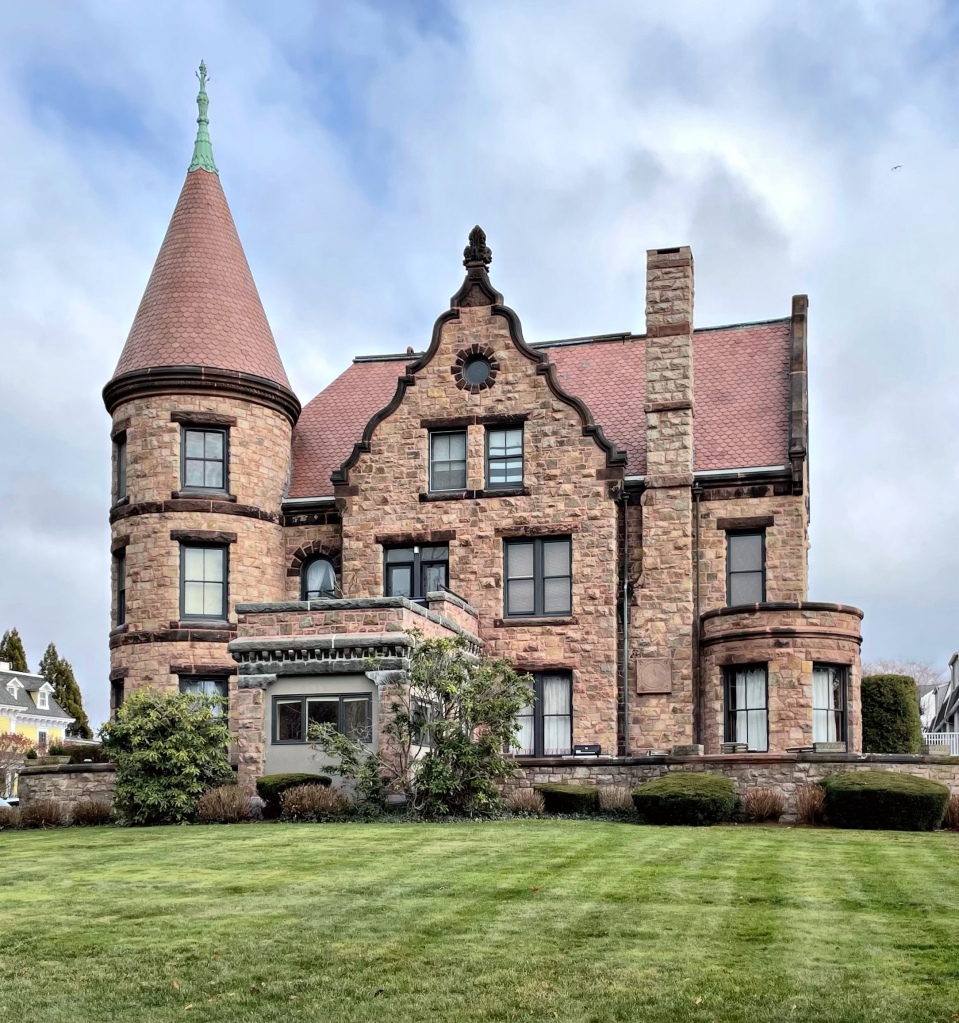
De La Salle // 1884

The Weld family has long been a prominent family in Boston, with ancestors dating back to the 17th century in New England. One of these men was William Fletcher Weld, a merchant, later making investments in railroads and real estate. By the time of his death in 1881, he had an estate of approximately $20 million, or more than half a billion in today’s dollars, and he left nearly all of it to his family. His eldest son, William Gordon Weld II, received a large inheritance and he began construction on this summer “residence”cottage” in Newport. The house was designed by local architect Dudley Newton, who had the estate built of locally-quarried granite. Architecturally, the dwelling is eclectic in style with Dutch Renaissance gables with conical roof forms seen typically in Queen Anne and Romanesque buildings. Weld spent his summers here for over a decade until his death in 1896. His widow Caroline, summered in the mansion until her death in 1918. By this point, Newport was beginning to fall out of favor as a wealthy resort community, and the many Gilded Age mansions were increasingly viewed as costly white elephants from a previous era. This property was sold by the Weld family in the early 1920s and became the De La Salle Academy, a Catholic school for boys, and remained in use until it closed in the early 1970s. After the school closed, the mansion was converted to condominiums and some townhomes were built on the expansive property.