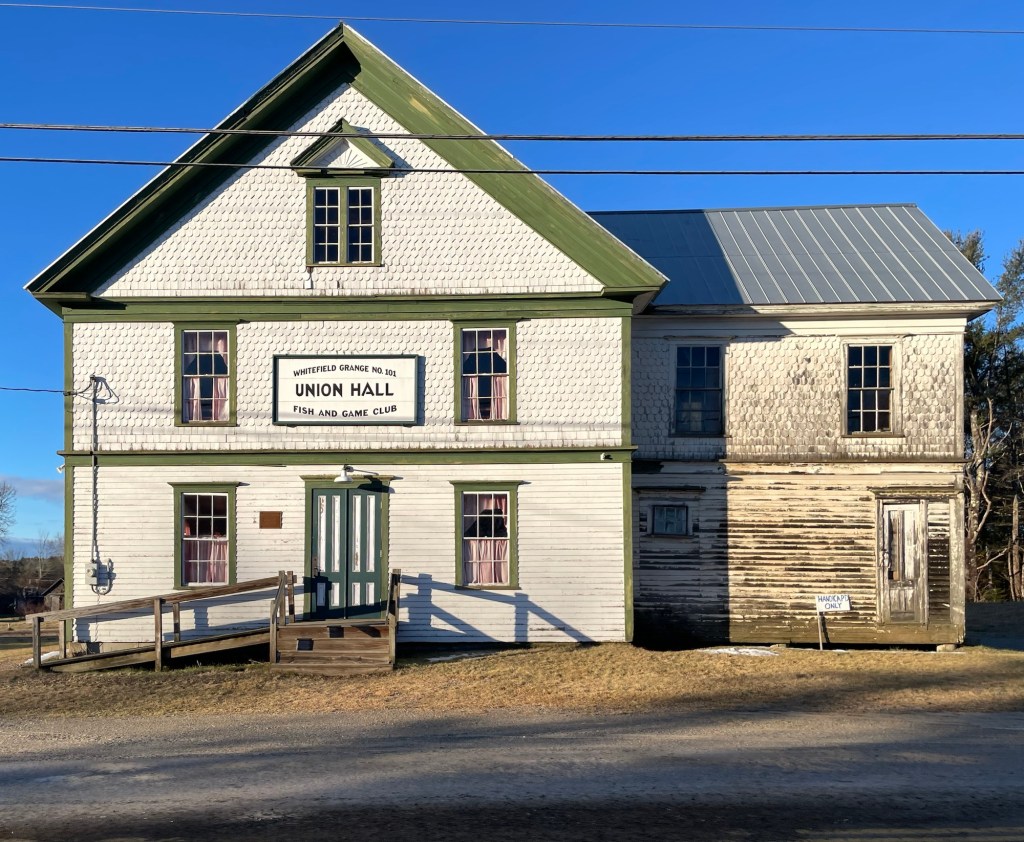
Whitefield Union Hall // 1900

Finding a Grange Hall in Maine are almost as common as finding an old church, they are everywhere! Located the next town over from Jefferson, Maine’s Willow Grange Hall, the town of Whitefield has an equally charming example. The National Grange of the Order of Patrons of Husbandry was established in 1867 to advance methods of agriculture, as well as to promote the social and economic needs of farmers in the United States. Communities all over built grange halls where farmers and residents could meet and discuss prices, trade, and share tips for larger crop yields. The Whitefield Union Hall was built in 1900, primarily under the auspices of the Whitefield Fish and Game Club, but with design input from the local Grange chapter, which contributed funds to its construction and was also a tenant. It was until 1919 the only public hall with a stage in southern Whitefield, playing host to dances, meetings of fraternal and social organizations, and other community events. The hall was managed by an association of the two organizations until 1947, and by the Fish and Game Club after the Grange chapter merged with another in 1969. The club closed down in 1974, and the hall is now managed by a union consortium of village community groups. The building is listed on the National Register of Historic Places.

Jefferson Willow Grange Hall // c.1901

Grange Halls have long been vitally important buildings in agricultural towns all over New England and are becoming threatened due to shifting development patterns and dwindling membership. The National Grange of the Order of Patrons of Husbandry was established in 1867 to advance methods of agriculture, as well as to promote the social and economic needs of farmers in the United States. Communities all over built grange halls where farmers and residents could meet and discuss prices, trade, and share tips for larger crop yields. The Willow Grange Hall in Jefferson, Maine was built in 1901 and is a vernacular building which remains a community meeting hall to this day.

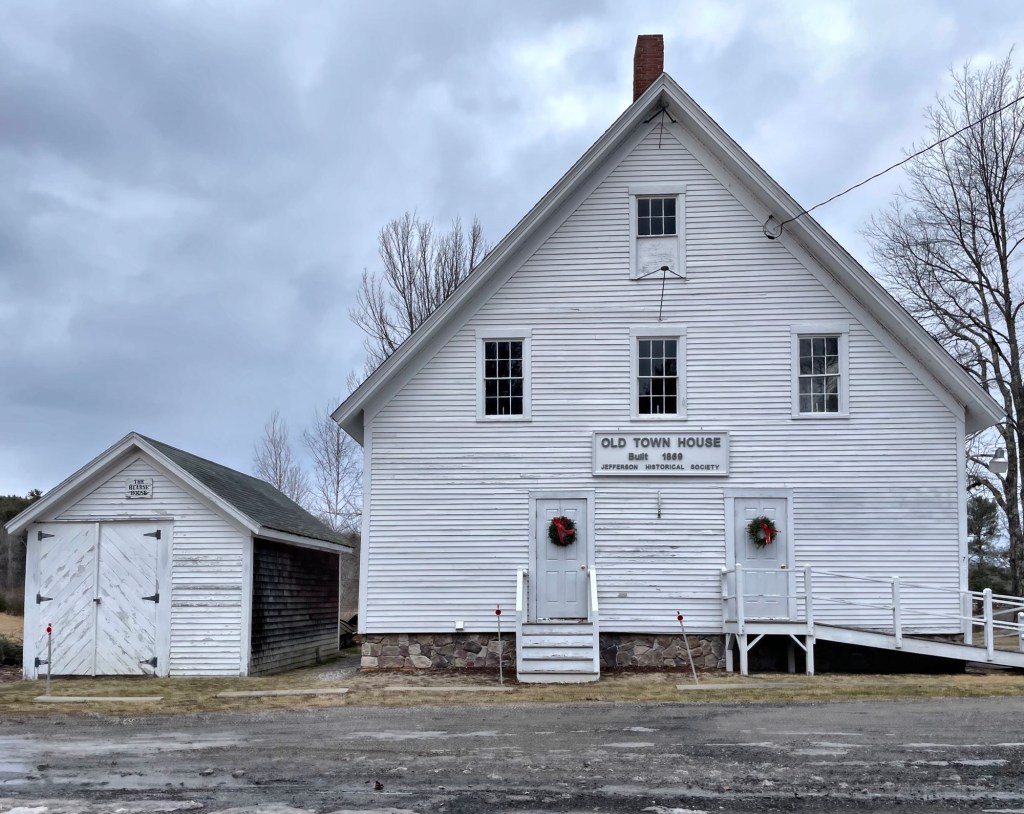
Jefferson Town House and Hearse House // 1869

Following the conclusion of the French and Indian War in 1763, much of the un-colonized land in central Maine began to see development. The Ballstown Plantation was settled in the 1760s and today includes two separate townships created from it, Jefferson and Whitefield, Maine. Jefferson was initially settled by emigrants from the coastal towns of Boothbay and Woolwich in the years just prior to the Revolution and incorporated in 1807, named after Thomas Jefferson, then President of the United States. A Town House was built in 1828 and was eventually outgrown and a new structure was funded in 1869. This is the second Jefferson Town House and like in many rural towns, it served many purposes. The building was used for town meetings, a high school, and was sometimes rented to fraternal organizations (talk about Mixed Use)! The outdated building was no longer needed by the town in the 1970s and a new building was erected closer to the center of town. This building was subsequently rented to the Jefferson Historical Society, who have restored the building, and the historic hearse house next door. The vernacular civic building will hopefully be preserved for another 150 years!

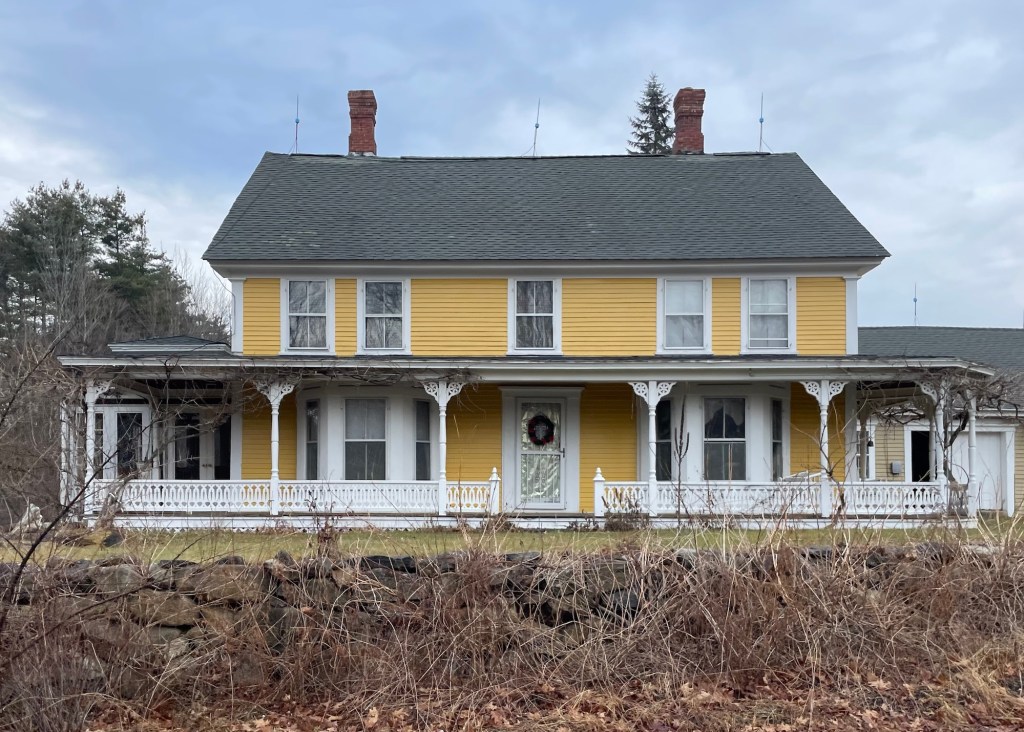
Cyrus Hazen House // c.1850

The backroads of New England always lead you to great discoveries! This time, driving around Weare, New Hampshire, I stumbled upon this large farmhouse on the side of the road. The home was owned by Cyrus Hazen by 1858 and due to its style, I would date it to be built in the 1850s. Cyrus Hazen married Louisa Bartlett (as her second marriage) in 1847 and they appear to have had this home built a few years later. The Hazen’s ran a farm from this home for decades. Sometime after the Civil War, the home would have gotten the full-length verandah (front porch) and a side tower, both Victorian-era additions. The home is now attached to the historic barn by an ell.

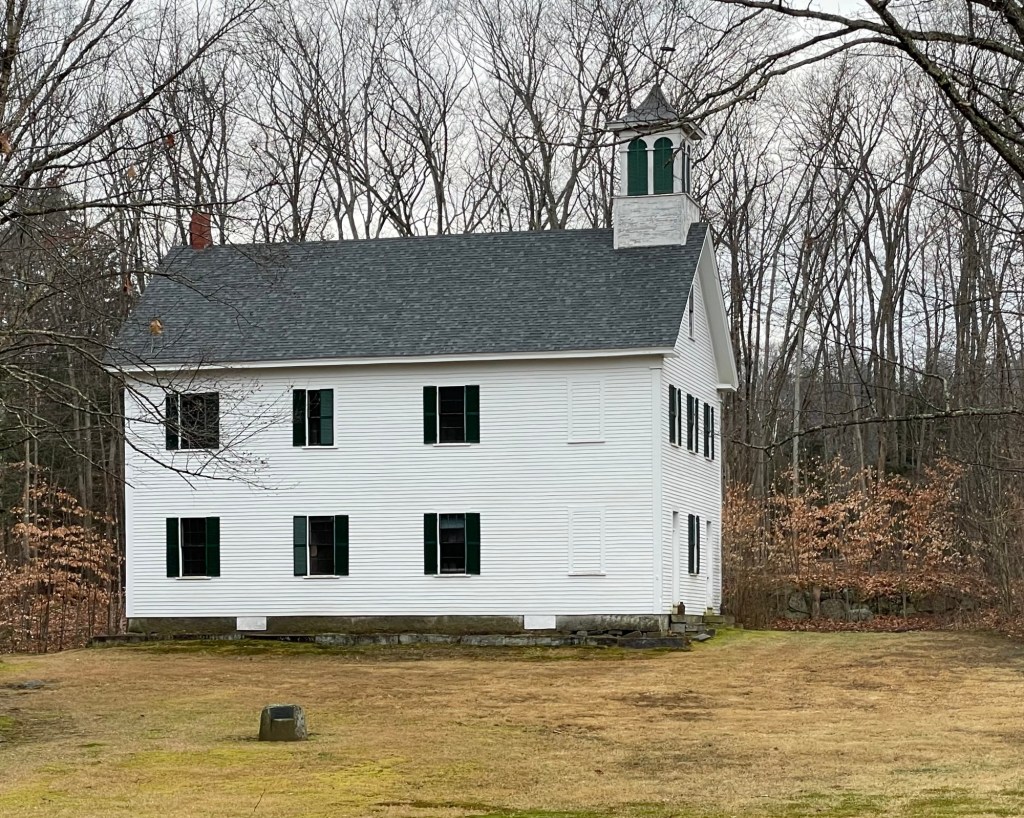
Clinton Grove Academy // 1874

Clinton Grove Academy of Weare, New Hampshire was the first Quaker seminary in the state when it was founded in 1834 by Moses Cartland (1805–1863). Moses Cartland was a Quaker abolitionist who served as the first Principal of the school and for fourteen years after. He later would move to Lee, NH, and aided those who escaped slavery in the south, sheltering them and assisting them on their way north to Canada. The original Academy here served as a private high school and included a classroom building, boarding house, barn and sheds. Students came from as far away as Ontario, Nova Scotia, Minnesota and Texas to study here under Mr. Cartland. In 1872, the Academy complex burned. It was quickly rebuilt as one structure here, in 1874. This building served as a district school until the 1930s. Today, it looks like the building is largely vacant, anyone know what its purpose is?

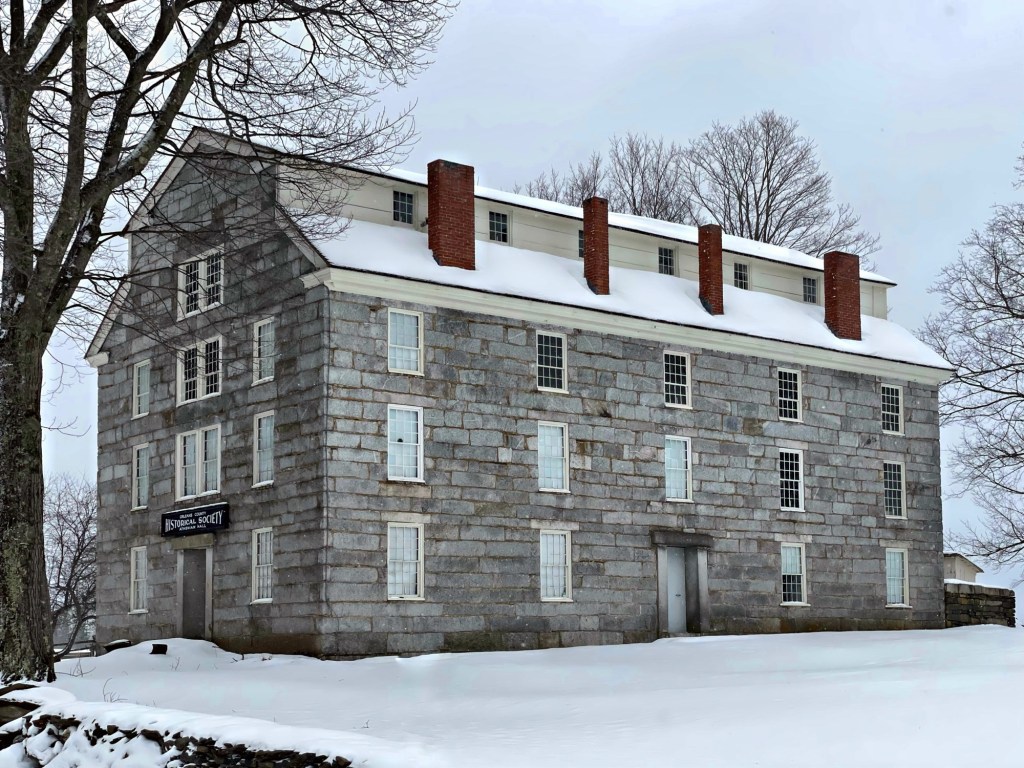
Weare Town House // 1837

Weare, New Hampshire has a pretty cool history. Located at the northern edge of Hillsborough County, the land presently known as Weare was granted to veterans of the Canadian wars in 1735 by Governor Jonathan Belcher, who named it “Beverly-Canada” after many of the veteran’s hometown, Beverly, Massachusetts. After various disputes over the settlement and naming of the town, it became known as “Weare’s Town” before being incorporated by Governor Benning Wentworth in 1764 as Weare, after Meshech Weare, who served as the town’s first clerk and later went on to become New Hampshire’s first Governor. The town grew slowly during the 18th and 19th centuries around five major villages, with farmland and forests connecting them. Near the geographic center of town, this Town House was built in 1837 to be a government and religious center of the town. Originally, town meetings were held on the first floor and the Universalist Church met on the second floor and the local high school was installed on the second floor in 1919. The building remains the town offices with event space for rent inside today. The building is a great example of a vernacular Greek/Gothic Revival town house of the period with a two-stage tower with pinnacles at the corners of each stage and a louvered belfry at the bell.

Dorchester Pottery Works // 1896

Founded in 1895 by George Henderson, the Dorchester Pottery Works successfully produced commercial and industrial stoneware for many years and its building is a significant piece of Dorchester’s industrial heritage. Located in the Harrison Square/Clam Point area of Dorchester, the building began as a two-story wood-frame industrial structure for the young company. It saw immediate success and Henderson oversaw the construction of a large, brick addition which housed an enormous beehive kiln 28-feet in diameter of his own design made of bricks. Here he could fire pottery and other clay goods from his modern facility. Besides clay pots, tableware, and jugs, the company became known for the production of foot warmers, which became known as the ‘Porcelain Pig’ or ‘Piggy’. Foot warmers were widely used in the days before central heating. These clay vessels would be filled with hot water and placed under bedding for overnight warmth. The company made foot warmers until 1939. The company saw dwindling sales after WWII, and eventually closed in 1979. The structures began to decay and the towering smokestack and brick structure was open to the elements. The local neighborhood advocated for its preservation, listing it on the National Register of Historic Places and protecting it as a City of Boston Landmark. After decades of neglect, Bay Cove Human Services acquired the property in 2001 and renovated the building for its own use, keeping the kiln room and the kiln itself intact for community exhibitions. Today, it provides an important historic survivor of Dorchester’s industrial past.

Putnam Nail Company Factory // 1860+

The Putnam Nail Company was founded in 1860 and located at the northern tip of the Port Norfolk neighborhood of Dorchester, Boston, Massachusetts. The company was founded by Silas Safford Putnam (1822-1895), who was the seventh of nine children by Israel Smith Putnam and Charlotte Safford of Hartford, NY. He moved to Boston and found work as Boston’s industrial growth took-off. He owned a curtain factory before patenting a process to manufacture wrought nails in the 1850s. After some time in Abington and Roxbury, he moved to Dorchester, purchasing large pieces of land and began building a manufacturing complex for his new Putnam Nail Company. The company made world-class horseshoe nails until it closed in the early 1900s. The property here was acquired by the George Lawley & Son Shipyard, who moved from their cramped City Point, South Boston shipyard to this newer yard. Already an established and respected New England manufacturer, the Lawley company had been building wooden ships in Massachusetts since 1866. The site was later the home to Seymour’s Ice Cream and was abandoned in the late 20th century. The large 1890s brick factory is now occupied by RISE, a development/construction management firm, with other buildings occupied by the Boston Winery and Boston Harbor Distillery.

Newburgh Center Union Church // 1878

Image courtesy of Amy Higgins

The Newburgh Center Union Church was built in 1878 as a non-denominational religious building for the small, rural town of Newburgh, Maine. At this time, the small town had just over 1,000 residents and it was not economically feasible for each congregation to build its own meeting house. The vernacular Greek Revival/Italianate style church building was eventually the house of worship of a local Pentecostal congregation, but that too appears to have disbanded. The building has been falling into disrepair, so hopefully it will be preserved.

Jackson Congregational Church // c.1812

Image courtesy of Amy Higgins.

In the year 1812, Jackson, Maine, was organized as a plantation, and the Congregational Church of Jackson was organized the same year with Rev. Silas Warren, as its Pastor. Mr. Warren was born in Weston, Massachusetts and graduated from Harvard University in 1795. He was ordained as Pastor of the Jackson and Brooks Church in 1812 when it opened. The town of Jackson has not grown much since then (610 according to 2020 census) and has maintained its very rural character. The Congregational Church here was likely more vernacular when built and given the belfry after the Civil War. Gotta love these old churches on back roads!