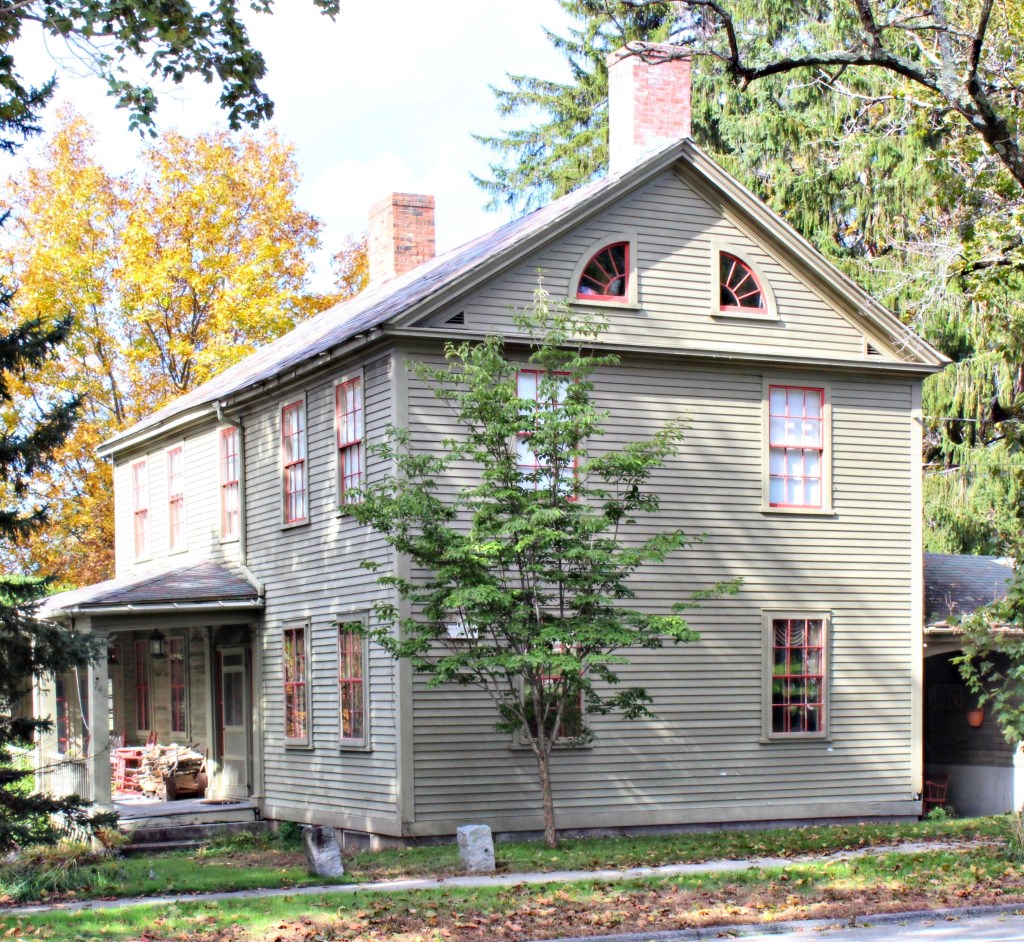
Longley Farmhouse // 1819

Backroads in New England are just amazing! When driving through Millbury on my way to visit one of the finest examples of Federal style architecture in the state, I stumbled upon this gorgeous rural Federal style farmhouse, and had to snap a picture! Millbury is best-known as a mill town (hence the name), but you can find dozens of rural farms dispersed between the mill villages in the township. The Blackstone River cuts through the town, and during the Industrial Revolution, it provided much of the water power to the town’s many textile mills and factories. Like many former mill towns, the shifting of the economy away from manufacturing towards the service sector, harmed the economy of Millbury in the 20th century. Many mills were abandoned and demolished, others adaptively reused. Before we get to some industrial history, I wanted to share this charming farmhouse. This home was built for Nymphas Longley upon the time of his 1819 marriage to the love of his life, Nancy Bond. They ran a farm on over 80 acres, with Nymphas also serving as a town selectman, an overseer of the poor, and led recruitment efforts in town at the start of the Civil War. Like many farms, this one saw suburban development take some of the former land, but this home still sits on over 9 acres, not bad for being so close to Worcester!

Unity Church Parsonage // 1878

Architects William Robert Ware and Henry Van Brunt designed this parsonage in Easton, Massachusetts for the Unity Church in town (featured previously). The Victorian Gothic house is constructed of polychromatic stone, wood trim, slate and copper roof surfaces, and terracotta finials. The architecture is very well-developed and stands toe-to-toe with the other architectural landmarks in town, just a short walk away.

Queset House // 1854

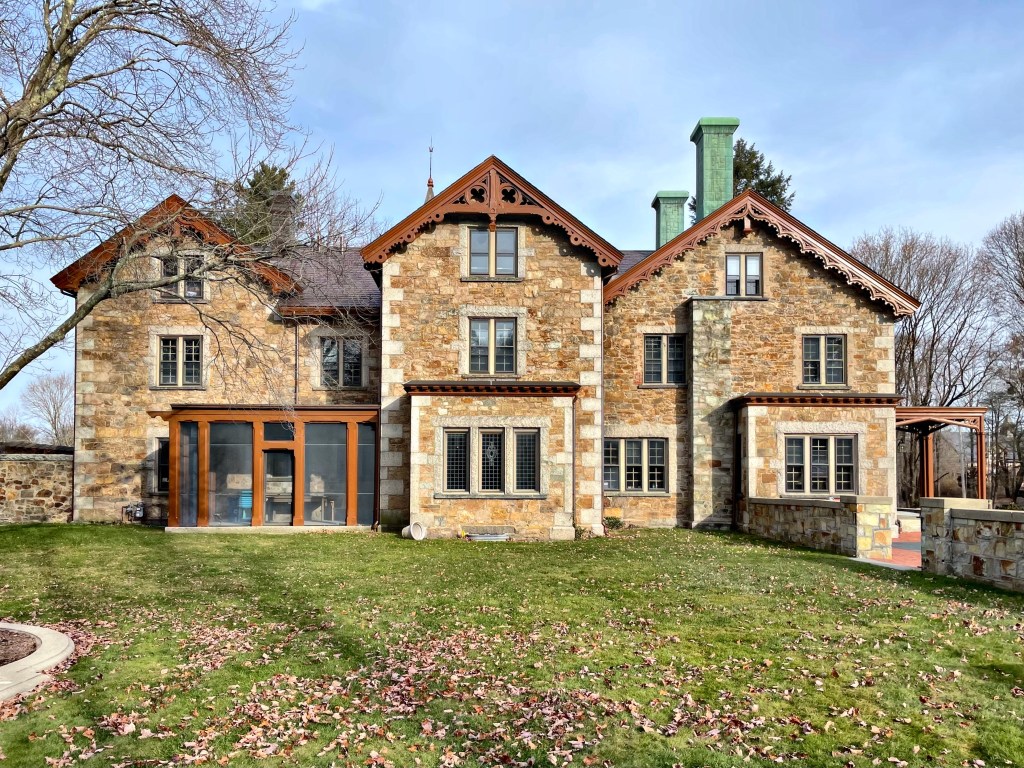
Tucked away behind the Ames Free Library in Easton, you will find one of the most stately examples of Gothic Revival architecture in a house in New England. The house is known as Queset House. Queset was commissioned to be built in 1853 and it was completed the following year for Oakes Angier Ames, of the wealthy Ames Family, who ran a shovelworks in town, and built some of the most handsome structures in the state. The house’s front portion design was drawn from a plan by noted architect Andrew Jackson Downing (who died in 1852). Downing collaborated with Alexander Jackson Davis who provided architectural drawings. The two architects created pattern books which greatly influenced Gothic Revival and Italian Villa style architecture for the next decades, with many wealthy people hiring builders to complete homes in their designs. Queset House is different than most in that the house is constructed of local stone. Oakes would later hire Harvard-educated architect John Ames Mitchell, (a first cousin of Oakes Angier and architect of the nearby Unity Church in Easton) designed the rear addition in 1873, adding the copper-clad chimneys. In the later years of his life, Oakes wanted to help further-improve his town and worked with his family to consult with starchitect H. H. Richardson and landscape starchitect Frederick Law Olmsted on projects in town (the Library, Town Hall, Rockery). After his death in 1899, the home was occupied by his son, famous theatrical producer Winthrop Ames, and his wife. The family would eventually gift the property to the Town of Easton, who today occupy it as an extension of the Public Library, open to the public!

Side view.

Ames Gate Lodge // 1880

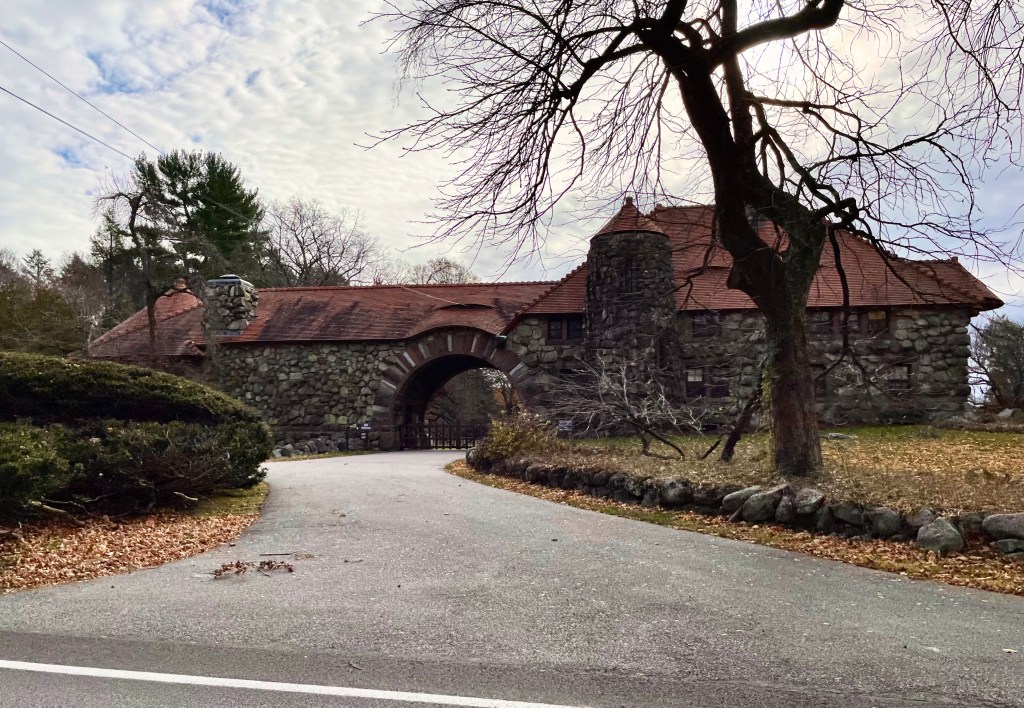
In 1880, twenty years after Frederick L. Ames built his rural estate “Langwater”, he felt the need to give the property more rural character, especially given the close proximity to the Ames Shovel Works. Emulating old European estates with gatehouses, Ames hired star-chitect Henry Hobson Richardson, to design a gate lodge at the entrance to his property, fitting of one of the richest men in Massachusetts. Richardson’s design for the gate lodge was oriented longitudinally and is bisected by the arched entry to the estate. The large room on the left was intended to serve as a storeroom for flowering plants, and the two-story portion had a caretaker’s residence on the lower floor and a “bachelor hall” for men’s socializing and spill-over bedroom. The building uses glacial boulders found on the expansive grounds and older stone walls, with trim of Longmeadow brownstone. The bright red terracotta roof contrasts boldly with the rough stone walls. The building is one of the most beautiful structures I have seen, but can be difficult to photograph without trespassing. Ugh!

Langwater // 1859

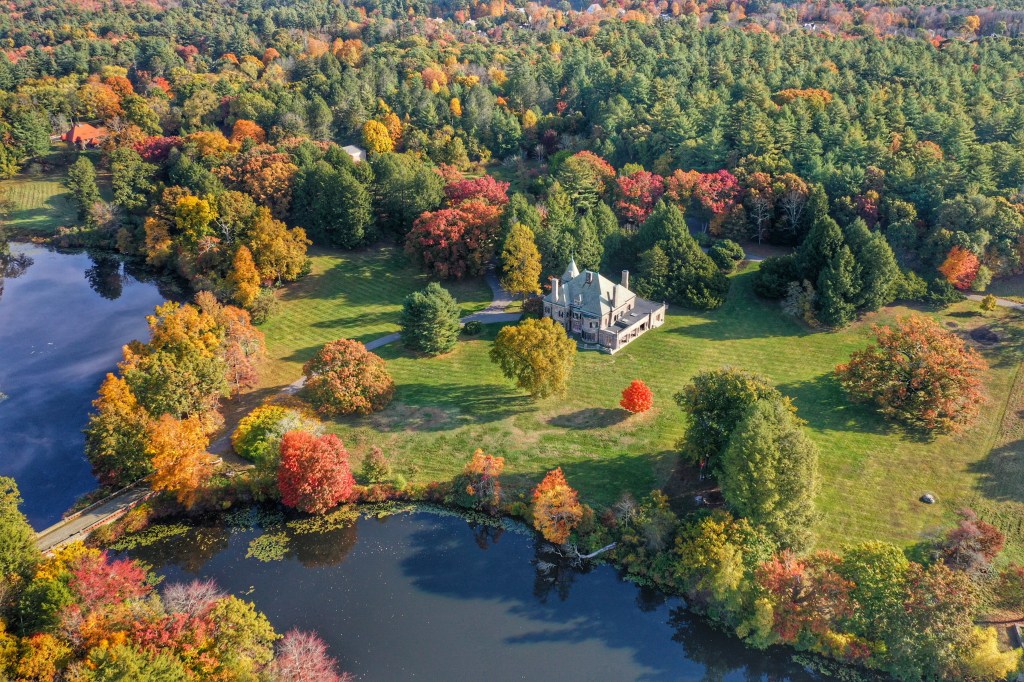
The country estate of Frederick Lothrop Ames (1835-1893), “Langwater” sits in North Easton amongst a collection of some of America’s greatest architectural treasures, all thanks to the Ames Family. The Ames family was a wealthy family which had lived in Easton for many generations. Frederick’s grandfather Oliver Ames Sr. founded the Ames Shovel Works in Easton, Massachusetts. The Shovel Works earned the family a huge fortune, during a time when aggressive canal and railroad expansion was built by the hands of thousands of men using shovels. Frederick’s father Oliver Jr. was president of the Union Pacific Railroad during the building of the transcontinental railroad. Frederick’s cousin Oliver Ames was governor of Massachusetts 1887–1890. Frederick himself was Vice President of the Old Colony Railroad and director of the Union Pacific railroad. At the time of his death, Ames was reported to be the wealthiest person in Massachusetts. With this immense wealth, Frederick built a castle where he would spend most of the year, overseeing his various businesses, in his hometown of Easton, Massachusetts. The mansion was designed by architect George Snell and built around 1860, with a couple additions and updates until Frederick’s death. A few years before his death, Frederick hired famed architect Henry Hobson Richardson, who he already worked with in designing the Oakes Ames Memorial Hall(Easton’s Town Hall), to design a gate house leading to Langwater (more on that later).

Oakes Ames Shooting Lodge // c.1905

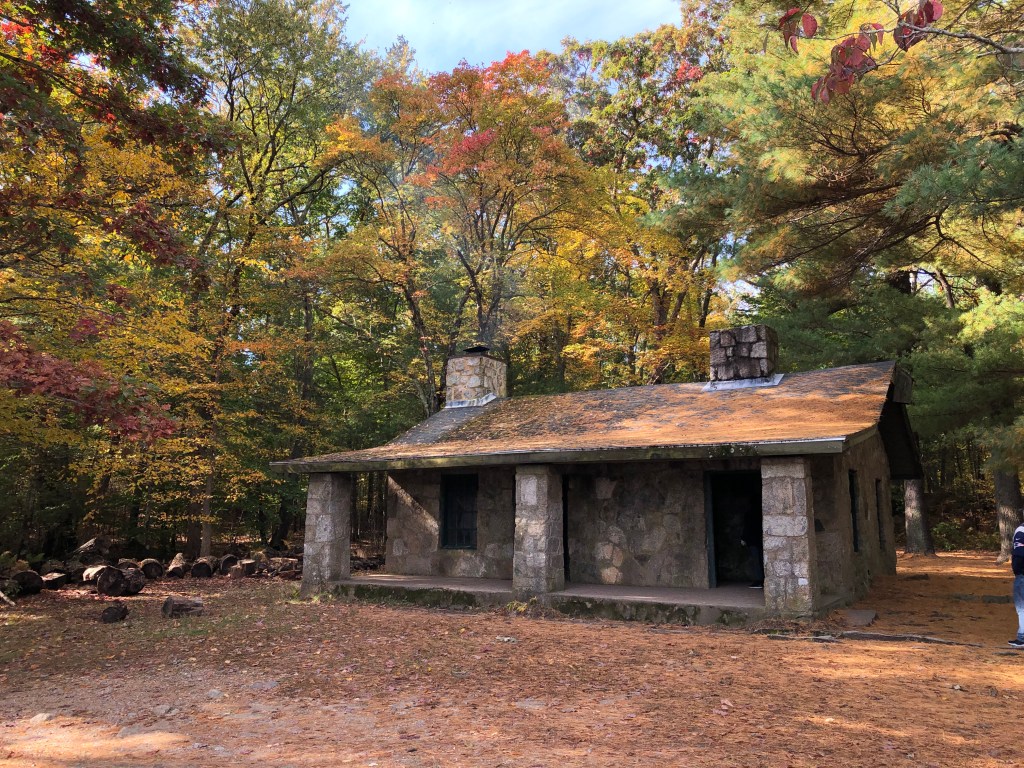
Located near the banks of Leach Pond in Borderlands State Park, this handsome stone structure set the style for one of the most iconic and beautiful buildings in Easton, the Ames Mansion. The one-story concrete and stone structure was designed and constructed under the supervision of Blanche Ames, and may have been a prototype for the construction technique used in the Ames Mansion, built just years later. Blanche was an amazing woman. She was an artist, political activist, inventor, writer, and prominent supporter of women’s suffrage and birth control. In 1900, she married Harvard University botany professor Oakes Ames (no relation). She took the married name Blanche Ames Ames. She illustrated her husband’s botanical research on orchids, and later got involved in designing the family’s country retreat. Originally designed as a warming hut during hunting season, this lodge was originally minimally designed with exposed stone walls. In the 1930s, the lodge was renovated to contain a living space, a kitchen, and a bedroom. When the Commonwealth of Massachusetts acquired the Ames Estate in the 1970s for a state park, the Lodge was restored to its original condition. The hunting lodge is open to the elements and the public, who can warm themselves in one of the two six-foot fireplaces.

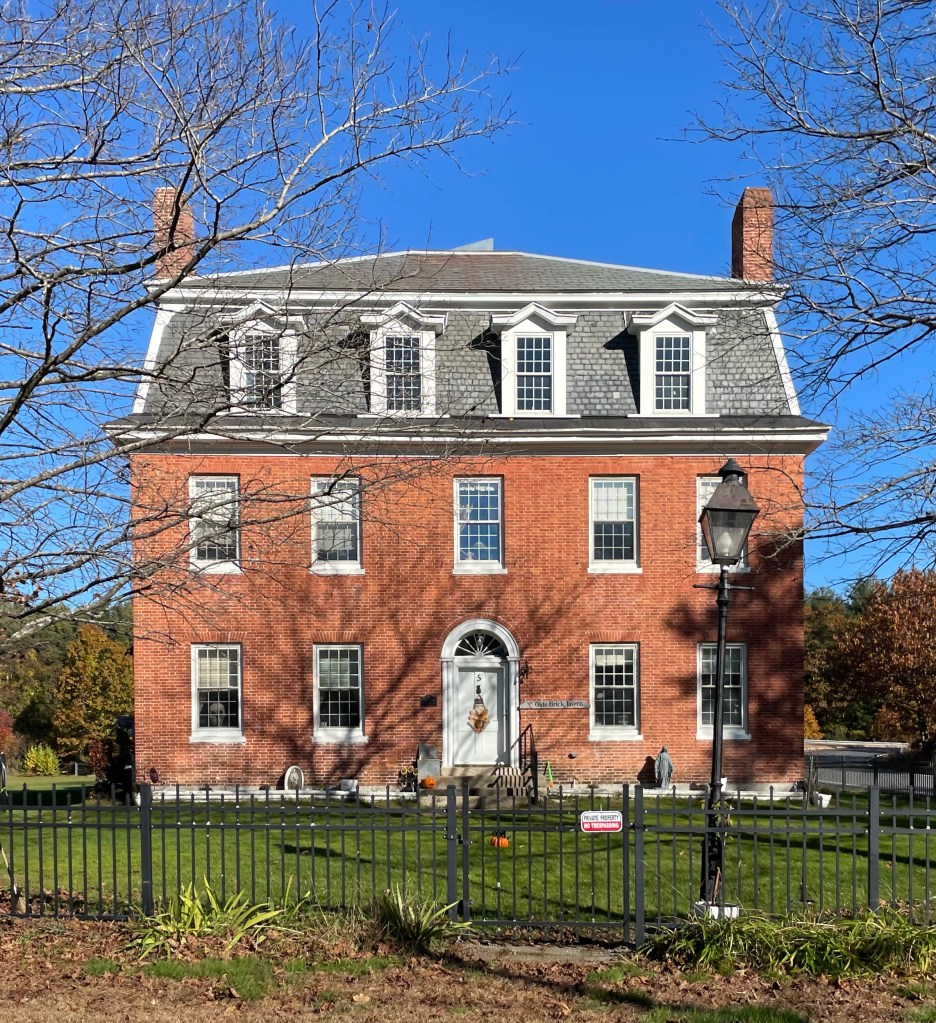
Old Brick Tavern // 1804

The Brick Tavern was an important stopping point on the old Union Turnpike, and the original two-story brick structure was completed about the time of the turnpike construction by Paul Willard, who with his heirs, operated the inn for 25 years. In the first years of the 1800s, the Union Turnpike Company planned and built a road providing a link for travel from Boston to Albany. Realizing the possibility for an inn along the first leg of the route, Willard financed this substantial brick building for travellers to stop, eat and spend the night. The tollroad was later made free, and less people stayed at the inn. After subsequent ownership, the building started to suffer from deferred maintenance and it was sold to a local Quaker group. The Quakers modernized the building by constructing the mansard roof and updating the interior. They never occupied it, but rented it to tenants for income. After, it was a hospital, boarding house, and in WWII, as a barracks of sorts for soldiers training nearby at a military base. The building is now a house!

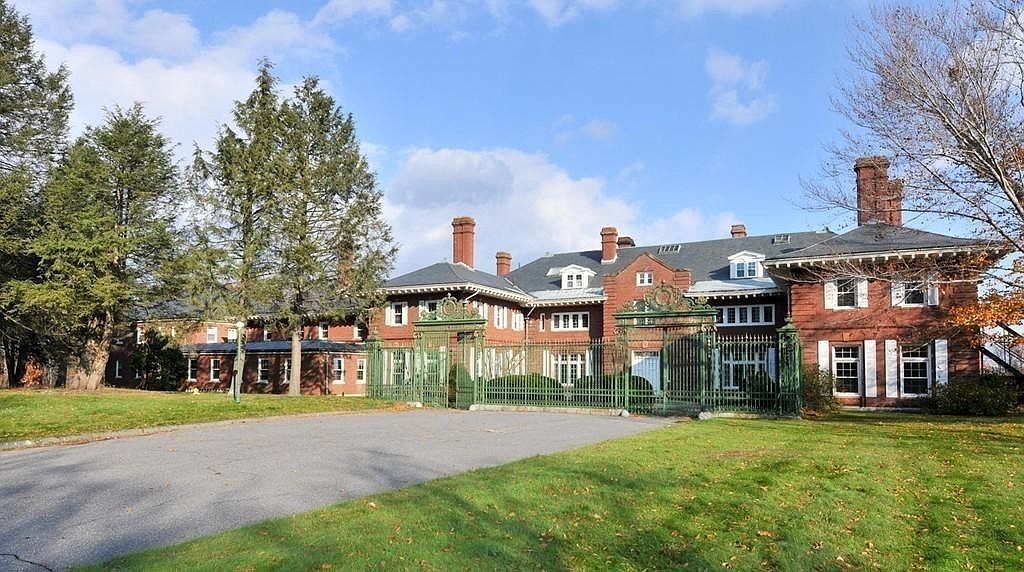
Hawthorn Hill Estate // 1903

The only estate in Lancaster that can rival the Nathaniel Thayer Estate in size and grandeur is the OTHER Thayer estate, built for Bayard Thayer. Sitting on over 55 acres of forests and gentle rolling fields, Hawthorn Hill is one of the most impressive mansions in Central Massachusetts. The property is so secluded that I had to rely on real estate photos to share! The listings mention that there are over 40 bedrooms and 27 bathrooms… Bayard Thayer (1862-1916) is the grandson of Nathaniel Thayer, Unitarian minister of the First Church of Christ in Lancaster and son of Nathaniel Thayer, a banker. When his brother was willed the family estate (featured previously) after the death of their father, Bayard used the opportunity to build a modern estate high upon a hill in town. The mansion was built in 1903-1904 under the direction of Guy Lowell, a renowned Boston architect of the time. In 1907-1908, Little and Browne were commissioned for landscape alterations and in 1914-15, Ogden Codman Jr. was commissioned to renovate the interiors. Bayard died one year later, and the property remained in the family until around WWII. In 1953, the property was acquired by the Boston Cenacle Society, who added a massive dormitory addition to the building. Recent plans were unveiled to subdivide the land and build house lots on half the estate, which gives me mixed feelings.

Newhall-Lane House // 1809

The Newhall-Lane House (could be the home of many wives) was built in 1809 by Pliny Newhall, a bricklayer. He purchased the land here at a prominent crossroads in Lancaster in 1808 from his employer who owned a brickyard across the street. At a previous home in town, Newhall’s wife Patty died giving birth to their son, at just 23 years old. Their son also died during childbirth. He remarried and had a full family to grow into the couple’s new house. They relocated to Lincoln and the home was sold to Captain Anthony Lane, who was the son of Deacon Jonas Lane, an important figure in Lancaster town history. Jonas had four wives, outliving three of them. Captain Lane himself, was married twice while living in this house; he had no children from either marriage. Although he was a talented craftsman and cabinetmaker, Captain Lane listed his occupation as farmer. The house is significant architecturally, as a fine example of Federal style architecture in Lancaster . Its sophisticated design is reflected in the graceful entrance. One of the unique features of the house is the pedimented gable of the facade which in combination with the narrow plan of the house, creates a delightful massing in this distinctive combination of Greek Revival and Federal styles.

Carter House and Publishing Company Building // 1820

Here is a two-for-one post! These two absolutely gorgeous Federal style buildings on Main Street in Lancaster were built in 1820 for George Carter and his brothers who ran a publishing company in the sleepy town. The Carter family was very active in the Swedenborgianism, a very small church in the general realm of Christianity, and they helped create a small enclave of worshippers in town. The brick, Carter and Andrews Publishing Company building (on the other side of a dead end street from this house) was built at the same time as the Carter home. The company was extremely popular in publishing children’s books, textbooks, and maps. One of my favorite publications the company made was “Peter Piper’s Practical Principles of Plain and Perfect Pronunciation”, now say that three times fast!