Westborough Unitarian Universalist Church // 1850

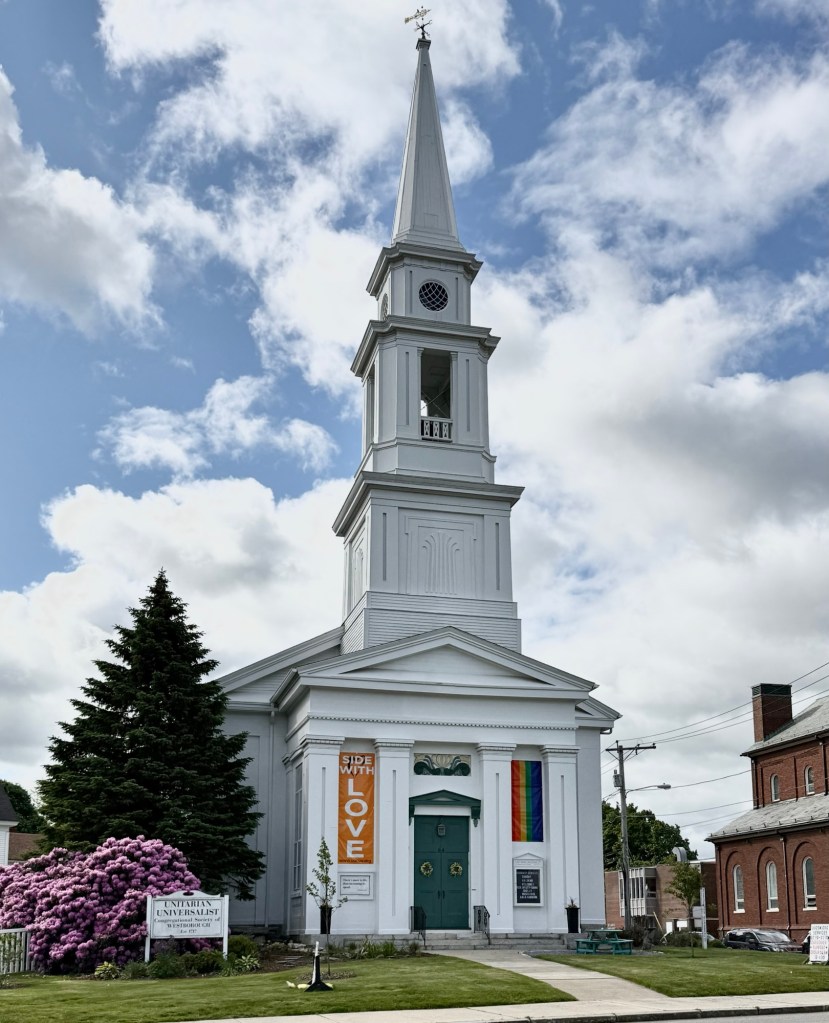
The Unitarian Universalist Church of Westborough, Massachusetts is architecturally significant as an excellent example of a ecclesiastical building in the Greek Revival style, but it is also significant historically as it tells a richer history of the community and New England as a whole. The Congregational Church has its roots in the first church in Westborough, established in 1724 under Reverend Ebenezer Parkman. The Religious Freedom Act of 1811 and the official separation of church and state in 1825 encouraged a diversity of religious views in Westborough and a branching out from the first church both spiritually and since churches needed new houses of worship. As a result, the local church in Westborough split due to differing beliefs, with the Congregationalists building a church and a few years later, the Unitarians building this church, both in variations of the same architectural style. The UU Church in Westborough was built by 1850 and was expanded as the congregation grew. The building remains nearly identical to when it was built except for the steeple, which in 1921, was in such bad repair that it had to be removed. Less than a decade later in 1930, member Isadore Forbes donated the funds to have the steeple rebuilt and a bell installed. 

Old Boston Public Library // 1855-1898

Courtesy of BPL collections.

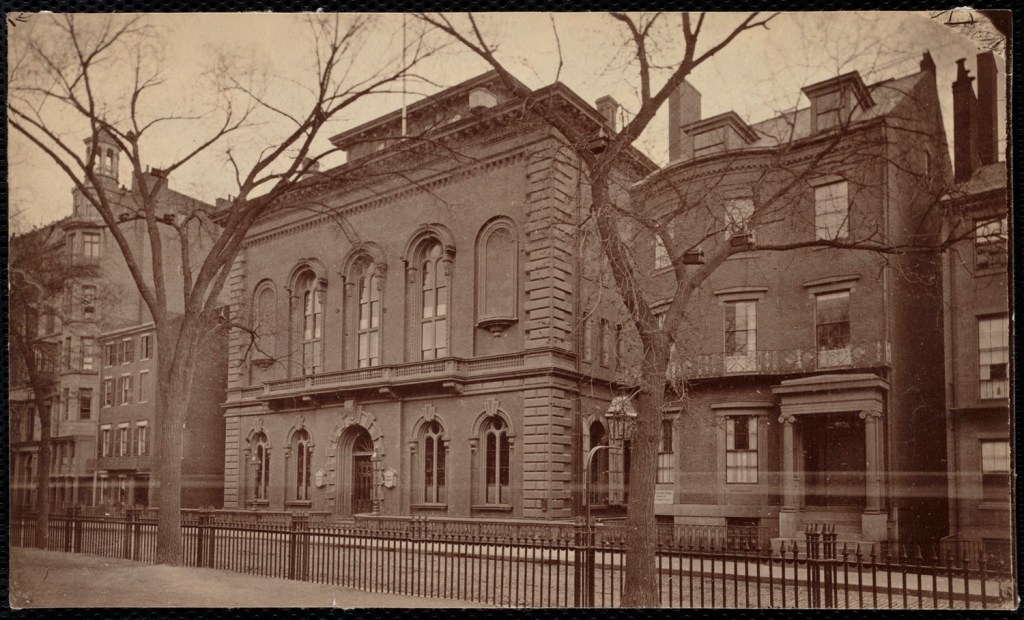
Established in 1848, the Boston Public Library was the first large, free municipal library in the United States. The Boston Public Library’s first building of its own was a converted former schoolhouse located on Mason Street that opened to the public in 1854. As soon as the library occupied the building, it was apparent that the amount of visitors and collections could not effectively be held in the cramped quarters. Planning began almost immediately for it’s first purpose-built library. Less than a year later, in December 1854, library commissioners were authorized to purchase a lot and fund the construction of the new library. A desirable building lot on Boylston Street, opposite the Boston Common, was purchased and a public invitation for proposals from architects was held. The requirements for the building included: a library hall with alcoves capable of containing on fixed shelves at least 200,000 volumes, a general reading room with ample accommodations at tables for at least 150 readers, a ladies reading room, an adjacent library room for the arrangement of 20,000 books “most constantly demanded for circulation,” and quarters for the Trustees and Librarian. The facade was to be of brick, with stone dressing”. The selected design by architect, Charles Kirk Kirby, was for this handsome Italianate style building which took nearly three years to build, opening in September 1858. Twenty years later, as the library outgrew that space, the Trustees asked the state legislature for a plot in the newly filled Back Bay, and planning began on the McKim Building, built in 1895 down Boylston Street. This building, the first purpose-built Boston Public Library building, was demolished in 1898, and replaced by the ten-story Colonial Theater Building. It stood just 40 years.

Old Pierce School // 1855

Located in the heart of Brookline Village, the old Pierce School sits tucked away behind the Brookline Town Hall and other municipal and institutional buildings. The school was built in 1855 at a cost of $15,000 and later expanded in 1904 from plans by Julius Adolphe Schweinfurth, a prominent local architect. Julius had two brothers who also were architects:  A. C. Schweinfurth, who worked out of California and Charles F. Schweinfurth, out of Ohio. The Pierce School was named after Reverend John Pierce, noted pastor of the Walnut Street church during the mid 19th century. He and his wife, Lucy Tappan Pierce, were active leaders in the abolition movement in Brookline. The school was expanded a number of times until the 1970s, when the present Pierce Elementary School was built, in an unsympathetic Modern design that does little to enhance the busy street. As expected, the 1970s school will soon be demolished and replaced by a new, $212 million school. The old Pierce School will be incorporated into the new development.