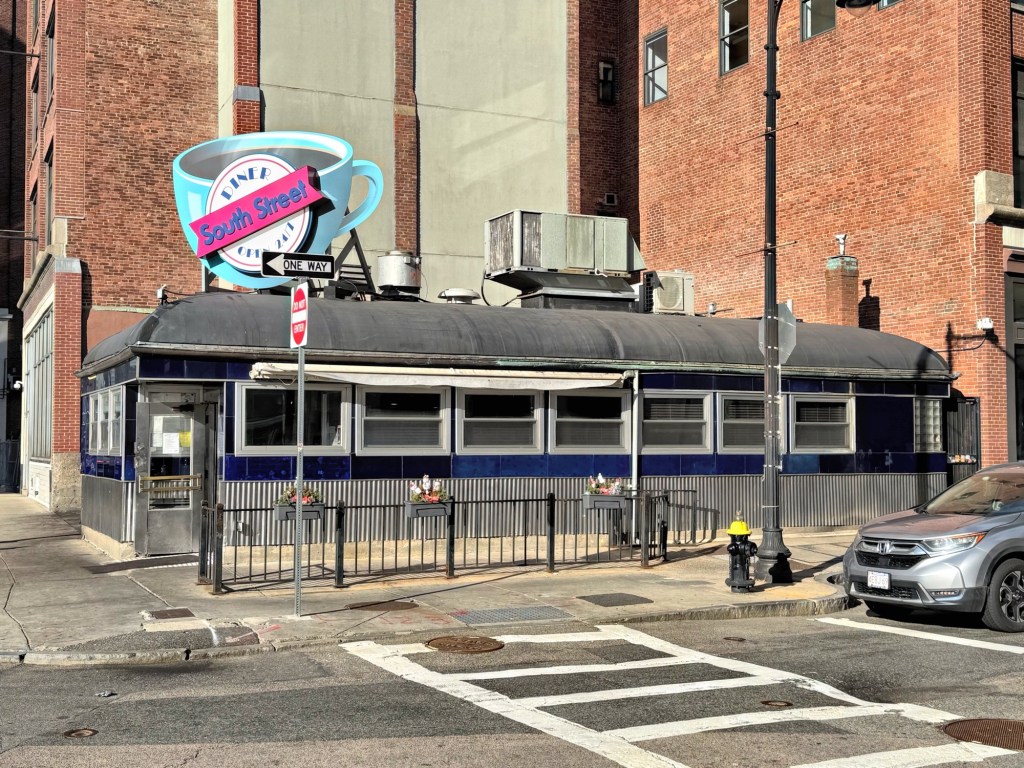
One of the hidden gems of Boston can be found tucked away in the Leather District, one of the last remaining diner cars in the city, this is South Street Diner. At this site, at the corner of South and Kneeland streets, a diner car has existed since about 1935. In 1947 the present diner car was built by the Worcester Lunch Car Company and moved on this site as the Blue Diner opened, possibly named after its patrons, largely blue-collar workers. The diner would be renamed the South Street diner in 1992, a name that has stuck ever-since. The diner attracts tourists, nearby workers, and drunken college students, serving as a much-needed melting pot for people of different backgrounds to grab a good bite to eat.
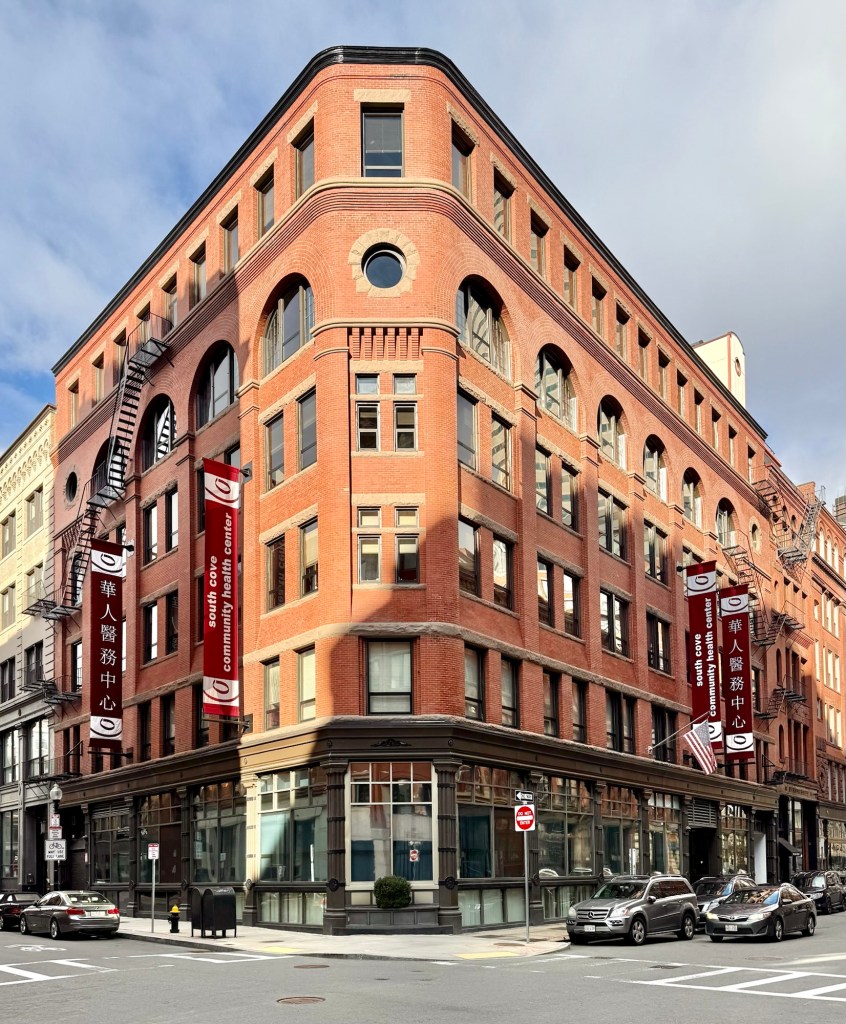
This impressive commercial block is prominently sited at the corner of Beach and South streets in Boston’s Leather District, a wonderful enclave of late 19th and early 20th century mercantile buildings, historically centered around the leather and shoe-making industries. Like many in this block, the building was developed by the Faxon Brothers, some of the major developers of this district and areas of Quincy. Also like many other buildings in the Leather District, the block was designed by 1886 in the Romanesque Revival style, constructed of brick and brownstone with a clipped corner and Syrian arches and an oculus window at the fifth floor. The building was designed by relatively unknown architect, John H. Besarick and today houses professional offices.
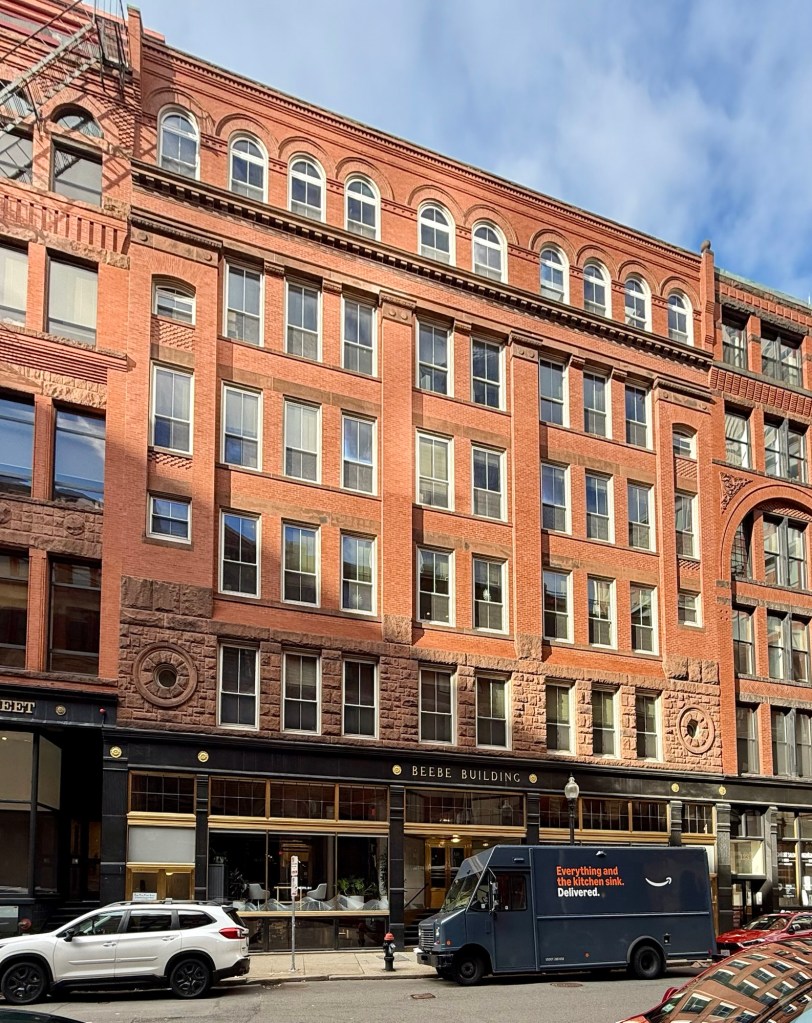
Located at 127-133 South Street in the under-appreciated Leather District of Boston, the 1886 Beebe Building is an excellent vestige of the leathergoods trade and commercial architecture of the late 19th century. This building was constructed by J. Franklin Faxon (1832-1912), a business owner who engaged in real estate development and built a number of commercial blocks in this part of Boston. Rand & Taylor, architects, designed the building in an effective blending of Classical and Romanesque styles with rock faced brownstone ashlar above the storefronts, oculus windows, and segmental arched openings on the top floor. The Classical detailing of the two-story brick pilasters and modillion cornice add to its complexity. The building was originally occupied by the Thomas E. Proctor Leather Company and was later purchased by leather goods company Lucius Beebe & Sons and the storefront was renovated by Hutchins & French in 1930. The building has since been known as the Beebe Building and has been well-maintained by subsequent owners.
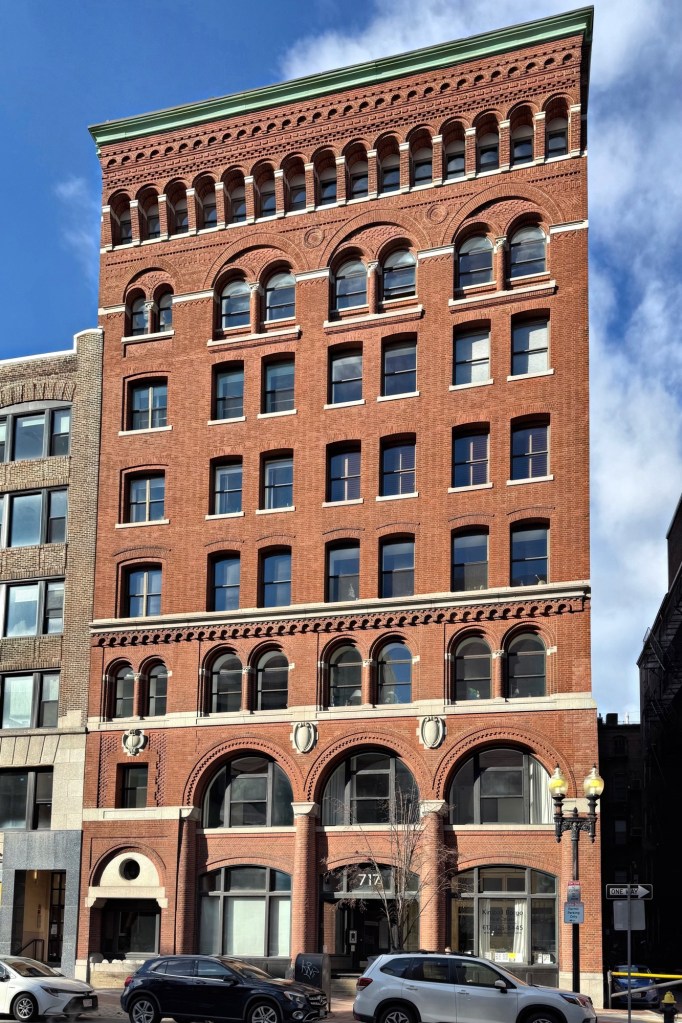
As far back as Colonial days, the boot and shoe industry was one of the State’s leading industries. Buyers came suburban towns to purchase supplies, and in the early 1800s, the larger manufacturers began to open offices and stores in Boston. Soon, most of the leading merchants had established places of business in Boston, by the late 19th century, many were located in the South Cove area, which became known as the Leather District. The Leather District is characterized today by large, brick structures with flat roofs and feature continuous floor levels, band courses, and cornice lines. This handsome brick building on Atlantic Avenue was built in 1901 for Charles G. Rice and the Heirs of Nehemiah W. Rice as a warehouse for the U.S. Leather Company. The building was designed by William Gibbons Rantoul, who studied architecture at Harvard, and apprenticed with Henry Hobson Richardson as a draftsman in the 1880’s before opening his own practice. In 1946, the subject property was purchased by Frank Einis, and the new tenants, Fur Merchants Cold Storage, Inc., used the building for the storage of skins and furs for manufacturing into soft goods. Architecturally, the building showcases the lasting influence of Richardson on architects and industrial buildings in Boston from the late 19th century into the early 20th century. The building can be classified as Romanesque Revival in style with its use of arches in the façade both structural and decorative, the Venetian arches at the 7th floor, as well as its arcaded corbelling over the 3rd level and at the cornice. I especially love the tall, engaged brick columns at the storefront, they are very unique!
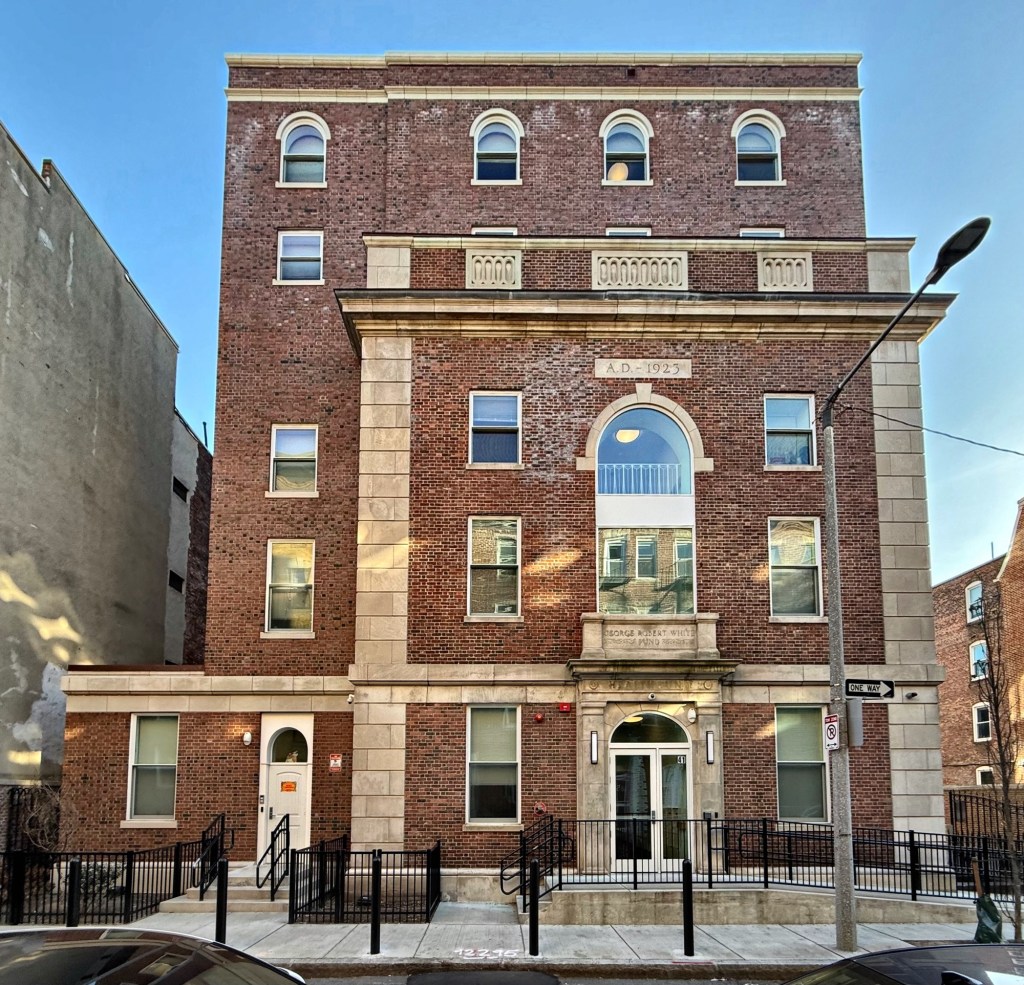
Originally known as the George Robert White Health Unit Number 2, this Colonial Revival style building is located on North Margin Street in the North End of Boston, and is significant as an early health center providing health and education services for some of Boston’s most underserved residents. The building was constructed in 1923 as one of the neighborhood-based health centers built in Boston in the 1920s and early 1930s from funding by the George Robert White charitable trust. George Robert White (1847-1922), a longtime resident of Boston, worked in the office of the Potter Drug and Chemical Company as a boy, eventually becoming president and an owner of the corporation. He was an investor in real estate and reportedly was known for many years as the largest individual taxpayer in Boston. Upon his death, his will specified that his bequest to the city, about $5 million in 1922 (approximately $93 Million valued today), would be held in a permanent charitable fund “to be used for creating public utility and beauty and for the use and enjoyment of the inhabitants of Boston.” The North End Health Unit was the second built (the first was in the West End), and designed in the Colonial Revival style from plans by Coolidge and Shattuck, later known as Coolidge, Shepley, Bulfinch & Abbott. Since the 1970s, the building was occupied by the Knights of Columbus, a fraternal organization, until 2020, when the building was renovated and converted into housing with 23 units for elderly residents.
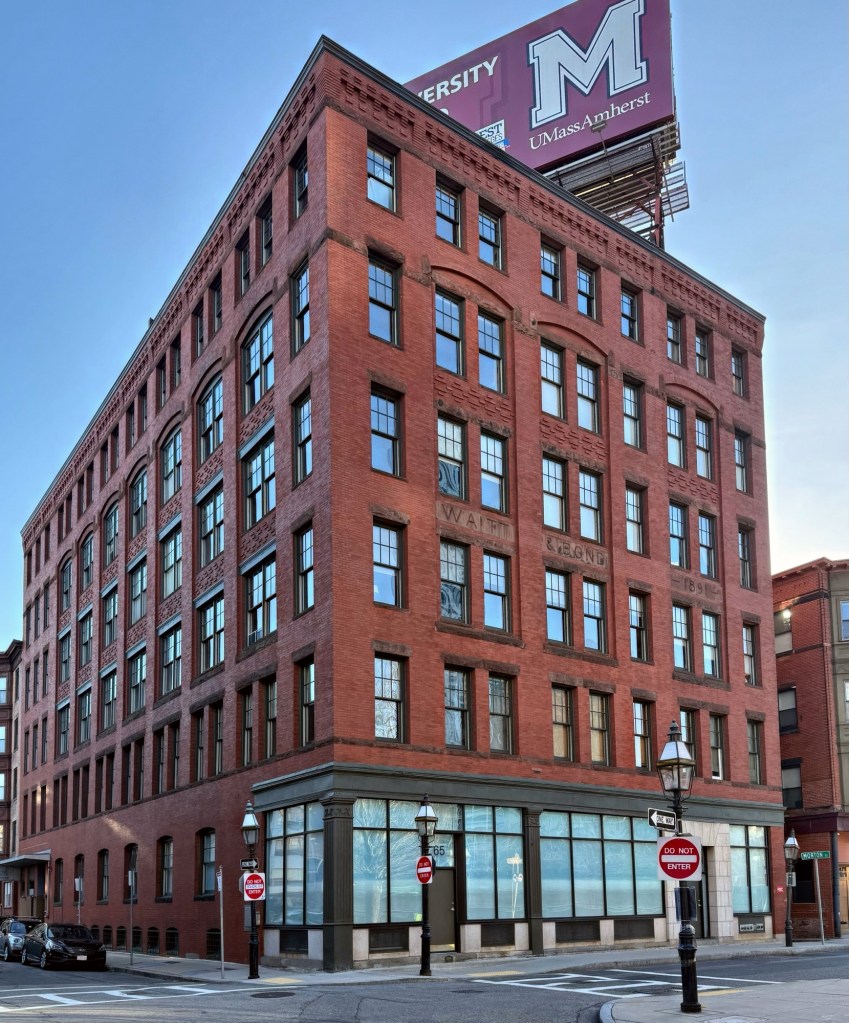
One of several late 19th-century industrial buildings in the North End, the Waitt & Bond Building stands on Endicott Street, looking over the scar on the landscape that is I-93. This six-story building was constructed in 1891 and is the oldest extant building in Boston associated with cigar manufacturers Henry Waitt (1842-1902) and Charles H. Bond (1846-1908), who started business in 1870. The business relocated from Saugus to Boston in 1873 and moved into this building upon its completion. Waitt & Bond produced handmade cigars with each employee hand-rolling over 300-a-day. The architect, Ernest N. Boyden, designed the building in the Panel-Brick and Romanesque styles with decorative brick panels, cornice, and arched detailing. Rooftop billboard signage (blight) was first added to the building in 1956, with increased visibility via the elevated John Fitzgerald Expressway (the Central Artery). By the early 1960s, Joseph Castignetti moved his men’s clothing store, Castignetti Brothers, to this location. In 2001, the building was converted into 28 loft-style condos, an early sign of the gentrification to come to the North End.
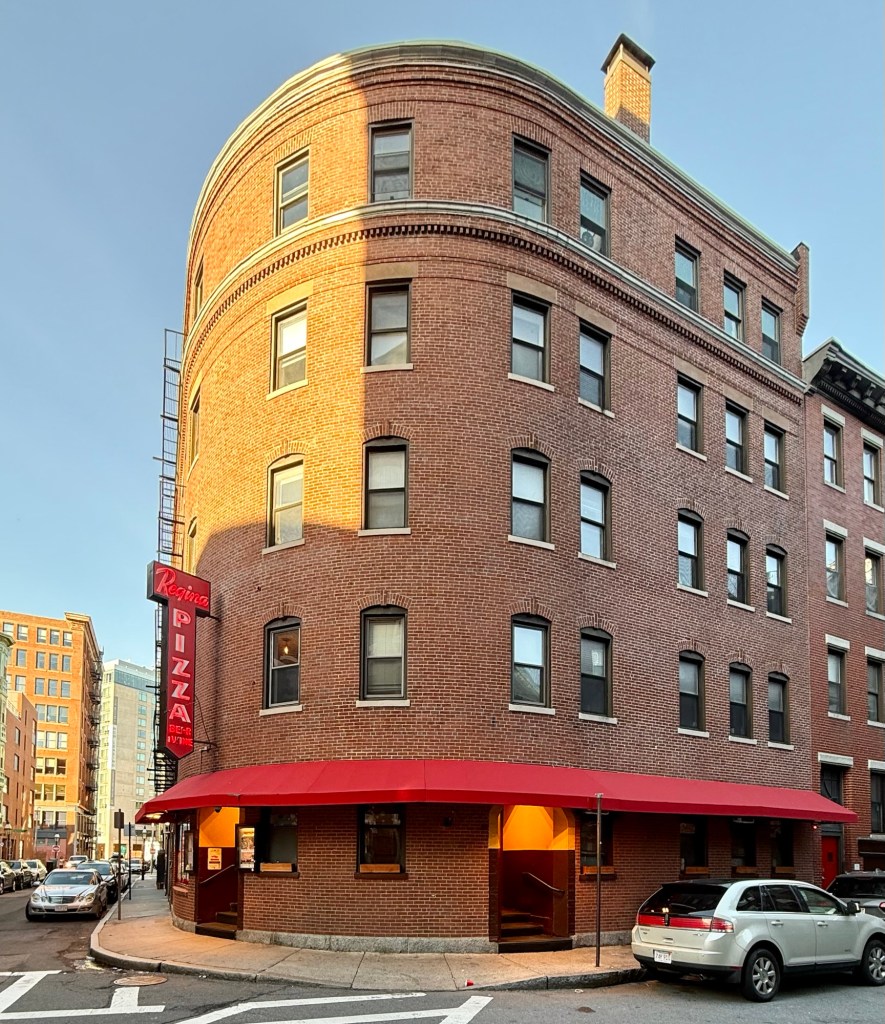
What is your favorite pizzeria in the Boston area? For many, it is likely to be Regina Pizzeria, but specifically this location in Boston’s North End. The building was originally constructed in 1886 for the Boston Cooperative Building Company, a charitable organization which built and rented tenement housing for low-income residents in the city. Many recently arrived immigrants would have lived in the building and paid a nominal rent, giving them the opportunity to work and grow their savings to move into better, more permanent housing. The Association was incorporated in 1871 and its original stockholders represented the financial elite of Boston. As a result of their financial backing, the association was able to hire the white-shoe architectural firm of Cabot & Chandler to design this tenement block in 1886. While not ornate, the building fits within the late 19th century vernacular of brick tenements of the North End. The building is now best known as the home to Regina Pizza, which was founded in 1926 by Luigi D’Auria, who was born in Campania, Italy, who purchased the building around that time. Regina Pizza (translated to “Queen Pizza” in Italian), was sold to the Polcari family in 1956, who have operated the restaurant since. The pizzeria with its prominent blade sign is one of the best landmarks in the North End.
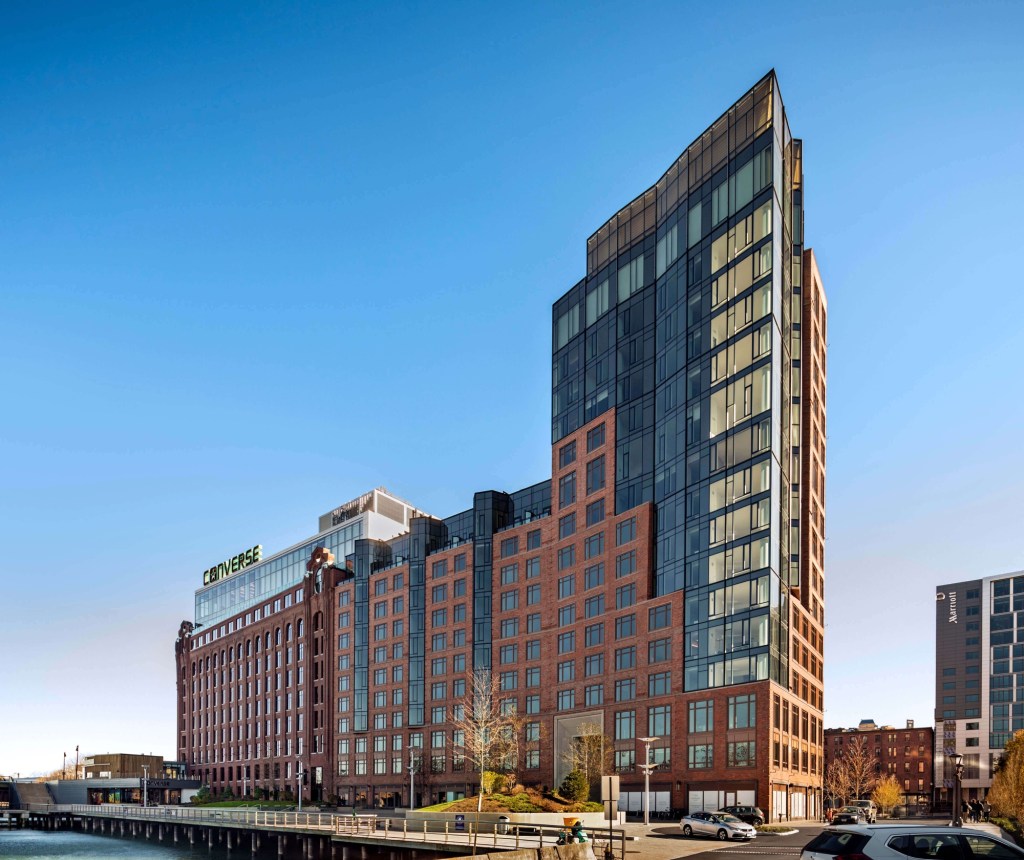
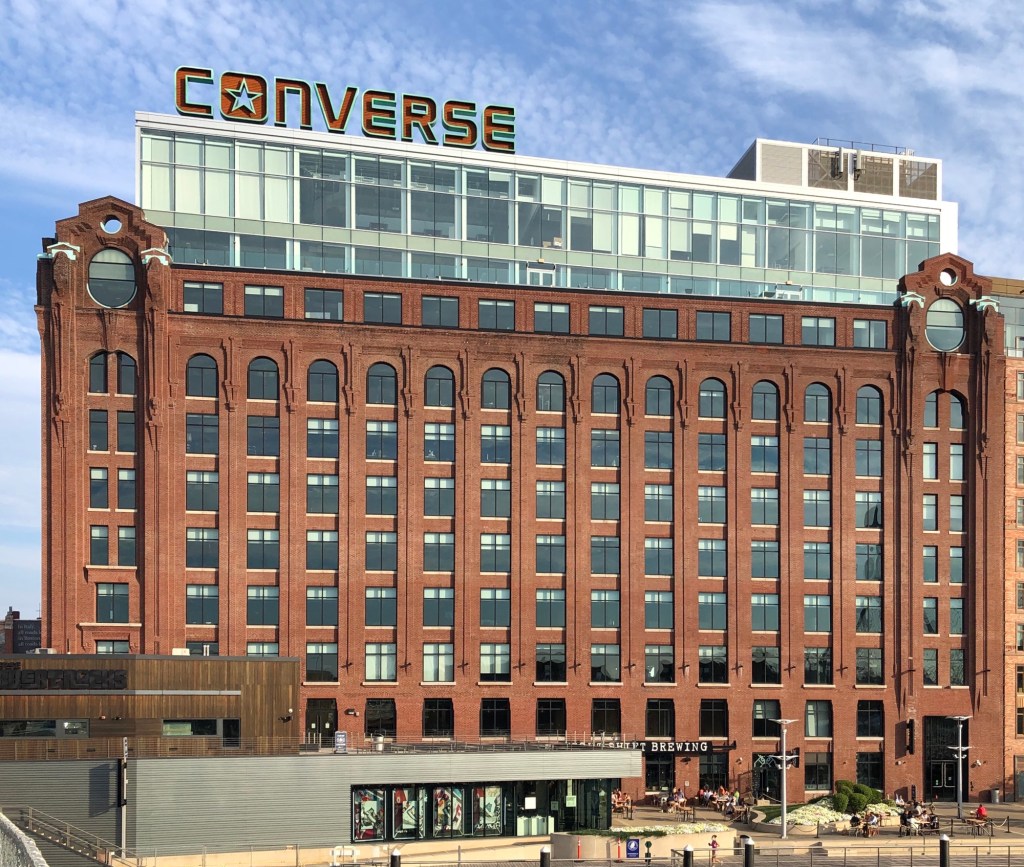
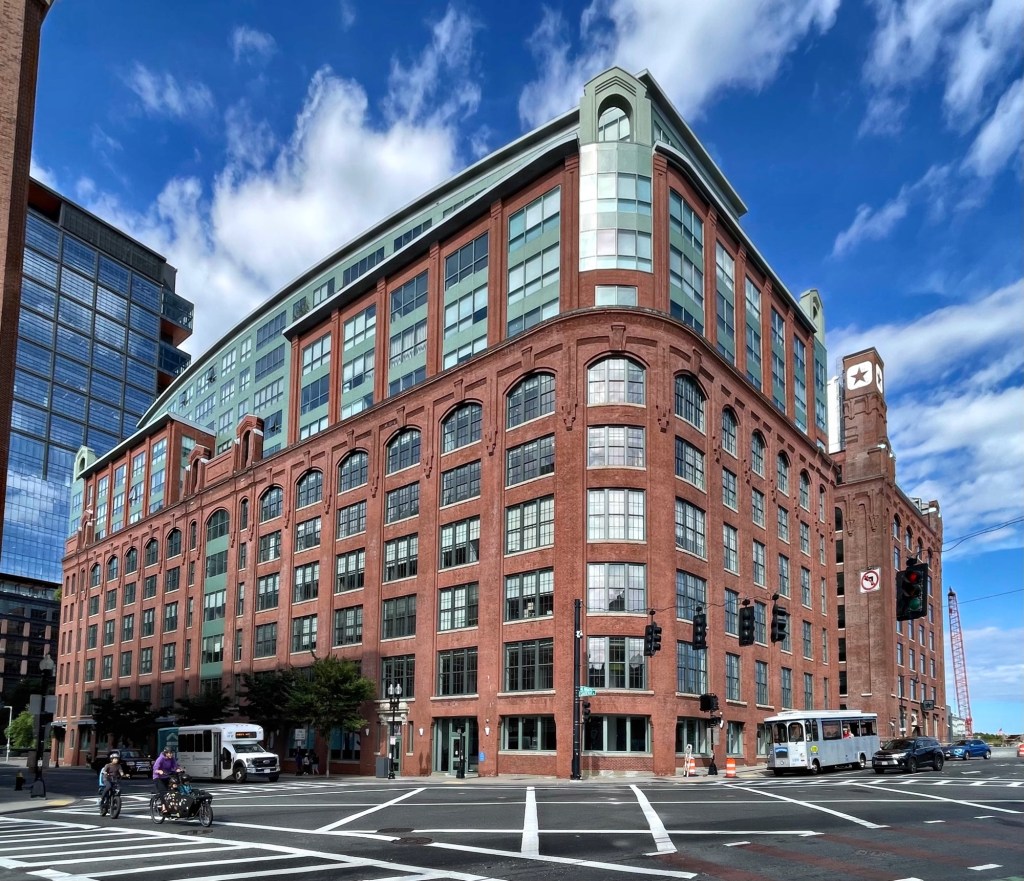
New buildings in Boston rarely are contextual and so often take no cues from their surroundings, but Lovejoy Wharf, one of my favorite 21st century buildings in the city breaks that mold. Completed in 2017, the contemporary building is clearly modern, but takes important cues in the design and materials to relate it to the surrounding industrial context surrounding the site. The Lovejoy Wharf condominium building was designed by the great Robert A.M. Stern Architects and incorporates red brick facades, stacked bay windows, and a glass curtain wall, which effortlessly blend old with new. A glass tower breaks free from the masonry mass at its corner, which leads into the denser, more modern West End buildings while the eastern side closely follows the old Schraft’s Candy Factory (now Converse Headquarters building) brick industrial style. Additionally, the developer, Related Beal, took a gamble by not including parking in the facility, hoping the unit owners would instead use local public transportation (or walk), it seems to have been a success and promotes healthy urbanism. What do you all think of this contemporary building?
Possibly my favorite building in the Bulfinch Triangle/North Station area of Boston is this brick behemoth. Known as the Schrafft’s Candy Factory, Hoffman Building, Lovejoy Wharf, Submarine Signal Building, etc., the building was constructed in 1907 from plans by Codman & Despradelle and first-occupied by the Schrafft’s Candy Company. It held the candy makers until 1928, when Schrafft’s moved to Charlestown, building their massive factory in Sullivan Square. A landmark in the Panel Brick style of architecture, prevalent in industrial and multi-family structures in the late 19th and early 20th centuries, the old factory saw many later uses from cold storage, to a Submarine Signal Co. before it was largely vacant by the end of the 20th century. Through Preservation Tax Credits and grants, developer Related Beal was able to reimagine the building, restoring it to its former glory. The Architectural Team (TAT) oversaw the renovations and expansion of the building with a glass crown with the project accommodating the corporate headquarters for world-renowned sneaker manufacturer, Converse.
Originally constructed in 1906 for the Austin Biscuit Company, this building on Causeway Street serves as both a gateway into Boston from the north and as an excellent example of adaptive reuse with thoughtful additions. The massive structure, which was originally two separate but connected buildings are a significant example of the panel brick construction with Romanesque detailing. Part-owner of the site, Edmund Dwight Codman hired his brother, architect Stephen Russell Hurd Codman (1867-1944) and business partner Constant-Desire Despradelle (1862-1912) to design the building which was immediately rented out to the Austin Biscuit Company and the American Glue Company. When opened, the Boston Daily Globe wrote that it was “…a large new building of a thousand windows, a building which on fine days is flooded with sunshine and good air”. By the late 1900s, the building was altered and suffering from deferred maintenance, with an unknown fate. Luckily by 2001, the local architectural firm of Finegold Alexander, was hired to re-envision the building. They converted the two connected buildings into a unified mixed-use residential condominium and retail/office complex. The adaptive reuse of this building provided for 108 dwelling units in the top six floors (in the addition), offices on floors two through six, retail space on the first floor and garage parking in the basement. This is one of my favorite success stories in Boston architecture and historic preservation!
 Buildings of New England