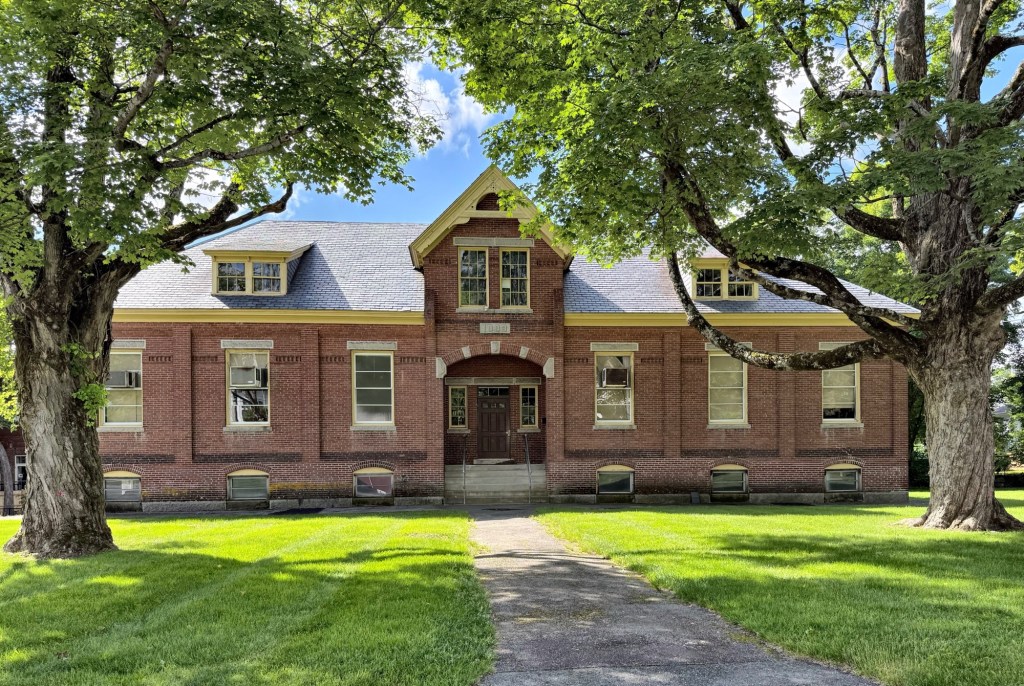
Lancaster Central School // 1904

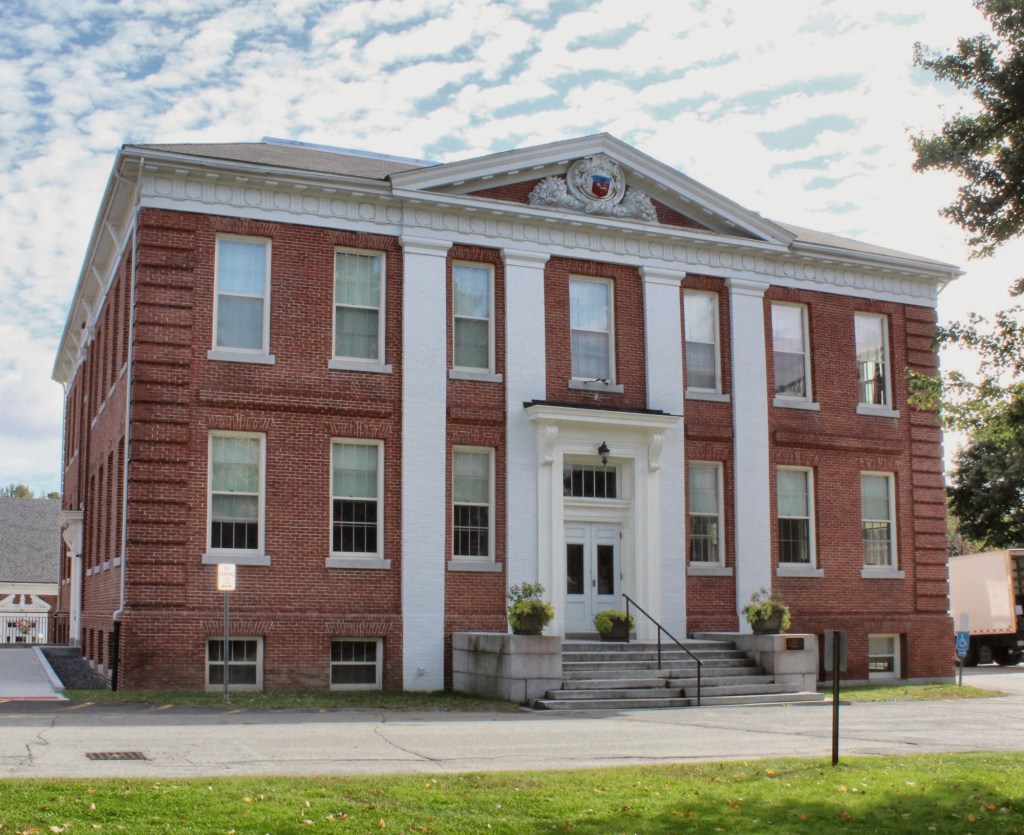
Located across the Town Common from the iconic Bulfinch Church in Lancaster, Massachusetts, this handsome 1904 Colonial/Classical Revival style school building was designed in response to its neighbors and Colonial context of the town of Lancaster. At a Town Meeting in 1903, a local building committee determined that “Bulfinch Colonial” would be the best style for the architecture for a new high school that would be built in the town center, with Herbert Dudley Hale, selected as the architect for the planned two-story brick building. The Center School had been used continuously as a public school until 2001, when it outlived its utility as school facility in town, which was vacated for years until grant funding and a restoration of the building, now known as the Prescott Building, for Town Offices, including the Lancaster Historical Commission. The facade is dominated by its seven-bay symmetrical façade featuring brick
corner quoins, double-door entrance, and two-story white-painted brick pilasters framing the entrance and “supporting” the pediment that contains the town crest in high-relief.
Forbes Public High School // 1924

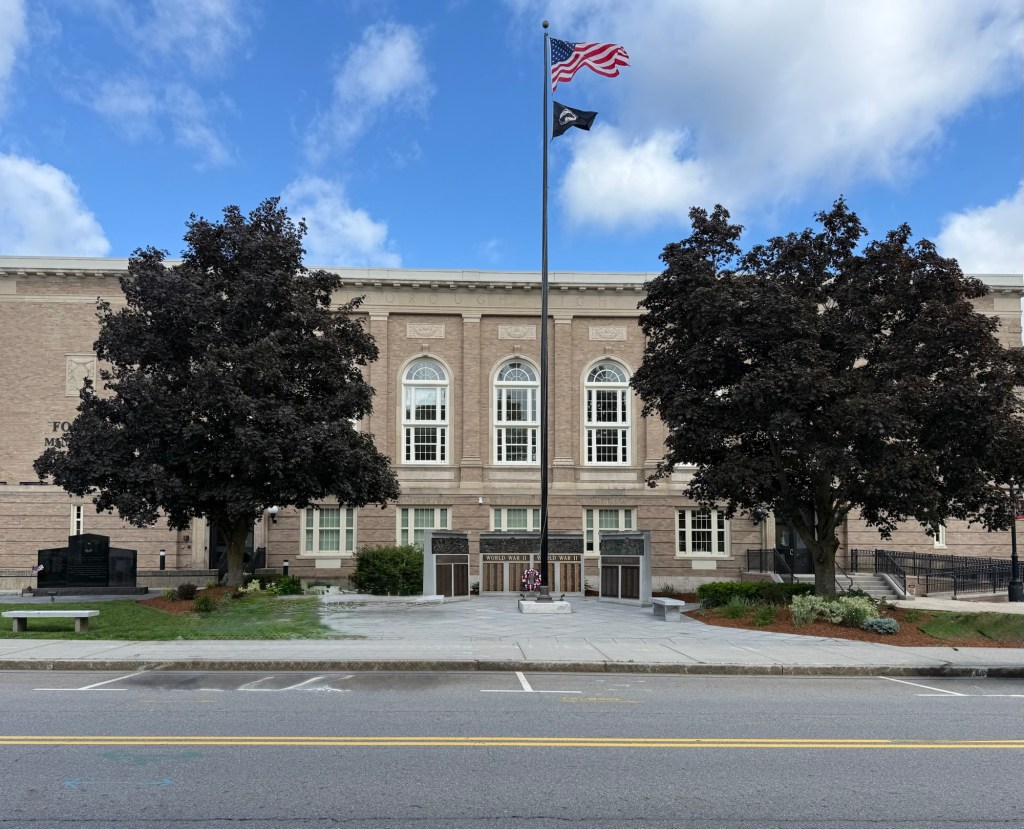
The former Forbes Public High School in Westborough, Massachusetts, is an excellent example of a civic building in the Classical Revival style. Built in 1924 for a growing suburban community, the building was constructed as the town’s high school with the grounds and substantial funding donated by Francis and Fannie Forbes, life-long residents of town with Francis having roots going back to the earliest settlers here. The building was permitted in late 1924 and plans were drawn by the firm of Ritchie, Parsons & Taylor. who designed the large school with stone and brick construction, large arched windows, and pilasters breaking up the bays. Inside, the new building had 14 classrooms, a gymnasium, a shop room, and cooking rooms, all with fine carved woodwork. After WWII, Westborough further consolidated its schools, and built a new High School nearby. This building was repurposed as the Forbes Municipal Building, containing city offices and the Police Department headquarters.

Harvey School // 1883

Built to meet the needs of an expanding and prosperous community, the Harvey School in Westborough, Massachusetts, was built as a neighborhood school and is both historically and architecturally significant. Located on Phillips Street, a residential, tree-lined street just north of the commercial center of town, the Harvey School was built in 1883 under the supervision of Dr. Edwin Bayard Harvey, a local doctor who served on the town’s School Committee and as superintendent of schools from 1887-1890. As a State Senator he introduced a bill in 1884, which became law, to provide free textbooks for schoolchildren of Massachusetts. The Queen Anne style school building was in plan, designed by Dr. Harvey, who hired the Worcester-based architectural firm of Barker & Nourse, to furnish plans and design the building itself. The school would eventually close in 1980 as many local schools were consolidated, and the building was rented to the Boy Scouts and the Westborough Community Chorus. Recent attention on the under-utilized building has initiated more discussion on the future of the building, which may eventually house a regional emergency communications center.

Georgetown Brick Schoolhouse No. 4 // 1854

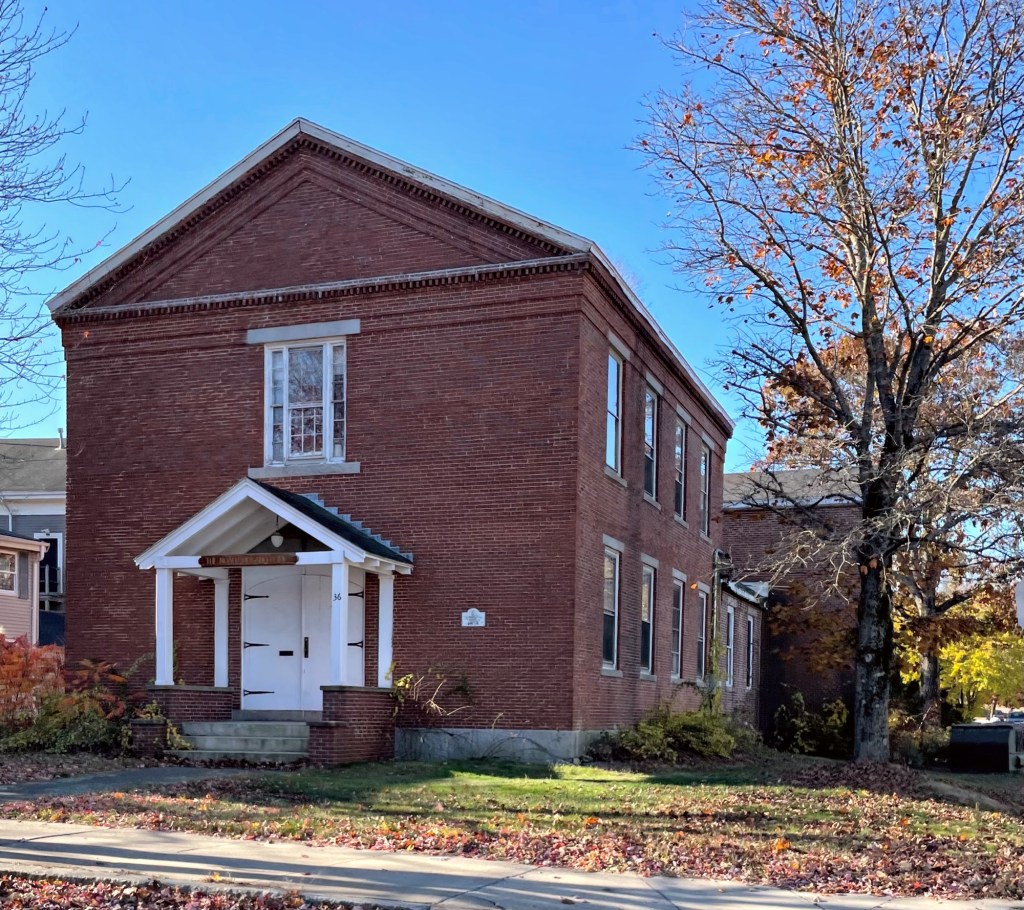
Constructed in 1854 for intermediate and high school classes at a time when one-room schoolhouses were still the rule in Georgetown, this well-preserved brick building is a reminder as to how far education and schooling has come. As nearby one-room schools consolidated and after the new Central School Building (now Georgetown Town Hall) was built in 1905, this Greek Revival school building was converted to town offices. The town was still fairly small, so the offices only occupied the ground floor, and the town rented the upper floor to the All Saints Episcopal Church, who purchased the building in 1917 and occupied it for nearly 50 years. They likely added the Craftsman style entry porch. The church was deconsecrated in 1966, and the building sold in 1970 to the Noack Organ Manufacturing Company, who added an assembly room at the rear.

Old New Ipswich Center Schoolhouse // 1829

Presently owned and occupied by the New Ipswich Historical Society, this handsome brick building was originally constructed in 1829 as a schoolhouse for young students in town. The structure is located on Main Street and replaced wood-frame school that was located on the other side of the road. Almost immediately after it was built, the building and its location were heavily criticized as early as 1847. There were up to 92 pupils in its two rooms, both of which were accessed by a central entrance, causing those entering and leaving to disrupt both classrooms. Additionally, the closeness to the road caused noise and dust to enter the classrooms. The school closed in 1860 and was used for a time as a blacksmith shop before it was acquired by the New Ipswich Historical Society in 1939.

North Weare Schoolhouse // 1856

The Town of Weare, New Hampshire was first divided into thirteen school districts in 1805 as a result of a state law to divide each town into school districts to service all students equally. Over the years the number of school districts fluctuated and were periodically redefined based on population distribution and class sizes. The North Weare Schoolhouse was built in 1856 and was operated as a one-room school until 1952 when a consolidated school was built in town. Architecturally, the building blends multiple styles, most notably the Greek Revival and Italianate styles. The property was later occupied as a Grange Hall with a 1960s addition to the rear. It was purchased in 1985 by new owners who had spent years restoring the building as a residence before they sold it more recently. Today, the former schoolhouse has modern additions and windows, but maintains its charm and uniqueness.

Brookline Round Schoolhouse // 1822

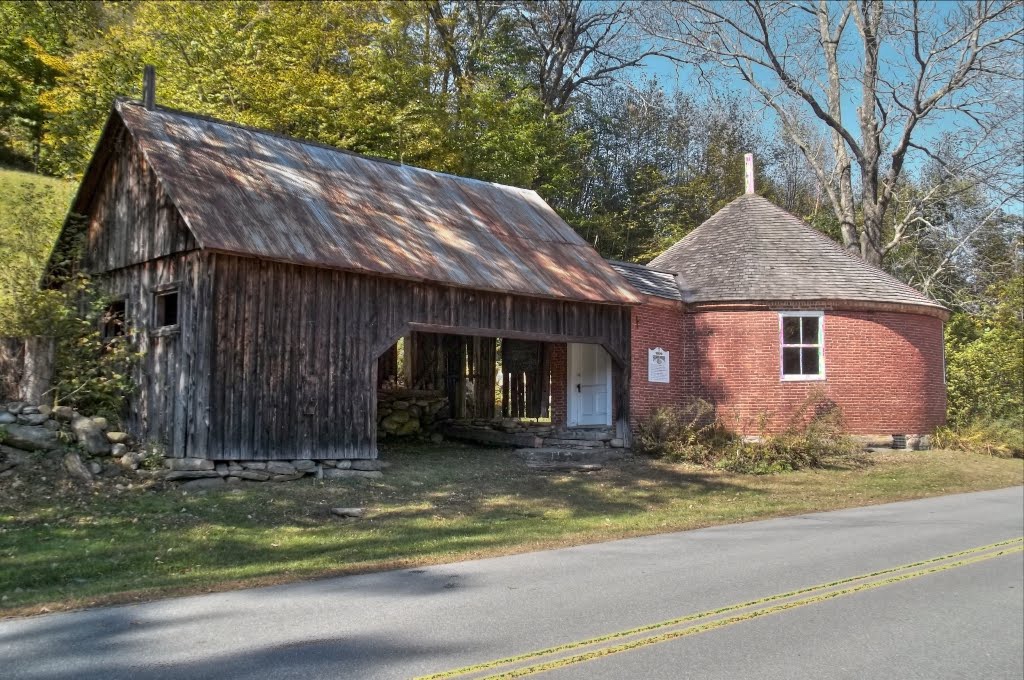
Historic schoolhouses in rural New England are often one-room wood-frame buildings, but not in Brookline, Vermont! The Brookline Round Schoolhouse is constructed of brick and… you guessed it, ROUND! The iconic building sits on the same road as the Baptist Church in town (last post) and likely built from bricks made at the same brickyard. The school was built in 1822 to replace a log school house originally built nearby. The plan for the round design was apparently made by Dr. John Wilson. Wilson, known as “Thunderbolt”, was reputed to have been a robber and highway-man who came from Scotland to escape punishment. He eventually settled in Vermont and had many occupations but settled on saying he was a doctor and began practicing. He eventually took up teaching and somehow convinced the town he should design the new school building. Local legend asserts that Wilson designed the school house round so that he could see from any position, all possible intruders. At the interior, the single-room originally contained sixty oak benches and desks arranged in a circular position facing a teacher’s desk near the door. The building is capped by a conical wood shingle roof, which appears in great condition. The structure functioned as a school until 1929, when a new school was built which conformed to state codes. At this time the round school was turned over to the town for use as a Town Hall, a use it held until the 1980s.