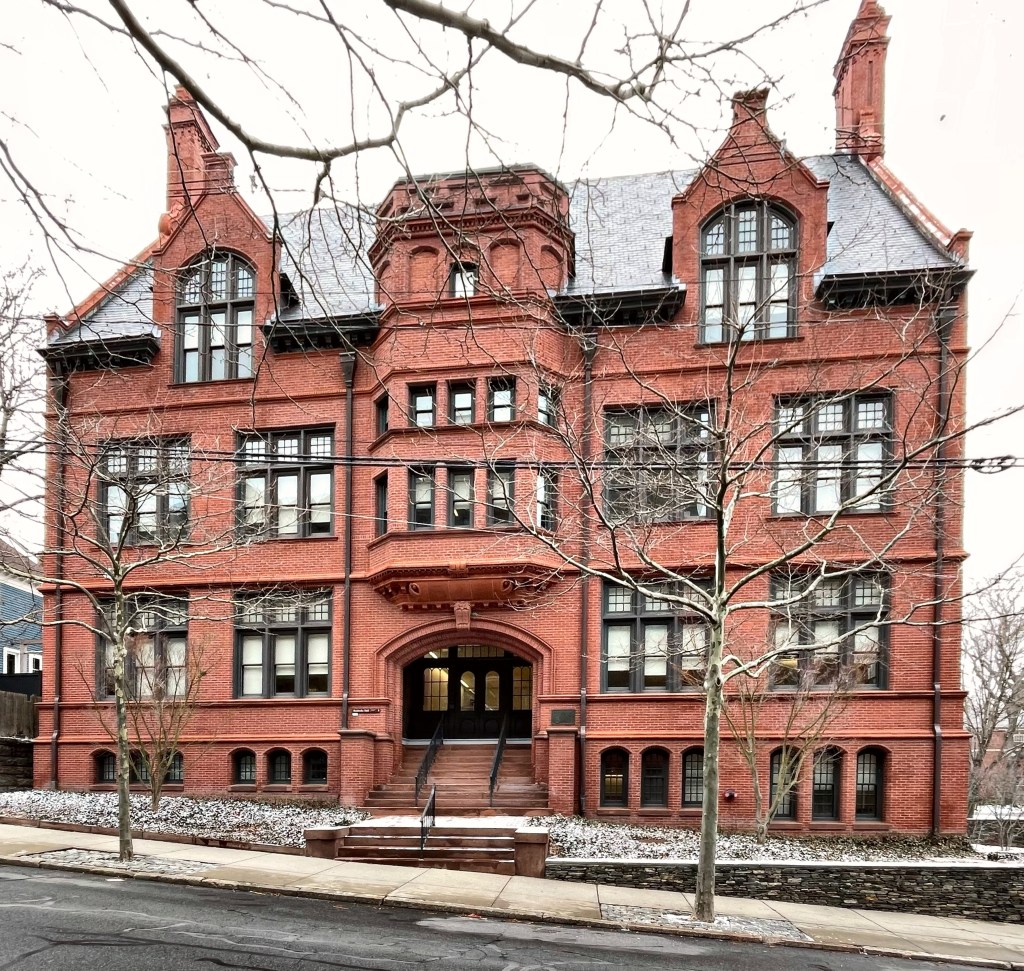
Rose and Howard K. Hilton House // 1900

Tudor Revivals may just be my favorite style of house. The interesting roof forms and gables, the use of stone, brick or stucco, and the presence of garrisoning and half-timbering in designs are always so charming. This enchanting Tudor Revival home in Providence, Rhode Island, was built in 1900 by local architect Howard K. Hilton (1867-1909) as his personal residence with wife Rose. He first worked in the office of H. W. Colwell and continued his training under Ellis Jackson joining him in partnership (Jackson & Hilton) and under the firm name was identified with the design of several churches, schools, hospitals and various other buildings in his native city before he retired in his final years. This home is very unique for its site on a narrow urban lot with the door at the side, brick first floor with jettying at the second floor of wood construction with half-timbering. While writing this, I noticed that there are also projecting gargoyles which serve as water spouts to send water away from the structure during rainfall events. Tudors are really the best!

William Binney House // 1859

Another of Providence’s stunning monumental Italianate mansions on College Hill is this, the William Binney House, which was built in 1859 from plans by local architect Alpheus C. Morse. In the mode of an Italian Renaissance palace, it features a strong, symmetrical facade, molded string course, classic trim detail at the windows and doors in brownstone, and a shallow hip roof. The original owner, William Binney (1825-1909) was born in Philadelphia and became a prominent attorney and became involved on various boards, building more wealth. Additionally, he was elected as member of the Rhode Island Assembly and the Providence City Council continuously 1857 to 1874. The house’s rear ell and wooden bay would provide sweeping views to Downtown Providence even today from the aptly named Prospect Street.

First Church of Christ Scientist, Providence // 1906

One of the most stunning and monumental buildings in Providence is this building, a church which pretty closely resembles the Rhode Island State House! Christian Scientists in Providence began to hold informal services in 1889 and received a charter from the state legislature in 1895. Construction started on this church, the First Church of Christ, Scientist in 1906 from plans by local architect Howard Hoppin who roughly modeled the building after the congregation’s Mother Church in Boston. The Classical Revival building is capped by a copper hemispherical dome supported by a colonnade of Corinthian columns. The main block of the structure at the street is fairly modest, possibly due to the residential character of its surroundings.

Andrews Hall – Brown University // 1947

Andrews Hall was built after WWII to serve as a dormitory for Pembroke College, the women’s college affiliated with Brown University (later merging in 1971). The new building was named for Elisha Benjamin Andrews, president of Brown University (1889-1898) who was instrumental in the establishment of the college for women in 1891. The new building created a central link, joining Miller and Metcalf halls and nearly doubling the dormitory capacity of Pembroke College, creating an enclosed yard in the process. The architectural firm of Perry, Shaw, Hepburn & Dean (in existence today as Perry Dean Rogers Architects) was hired to provide the plans, which serves a northern edge of the small former Pembroke College quad. Principal architect Thomas Mott Shaw used specially colored brick to give the building a weathered look to achieve harmony with the two buildings which it connected. The style of Andrews Hall is Colonial Revival with a hip on cross-gable roof and is constructed of brick with central three-bays clad limestone facing the courtyard. The building is set over the dining hall which is set into the sunken landscape with the terrace above. The three buildings were recently renovated by CBT Architects and shine today!

Alumnae Hall – Pembroke College – Brown University // 1926

It’s not often that a building has not one, but three distinct and beautifully designed facades. Lucky for us, the 1926 Alumnae Hall at Pembroke College (now Brown University), fits the bill! Alumnae Hall on the Pembroke Campus was dedicated in October 1927 with funds for the building raised through the efforts of the Alumnae Association with Stephen O. Metcalf would duplicate all gifts of students and alumnae. The campaign continued until 1926, when the $50,000 contributed by the students and the $150,000 contributed by the alumnae, together with Mr. Metcalf’s matching funds, were deemed sufficient to start the building. The cornerstone was laid in May 1926 with the Boston architectural firm of Andrews, Jones, Biscoe and Whitmore as architects, who designed the building in the Colonial Revival style. Alumnae Hall, built of brick with limestone trim, was designed to accommodate the social and religious activities of the Women’s College. Its main entrance is a balustraded stone terrace on the campus leading to an auditorium on the main floor, the various sections create a visually stunning complex of wings and facades built into the landscape.

Sayles Hall – Pembroke College – Brown University // 1907

Sayles Hall was the second purpose-built building erected for Pembroke College, a women’s college affiliated with Brown University in Providence. Sayles was originally built as a gymnasium facility for female students and was designed by the same architects as Pembroke Hall, Stone, Carpenter and Willson. Architecturally, the building compliments Pembroke Hall which was built the decade prior with the use of red brick, terracotta trim, and arched openings and gabled pediments at the roof. The funds for the construction of the building were a gift from Frank A. Sayles (whom the building was originally named after). Until 1990, Sayles Gym was used for sports and offices by the Physical Education Department. In 2001, Sayles Hall was completely renovated and converted into classroom space, receiving a new name (Smith-Buonanno Hall). A great example of adaptive reuse!

Pembroke Hall – Brown University // 1896

Brown University from its founding in 1764 until 1891 never admitted women. Brown’s all-male student body was first challenged in 1874, when the university received an application from a woman (who to this day is still unnamed). The Advisory and Executive committees decided that admitting women at the time was not a good proposal, but they continued to revisit the matter annually until 1888, when they began work to establish a separate women’s college affiliated with Brown. After similar institutions like Radcliffe (affiliated with Harvard) and Barnard College (affiliated with Columbia) were established in 1879 and 1889 respectively, Brown had a blueprint for how to operated the new women’s college. Professors at Brown would work alongside women educators and taught many of the the same courses to men as they did for female students. Pembroke Hall was the first building for Pembroke College and was built in 1896 from plans by local firm Stone, Carpenter and Willson in the Elizabethan Revival style. The building was designed to be multi-purpose with administrative offices, classrooms, reception rooms, and a library in the attic. Pembroke College was officially merged with Brown University in 1971, which was long overdue. The building is one of the finest on Brown’s now co-educational Ivy-league campus.

H. P. Lovecraft House // c.1823

In 1823, Samuel B. Mumford (1791-1849) purchased a lot on College Street in Providence and erected this modest Federal style home. The house’s marker reads “Samuel Mumford House”, but the most famous resident was actually Howard Phillips Lovecraft aka. H.P. Lovecraft (1890-1937). Lovecraft was born in Providence, Rhode Island, and lived almost his entire life there besides a few years in New York. He resided in a few places in the city but eventually settled in this home which he rented a room in his final years. Sadly, Lovecraft died at just 46 years old from intestinal cancer, and was largely unrecognized during his short, impoverished life. Since his death, he’s grown in literary stature to become one of the great fantasy classic horror authors of all time. While Lovecraft only lived in this home from 1933-1937, it was the location where he wrote his most mature and final pieces. I bet he would never imagine how popular he would become (even with an HBO series based on his worlds). The house was moved in 1959 (due to Brown University’s ever-growing and expanding campus) and now sits not too far from Prospect Terrace a small square that Lovecraft visited frequently during his time in Providence.

Edward Aldrich House // 1902

Built next door and just a year after the Hidden Family House (last post), the Edmund Aldrich House in Providence’s College Hill neighborhood shows how stately a wood-frame Colonial Revival house can be! The property was purchased by U.S. Congressman and U.S. Senator, Nelson Wilmarth Aldrich (1841-1915) who quickly sold the lot to his son Edward Aldrich, who worked as president of the Times Publishing Company and was very engaged in Republican politics along with members of his family. The Colonial Revival style dwelling was designed by Providence architecture firm, Stone, Carpenter & Willson, who were pretty prolific in this part of the region by this time. It exhibits a gambrel roof punctuated with segmental pedimented dormers along with a segmental pedimented portico over the entrance. Swoon! In his will, Edward left the property to Brown University, who apparently saw no need for the property and eventually sold it to private owners. The owners today maintain the house very well.

Walter and Kate Hidden House // 1901

I love a good high-style Colonial Revival home with big proportions and warm red brick! This example on College Hill in Providence is a great example. The 2 1/2-story dwelling is five bays at the facade with a center entrance under a hollow pediment hood with an enframement which reads much in the Palladian-realm. Owners Walter and Kate Hidden hired local architect Wallis Eastburn Howe to design their elaborate Colonial-inspired home in 1901, they moved in within a year. Mr. Hidden worked at his father’s business, and in 1875 became a member of the firm of H. A. Hidden & Sons. He did well for himself and became a member in many social and outdoors groups including the Audubon Society, the Squantum Association, the Hope Club, and for five years was president of the Agawam Hunt Club.