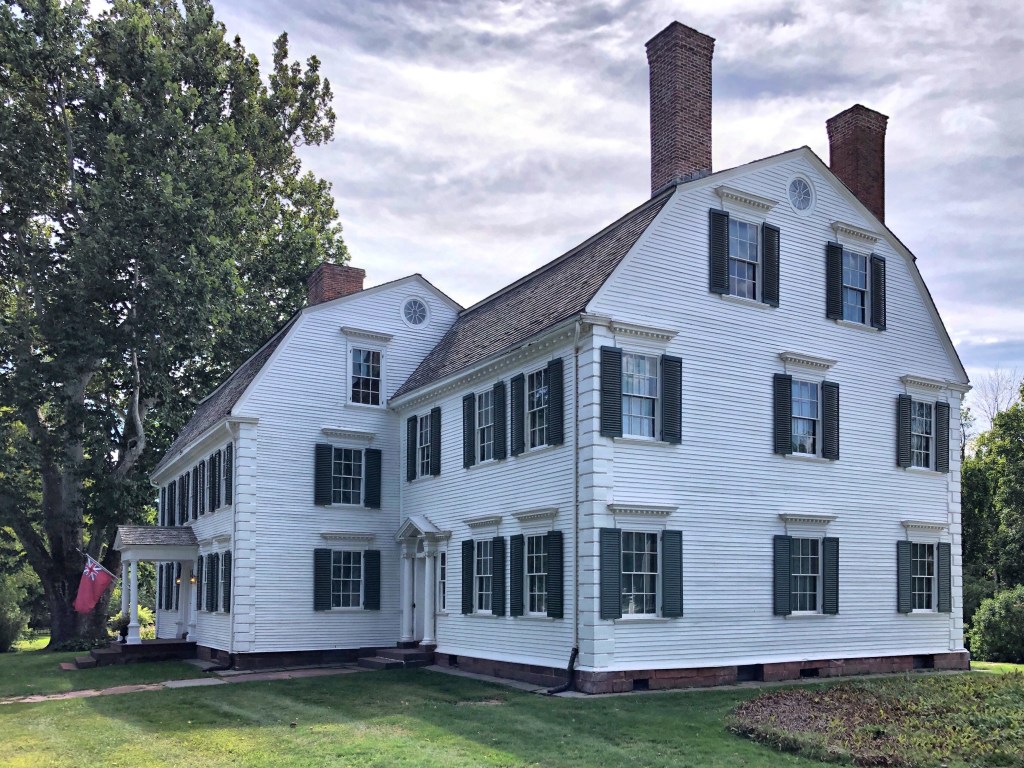
Gay Manse // 1743

Ebenezer Gay (1718-1796), the third minister of the First Congregational Church of Suffield, was born in 1718 in Dedham, Mass. His father was a substantial farmer, and his uncle was the famous minister, Ebenezer Gay of Hingham. Young Ebenezer graduated from Harvard in 1737, and held his first preaching job three years later. Reverend Gay became a candidate for a pastor in the Suffield Congregation, becoming ordained in 1742. That same year he married his wife, Hannah, and they had this massive home built adjacent to the town’s church. Rev. Gay and his wife had no children, but had adopted a black girl “Sybil” who was baptized as the “child of Ebenezer and Hannah”. There were other black members in the Gay household in later years including Titus Gay. “Old Ti” was born in 1787, and lived nearly his entire early life in Suffield, CT. He was born to a family of slaves also owned by Reverend Ebenezer Gay, making him born into slavery. His mother, Rose Gay, was a princess in Africa, and his father was owned by Major Elihu Kent. Reverend Gay was the pastor of the church until his death in 1796. The home was later occupied by other pastors at the church, and was eventually acquired by Suffield Academy for use as housing. The gambrel roof Georgian mansion features a stunning Connecticut Valley doorway with swan’s neck pediment.

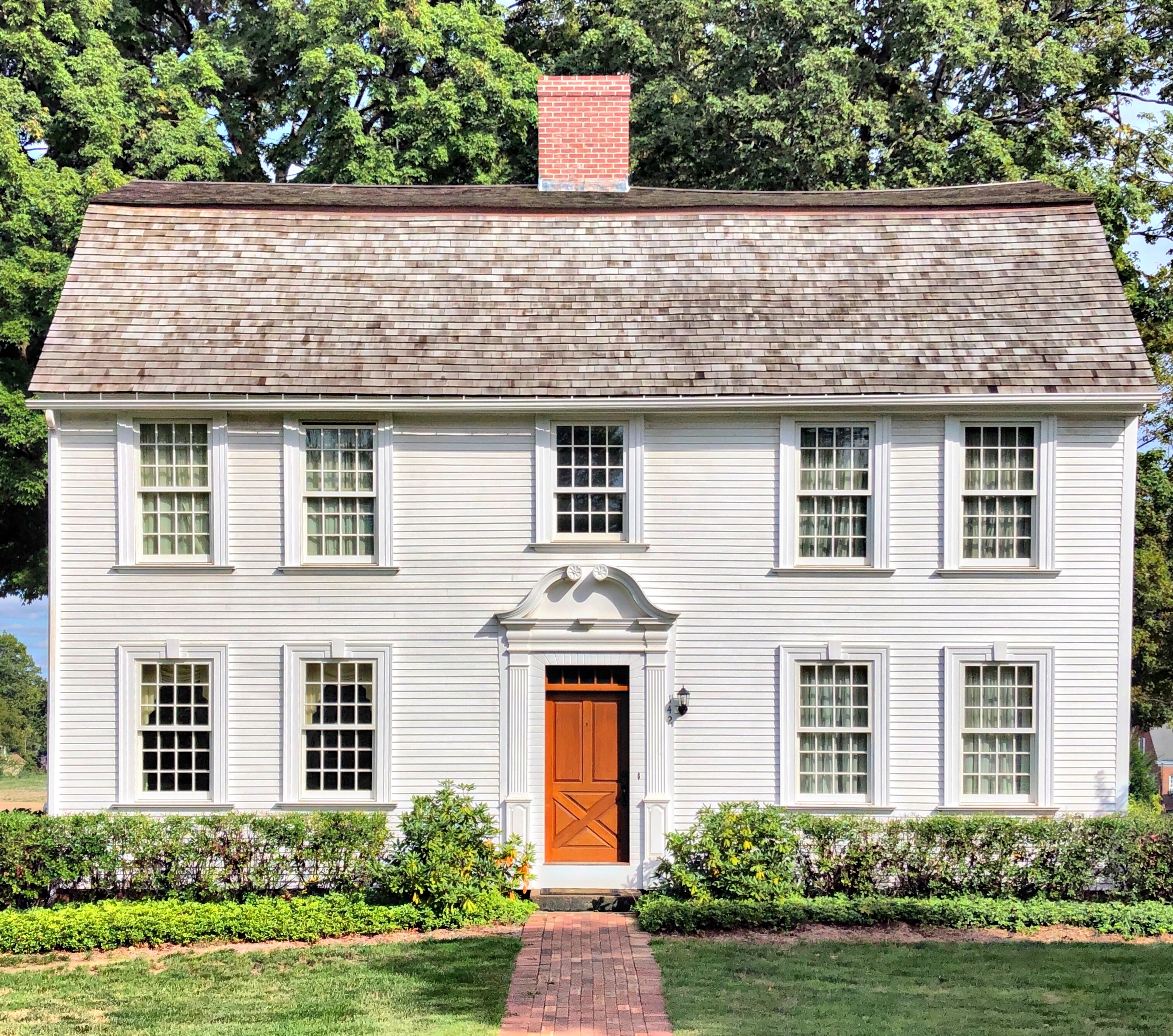
Elihu Kent Jr. House // 1787

In 1775, when news of the Battle of Lexington reached Suffield, Elihu Kent Sr. (1733-1814) at the age of 42 took command of a local militia of 59 men the next day, along with his son Elihu Kent Jr., 18, and his slave Titus Kent, and marched to Springfield, before heading toward Boston. Initially, slaves were discouraged from enlisting in the Continental Army as the Continental Congress was trying to appease the southern states into fighting in the Revolution. England offered freedom to slaves who fought for their side. forcing the Continental Congress to do the same in order to keep a balance. The militia later ended up on Long Island and Kent Jr. was captured by British forces and confined for a long time as a prisoner of war in the old Rhinelander Sugar House in New York. After his return to Suffield, Elihu Kent Jr. had this Georgian home built for his family.

Thomas and Esther Smith House // c.1758

The Thomas and Esther Smith House in the Feeding Hills area of Agawam, Massachusetts is a 1½ story, vernacular Georgian style house with a gambrel roof. Feeding Hills, so named for its bountiful soils, is an agricultural plain approximately five miles west of the Connecticut River at the eastern foot of Provin Mountain. The land was highly sought after by farmers, with many agricultural uses still taking place here to this day. This parcel of land was purchased by Thomas Smith, a carpenter, in 1757, who likely built the home soon after for his new family. The family occupied the home into the mid-19th century, harvesting crops and raising cattle for sustenance and sale. The agricultural property was subdivided numerous times and now sits on just an acre. The home and remaining land was purchased by the Agawam Historical Society in 2002, who maintain the property and educate on Agawam’s agricultural heritage.

Captain Benjamin Smith House // 1790

The Captain Benjamin Smith House at 34 South Summer Street in Edgartown was constructed around 1790. The building sits on land that was once owned by the Coffin family who owned a broad sweep of land from Edgartown Harbor back to Pease’s Point Way. Many of the oldest houses in town were constructed by members of this family who had first settled in Newbury. Smith, a military captain who commanded a company of militia on Martha’s Vineyard during the Revolutionary War, was married to a member of the Coffin family and the family owned the home for over one hundred years. After successive ownership, in 1939, the Vineyard Gazette took over the building. The Gazette was the first newspaper to be published in Dukes County, and remains in the building to this day.

John Coffin House // 1703

This historic Georgian mansion was built in 1703 for John Coffin (1647-1711) who moved to Edgartown by the way of Nantucket and Haverhill, Massachusetts looking for new work. John Coffin opened a blacksmithy
on the waterfront in Edgartown and immediately prospered, building this home after his success. Legend says the home was actually right on the street before the street was widened and after, the front steps and home’s location obscured the view of other buildings on the street. The home was moved back on the lot in its bucolic setting now amongst the hustle and bustle of downtown Edgartown. The home was threatened with demolition almost all of the 20th century due to the commercial nature of its location. Thankfully, it was acquired by the Vineyard Trust in 1946, who preserve it to this day with small businesses located inside.

Norton-Coffin House // c.1740

This home on the idyllic Water Street in Edgartown (maybe my favorite town in Massachusetts) was built in two main phases in its storied history. What is now a rear ell, was built as a home around 1740 by “Squire” Norton, who ran the Customs office out of the house in his role as Customs Collector in town. The home was located in the current location of North Water Street, which had to jog around the home until the early 19th century when it was moved to the current location and altered as an ell of the new house standing there. The home was later owned by Captain Edward Coffin (1850-1917), a renowned sea captain. At just 15 years old, Edwin Coffin left Edgartown to be a cabin boy on his first ship. Through the end of the 19th century, he voyaged on numerous whaling vessels and served as captain on many. In 1902, Captain Coffin was chosen to command the steamer America, which carried the Fiala-Ziegler Expedition, a failed attempt at reaching the North Pole. The party remained stranded north of the Arctic Circle for two years before being rescued, yet all but one of its members survived.

Daniel Walker House // 1784

One of the older extant homes in Kennebunkport is the Daniel Walker House on Maine Street. After the American Revolution, shipbuilding and other maritime industries grew along the Maine coast, especially in Kennebunkport (then still named Arundel). Sea captain Daniel Walker built the home on ample land on the outskirts of the village at the time. By the early 19th century, he sold off much of his land closer to the river to family and friends. The Georgian home is minimal, yet commanding with its massive facade, rusticated lintels and corners, an elaborate entry and a large central fireplace.