Talitha Cumi Home // 1912

One thing I love about Boston is that nearly every old building has such a rich history that takes so much time to compile and write up (this account keeps me busy)! Located on Forest Hills Street in Jamaica Plain, this stucco building caught my attention when driving by, so much so, that I had to stop and go back. The building was constructed in 1912 as a home for unwed mothers called Talitha Cumi Home (a phrase from the Bible meaning “Arise, young woman”). The charitable organization outgrew their space in the South End and sought greener pastures and open space in Jamaica Plain. The group had been organized in 1836 by “earnest Christian women” who longed to open a “door of hope” to “those hopeless and helpless girls who found themselves facing the sadness and shame and wrong of unwed motherhood.” The Talitha Cumi Home allowed pregnant women to reside and birth their children before their pregnancy began to show. The site originally included an administration building and a hospital with both structures connected by a covered breezeway. The home closed in the 1950s and the former home for unwed mothers has since been converted to a middle school.
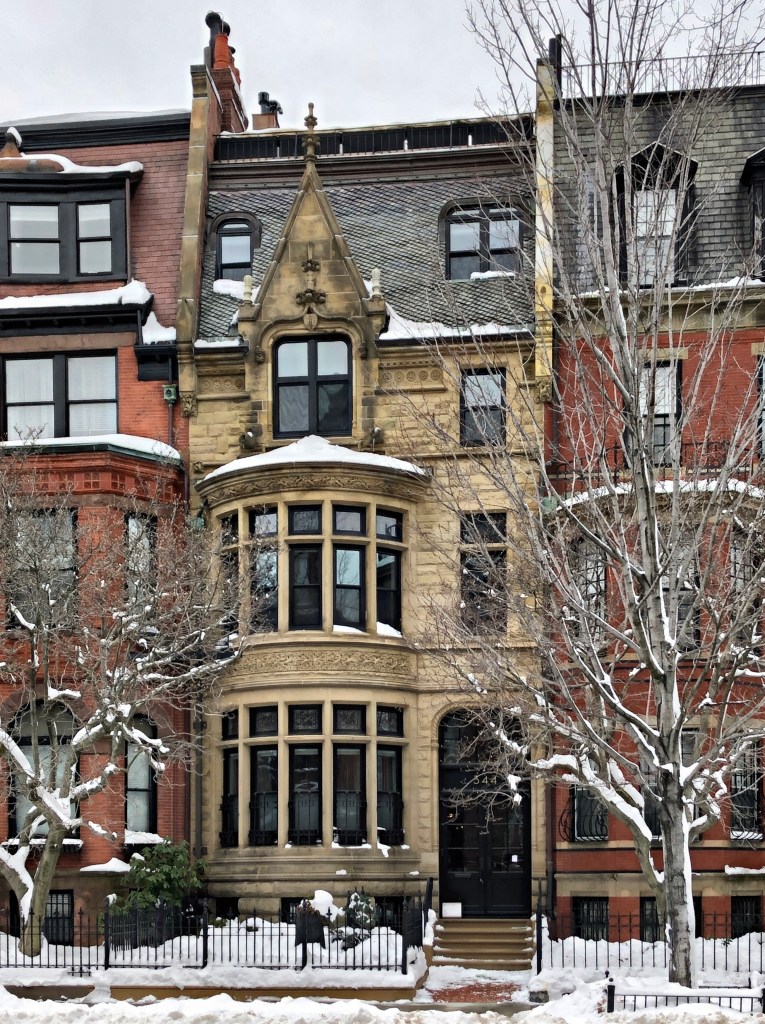
Daniel and Mary Knowlton House // 1880

Another of my favorite townhouses in the Back Bay neighborhood of Boston is this Victorian Gothic mansion on Beacon Street, built for Daniel and Mary Knowlton. The residence was designed by the firm of Allen and Kenway and built in 1880 and stands out architecturally for its use of style and use of material amongst a sea of brick. A former cotton merchant, Daniel Knowlton was treasurer of the Flexible Shoe Nail Company and later worked as a stockbroker. The large single-family dwelling was converted into four condominium units in 1989, but has since been switched back to a single-family residence. It sold for $11.2 million dollars as a five bedroom, six full and two half bath home in 2017. Yikes!

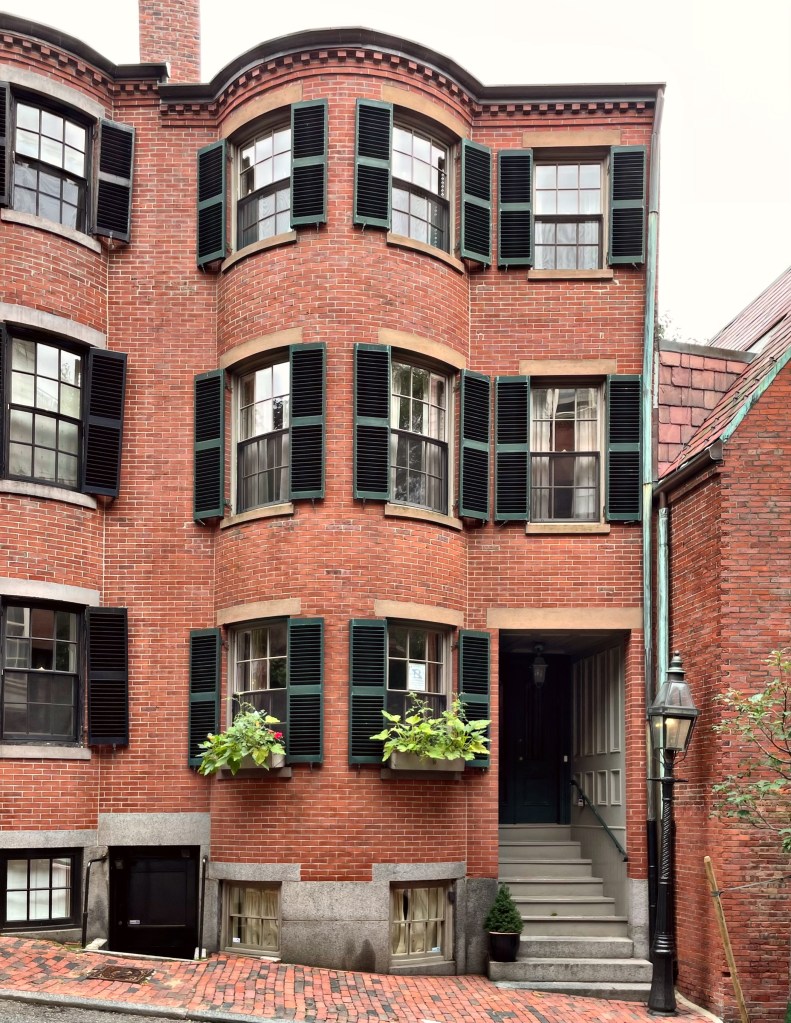
Joshua Bennett Townhouse // 1834

Just steps from the iconic Louisburg Square in Boston’s exclusive Beacon Hill neighborhood, a man named Joshua Bennett in 1834, purchased two recently completed townhouses built by housewrights Samuel H. Mitchell and Loring Dunbar. Joshua Holden Bennett (1792-1865) was born in Billerica, Massachusetts and split his time between his hometown and Boston. Bennett and his family owned the two identical bowfront houses until about 1930, likely renting them out to middle-upper class families. The home on the right (pictured) was later purchased by Benjamin B. Gillette an organist at a local church. After WWII, property values in Beacon Hill began to falter and this property and its neighbor became lodging houses of rented rooms to a more wealthy clientele than those on the North Slope of the hill. The home last sold in 1989 for $753,000 and is estimated at a value today at over $4,000,000!

Pagoda Building // c.1850-1917

For the last on this series of Lost Boston buildings, I present this little-known landmark which was once neighbors to the Old State House. The Pagoda Building as it was named, was located on the corner of Washington and State Streets and was one of the tallest buildings on the street upon completion. The seven-story building of Quincy granite exhibited round arched windows and an interpretation of a belvedere at the roof which served as a penthouse. The building’s upper six stories were residential, including the spectacular Oriental penthouse at the top, with retail space at the ground floor. The architect was a recent immigrant from Britain named George Snell, who clearly made a name for himself, later entering a partnership with James R. Gregerson. The Pagoda Building, which was originally an early “skyscraper” in Boston was quickly surpassed in height and floor plate size and was deemed inadequate for such a prominent location. It was demolished by 1917.

Trinity Place Station // 1900-1964

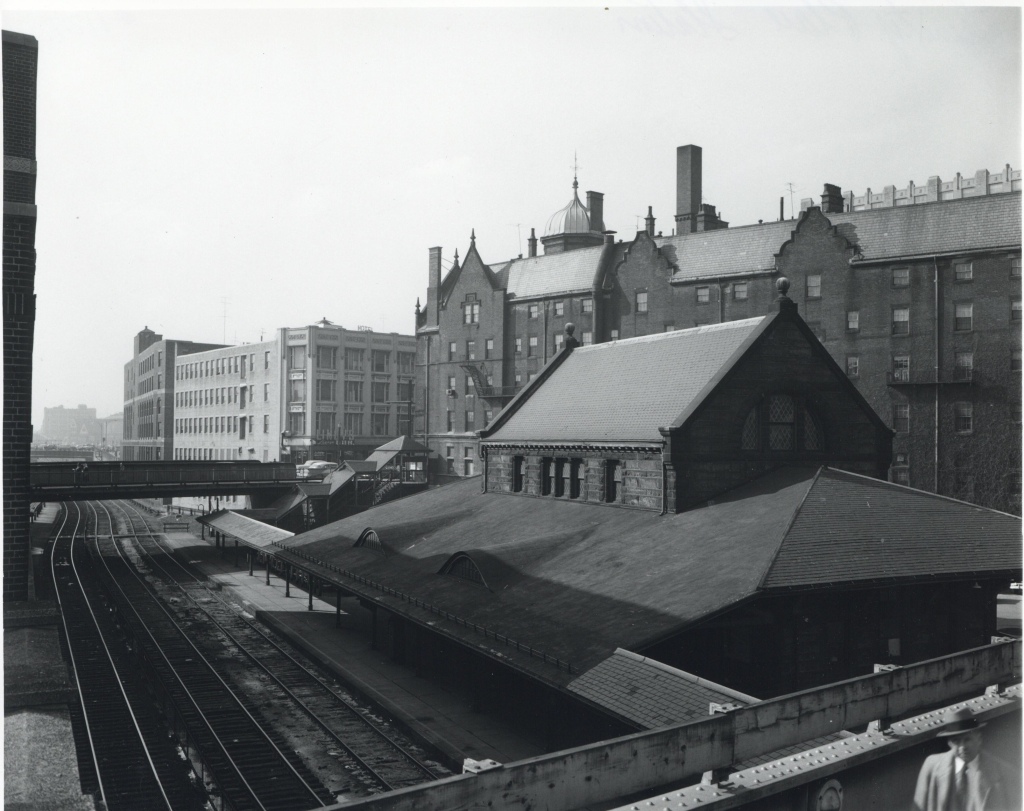
Trinity Place Station was the Boston & Albany Railroad’s second depot for trains running outbound from its newly completed South Station. The depot was designed by Alexander Wadsworth “Waddy” Longfellow, Jr., who from Harvard University in 1876, later studying architecture at the Massachusetts Institute of Technology and the École des Beaux-Arts in Paris, and then worked as senior draftsman in Henry Hobson Richardson‘s office upon his return to the United States. A. W. Longfellow was also the nephew of poet Henry Wadsworth Longfellow. He designed the station of pink granite with a covered platform 375 feet in length. The building long served train commuters leaving the ever-changing Back Bay neighborhood. Consolidated lines led to the station being deemed obsolete, and it was scheduled for demolition. Much of the old line route would be cleared for the right-of-way for the Mass Pike Expansion into Boston. The demolition on Trinity Place was postponed until early 1964 to allow for scenes of the movie, “The Cardinal” to be filmed there.

United States Hotel, Boston // 1839-1930

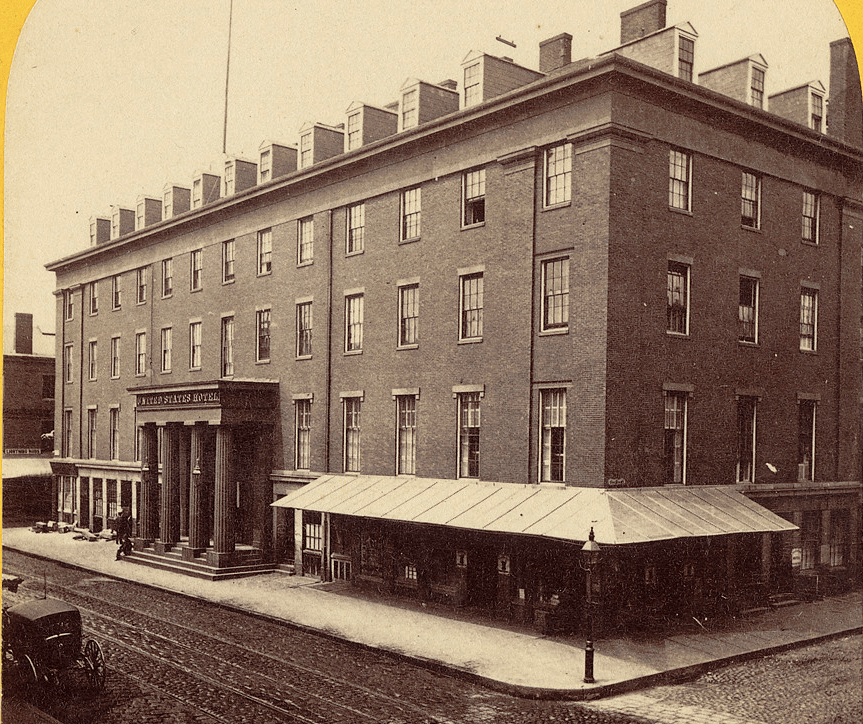
On August 18, 1929, the United States Hotel in Downtown Boston closed its doors for good. Once housing and feeding over 700 guests per night, the hotel saw severely declining numbers by the time of the Great Depression. Construction on the hotel commenced in 1837, and it was completed two years later in 1839. The hotel was operated by the Messrs. Holman and Clark, who saw an immediate success due to the hotel’s location central to Boston’s major train stations. The hotel (which first contained 300 rooms) did so well that the building was expanded numerous times with undulating additions to maximize light and air into the many rooms. At the hotel, over 150 employees served the guests at their rooms, the dining halls, bathing facilities or the stables which had drivers ready at a moments notice. The United States Hotel was one of the finest establishments in Boston and was thought to be the largest in the country by the middle of the 19th century. The size and amenities however was the downfall of the iconic hotel as Boston’s train stations saw fewer passengers in the early decades of the 20th century. Owners of the hotel sought to squeeze out every last dollar from the complex before they locked her up for good, hosting an auction on everything from beds to a chair said to have been sat on by Charles Dickens during his stay. The hotel was razed in 1930.

Downe-Tremere House // c.1674-1896

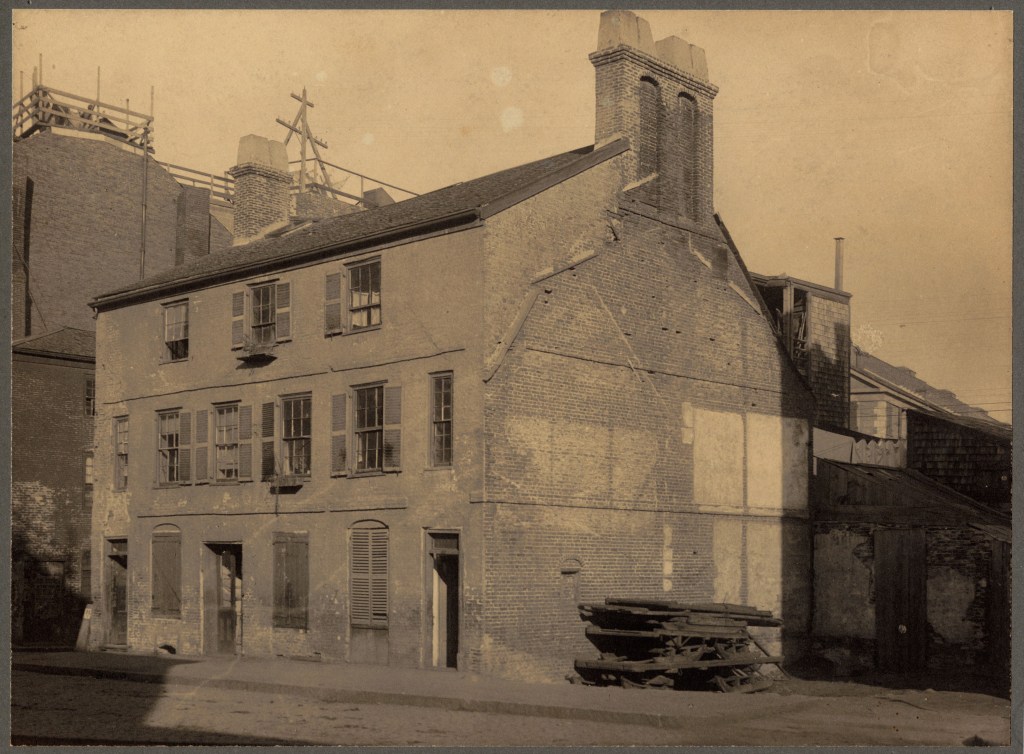
Image c.1896 courtesy of Boston Public Library.

One of the finest First Period Houses to have been built in New England was this brick mansion, formerly on North Street in Boston’s North End. On December 29, 1674, John Paine conveyed his property including a dwelling house to William Downe his new son-in-law. It is unclear when the house was built, but it was completed by the time of sale to William. Luckily, the house was constructed of brick, which likely saved it from the Fire of 1676. In later centuries, the building was converted to commercial use. After the Civil War, the property was owned by the Tremere Family, who rented out commercial space and held tenements in the floors above (the third floor was added, filling in the space between the two end chimneys which were added in the early-19th century. The property was razed in 1896 for the present tenement building on the site.

Bauckman House // 1915

The Arts & Crafts movement in architecture provided some of the most stunning and well-designed properties of the early 20th century but sadly, there are not too many examples here in New England. When I find some, I always get excited and pull over to snap a photo! This home on busy Beacon Street in Waban, Newton, was built in 1915 for Harry W. Bauckman a salesman in Boston. The designs are credited to architect James G. Hutchinson, who specialized in Arts & Crafts and Tudor style buildings in the area. The Bauckman House is Foursquare in form which basically segments the house into four, large rooms on each floor with a stairhall in the center. The home is clad with banded shingles which extend to the piers at the porch, a subtle nod to Shingle style architecture. SWOON! I was later informed by a follower that this was also the home of landscape historian and author Judith Tankard for some time.

Burdett Building // 1928

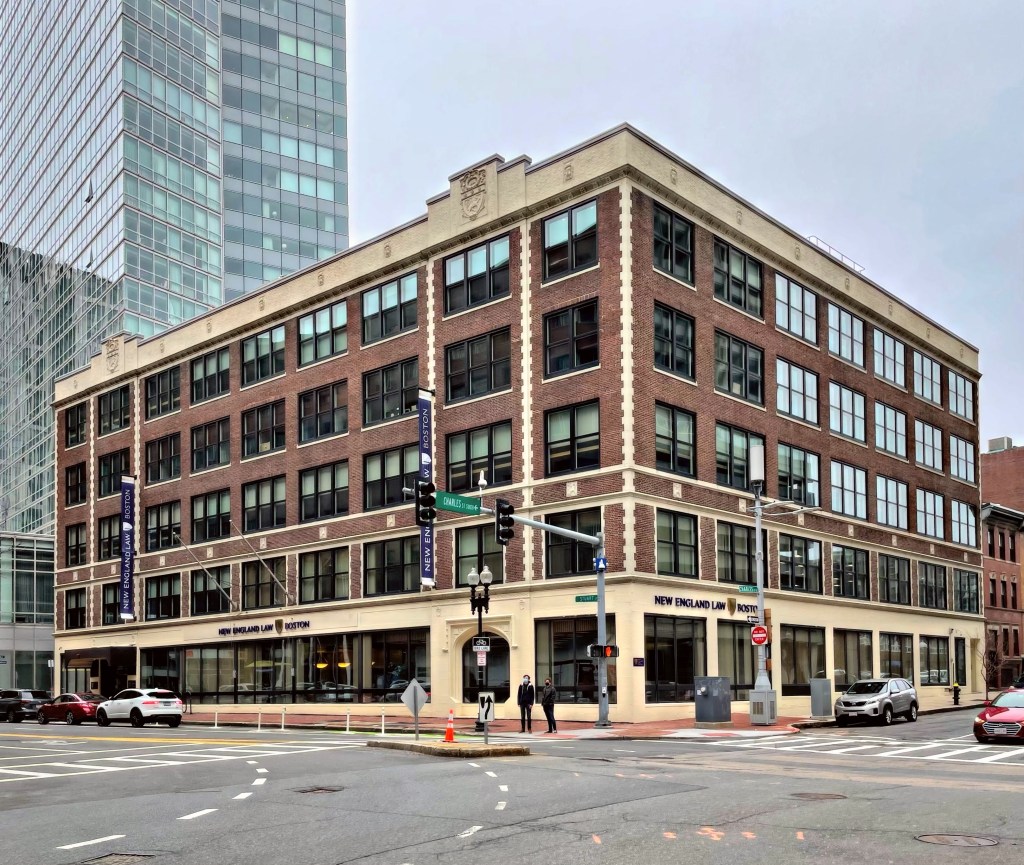
In 1921, Stuart Street was widened and extended between Boston’s Back Bay and Bay Village neighborhoods, which necessitated razing of all buildings along the route. From this, new lots were platted along the street where once thriving businesses were. Some relocated and others rebuilt. In 1927, the Park Square Corporation purchased seven contiguous lots at the corner of Stuart and Charles Streets and began construction of a large office building with storefronts on the ground floor. The Burdett Building opened in 1928. The building was built for Burdett College, which was founded in 1879 and focused on business and shorthand courses for students as a junior college. Architect Thomas H. James wanted the building to be like the new buildings at Princeton and Yale. The design featured Gothic inspired entrances and stone carvings of books and lions. Burdett College occupied the building until the 1950s and it was subsequently sold. By 1980, the building was acquired by the New England School of Law, who occupy it to this day as a place of learning.

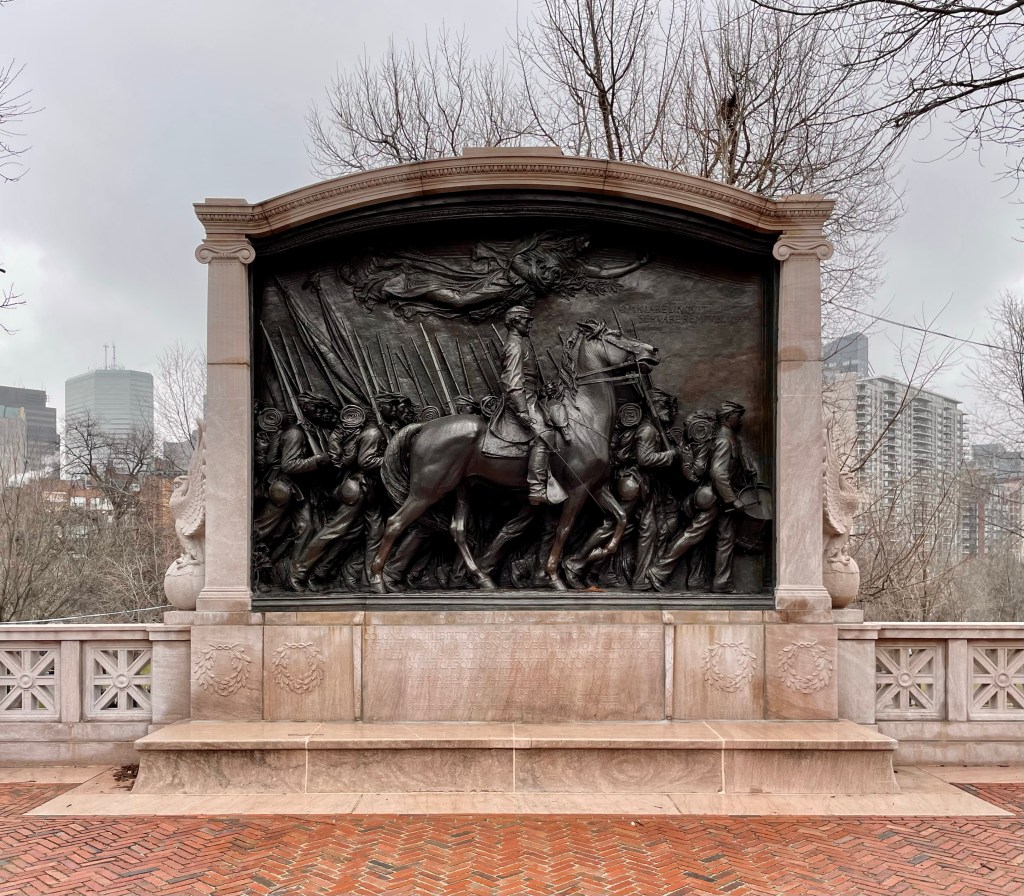
Robert Gould Shaw Memorial // 1897

Commissioned from the celebrated American sculptor Augustus Saint-Gaudens in the early 1880s and dedicated in 1897, The Shaw 54th Regiment Memorial (aka the Robert Gould Shaw Memorial) has been acclaimed as the greatest American sculpture of the 19th century. The memorial was designed by famed artist Augustus Saint-Gaudens, and it is a stop on the Boston Black Heritage Trail, commemorating the valiant efforts of Colonel Robert Gould Shaw and the men of the 54th Massachusetts, one of the first Civil War regiments of African Americans enlisted in the North. In July 1863, the regiment was sent to South Carolina where an assault was planned on Fort Wagner guarding Charleston harbor. Shaw had asked to have 54th Regiment lead the attack. Of the 600 men in the attack that day, there were 285 casualties, and Col. Shaw was killed, but the men never wavered in the battle and demonstrated great courage and determination. Following this display of valor, other black regiments were formed, and by the end of the war, 10% of the union army was made up of African American soldiers.

The monument in Boston shows the 25-year-old Shaw seated on his horse, with his regiment as it marched down Beacon Street on May 28, 1863 to depart the city to fight in the South. The concept of Shaw on horseback with marching soldiers was inspired, at least in part, from a painting Saint-Gaudens saw in France, Campagne de France 1814, by Jean-Louis Ernest Meissonier, which depicts Napoleon on horseback with rows of infantry in the background.While Shaw is the centerpiece of the monument, the significance of the monument is the Shaw Memorial is the first civic monument to pay homage to the heroism of African American soldiers in the U.S.