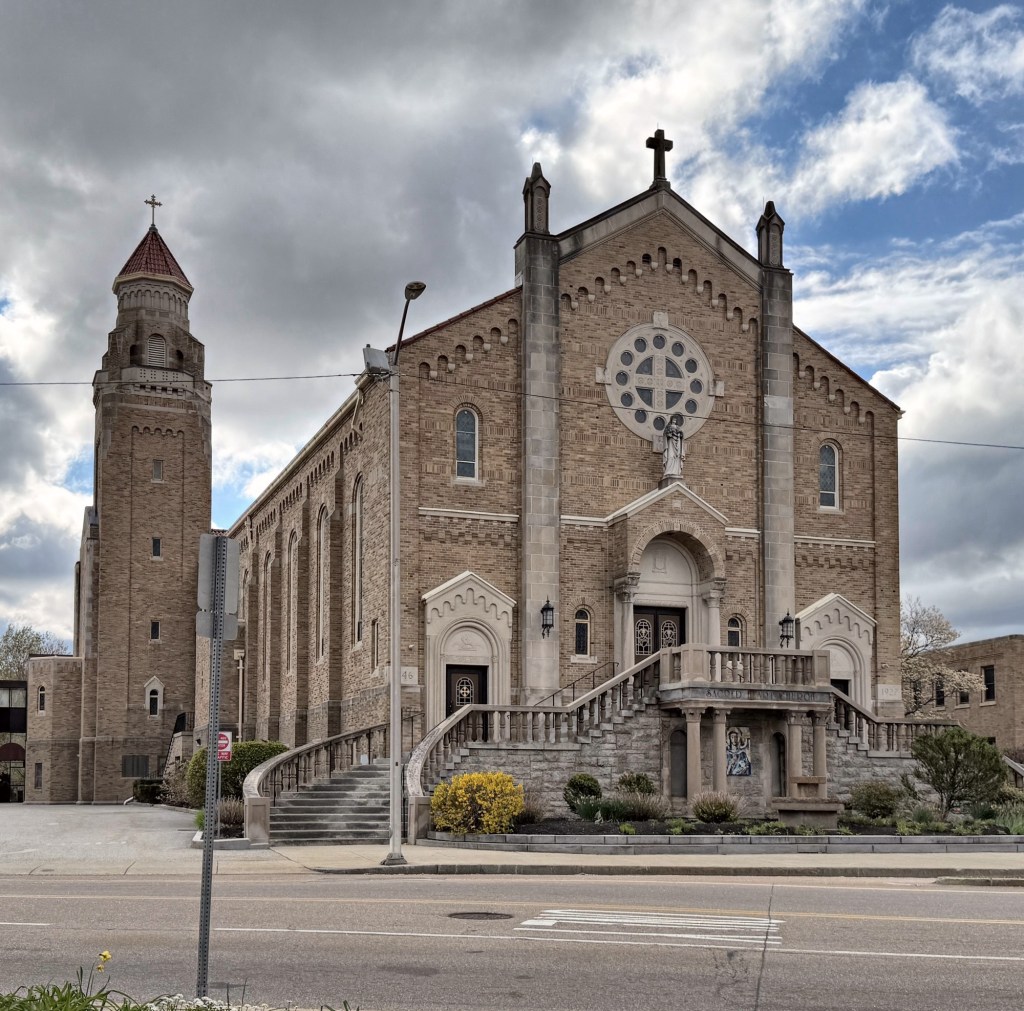
Sacred Heart of Jesus Church, Milford // 1927 & 1941

The Sacred Heart of Jesus Church in Milford, Massachusetts, was formed in 1905 as a local Catholic church that was the Italian response to the Irish, Saint Mary of the Assumption Catholic Church nearby. The congregation struggled to build an edifice that could compete with its Irish counterpart a few blocks away, that was until 1927, when funding was secured and construction began on the church. Architect, John W. Donohue was selected by the Roman Catholic Bishop of the Springfield Diocese, to furnish the plans for the building, which was delayed by the Great Depression. The church, which was long unfinished as a one-story building with basement, was ultimately constructed after plans were finalized in 1941 by architect, Anthony J. DePace, but construction did not begin until after WWII. Work on the upper church began in 1946 and it was dedicated in 1947. With its iconic Roman brick walls, red tile roof, bell tower, and entry staircase built of locally quarried Milford granite, the building showcases the Italian-American culture through its architecture.
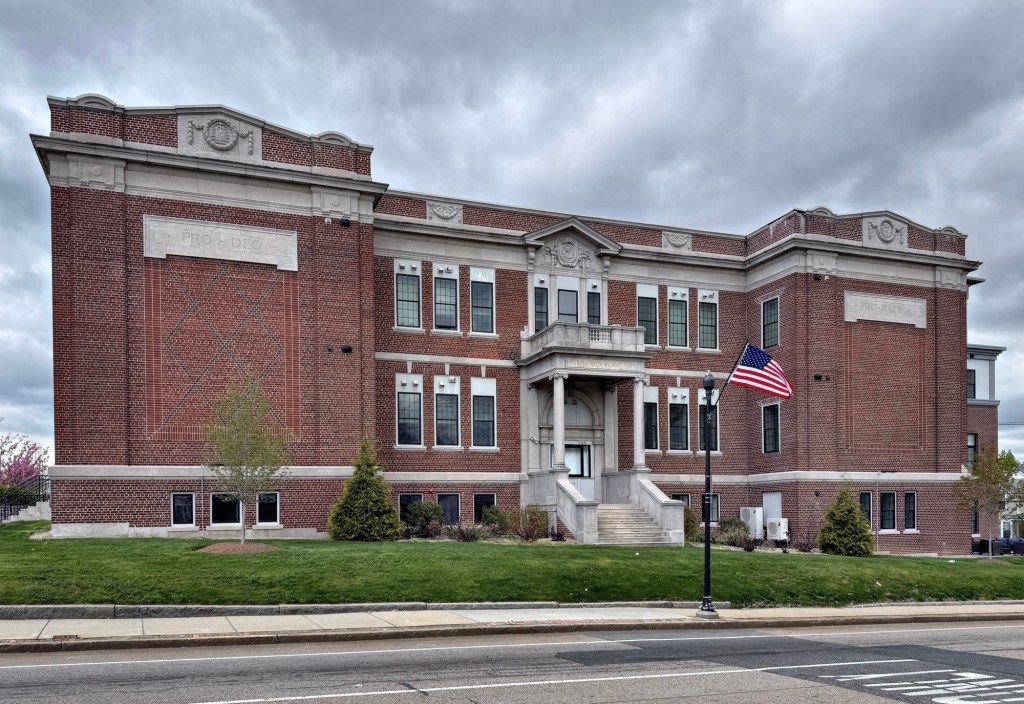
St. Mary’s Academy – Landmark Place Apartments // 1924

As the St. Mary of the Assumption Catholic Church of Milford expanded, the diocese determined that an academy building was warranted to educate the pupils affiliated with the growing congregation. In 1924, Massachusetts ecclesiastical architect, John W. Donohue was hired to furnish plans for a new parochial school building. The two-story Colonial/Classical Revival style edifice was constructed of brick with limestone trim and follows the form of many school buildings constructed in New England in the early decades of the 20th century. In 1954, the building became the St. Mary’s Catholic High School and it was expanded in 1962 with a Modern addition. When the two local Catholic churches merged schools in the 1970s, this building was sold to the Town of Milford, who converted it to use as a public middle school, a use that remained until a new middle school was built elsewhere in town. With its future uncertain, in 2018, the Town of Milford sold the school building to developers, who demolished the 1960s additions and constructed a new addition to the rear, converting the entire building into elderly housing named, Landmark Place Apartments. Adaptive reuse is a great way to build additional housing while retaining local history and meet sustainability goals!

Holy Name Science High School // 1925

The third and final extant building on the former Church of the Holy Name of Jesus complex in Chicopee, Massachusetts, is this former school building, a stunning example of Colonial Revival architecture. Located behind the former church and rectory buildings, this three-story building was built in 1925 as a “Science” building to accompany an existing girl’s high school. Inside, the building had a “Commercial” department, where young girls could learn important skills like banking, stenography, and typing; with the second floor containing traditional science classrooms and labs along with the school library. Springfield-based architect, John W. Donohue, who specialized in ecclesiastical buildings in Western Massachusetts, designed the building in the Colonial Revival style with brick and stone construction, an elaborate entrance and Palladian window on the second floor facade. The school building closed in the late 20th century, and has seemingly sat vacant ever-since. I sincerely hope this important building could be incorporated as much-needed housing for Chicopee residents!

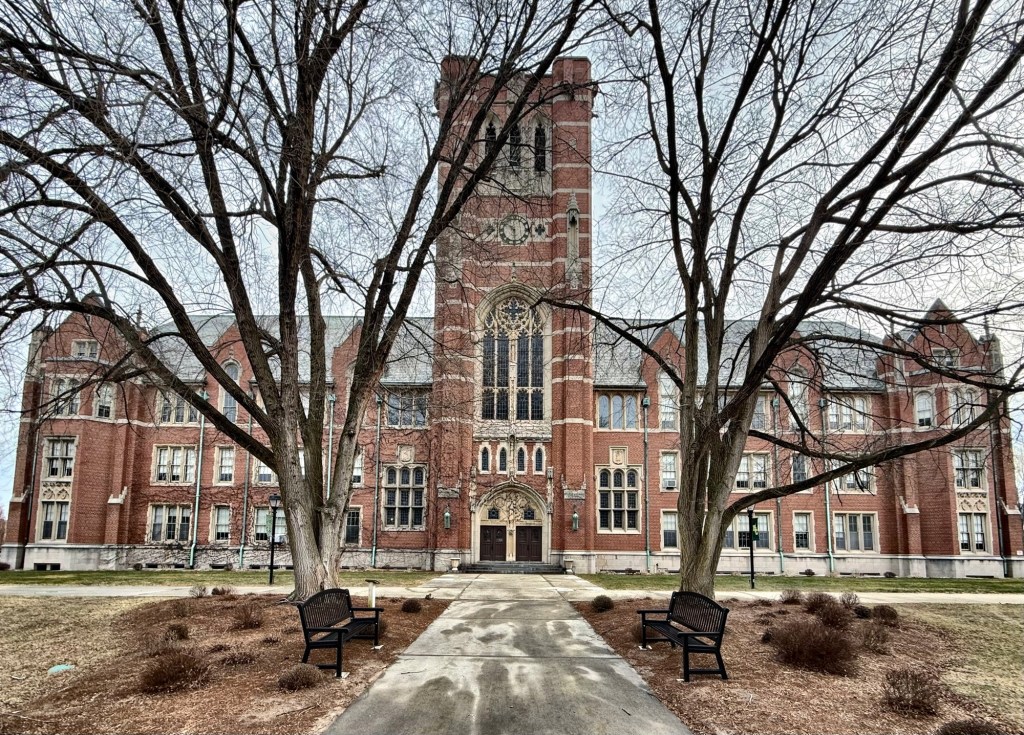
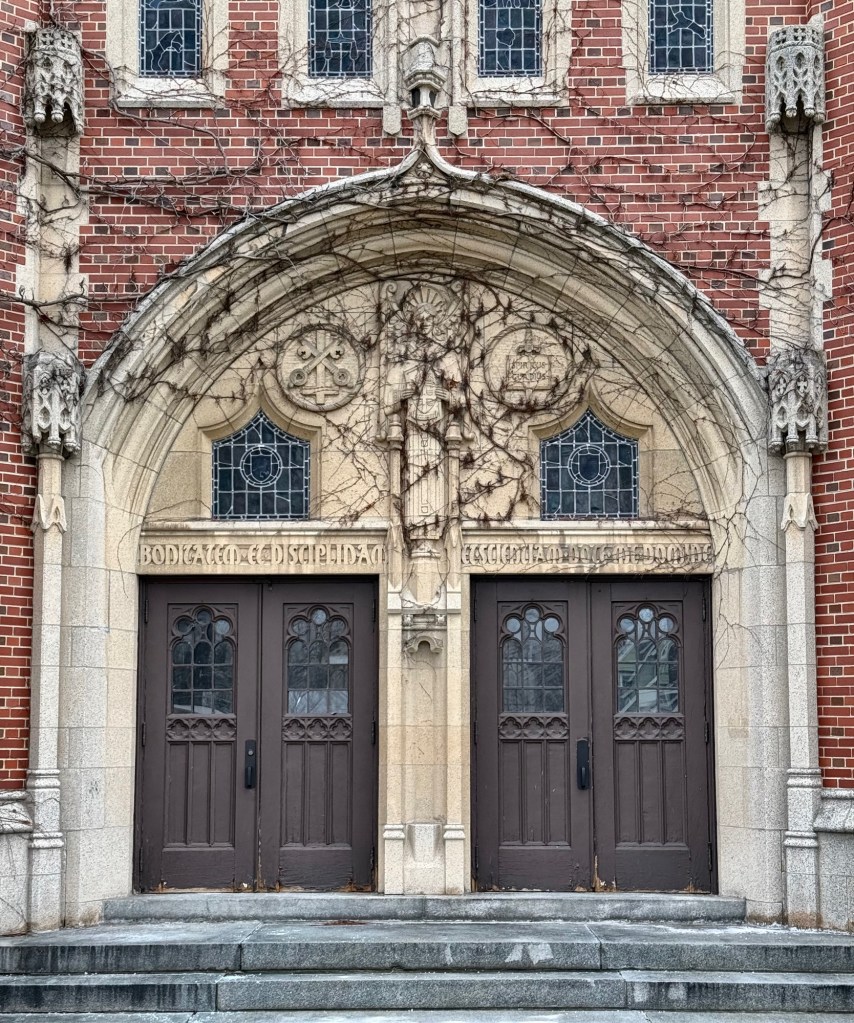
Administration Building – Elms College // 1932

Elms College in Chicopee, Massachusetts began as the Academy of Our Lady of the Elms, a Catholic boarding school for girls established in Pittsfield by the Sisters of Saint Joseph in 1897. The academy was relocated to Springfield Street in Chicopee through the efforts of Bishop Thomas D. Beaven in 1899. The Academy provided elementary and secondary education with a Normal School component that prepared young women for careers in teaching. In 1924, Bishop O’Leary announced the intention to expand the school into higher education, creating a women’s college. The college charter was approved in 1928 and the Academy became the College of Our Lady of the Elms. Planning and construction of the Administration Building (later renamed Berchmans Hall in 1983) began immediately after the incorporation of the College in 1928. Designed by John W. Donohue, the official architect of the Diocese of Springfield at the time, Berchmans Hall is a landmark example of the Collegiate Gothic/Neo-Gothic style that proliferated higher education and ecclesiastical buildings in the early decades of the 20th century. Completed in 1932, the new building included offices, modern classrooms and laboratories. The back section contained a gymnasium in the basement and an auditorium on the main floor. The building remains the main building on the Elms College campus and serves as an important visual anchor to the school.