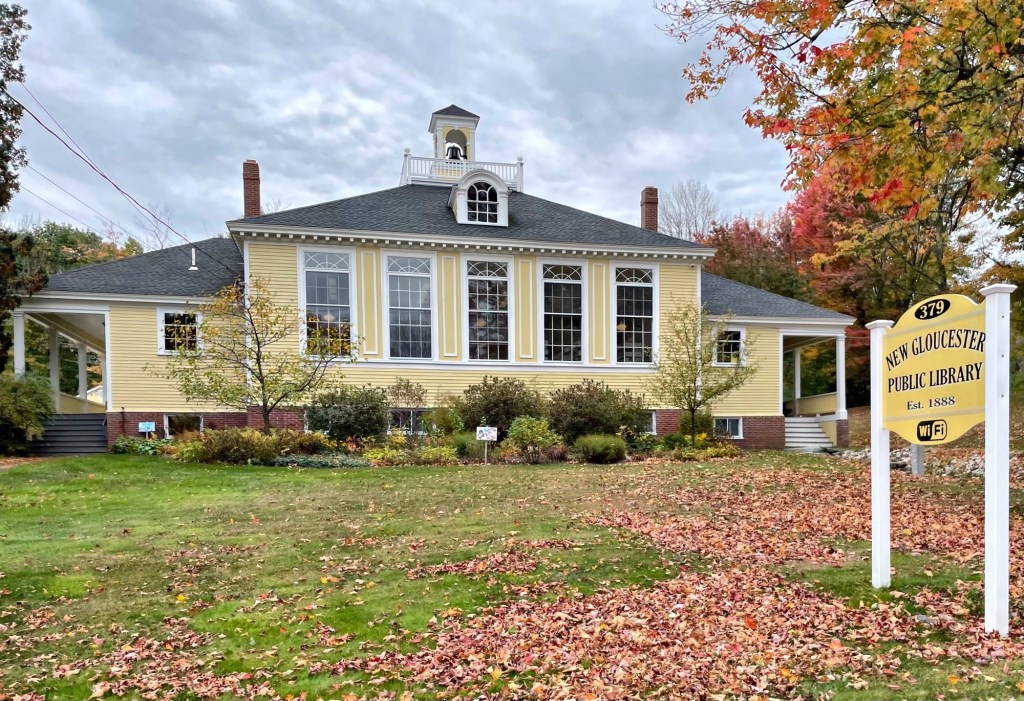
This building, the present New Gloucester Public Library, was originally constructed in 1902 as the town’s high school, a use that remained until 1962, when pupils would go to a modern school building in nearby Gray, Maine. The building is an excellent example of the Colonial Revival style with a symmetrical facade dominated by a row of multi-light windows separated by paneling, a segmental-arched dormer, and cupola at the roof with a bell. When the high school moved to its present location, this building sat vacant for some time and would be occupied by the New Gloucester Historical Society for storage and display of their collections until the public library moved into the building by the early 1990s.
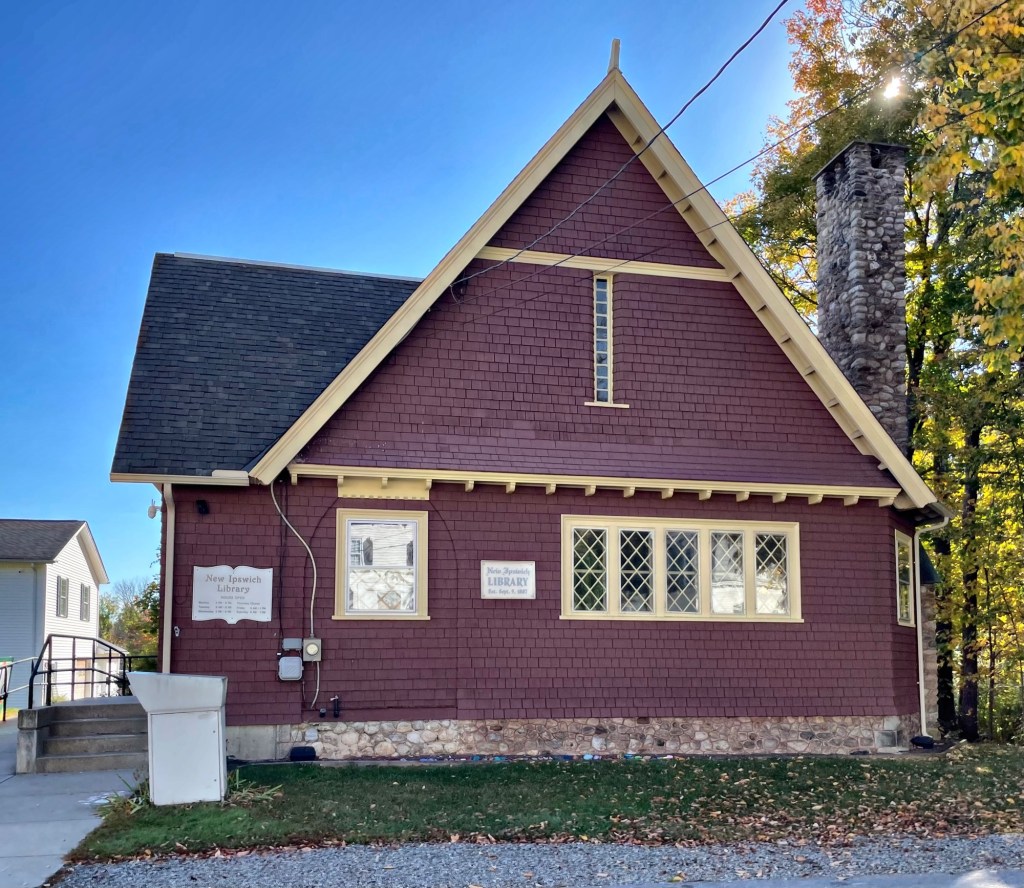
The New Ipswich Public Library is a one-story Shingle style building on Main Street in the charming village of New Ipswich, New Hampshire. The library building was likely designed by Ernest M. A. Machado, one of the best, and relatively unknown architects of the late 19th and early 20th century in Salem. The entrance which faces the side, is flanked by two diamond-pane windows, which can also be found on the primary facade. A special ten-light vertical window is recessed within a shingled depression in the gable, which adds some complexity to the design.
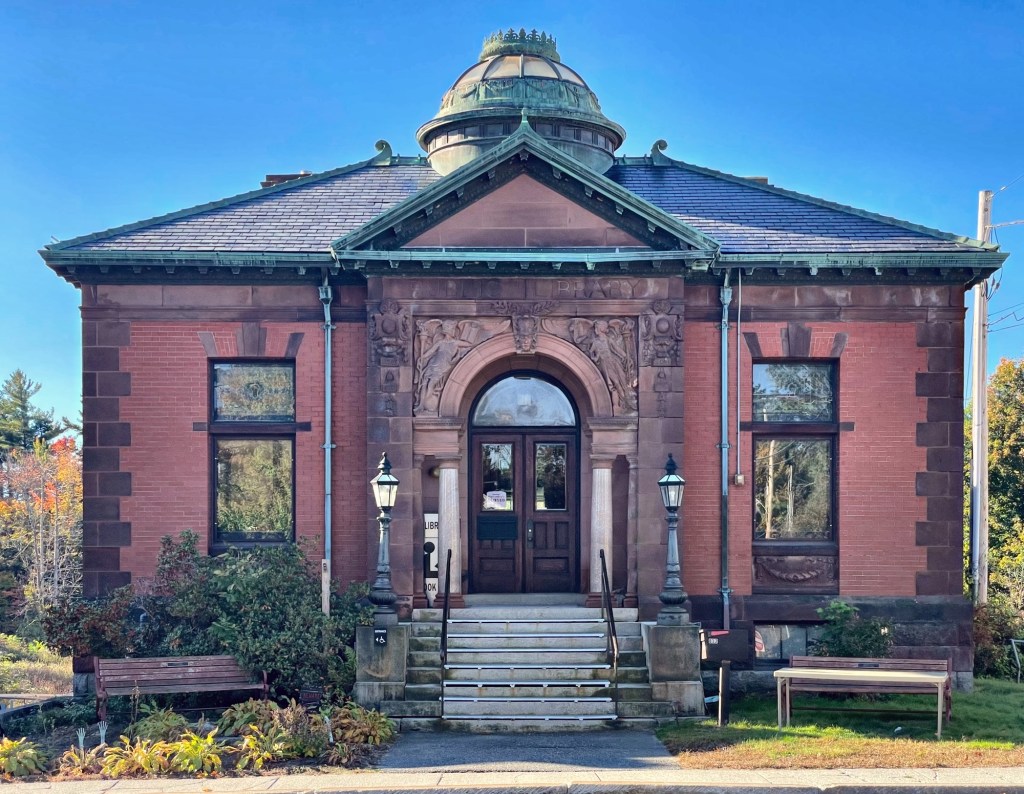
The Ashby Public Library in Ashby, Massachusetts, was built in 1902, completely funded by a donation from Edwin Chapman (1841-1915) who lived across the street from the new library. Mr. Chapman was raised in Ashby and became a wealthy Boston-area merchant in the meat trade by the late 19th century. Before this library was built, the town’s library collection was housed in the Wyman Tavern. The building was designed by architect Henry M. Francis in the Neoclassical style with Romanesque detail in brick and brownstone to make the building fireproof. The library was added onto in the rear in 2006 by The Galante Architecture Studio, which is recessed and mostly visible from the rear parking area. The addition is Modern in style to distinguish itself from the main library building.
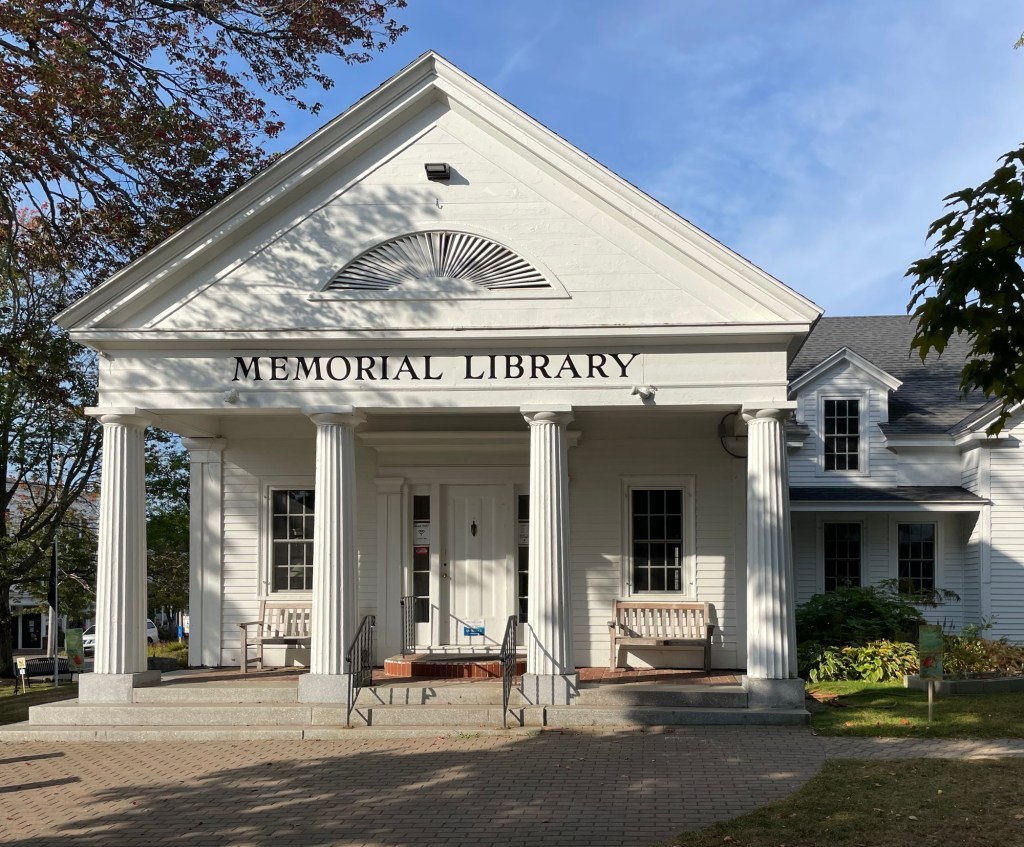
In 1906, the citizens of Boothbay Harbor voted to establish a free public library for all to enjoy. In 1923, the need for more library space, along with a desire for a World War I Memorial, led to the approval of a bond for the purchase of a 1842 Greek Revival style house on Oak Street. The building was remodelled for use as a library by the Boston architect William Stanley Parker, and was enlarged in 1966 to a design by Parker’s son, Stanley Jr. The temple-front, Neo-Classical entry was added at this time and harkens back to the original classical style Greek Revival home, while clearly showing a grander scale seen in the 20th century.
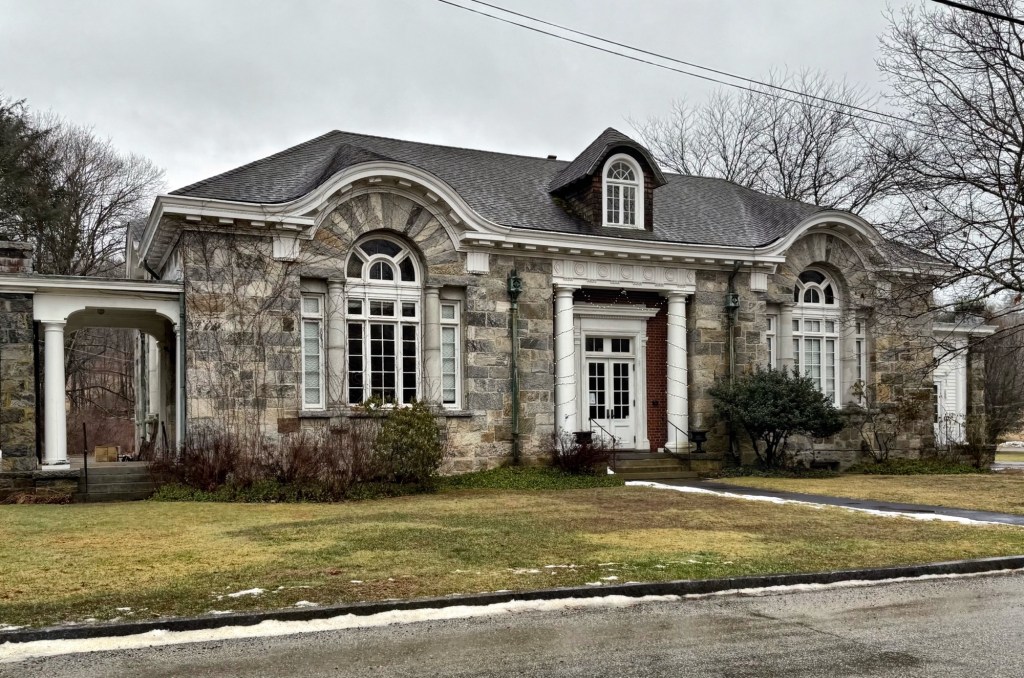
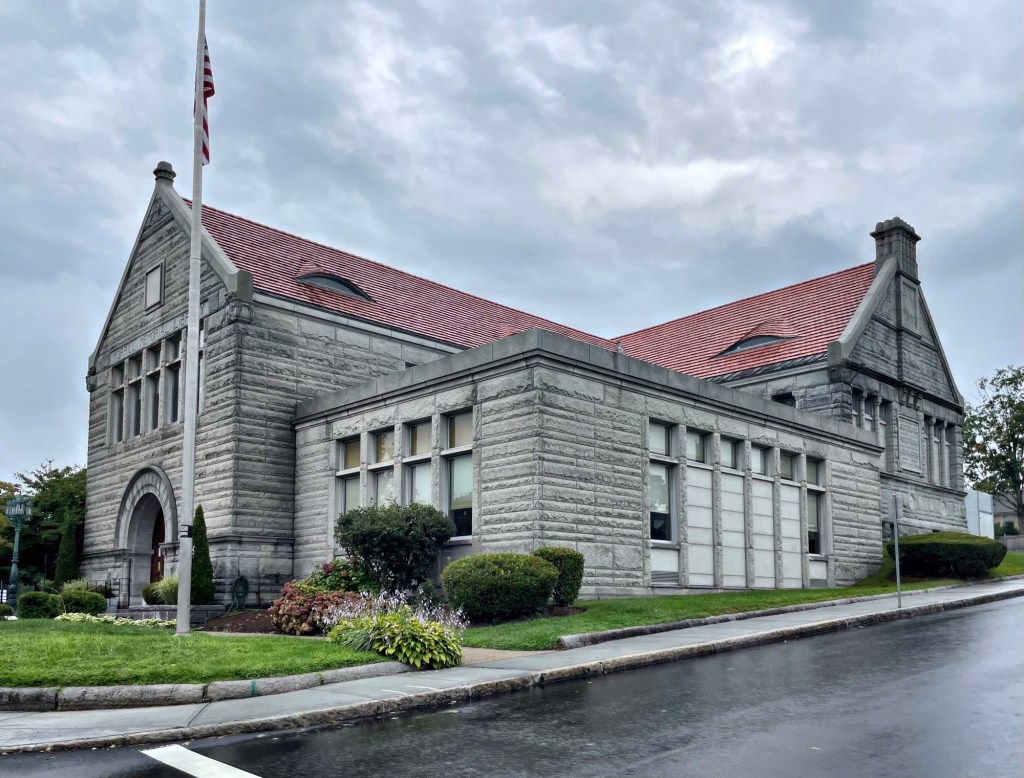
One of the best parts about New England is the diversity of the architecture and history of local public libraries. The Morrill Memorial Library in Norwood, Massachusetts, was erected by George H. Morrill in memory of his daughter Sarah Bond Morrill, who apparently died in 1895 of Typhoid Fever at the age of 22. George Morrill made his fortune as one of the largest producers of printing inks in America. The business was founded by Samuel Morrill, father of George H. Morrill in 1845 in Andover, but in 1856, he moved the works to South Dedham (present-day Norwood). The company grew rapidly and factories were built in Norwood and expanded to meet increasing operations. Mr. Morrill built a massive estate in Norwood (no longer extant) and also houses for his family members nearby to create a small enclave for the family. One of the lots on Walpole Street was utilized for a memorial library in honor of his late daughter. Architect Joseph Neal, who originally worked for Shepley, Rutan & Coolidge in Boston, designed the Richardsonian Romanesque library constructed of rough-faced granite blocks with a red terracotta tile roof above. The main entrance was deeply recessed within a great Assyrian arch typical of an arch-type that was a hallmark of the public and ecclesiastical buildings of Boston architect Henry Hobson Richardson during the 1870’s and 1880’s, but has since been enclosed by a vestibule, somewhat diminishing the original entry. The library was originally cruciform in plan but one-story additions constructed in the 1960s, on either side of the original facade have altered its original volume, but at least they are of a similar material. The library is one of the more unique in the Boston area and a testament to a father’s love to their children.
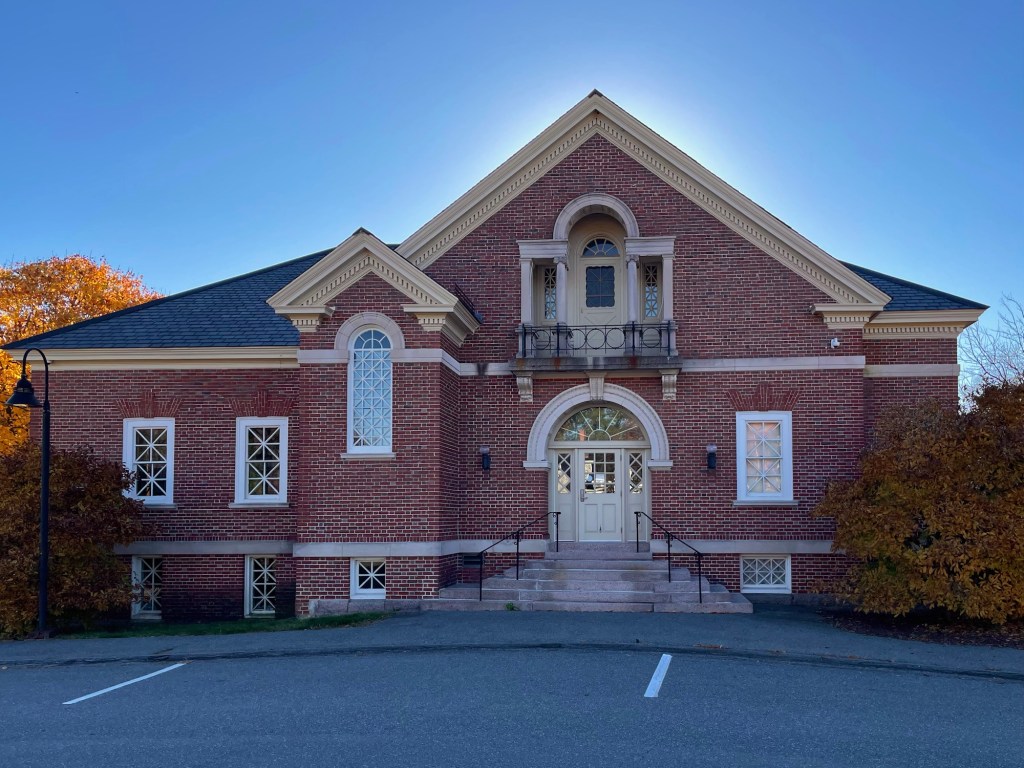
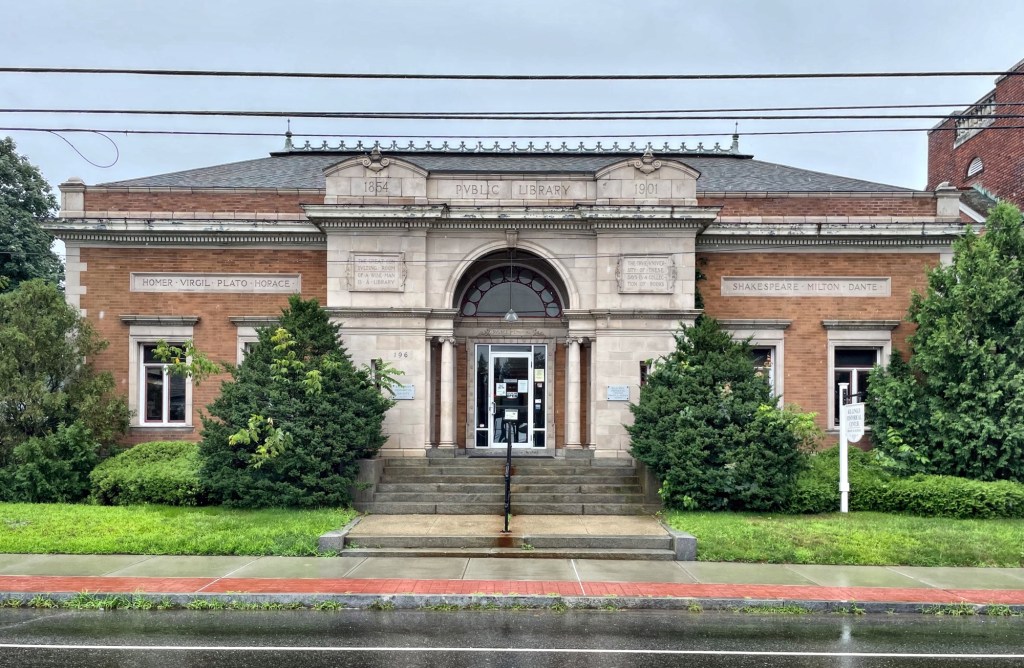
The Bugbee Memorial Library sits on Main Street in Danielson, the main village in the town of Killingly, Connecticut. The library was built in 1901 and financed by a bequest from Edwin Holmes Bugbee, who made his fortune at local mills. When Bugbee died in 1900, his estate left his entire collection of books along with funds for a new library for Danielson. Boston architect Walter Jefferson Paine designed the library building in the Classical Revival style with buff brick and stone construction. The names of Homer, Virgil, Plato and Horace, along with Shakespeare, Milton and Dante, are boldly emblazoned across the facade denoting the building as a house of learning. The library was outgrown, and a new library was built nearby in 1994. The old Bugbee Memorial Library has since been occupied by the Killingly Historical Society.
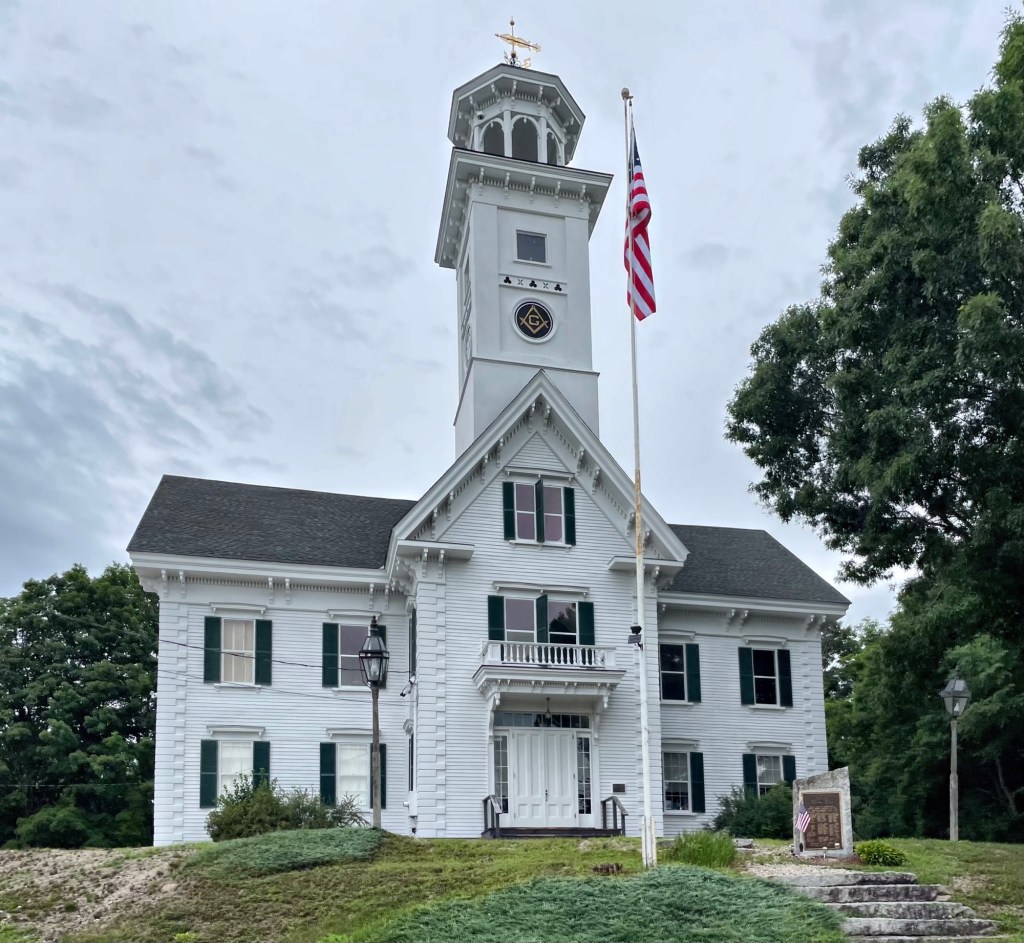
The New England Masonic Charitable Institute building is located in Center Effingham, New Hampshire, and is among the rural town’s most impressive structures. The structure was built in 1858 by the Charter Oak Lodge No. 58 of Free and Accepted Masons as a school to educate orphans of Masonic members, but they also admitted local students. It is the only known school building purposely constructed by Masons in the United States. Classes were conducted from 1861 to roughly 1882 with students boarding with local families. The impressive Italianate style building is dominated by a six-story bell tower supporting an octagonal cupola, and exhibits many architectural details including the corner quoins, paired eave brackets, and dentilled cornice. Charter Oak Lodge No. 58 sold the building to the Town of Effingham in 1891 for one dollar but retained rights to the second floor temple room in perpetuity. The walls and ceilings of the Lodge’s temple space are covered with trompe l’oeil murals attributed to Massachusetts painter Philip A. Butler. Images of classic sculptures, architectural details and Masonic symbols, including the All-Seeing Eye, are incorporated into the paintings. Heavily water-damaged in the late 1980s, they have since been restored. The building remains occupied by the Effingham Public Library, what a library building for a town of just 1,700 residents!
Methodists established a small congregation in Eastford, Connecticut by 1826, and by 1831, a new meeting house was built in the center of the village. The meeting house was used jointly by Methodists and Universalists, each having the right to occupy it half the time. By 1847, Methodists here were able to erect their own church, this building, in the Greek Revival style. Originally, the building had two doors on either side of a center window in the façade. There was a steeple and, rare in those days, a pipe organ in the sanctuary. In 1916, the church joined with the nearby Congregational church, requiring them to sell the building ten years later. The town of Eastford bought the structure for $200 in 1926 for use as a town hall. In 1934, the Civil Works Administration provided funds to renovate the building with the town library being installed in a portion of the basement along with town offices and a vault. Town meetings were held in the former sanctuary space upstairs. When the space was outgrown for town offices, a new building was constructed elsewhere and this building transitioned to solely library use. The renovation project was paid for by money bequeathed by Wilmer Glenn, a New York stockbroker who spent summers town. He donated funds in memory of his late wife, Ivy. The present-day name of the building came to be the Ivy Glenn Memorial and the library moved into its new spacious home in 1972.
Every village needs a library, and East Blue Hill is no different! Without easy access to the main Blue Hill library, a group of “willing workers” amassed a collection of books with the hopes to donate to a future village library organization. A campaign to build the present building began in 1914 with the acquisition of land adjacent to the village post office, with major fundraising undertaken in 1917. The building, completed in 1920, was designed by John W. Merrow, a New York City theatrical architect and is an uncommon example of a small, Arts and Crafts style library in the state of Maine.
The Friend Memorial Public Library in Brooklin, Maine was built in 1912 on land donated three brothers in the Friend family. The brothers, Leslie, Robert and Victor Friend were born in Brooklin, but were raised in Melrose, Massachusetts. There, they made a fortune producing Friend’s Brick Oven Baked Beans. With their new wealth, the brothers had the bright idea of building a roller-skating rink for the enjoyment of the Brooklin community. As the need for a library overtook that of a roller rink, the brothers sought to cement their name in the town’s history by funding a new library building. The previous library was located in a small space in the IOOF Hall nearby (featured previously) and a new, purpose-built space for a library was a desire for the small community. William Nelson Wilkins, an architect of Magnolia, Massachusetts, and husband of Brooklin native Ella McFarland, was hired to furnish plans on the new building which was built in 1912 in the Colonial Revival style. In 1940, Katerine and E.B. White (author and summer resident), Owen Flye and others were instrumental in revitalizing the library, increasing the collections and hours of operations. About ten years ago, the library was restored and renovated inside by Elliott Architects.