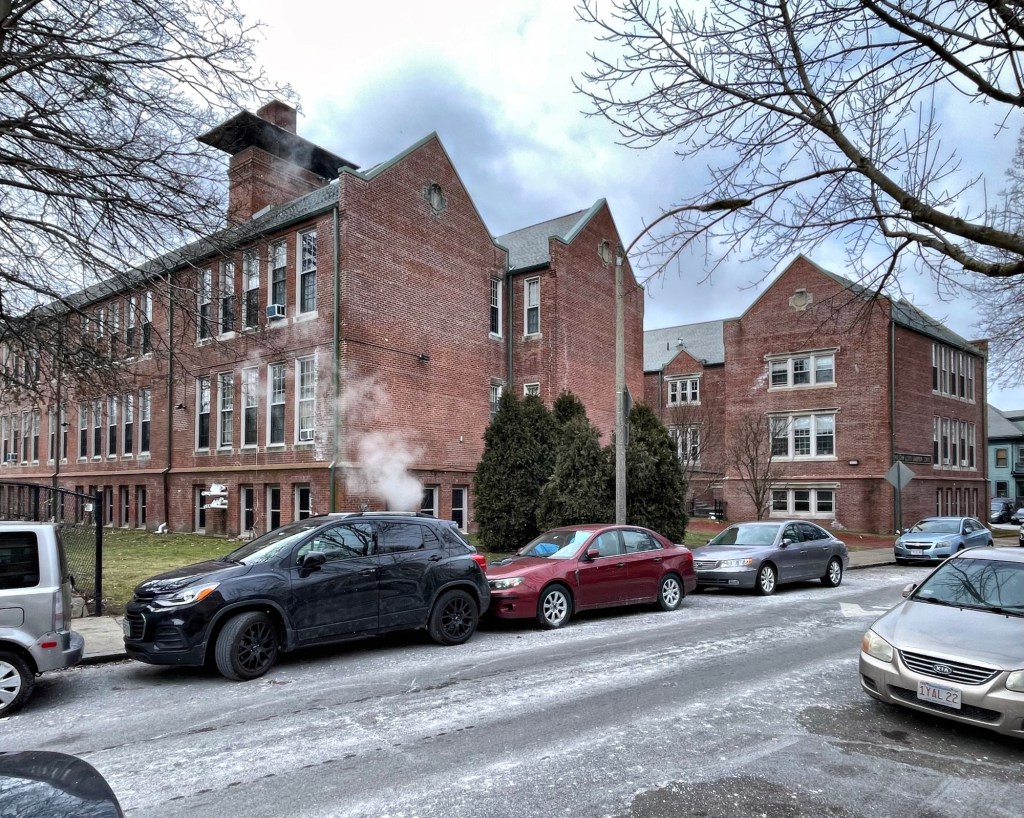
Dorchester Mutual Fire Insurance Building // 1860

This is your sign to take a different route! When exploring a new town or neighborhood, I love to explore the obscure streets just as much as the iconic Main Streets as hidden treasures can always be found! This building in Dorchester’s Port Norfolk neighborhood was constructed in 1860 as the new home of the Dorchester Mutual Fire Insurance Company, which was incorporated in 1855. The company seemingly hired Dorchester-based architect Luther Briggs, who also laid out the streets for Port Norfolk and the Clam Point neighborhoods and designed many buildings in the area at the time. The high-style Italianate building features bold proportions, quoins, and cornice. While the former round-arched windows have since been enclosed and are traditional double-hung windows, they building still stands out! At the rear, Second Empire style rowhouses were built for private ownership. The building is now all condominiums following a renovation.

Freeman House // c.1870

One of my favorites in Dorchester is this Second Empire manse, built c.1870 for cotton broker Freeman S. Packer. The house at 14 Everett Street in the Clam Point/Harrison Square neighborhood is a handsome, formal example of a Luther Briggs-designed Italianate Mansard residence. Although today sheathed in vinyl siding, much of the original siding and trim detail are likely still under there, preserved. Set back from the street facing an ample hedge-enclosed front yard, the three bay main façade exhibits a center pavilion and full-length front porch which undoubtedly appealed to summer guests who vacationed here when this house was known at the Russell House, an apartment hotel during the 1890s and early 1900s.

Freeport Street Power Station // 1896

The West End Street Railway was established in 1887 originally as an offshoot of a land development venture, but it rose to prominence when it merged several independent streetcar companies into a single organization. Over the next decade, it became the primary operator of public street transit within the Boston area! During this time, the company maintained one of the largest street railway systems in the world, the first unified streetcar system in the United States, and first electrified system in a major US city. Now, it’s the infamous MBTA. How far they fall… Power plants were needed all over the city to provide electrical power for the company’s street cars, this was the fourth (and final) power station built, and it powered the Dorchester, Neponset, Ashmont and Milton lines. The station was constructed in 1896 on the shores of Dorchester Bay, which allowed for coal to be delivered in barges to the plant. Old stone walls formerly lining the shore can be seen to this day. Landfilling in the second half of the 20th century and the construction of I-93 have since cut off the building from the shore. Eventually the building was sold off and today is home to Yale Appliance, good thing none of their products are coal powered!

Putnam Nail Company Factory // 1860+

The Putnam Nail Company was founded in 1860 and located at the northern tip of the Port Norfolk neighborhood of Dorchester, Boston, Massachusetts. The company was founded by Silas Safford Putnam (1822-1895), who was the seventh of nine children by Israel Smith Putnam and Charlotte Safford of Hartford, NY. He moved to Boston and found work as Boston’s industrial growth took-off. He owned a curtain factory before patenting a process to manufacture wrought nails in the 1850s. After some time in Abington and Roxbury, he moved to Dorchester, purchasing large pieces of land and began building a manufacturing complex for his new Putnam Nail Company. The company made world-class horseshoe nails until it closed in the early 1900s. The property here was acquired by the George Lawley & Son Shipyard, who moved from their cramped City Point, South Boston shipyard to this newer yard. Already an established and respected New England manufacturer, the Lawley company had been building wooden ships in Massachusetts since 1866. The site was later the home to Seymour’s Ice Cream and was abandoned in the late 20th century. The large 1890s brick factory is now occupied by RISE, a development/construction management firm, with other buildings occupied by the Boston Winery and Boston Harbor Distillery.

St. Anthony of Padua Catholic Church // 1956

Believe it or not, the city of North Adams, Massachusetts has long been home to a large Italian population. The first waves of Italians first arrived to this part of the Berkshires in the mid-late 19th century, many of which were hired to build the Hoosac tunnel, which when it was finished, was the second longest tunnel in the world. It took almost 25 years to build! Some Italians were experienced stone carvers and others worked in the cotton mills and other factories in the area. As the Italian population grew, Roman Catholic churches were required for these new first- and second-generation families in the mill town. The first St. Anthony of Padua Roman Catholic Church was erected in North Adams in 1906. Four years later, the 1910 census noted that roughly 16% of North Adams’ population was of Italian descent. After the first church burned down around 1950, money was raised to build the present church which is located across the street from Mass MoCA. The church was designed by architect Anthony DePace (1892–1977), an American architect who designed numerous Roman Catholic churches throughout the Northeastern United States area during the mid to late 20th century. Architecturally, the building features late-Romanesque and Art Moderne details. Eventually, the decline in the number of Catholics in North Adams in recent decades led to the consolidation of parishes in 2009. St. Anthony’s is the sole remaining Catholic church in North Adams and the church and parish are now known as St. Elizabeth of Hungary, possibly after a merging of multiple parishes.

A. C. Houghton Mansion // 1897

The first mayor of North Adams, Albert Charles “A. C.” Houghton (1844-1914), built this house on Church Street in 1897. Albert was born in Stamford, Vermont and would become president and principal owner of Arnold Print Works (now Mass MoCA campus) and the Beaver Mill in town. He did well for himself and had this large mansion built from plans by Berkshires architect Henry Neill Wilson. Tragically, on August 1, 1914, A. C. Houghton was being driven in town by his driver with his daughter Mary and her husband in the car. They crashed and both Mary and her husband died, with seventy-year-old Albert succumbing to his wounds over a week later in his home. His driver soon thereafter shot himself. The Houghton mansion was inherited by Albert’s wife Cordelia, who passed away in 1918. Their daughter Florence Gallup next inherited the mansion but was living in the Boston area, and she decided to sell the family home to the local Masonic Lodge in 1927. They likely added the brick addition at the rear for meetings and events soon after. It is not clear to me what the mansion is used for today, any locals have more information?

The Porches Inn // 1895

Prior to a few decades ago, there were not many reasons one would visit or stay a weekend in North Adams, Massachusetts. The former industrial city, like many others in the region, saw a sharp decline in population, services, and quality of life when many of the local factories closed in the second half of the 20th century. The major draw of tourists today is Mass MoCA, a museum in a converted factory building complex that is now one of the largest centers for contemporary visual art and performing arts in the United States! The new museum has created a huge demand for restaurants, housing, and hotels of all types in the formerly decaying river city. This is a story of perseverance and rebirth! In the early 2000s, Jack Wadsworth, an alumnus of nearby Williams College, wished to revitalize a block of vacant 19th-century workers houses across from the growing attraction of MASS MoCA. He worked with Burr and McCallum Architects of Williamstown to convert the decaying workers cottages into a boutique hotel. The span of Queen Anne and Colonial Revival cottages were joined via a long porch lined with rocking chairs, and the space between the buildings is bridged with skylights, giving the complex its appropriate name, Porches Inn.

Murdock Hall – MCLA // 1896

In 1894, the Massachusetts legislature decided to build four Normal Schools for the purpose of training teachers for teaching in public schools. North Adams was chosen as one of the sites because it was a commercial and industrial center of the Berkshires, and because the city agreed to contribute the land and provide other support. The training of teachers for the public schools was especially important for North Adams in the 1890s, as the city was growing at a rapid rate due to an influx of immigrant laborers working in local factories and raising families in the city. Local architect Henry Neill Wilson was hired to furnish plans for the school building, completed in 1896, which was designed in the Renaissance Revival style. In 1932, the Normal School became the State Teachers College of North Adams, reflecting the increased importance of education as an academic discipline. In 1960, it changed names to North Adams State College with an expanded focus to include professional degrees in business administration and computer science. In 1997, the College joined the State University system and renamed again as Massachusetts College of Liberal Arts.

Ashe House // 1898

North Adams, like many formerly industrial towns and cities in New England has some amazing old Victorian and Colonial Revival houses built before the factories closed. Luckily for us, this town still has many unaltered residences, with some needing more love than others. This is the Ashe House, built in 1897-8 for Patrick J. Ashe and wife Katherine O’Brien. Classical details from many different styles make this house unique. An oval window dominates the traditional Greek facade which includes a pediment and side pilasters. A palladian window sits over the elliptical porch which is supported by columns. This one has so much potential!!

Vadner House // 1874

This elegant estate which stands on the corner of E. Quincy and Pleasant streets in North Adams, Massachusetts was originally built for Samuel Vadner in 1874, by architect Frank Davis the architect. Samuel Vadner established his carriage repository in town in 1870, which saw immediate success. His company manufactured carriages, sleighs, wagons, harnesses, and more, during a period of wealth for the industrial city. The high-style Second Empire style house features a bellcast style mansard roof with broad overhanging eaves, a small entry portico, and a three-tier entry tower that is capped by a convex mansard roof.