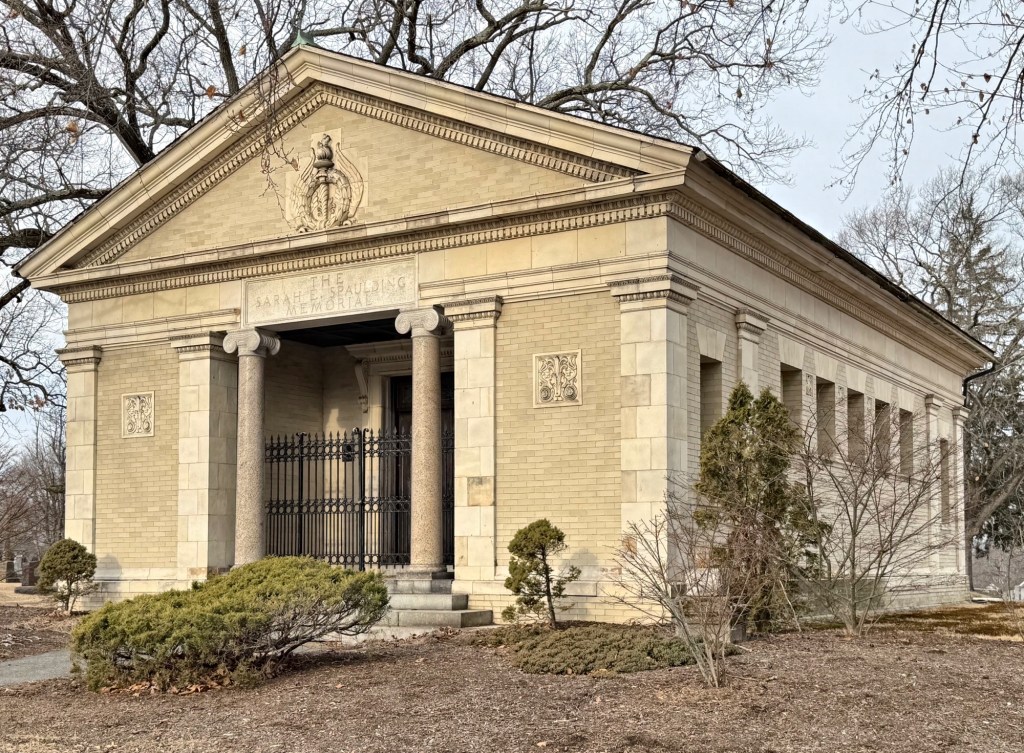
Spaulding Memorial Chapel // 1910

Located within the Fairview Cemetery in Chicopee, Massachusetts, this lovely memorial chapel serves as an everlasting love letter from one spouse to another. Justin Spaulding (1838-1906) was a wealthy grocer who operated stores locally and amassed quite a sizable fortune. He and his wife, Sarah Elizabeth (Cooley) Spaulding, lived in a large Queen Anne home and would bequeath substantial funds to the City in their will. Justin died in 1906, and Sarah would die a year later, and as they do not appear to have had any children, they became benefactors to the town, partially funding the construction of the town’s first purpose-built library and this memorial chapel in the Fairview Cemetery. Over $6,000 was spent on this chapel, with plans drawn by architects Eugene Clarence Gardner and his son, George C. Gardner. The Classical Revival building is constructed of yellow brick with stone trim and ornament, with a notable eternal flame motif in the gable.

Card Memorial Chapel // 1898

Cemetery chapels are fairly uncommon, but always a must-see when exploring a new place. These small charming buildings help bridge the gap between life and death and are often adorned with a permanence not seen in our lifetimes. This is the Card Memorial Chapel in the Spring Brook Cemetery of Mansfield, Massachusetts. The chapel was erected in 1898 as a memorial to 31-year-old Mary Lewis Card, who died in 1896. Mary’s parents, Simon W. Card and Mary J. Card, founded S.W. Card Manufacturing Company in 1874. The Mansfield-based company did very well and manufactured tap and die tools locally, shipping them all over the country. Before her abrupt death, Mary Lewis Card was set to marry architect Charles Eastman, who is credited with designing the memorial to his late-fiance. The chapel borrows from the Romanesque and Victorian Gothic styles, and is constructed of red brick laid with a tinted mortar atop a foundation of Quincy granite. The various roof sections are sheathed in green slate. The building displays a cross plan with a central tower rising forty-two feet from the ground to the apex, topped by a steeply pitched pyramidal roof. The building was restored years ago and still looks great!

Stone Memorial Building // 1896

Designed by New Hampshire architect William Butterfield in 1896, the Stone Memorial building in Central Weare is a significant example of a Neo-Classical style structure in a village setting. The building was constructed with money donated by Joseph Stone in honor of his father, Phineas J. Stone, who was born in Weare and moved to Charlestown, MA, later serving as its seventh Mayor. The building would “provide suitable room for a public town library” and a room for memorials to the Civil War soldiers who fought and died for the Union. When the town hall burned, offices there were relocated to this building. Eventually, the library and town offices left this small building, and it has since been home to the Weare Historical Society.

Ogunquit Public Library // 1897

One of Maine’s most charming libraries is right in the coastal village of Ogunquit, and like many of the greatest, it was built as a memorial to someone. George Mecum Conarroe was born Nov. 9, 1831. His father, George Washington Conarroe, was an accomplished Philadelphia portrait artist who provided his family with every advantage mostly from an inherited family fortune. The Conarroes and their cousins, the Trotters, who summered at Cape Arundel, had been associated in a very successful steel venture for several previous generations. George M. Conarroe apprenticed in a Philadelphia law firm and was admitted to the Bar in 1853. He ran a successful probate law practice and his prudent real estate development investments enhanced his formidable fortune. Nannie Dunlap, daughter of another leading Philadelphia lawyer married George M. Conarroe in 1868, they were inseparable. He built a summer estate in York Cliffs, a burgeoning Summer colony just south of Ogunquit (then a part of Wells). George died in 1896, and Nannie fought to keep her late husband’s legacy living in the coastal area he loved so much. She hired Philadelphia architect Charles M. Burns to design a new summer chapel in York and this beautiful village library in Ogunquit. The library was constructed of fieldstone taken from the site and is a lovely example of the Romanesque Revival and Queen Anne architectural styles in Maine.

Hathaway Memorial Library // 1895

One of the smallest and most charming public library buildings in New England is the Hathaway Memorial Library in Assonet Village, in Freetown, Mass. The building was constructed in 1895 from funds donated to the town by Florence E. Hathaway as a memorial to her late father, Guilford Hathaway. For the early years of the library, there was no hired librarian, so Florence staffed the building on Thursdays, and two others alternated on Saturdays, to serve the community. By the turn of the 20th century, the postmaster’s wife was hired as the librarian, and given an office in the small building. Little town libraries just make me smile, they are so inviting and cozy!

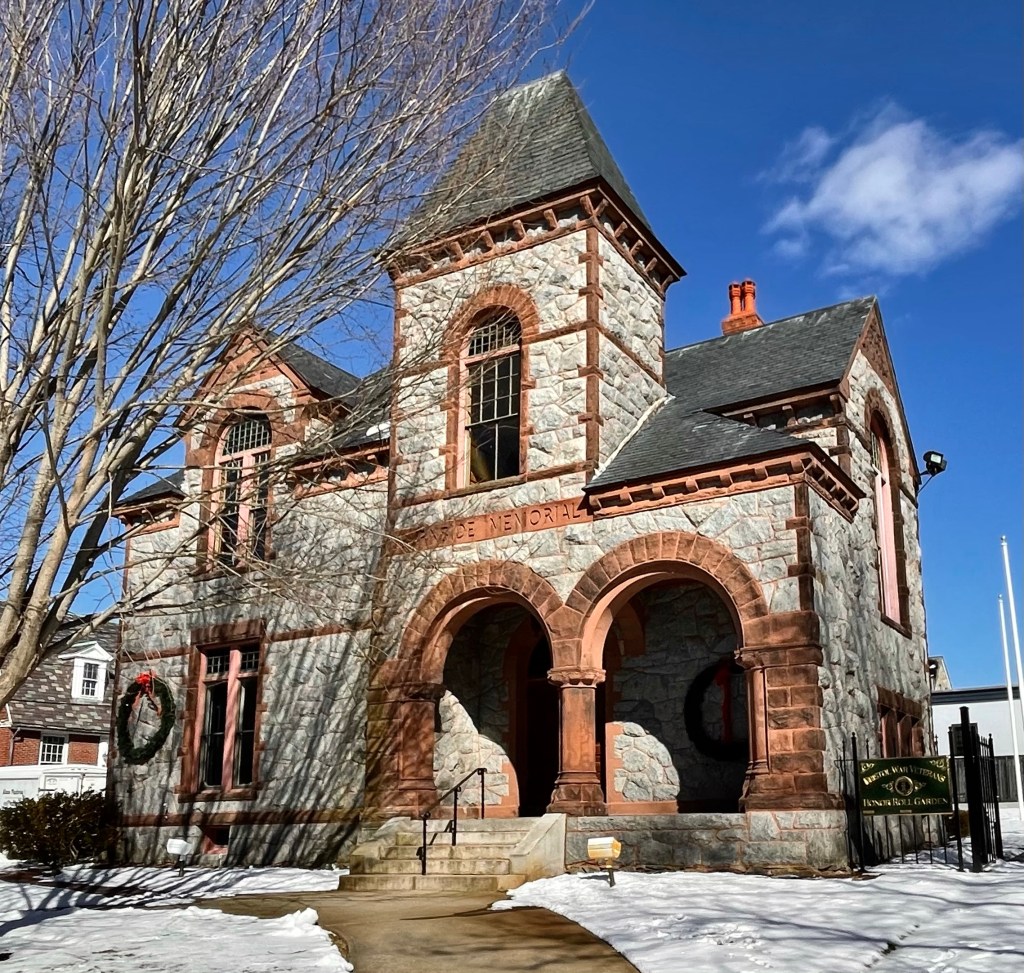
Burnside Memorial Hall // 1883

Located on Hope Street in Bristol, the Burnside Memorial Hall stands out as an elaborate, poly-chromed, two-story Richardsonian Romanesque public building. The Town of Bristol required a new town hall, and hired Worcester-based architect Stephen C. Earle to design the new structure. Earle’s program was to combine a town hall with a memorial to Major General Ambrose E. Burnside, Civil War hero, thrice governor of Rhode Island, and later United States senator, who died in 1881. The centerpiece of Burnside Memorial Hall was to be a statue of the general on its porch, long since removed from the building. Bristol town offices were removed from the building in 1969, and shifted to a bland building attached at the rear, Burnside Hall now serves purely as a memorial. Fun Fact: Burnside was noted for his unusual beard, joining strips of hair in front of his ears to his mustache but with the chin clean-shaven; the word burnsides was coined to describe this style. The syllables were later reversed to give the name we know today as “sideburns”!