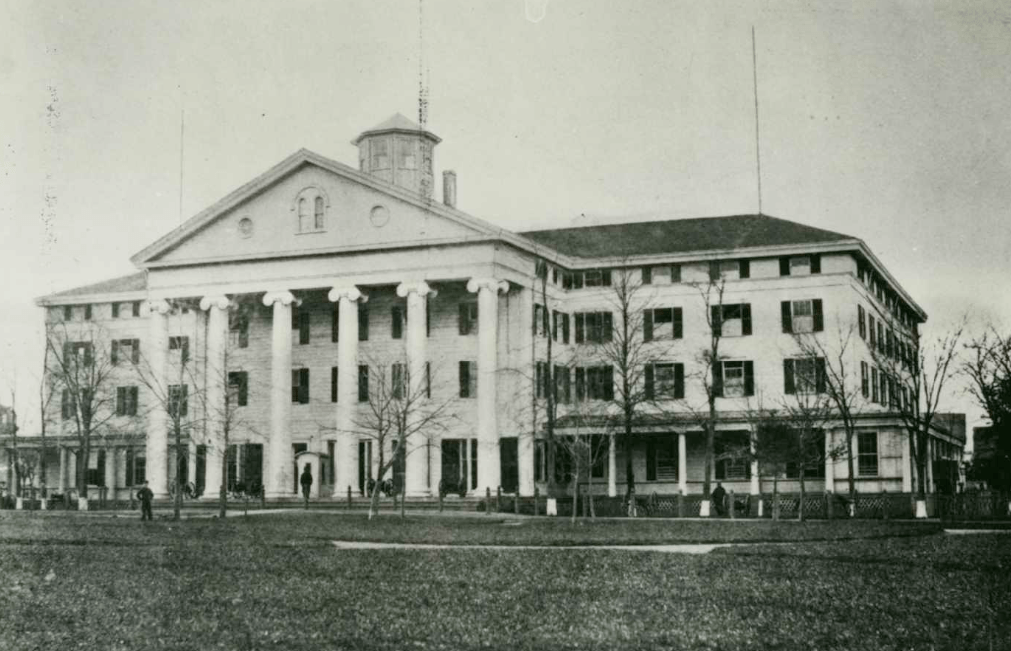
Atlantic House Hotel // 1844-1877

Prior to the present Park Gate Cottage at the corner of Bellevue and Pelham streets in Newport, this was the location of the stunning Atlantic House Hotel. Proprietor William T. Potter purchased this land in 1844 and built the Atlantic House Hotel, a massive Greek Revival style structure designed by Rhode Island architect Russell Warren. The Atlantic House faced Touro Park and the Old Mill and took the form of a large temple with a central two-story Ionic portico and hipped roof side wings. The building was constructed of wood and clad with smooth finish siding that was scored to resemble granite blocks to give it more stature. During the Civil War, the Atlantic House was home to the U.S. Naval Academy (1861-1865) when it was moved here to protect it from attack by the confederate forces at its location in Annapolis, Maryland. After the war, the Navy returned to Newport to establish three major facilities–the United States Naval Torpedo Station, the Naval Training Station and the Naval War College. The aged hotel saw dwindling numbers of visitors as newer, modern hotels were built after the Civil War. The hotel was demolished in 1877, just 33 years after completion, to make way for the Park Gate Cottage presently on the site.

Smith-Cottrell House // 1887

Located next to the Channing Memorial Church and the Derby Cottage on Pelham Street, this Queen Anne style cottage stands as a significant Victorian era residence on the street dominated by Greek Revival homes. Built in 1878 for a William H. Smith for his residence and office. The home is an excellent example of the Queen Anne style with asymmetrical form and massing, complex roofline with multiple gables and towers, varied siding, and intricate millwork. By the early 20th century, the property was owned by John and Mary Cottrell, and later purchased by the Channing Memorial Church as “Channing House”.

Derby Cottage // c.1848

Located off Touro Park in Newport, you may be surprised to find an early Gothic Revival style cottage obscured from view by the towering stone Channing Memorial Church. Newport has so many hidden treasures! Very little is written about this cottage, but it appears to have been built c.1848 for Richard Crowninshield Derby (1777-1854) of the famous Derby Family of Salem, Massachusetts. Richard Derby would move to Philadelphia and split his time between there, Boston, and his newly built summer cottage in Newport, Rhode Island. He did not get to fully appreciate the home as he died in 1854. The Gothic Revival cottage was inherited by his widow, Louisa S. Bomford Derby until her death and later by the couple’s two children (from both of their first marriages), Richard Catton Derby and Louisa Lincoln Lear Eyre, the mother of famed architect Wilson Eyre. The property was eventually sold by the half-siblings and the site became home to the 1880 Channing Memorial Church, which now dominates the site. Luckily for us, the cottage was spared and moved to the extreme rear of the lot and converted to the parish hall for the church.

Littlefield-Van Zandt House // 1836

In the late 1830s, Captain Augustus Littlefield (1803-1878) purchased a house lot on Pelham Street in Newport, Rhode Island and commissioned housewright John Ladd to design and build his new residence. Littlefield reportedly asked his Ladd to design an “authentic copy of an Italian Villa” he had seen during a trip in southern Italy. The result is a more traditional Greek Revival, temple-front house with a portico supported by four monumental columns with capitals that combine Corinthian and Egyptian lotus motifs. The minimal Italian Villa detail can be seen in the bracketed cornice and in the pediment. Built around 1836, the house remained in Littlefield’s possession until his death in 1878. The property was purchased by Charles C. Van Zandt, attorney and later the 34th Governor of Rhode Island. Gov. Van Zandt died in 1894 and was interred at Island Cemetery in Newport. The Littlefield-Van Zandt House remains a significant early, high-style Greek Revival house in the state and one with a great state of preservation.

Bowen-Newton-Tobin House // c.1825

Who would have ever imagined that the Federal and Second Empire architectural styles could work so well together?! This is the Bowen-Tobin House on Spring Street in Newport, Rhode Island. The house was originally built around 1825 by Stephen Bowen as a typical two-story Federal style house with five-bay facade and entry with pedimented fanlight above. The property and it remained in the Bowen Family until 1892, when it was sold by his heirs to Mary Bailey Newton, the wife of Dudley Newton, a prominent local architect who designed dozens of summer cottages for wealthy residents in Newport. Dudley Newton “modernized” this house, adding a towered mansard roof, bracketed cornice, new two-over-two windows, and a full-length front porch wrapping around the side. The couple later moved the house, which was formerly set back behind a front garden, to the side and at the sidewalk to lay out Green Place (originally Bowen Ct.) and house lots behind this home, removing the front porch in the process. The house was later sold to the Tobin Family.

Joseph Cottrell House // 1843

The Joseph Cottrell House on Spring Street in Newport is a handsome, two-story, Greek Revival style house with flushboard siding and a traditional pilastered recessed center entry. What really stands out about this home is the two-story rounded corner bay which is finished with columned porches (since enclosed) which were likely added in the second half of the 19th century. Cottrell worked as a ship-builder in Newport, likely constructing the house and later addition himself. Developers today would never!

West-Hathaway House // c.1800

Located on Mill Street, overlooking Queen Anne Square, the West-Hathaway House is one of the most charming Federal period houses in Newport, but it didn’t always call this city “home”! Believe it or not, this five-bay Federal style house was originally built in Tiverton, Rhode Island around 1800 and relocated to Newport about fifty years ago. The house was built by Samuel West (1774-1838), of a line of physicians, and later sold to Samuel Hathaway. The house was located on large farmland presently occupied by the Pardon Gray Preserve in Tiverton but was later donated to the Newport Preservation Foundation in 1977 by the owners who likely hoped to redevelop the area where this house sat. The West-Hathaway House was dismantled, moved, and reassembled on this site that same year!

Billings Coggeshall Double House // c.1784

This unique double-house on Mill Street is stopped me in my tracks when strolling around Newport. The two-family house was built around 1784 by Billings Coggeshall (1733-1810) and is unique architecturally as it is comprised of two houses, each with its own separate pedimented entry, into a single lengthy block. Both houses have interior chimneys and are just one-room deep! When urban renewal hit Newport in the second half of the 20th century, traffic patterns and revitalization of the waterfront were top of mind (not necessarily slum clearance and wholesale redevelopment of neighborhoods like in Boston). To bring traffic into the downtown shopping area, Memorial Boulevard was laid out by 1969, and the Newport Restoration Foundation was integral to saving this building from the wrecking ball, as it was in the path of the new road. As luck would have it, an area around Trinity Church was cleared to establish Queen Anne Square, a town common-like park in the center of town. To provide the quintessential “New England charm”, many historic buildings were relocated to line the square, including this house. When the Billings Coggeshall House was moved here, it replaced a gas station, and it was given an even longer side addition with breezeway, providing screened parking and a rear addition for offices. Here’s to preservation!

Newport Telephone Building // c.1897

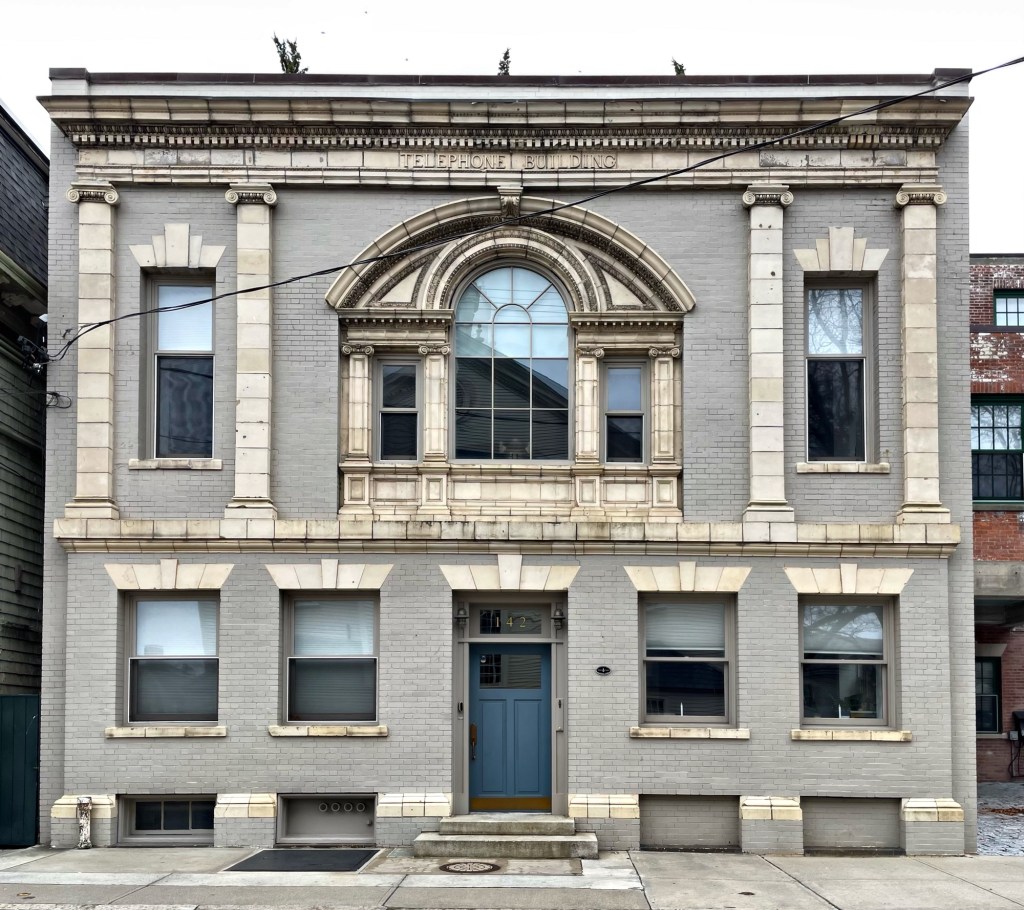
Before the days of virtual meetings, texting, and calls by cellphone, residents of towns and cities all over New England needed central telephone exchanges to connect them to those who they were trying to reach. Telephone exchange buildings were typically located in downtown areas and were often architectural statement-pieces by telephone companies. This example in Newport, Rhode Island, is located just behind Trinity Church and was designed around 1897 by the firm of Perkins & Betton of Boston. The building is constructed of brick (now painted) with terracotta trim details, which really pop. The oversized Palladian window with arch, pilasters, and cornice are all terracotta installed by the Waldo Brothers, contractors. The building was converted to residential use and was sold for $2.5 Million in 2020.

Trinity Church, Newport // 1725

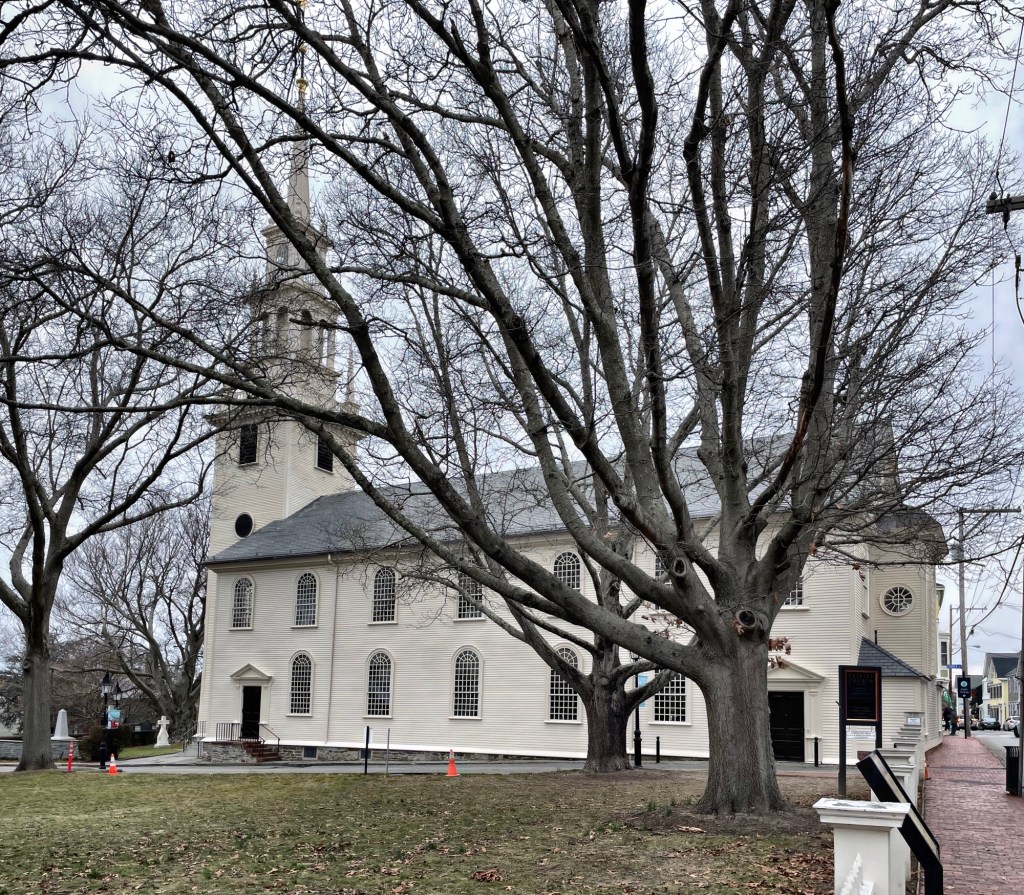
Trinity Church in Newport, Rhode Island is one of the largest extant 18th century churches in New England, and founded in 1698, it is the oldest Episcopal parish in the state. Built in 1725, the Georgian style church was built just as the influence of Sir Christopher Wren’s churches reached the colonies, about a quarter century after his work had come to dominate ecclesiastical design in London. Trinity is the second major church built in the original colonies influenced by Wren, following Old North Church in Boston’s North End (1723). Stylistically, both churches are similar, with the notable difference in material (Old North in brick and Trinity Church in clapboard). Local builder Richard Munday, is credited with the design of Trinity Church. By the late 19th and early 20th centuries, many members of the Vanderbilt family and other wealthy residents attended sermons here when summering in Newport. When Newport was undergoing Urban Renewal in the mid-20th century, Queen Anne Square (the park which fronts the church) was created in the 1970s to establish a town common in a city which had never truly had one. “Early” buildings in the area to be bulldozed for the common were moved to other sites to enhance the “colonial” rehabilitation of the area around the harbor, making this one of the few examples of urban renewal having a positive impact on a city.