You know you’ve “made it” if you have a music room, especially if you have one in your summer mansion in Newport! The Music Room in The Breakers evokes the opulent Parisian interiors of the Second Period and when inside the room, you just feel sensory overload (in the best way possible. The room is located off the Great Room and Morning Room, at the southern end of the house. The Music Room was used for recitals and dances for the Vanderbilt Family and guests. The room displays ornate woodwork and furnishings designed by Richard Van der Boyen and built by J. Allard of Paris. The room looks like it was plucked out of a French building and dropped into the mansion, and that is because it was! The room’s interior was constructed completely in France and then sent to America where it was installed at The Breakers by French craftsmen. My favorite parts of the interior are the bay window at the end and the gilt gold coffered ceiling.
The most opulent of all summer ‘cottages’ in Newport is the iconic Gilded Age mansion, The Breakers. This mansion was completed in 1895 as a summer residence for Cornelius Vanderbilt II. Cornelius’ grandfather, Commodore Cornelius Vanderbilt (1794-1877) established the family fortune in steamships and later in the New York Central Railroad. Cornelius Vanderbilt II became President of the New York Central Railroad system in 1885, and bought a wooden summer house called The Breakers in Newport during that same year. The original Breakers Mansion burned in a fire in 1892 and was rebuilt, but more substantially. Vanderbilt commissioned famed architect Richard Morris Hunt to rebuild it. Vanderbilt insisted that the building be made as fireproof as possible, so the structure of the building used steel trusses and no wooden parts. He even required that the boiler housed in an underground space below the front lawn. The Italian Renaissance-Beaux Arts style mansion was likely the most expensive home constructed in New England at the time at a cost of over $7 Million USD (equivalent to over $150 million today).
Cornelius Vanderbilt died from a cerebral hemorrhage in 1899 at age 55, leaving The Breakers to his wife Alice Gwynne Vanderbilt. She outlived him by 35 years and died at the age of 89 in 1934. She left The Breakers to her youngest daughter Countess Gladys Széchenyi (1886–1965). In 1948, Gladys leased the near-impossible to maintain property to The Preservation Society of Newport County for $1 per year. The Preservation Society bought The Breakers and approximately 90% of its furnishings in 1972 for $365,000 ($2.3 million today) from Countess Sylvia Szapary, Gladys’ daughter, although the agreement granted her life tenancy. Upon her death in 1998, The Society agreed to allow the family to continue to live on the third floor, which is not open to the public. The last-remaining family members residing there were evicted from the third floor due to safety concerns, but others state it is retaliation for the Szápárys’ opposition of the controversial Breakers Welcome Center, the plan for which other members of their family, including Gloria Vanderbilt, also opposed.
Newport in 1774 had approximately 153 free Black residents residing in 46 households comprising of thirty-percent of Newport’s population at this time. One of these free Black families was the Jack family who resided around Levin Street (Memorial Boulevard today). The Jack Family appears to have been from Antigua and may have had ties to the Redwood Family (the namesake of the Redwood Library), who owned a plantation on the island and resided in Newport. Alexander Jack, Jr. was a free African American whose trade was a cordwainer or shoemaker. He bought his land in 1811 and is thought to have begun construction almost immediately. Jack heirs remained on this property until 1881. The Newport Restoration Foundation purchased the house in 1969, moved it that same year to Mill Street to save it from urban renewal and the widening of Levin Street as Memorial Blvd.
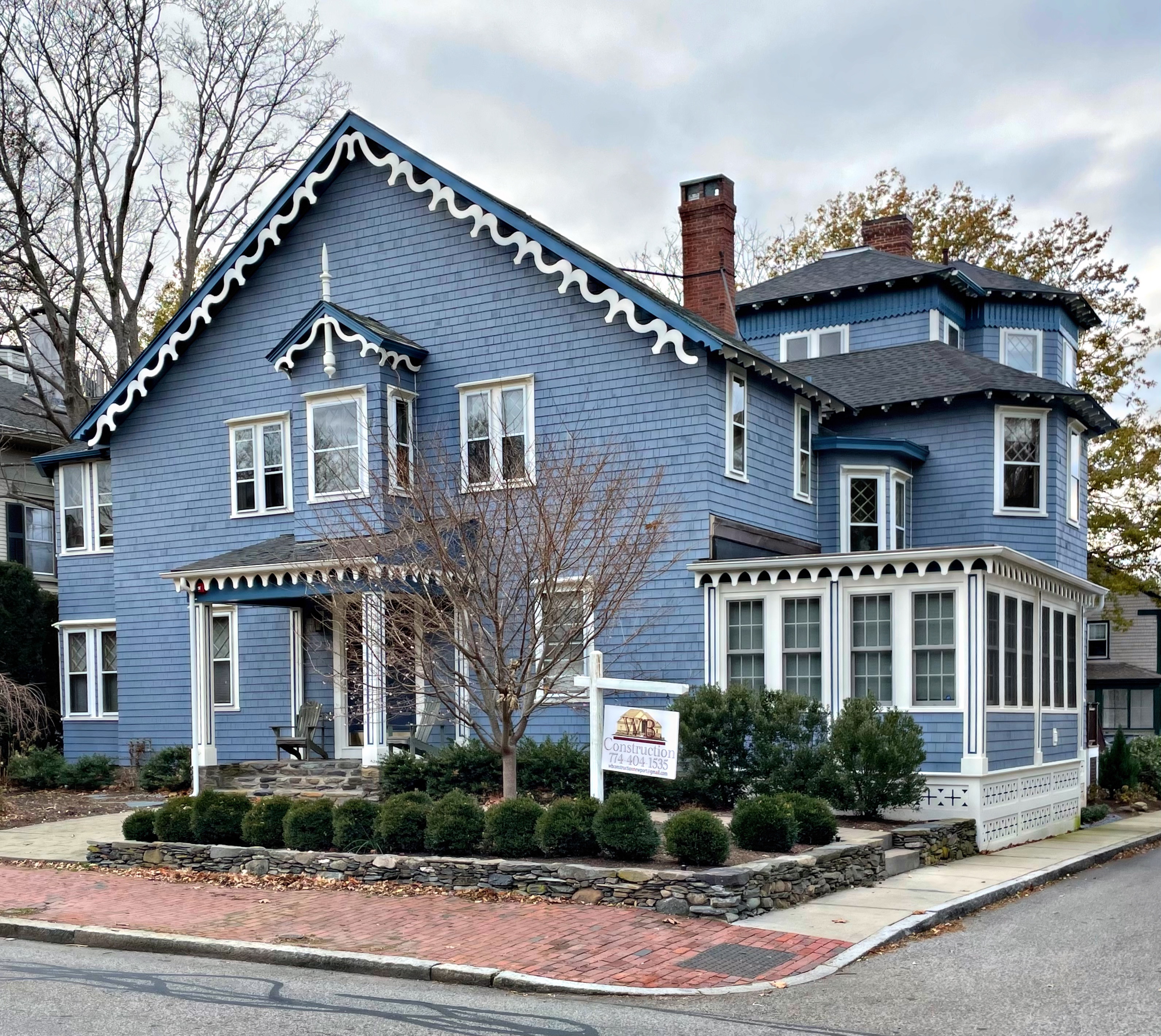
In 1843, George Henry Calvert (1803-1889) and his wife Elizabeth Steuart moved to Newport, Rhode Island from Maryland, not long after built or purchased this home. George was the son of George Sr. a plantation and slave-owner in late eighteenth- and early nineteenth-century Maryland. His plantation house, Riversdale plantation, also known as the Calvert Mansion, built between 1801 and 1807, was designated a National Historic Landmark in 1997. From his wealthy upbringing by unsavory means, George was able to attend Harvard and spent time travelling to Europe. There, he met poets Goethe and William Wordsworth. He lived in Baltimore and served as editor for the Baltimore American, the largest local paper in the city. He worked on poetry and eventually moved to Newport, RI, possibly seasonally. This home was built in the Gothic Revival style for Calvert and his family. Years later, he was elected Mayor of Newport. Calvert hired Fannie Jackson Coppin as a servant for the household. Coppin was born a enslaved in Washington D.C., but gained her freedom when her aunt was able to purchase her at the age of twelve. She went on to become an advocate and leader in Black education. Historic maps show two properties owned by the Calvert’s. A nearby building, presently 38 Kay Street was possibly built as a barn or stable for the Calverts. This home was purchased in the 1880s by Captain Mathias Candelaris Marin, a sea captain who fought in the Mexican and American Civil wars. Marin likely modernized the Gothic House, adding the shingle siding and large Queen Anne additions to the rear. The Marin Street at the side of the house is named after him.
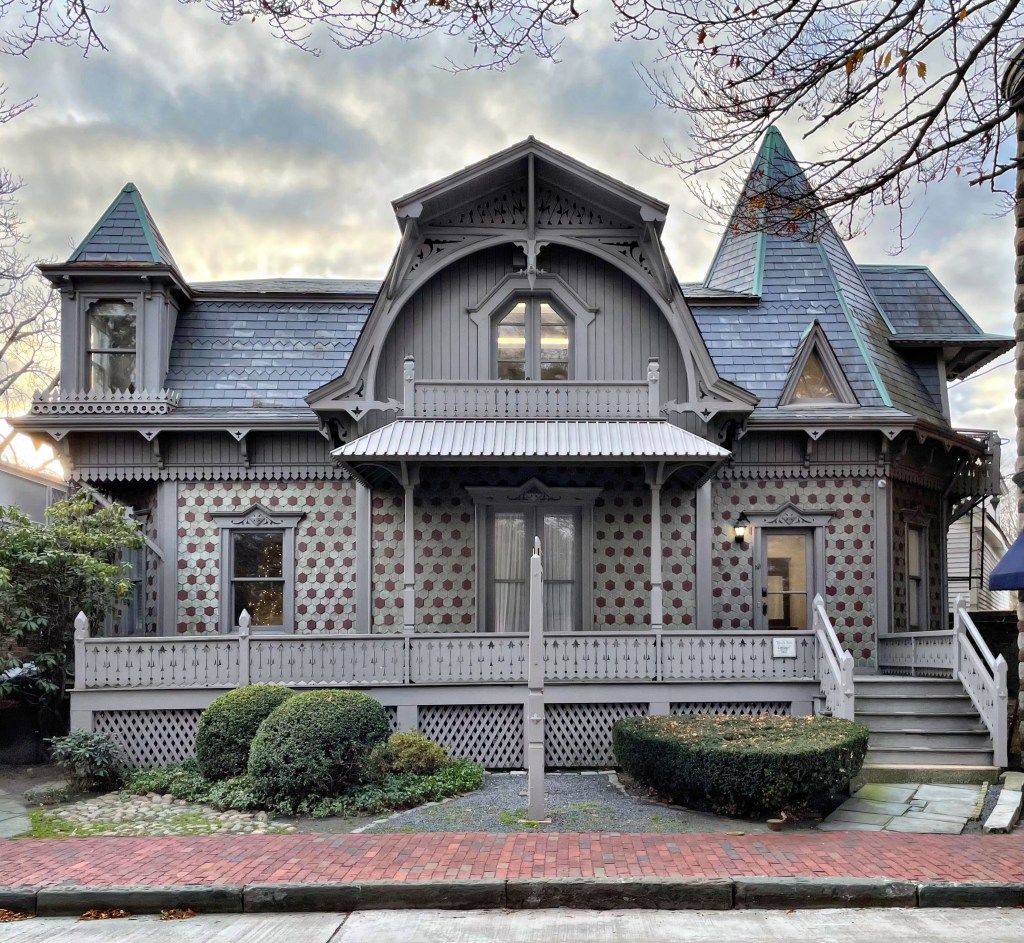
One of the more unique and relatively modest summer cottages in Newport, Rhode Island is Bird’s Nest Cottage on Bellevue Avenue. The cottage was built in 1871-2 for Samuel Freeman Pratt, who lived his early life in Boston. The son of a carpenter, Pratt was was working as a carver in Boston, where he saw success as an inventor with several patents to his credit. From the success of one of his inventions, a device for sewing machines, the invention gave him the financial freedom to explore other interests, namely architecture. In Boston, he likely learned his craft from partner John Stevens, before setting out on his own. He designed buildings in Oak Bluffs on Martha’s Vineyard, but decided to reside in Newport. While many state that this cottage for Pratt was designed by the Newport resident and star-chitect Richard Morris Hunt, the design and the fact that it was his own cottage lead me to believe it was designed by Pratt himself. The eclectic cottage features complex gable shapes, fancy stickwork under the eaves, projecting corner bays, and a wall covering of multicolored slate roof shingles. It is now a professional office.
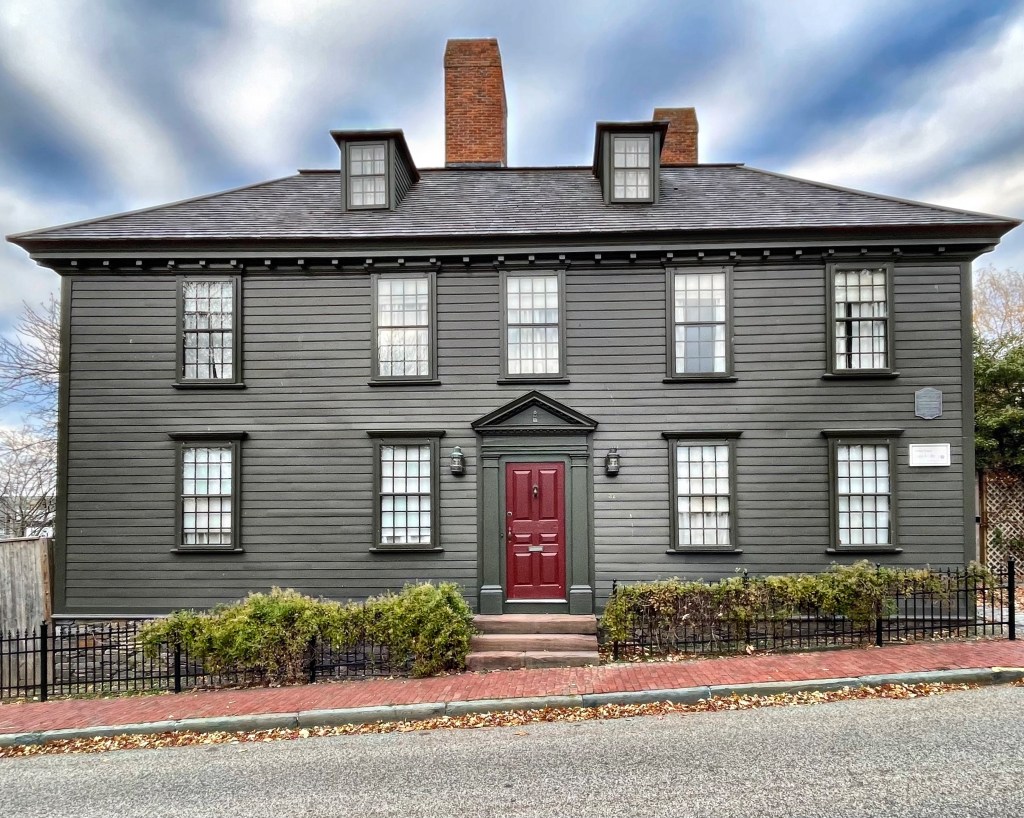
One of the oldest houses in Newport, the Charles Cotton House stands on Church Street, and has a similar story to its neighbor, the Langley House (featured previously). The home was built around 1720 and is named for Dr. Charles Cotton who owned it in the early nineteenth century. Cotton was born in Plymouth, MA, and was a direct-descendant of ministers John and Josiah and worked as a surgeon aboard the USS Constitution during the War of 1812. From Newport Restoration Foundation: “The original structure was probably a small, single-chimney house of one-and-a-half or perhaps two stories. The house as seen today was obviously enlarged in the Georgian style in the mid-eighteenth century and received further improvements in the early nineteenth century.” The likelihood of the building’s incremental growth is evident from the two chimneys are not of the same size above the roofline, nor are they in line with each other. Had the house been built new in the later Georgian style, elements on the exterior probably would have been more symmetrical and balanced. This building, like the Langley House was moved by Newport Restoration in the 1970s to save it from the wrecking-ball. In its original place, a parking lot.
This well-kept Federal home in Newport was apparently built pre-Revolution, but it was likely significantly altered in the early 1800s for its namesake, William “Billy” Bottomore. “Billy” was born in Bologna, Italy, and moved to Salem, MA, where he possibly met Michele Felice Cornè, a prolific painter and who is credited in making tomatoes mainstream… seriously. In early 19th century New England tomatoes were thought to be deadly poison. Cornè was accustomed to eating tomatoes in his native land of Italy and would regularly eat them without ill effect and, thus, allayed the fears of the residents of his adopted country. Cornè became friends with Bottomore and they both moved to Newport. Bottomore likely modernized this house with help from his friend and ran a confectionery store in the home.
Here is another of my favorite non-Gilded Age houses in Newport, the John Bush House on Mann Street! John T. Bush (1817-1881) was listed in directories as a “wool-puller” which clearly was a lucrative job, as he could afford to build this high-style Gothic Revival home. This house is heavily influenced by the publications of Andrew Jackson Downing first published in 1842, so the house is probably built within a couple years of that date. Hallmark features of the Gothic Revival style include: lancet windows, bargeboards, windows with drip molds, and steeply pitched roofs; this house has all of the above!
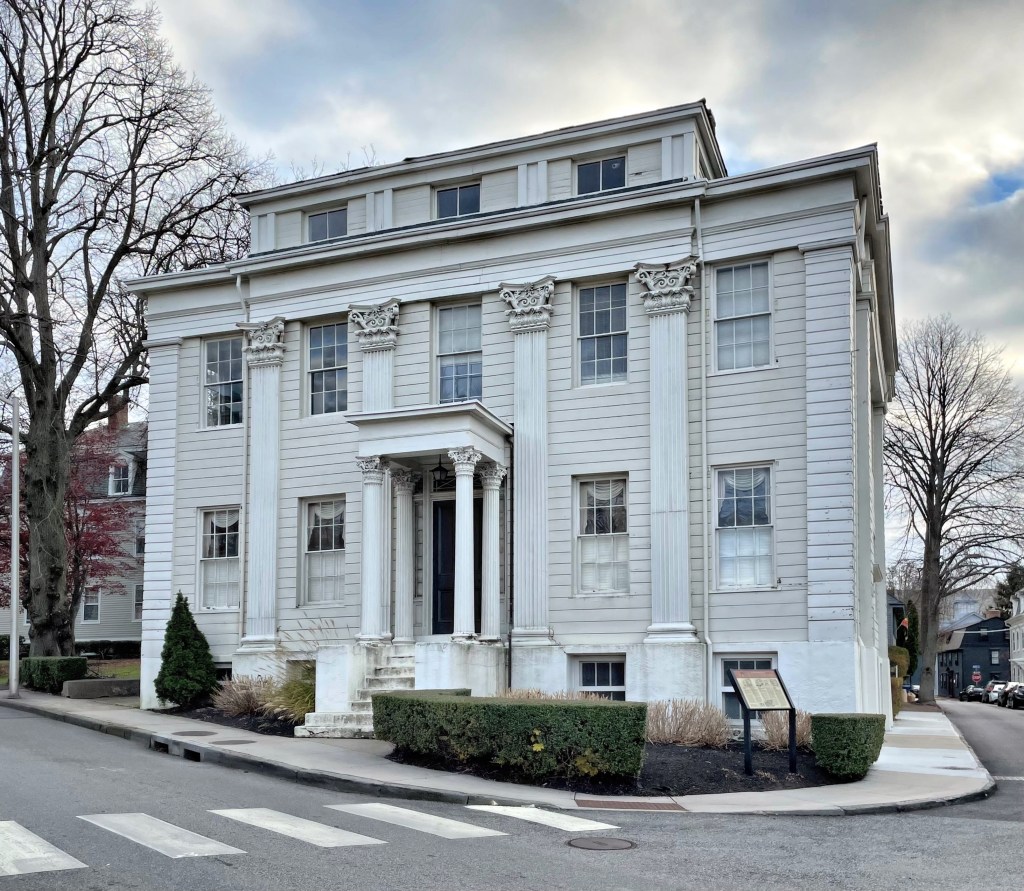
One of my favorite houses in Newport, Rhode Island is this amazing high-style Greek Revival mansion across from the Touro Synagogue. The house was built in 1835 for Levi Gale, and designed by esteemed Rhode Island architect Russell Warren. Gale was born in New Orleans and moved to Newport and is listed as a merchant. It is possible that Levi Gale was involved in the Triangular Trade, the trading of enslaved people, sugar (often in its liquid form, molasses), and rum between West Africa, the West Indies and Rhode Island. Many do not realize, but Rhode Island was heavily involved in the slave trade. The house follows the more traditional Federal form, but with two-story composite pilasters and flush siding, scored and painted white to resemble ashlar marble. The home is elegantly sited, but it is actually not on its original lot. It was actually built adjacent to Washington Square, in the place of the present Newport County Courthouse, and was moved to its present site in 1925. The mansion was cut in half, moved a block away, and re-assembled on a new foundation. It is now used as a Jewish community center, owned by the congregation that owns Touro Synagogue.
On a little stretch of Kay Street in Newport, you can find four strikingly similar Italianate style houses, all neighbors. Upon further research, it turns out they were designed by the same man, Job Peckham. Job Almy Peckham (1807-1885) was a descendant of one of nearby Middletown’s “founding” families. He ran a lumberyard and began working as a housewright, building homes. He was a believer of the philosophy “if it ain’t broke, don’t fix it”, so he built many of his houses in a sort of cookie-cutter way, but each showcasing slight design changes. One of the most impressive features of these homes is the massive overhanging eaves with scrolled brackets. Peckham’s own house (bottom right) is included in the bunch. What do you think of these homes?





 Buildings of New England