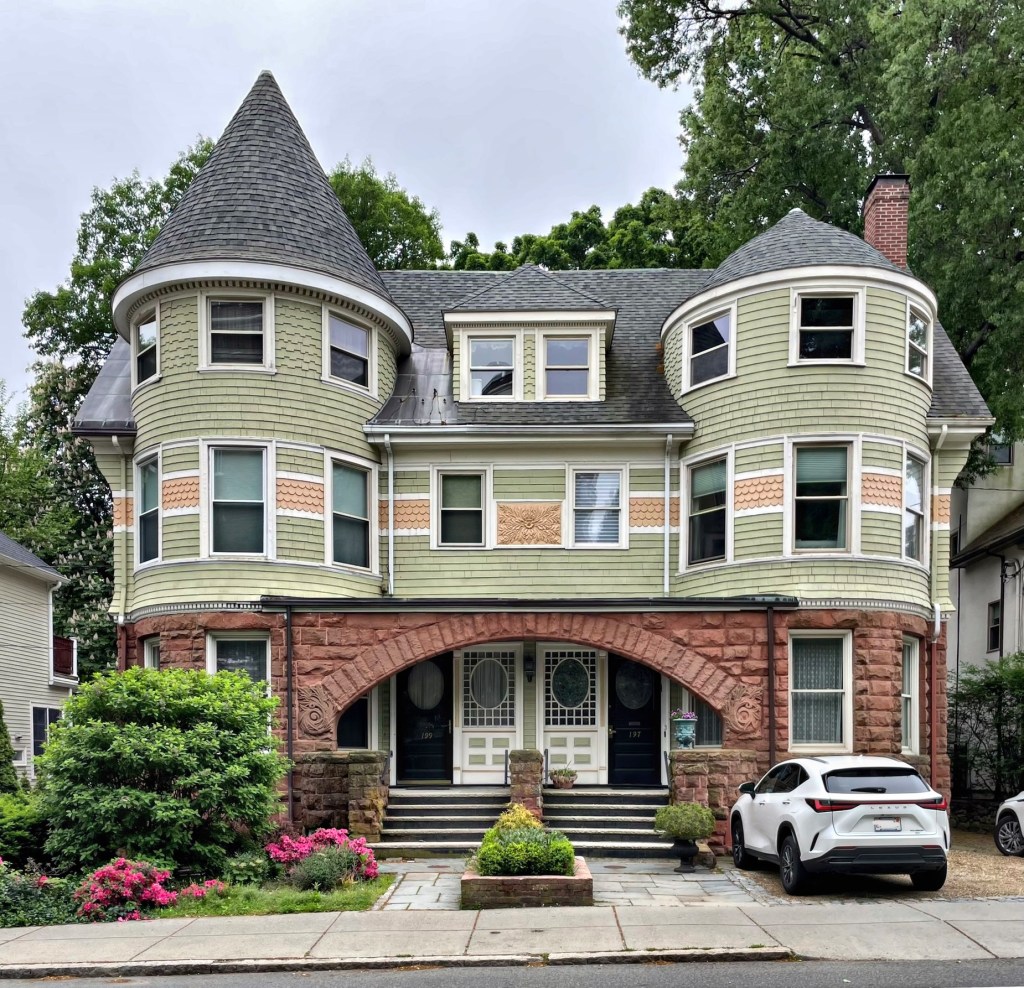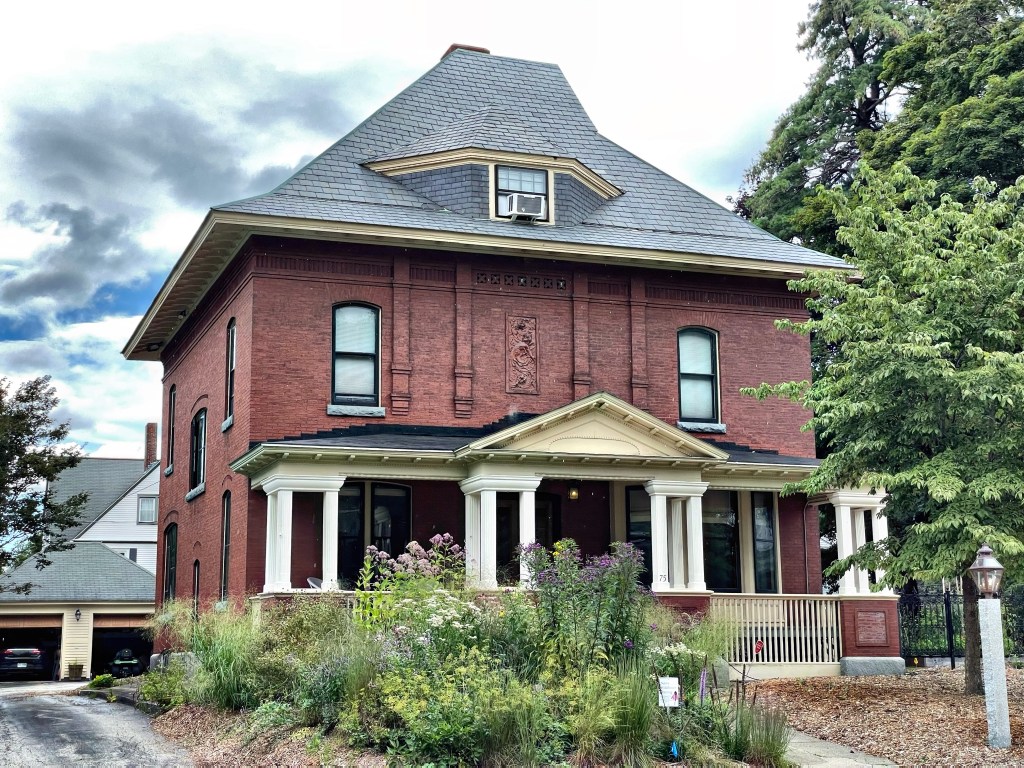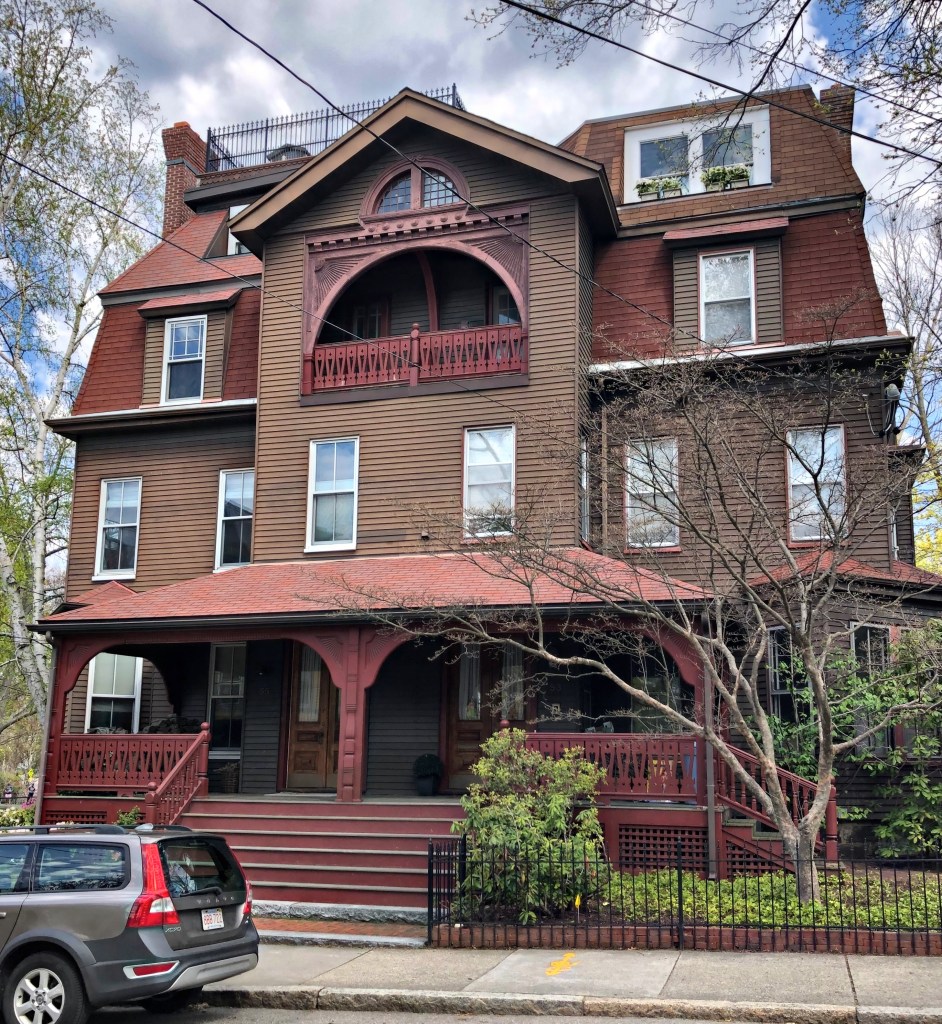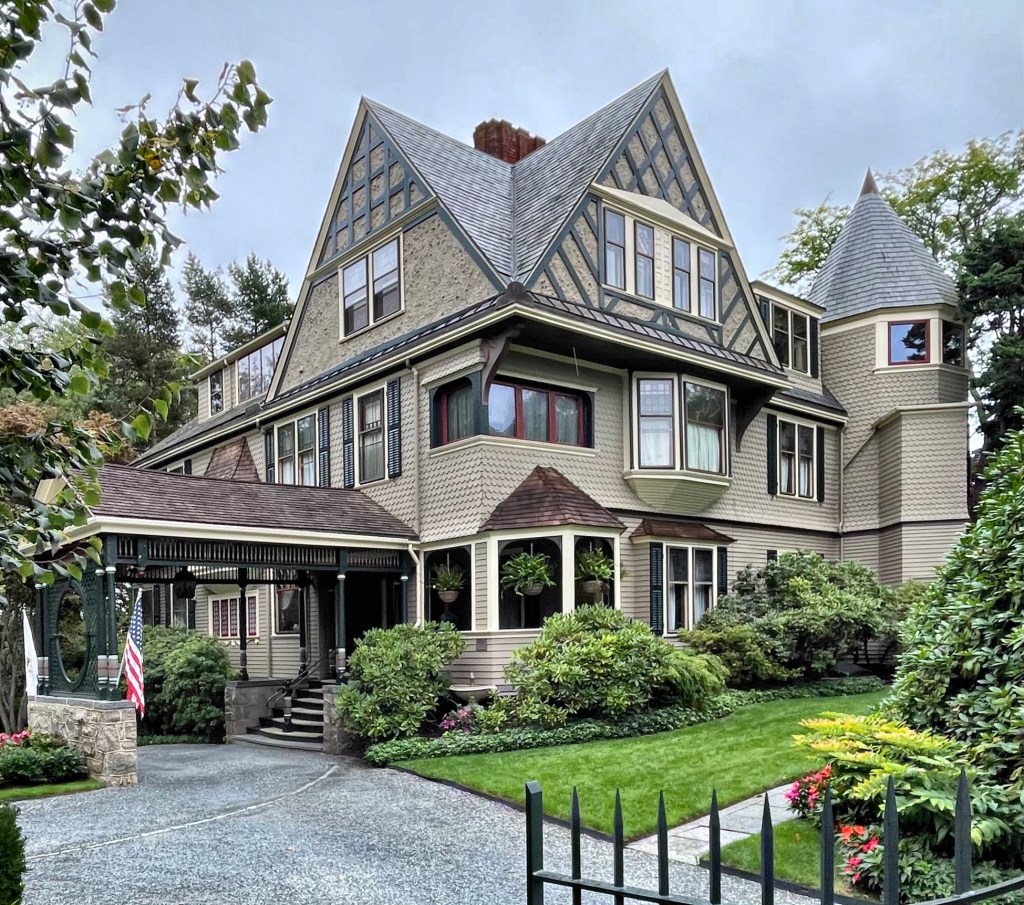
WOW! Would you just look at this absolute stunner in Nashua? The town is not necessarily known for its historic architecture, but like most New England towns and cities, there are some amazing buildings to check out. This example, the James Tolles House, was built in 1890 and is one of the finest residences in the city. The stately residence was built for Mr. Tolles who served as Nashua’s 23rd mayor. The Tolles House stands out for the use of sandstone ashlar construction on the first floor with shingle siding above, carved terracotta panels, and a large, rounded corner tower capped with a domed copper roof. This one is pretty close to perfect!
Brookline Village is full of amazing double houses (or duplexes) built in the late 19th century. Many feature Queen Anne detailing and are architecturally striking with porches, complex rooflines, and trim details. This example was built in 1884 by Elijah Emerson, who had an estate nearby. His house was originally located where the park, Emerson Garden is located, but it was moved across the street. He had this double house built and rented it out to middle-class families who flocked to the neighborhood for the ease of access to Downtown Boston, while maintaining a bucolic feel (why many still today move to Brookline). Even though it is covered in aluminum siding today, the original wood clapboards and trim likely are waiting underneath to be revealed someday. But for today, we can gawk at the original details that are visible, including the semi-circular window, recessed porch with decorative balustrade, and porch with original entry doors.
While many lots in Brookline village in the final decades of the 19th century were being redeveloped as duplexes, three-deckers, and apartment houses, some property owners still wanted single-family living. In 1885, George Carpenter had this home in the village built from plans by well-known architect Obed F. Smith, who designed many Victorian-era homes in Boston’s Back Bay and around the region. George Carpenter worked in Downtown Boston as an agent for the Massachusetts Mutual Life Insurance Company. The house features some Stick style elements seen in the porch spindles and carved brackets.
This house in West Acton is the last in this batch of Queen Anne style Victorian houses I’ll feature in the village. The dwelling was built in 1891 for a 31-year-old John Sherman Hoar, Jr. (1860-1954) and his new wife Minnie R. Hart. John was a master carpenter and built many of the Queen Anne style homes on Windsor Street and later Colonial Revival and Craftsman homes in the 1890s and 1900s himself. This was his own property which once included a workshop where he cut and manufactured many homes on the street. Today, the Hoar House has a cheery pink color scheme (which while not historically appropriate) brought a smile to my face when strolling by!
Another of Acton’s amazing old Queen Anne homes is the Edgar Hall House, an 1889 gem on Windsor Avenue. The house was built for Edgar Henry Hall and his wife Angelina who raised their daughter, Alice, in the home. Edgar and his brother inherited the family business from their father, Enoch Hall, and they produced wooden pails, tubs, clothing racks, and other wooden goods. The company employed over 30 workers in the early 20th century until it closed during the Great Depression. Edgar retired and relaxed from this stunning Victorian home until his death in 1954.
One of the most well-designed and least-pretentious summer cottages in Newport is this charming dwelling on a dead end street. The Samuel P. Tilton Cottage was designed in 1880 by the prestigious firm of McKim, Mead & White as an idiosyncratic blending of Queen Anne and Shingle architectural styles. Mr. Tilton was a milliner (maker and seller of women’s hats) with stores in Boston and Paris, France. He had this cottage built to summer close to the nation’s wealthiest, likely marketing some hats at elaborate Gilded Age events. The facade is assertively Queen Anne with its massing and decorative panels, with shingled side elevation seemingly sprouting from the earth. The architectural terminology for these unique decorative panels is “sgraffito” where here, cement or plaster siding is set and adorned with shells, pebbles, colored glass, and pieces of coal into a cartouche design. The house is one of the finest in Newport, and shows that bigger isn’t always better!
Behold this Queen Anne painted lady in all her glory! This home was constructed in 1898 as a late Victorian addition to Newton’s built landscape. The home’s earliest known owner was a T. C. Sullivan, who left the property to his family upon his death. The house is painted some pretty bold colors, which does an effective job at highlighting the many architectural details and intricacies in the design, but the home would have never been painted like this historically. A little history lesson: the “painted lady” trend took off in San Francisco when after WWII, disinvestment in the urban core led many Victorian homes there to be demolished, altered and covered with siding, and many were painted gray with war-surplus Navy paint (battleship gray). In 1963, San Francisco artist Butch Kardum began combining intense blues and greens on the exterior of his Italianate-style Victorian house. His house was criticized by some, but other neighbors began to copy the bright colors on their own houses. Kardum became a color designer, and he and other artists / colorists began to transform dozens of gray houses into Painted Ladies. By the 1970s, the colorist movement, as it was called, had changed entire streets and neighborhoods. This process continues to this day. The trend took off all over the United States as urban centers saw re-investment and gentrification. While not historically appropriate, the Painted Ladies can really make people happy and show pride in ownership.
Happy Halloween! To celebrate I wanted to feature one of the more creatively decorated houses in the Boston area, which blends spookiness with architecture! This is the Barrows-Goddard House, so named after its first two owners. The house is located in Newton and was built in 1898 as an eclectic Queen Anne/Shingle style home. The original owner was Joseph Barrows, who developed the property and sold it within a year, relocating to a new home on a less busy street. The property was owned next by Christopher Goddard, an insurance agent with offices in Boston. Architecturally, the gable roof of the main block is intersected by an over-scaled gambrel cross-gable clad in patterned cut wood shingles. The focal point of the design is the Syrian-arched entrance porch of coursed, dressed fieldstone which this time of year, eats trick-o-treaters!
In 1895, when the Queen Anne style was no longer in vogue among architects and builders in the Boston area, the Allston Real Estate Company took a gamble and built this house in a scarcely developed section of Waban Village in Newton on spec, hoping to find a buyer. They found one in Oscar Raymond Rice and his wife Maud Lois Sargent Rice. Oscar worked as a salesman, and Maud volunteered locally with various causes. The family home is a great example of Queen Anne Victorian architecture with varied siding styles, asymmetry, a tower, rounded bay window, porch with turned posts, and applied decoration in the gables. The house underwent a large renovation about five years ago and it still looks great! The listing from 2017 gives me serious house envy.
When you look up Queen Anne architecture on Google, this house in Wilton, NH should pop up! The Frederick Colony House was built around 1885 for the mill-owner who built a large cotton mill (last post) in town at the same time. Frederick Colony (1850-1925) was from a prominent textile and cotton mill-owning family based in Massachusetts and Keene, New Hampshire. Colony purchased land along the Souhegan River and built a new mill, there to make his own fortune, and that he did! The Frederick Colony House remains as one of the best-preserved homes in Wilton, and recently sold. Those interiors!