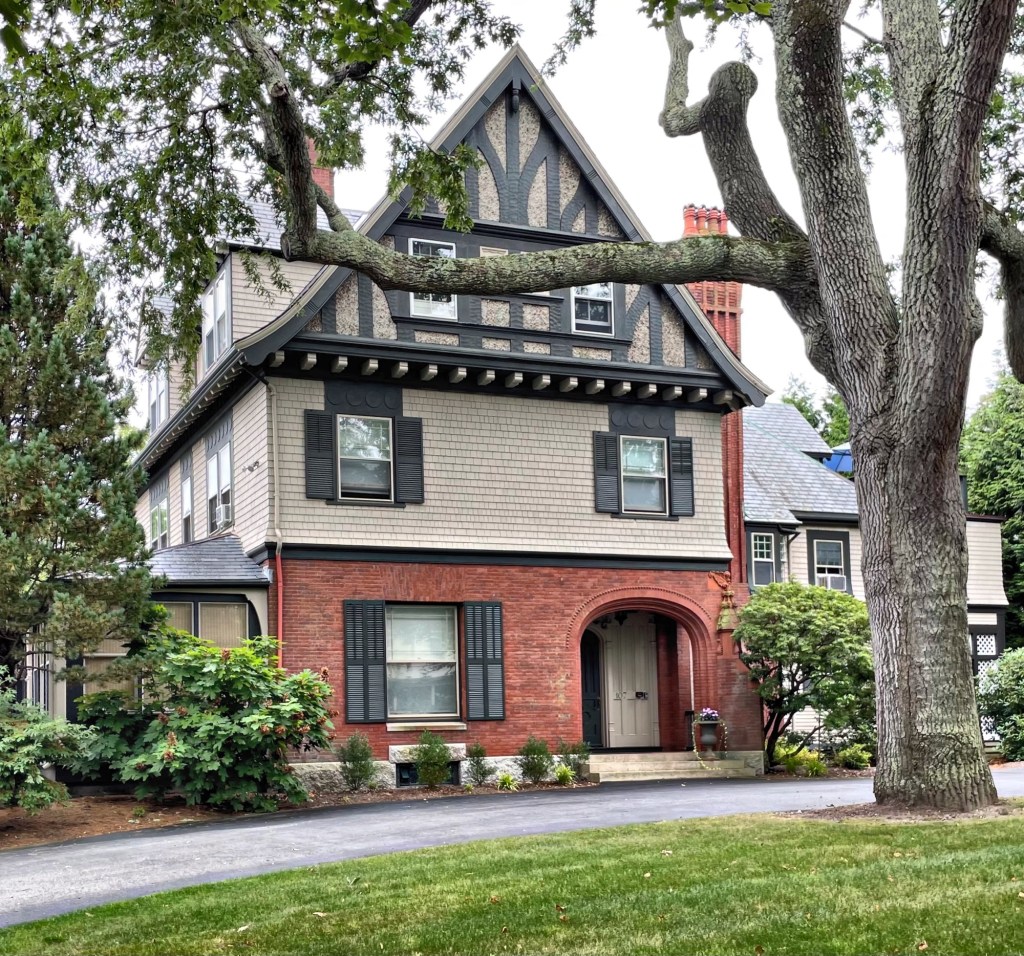
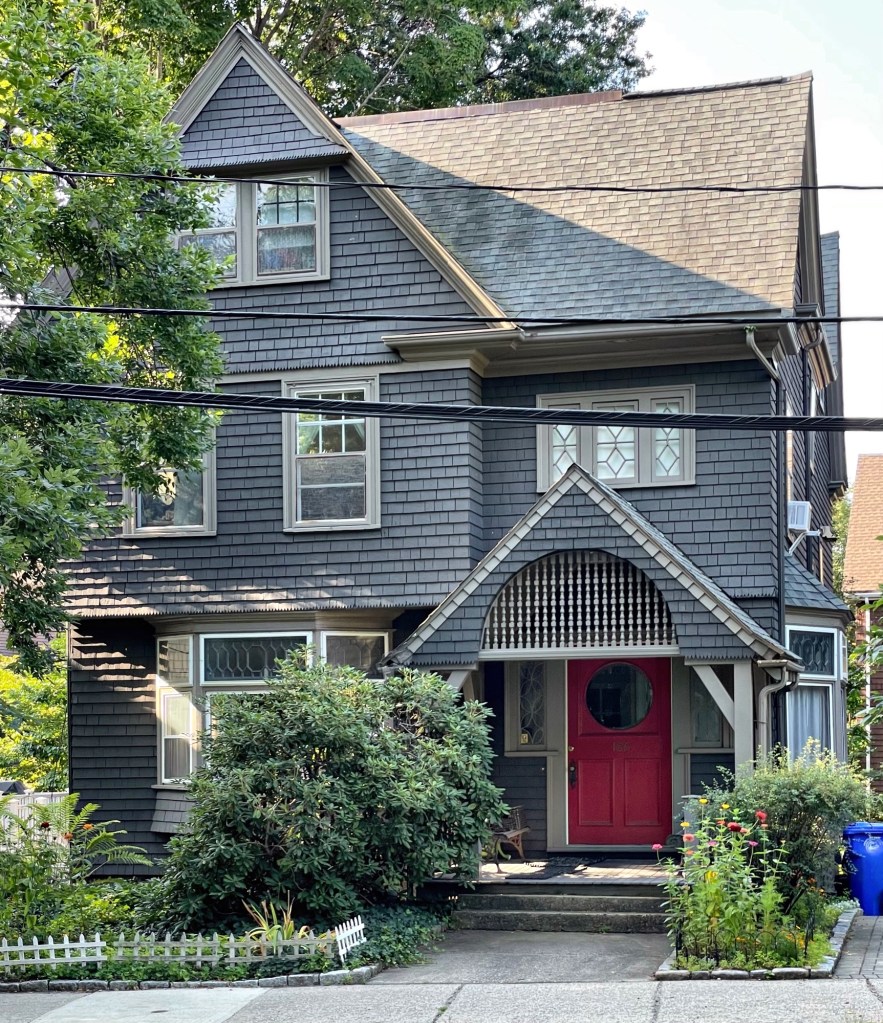
Francis Street in Brookline, Massachusetts, has some of the finest Queen Anne Victorian residences in the Boston area. This is the Potter-Leland House, built by 1888 by William Potter, a wealthy shoe manufacturer and businessman who developed rental housing in the neighborhood not far from his house on Kent Street. He built this just before the larger Queen Anne duplex was built nextdoor from plans by Rand & Taylor, architects, and it was rented out as a single-family income-producing property. Various exterior wall textures, irregular massing, and turned supports on the front porch contribute to the Queen Anne character of this house, but the real showstopper is the rounded bay projection with three, 25-over-1 (yes you heard that right) curved sash windows! The property was later purchased by Herbert M. Leland, a broker.
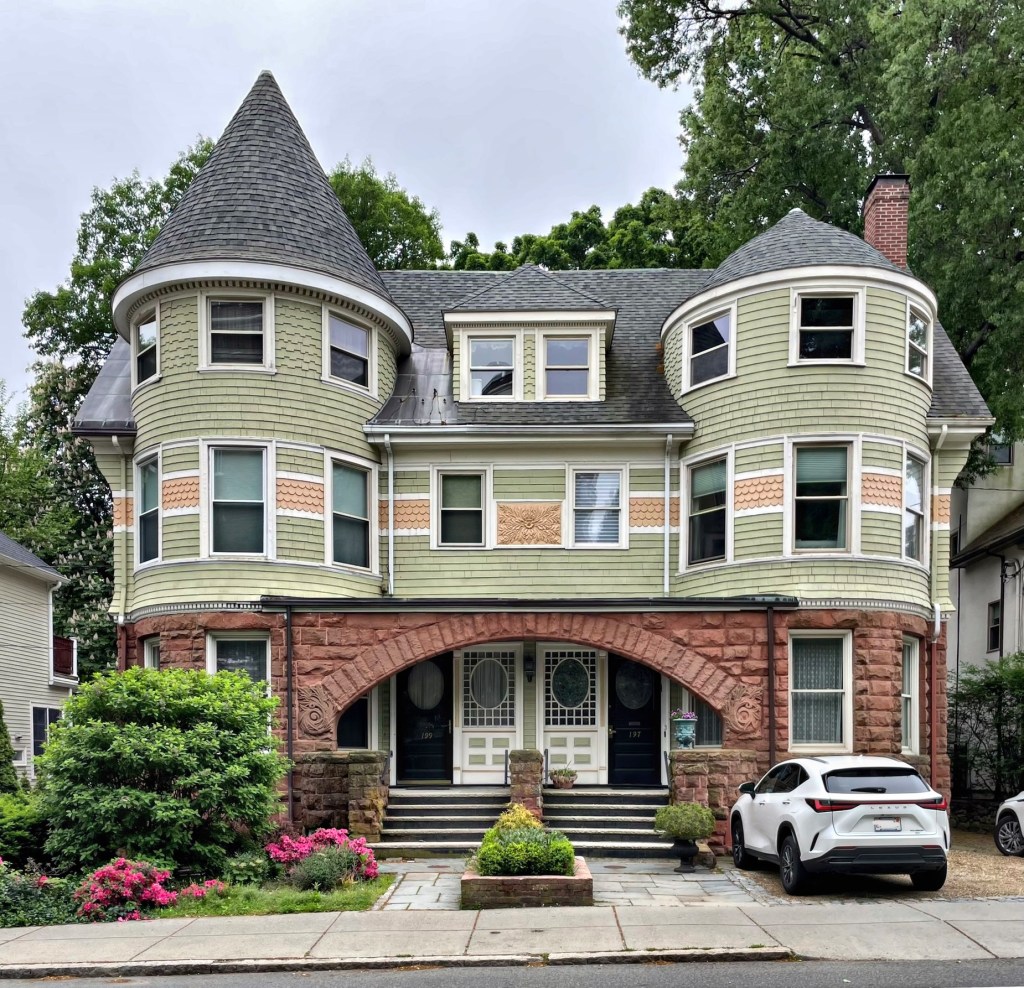
William W. Potter, a shoe manufacturer and businessman, and his wife, Isabella Abbe Strickland Potter, lived in the Longwood section of Brookline and became active in the surround areas development in the last decades of the 19th century. William bought land off Kent Street and began to lay out house lots, becoming a developer overseeing construction of stately Queen Anne Victorian rental properties marketed to upper-middle-class residents. For this house on Francis Street, he commissioned architects George Rand and Bertram Taylor, who were known for producing stylish residential designs for the middle class in the Boston area. The massive property was a duplex, providing units to two lucky families! The building has just about every hallmark feature of the Queen Anne style including: the conical roof on a rounded corner bay, a complex roofline, asymmetrical plan, varied siding/materials, and applied ornamentation. In the 1920s, the house was owned by Simmons College, and used as a boarding house. Luckily, the property was restored and now is one of the finest residences in the neighborhood.
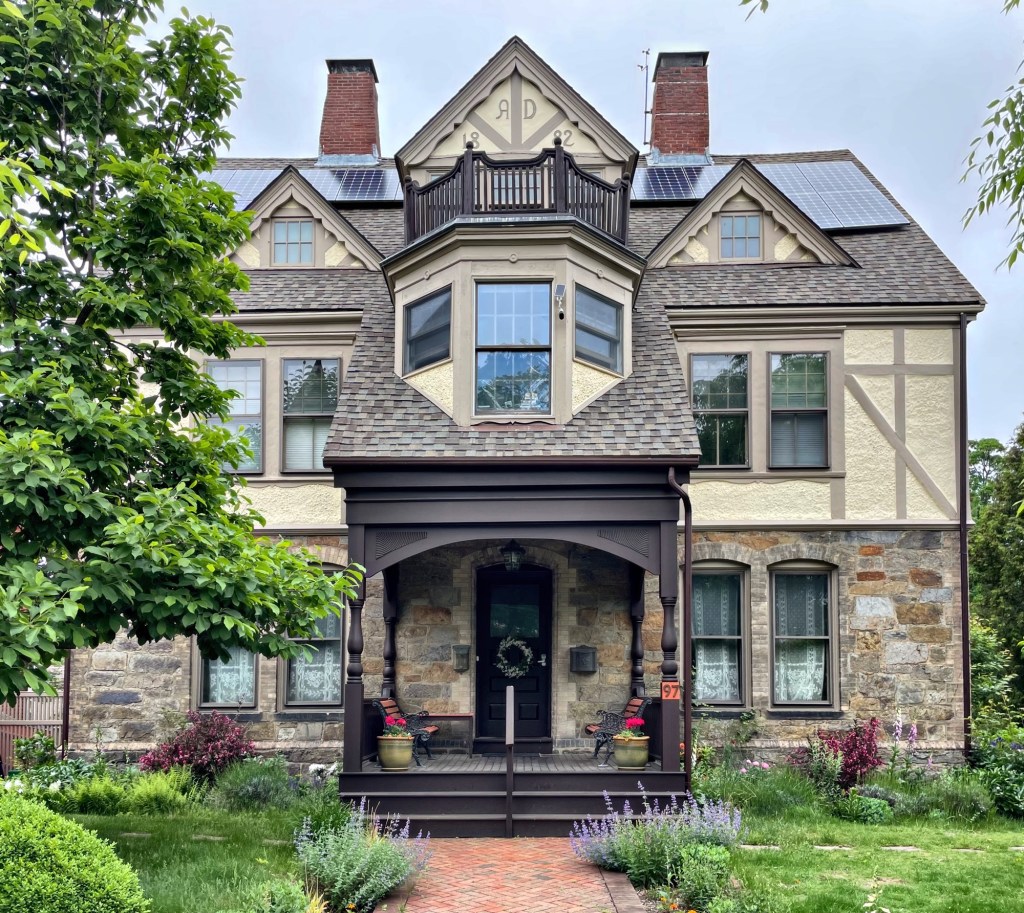
Orlando Hiram Alford (1840-1908) was an industrious and hardworking Vermonter who settled in the Boston area to make his wealth. He was a member of Bliss, Fabyan & Co., a large drygoods dealer, and would also become a director of the First National Bank, the City Trust Company, and the Franklin Savings Bank. In manufacturing, he serves the role of director of the Bates Manufacturing Company, the Merrimac River Towing Company, the Columbian Manufacturing Company, the Cordis Mills, and the Thorndike Company (among others). From his many positions and roles, he and his wife Ellen, were able to afford a house lot on Kent Street in the neighborhood between Longwood and Brookline Village. The Alford House, a stunning example of the Queen Anne style remained in family until after Ellen’s death in 1929, when it was purchased by the Boston Hospital for Women as a nurse’s residence. It was later used as apartments and was clad with vinyl siding, obscuring much of the original wood trim detailing. In the 2000s, later owners sought to demolish this house, which served as a rallying cry for neighborhood residents who understood the importance of the house and its context with surrounding lots. After the demolition delay process lapsed, they petitioned for a local district designation, effectively preserving the house for more generations to come! The Lawrence Local Historic District has since provided protection for houses in the area, but does not require a homeowner maintains or keeps up a property in a certain condition. Hopefully the Alford House will be restored soon!
In the late 19th century, the Longwood section of Brookline, saw a second surge of development when larger pieces of land were sold by heirs of the original developers. On the lot across from the Longwood Towers and near the Longwood rail station, Maine-born lumber dealer, John Prescott Webber, built this two-family residence and rented it out for supplemental income. Webber lived in a large home on Beacon Street while renting this and other properties in town to middle-class commuters to Boston. The Queen Anne style residence exhibits a unique rusticated stone first floor with wide arched entry with Richardsonian Romanesque carved detailing.
“Park Gate” Cottage sits on Bellevue Avenue near Touro Park in Newport, Rhode Island and is one of many summer “cottages” for wealthy summer residents. The home replaced the Atlantic House, a large summer hotel formerly on the site. The wood-frame dwelling was designed by Newport architect George Champlin Mason for Seth Bunker Stitt of Philadelphia and constructed in 1879. Mason’s design for “Park Gate” includes many features typical of the Queen Anne style including the asymmetrical facades, wrap-around front porch, tower, and even the small details like dentils, spindle work and balustrades. The house was later purchased by Newport Lodge #104 of the Benevolent and Protective Order of the Elks in 1920, who own the building to this day.
Located next to the Channing Memorial Church and the Derby Cottage on Pelham Street, this Queen Anne style cottage stands as a significant Victorian era residence on the street dominated by Greek Revival homes. Built in 1878 for a William H. Smith for his residence and office. The home is an excellent example of the Queen Anne style with asymmetrical form and massing, complex roofline with multiple gables and towers, varied siding, and intricate millwork. By the early 20th century, the property was owned by John and Mary Cottrell, and later purchased by the Channing Memorial Church as “Channing House”.
Built ca. 1890 for Boston salesman Washington Libby Krogman (1858-1894), one of Boston’s finest Queen Anne style homes can be found in the Clam Point neighborhood of Dorchester. The pronounced sculptural qualities of this residence, together with the juxtaposition of clapboards and patterned shingles, variety of window sizes, and ornamentation place this house squarely within the pantheon of important Queen Anne designs within the city of Boston. Painted in a manner that showcases its sheathing and ornament to great advantage, this well-preserved house is particularly noteworthy for its graceful verandah that encircles a distinctive, round, conically-capped tower at its northeast corner. The home was only occupied by Washington Krogman for less than four years when he died unexpectedly in 1894 at just 35 years of age. The property was deeded to his widow Carrie for a few years before she sold the property to Thomas Francis McManus, a noted naval architect (schooner designer). The home remains one of the finest mansions in Dorchester.
Queen Anne perfection! The Samuel Dearborn House sits at the beginning of Concord Avenue in Nashua, New Hampshire and is among the city’s finest examples of the great architectural style. Samuel Gerrish Dearborn was born in Northfield, New Hampshire, August 10, 1827. His father was an industrious farmer and allowed Samuel to be educated at Sanbornton Academy and the New Hampshire Conference Seminary. He graduated from Dartmouth in 1849 and began practicing medicine in various New Hampshire towns. He served as a surgeon during the Civil War and after, settled in Nashua, remaining a prominent doctor. He and his family were avid travelers and had trips to the Pacific northwest and Mexico. He had this stately Queen Anne style residence built in 1886 which exhibits all the hallmarks of the style. Varied materials and siding types, asymmetrical plan, ornate turned columned porch, gables with detailed shingling, and complex roofline are all so eye-catching.
Yet another of Nashua’s fine estates on Concord Street is the George French House, a more academic example of the Queen Anne style of architecture. The French House was built in 1890 for George Barstow French (1846-1933), an attorney in town. I really wish I could find more on the architect, as this seems to be a more academic example of the style with bold material choice of brick construction with brownstone and terracotta trim and detailing. The hipped roof with flared eaves and brick pilaster detailing on the second floor add a lot to the design and are not common! Does anyone know more?