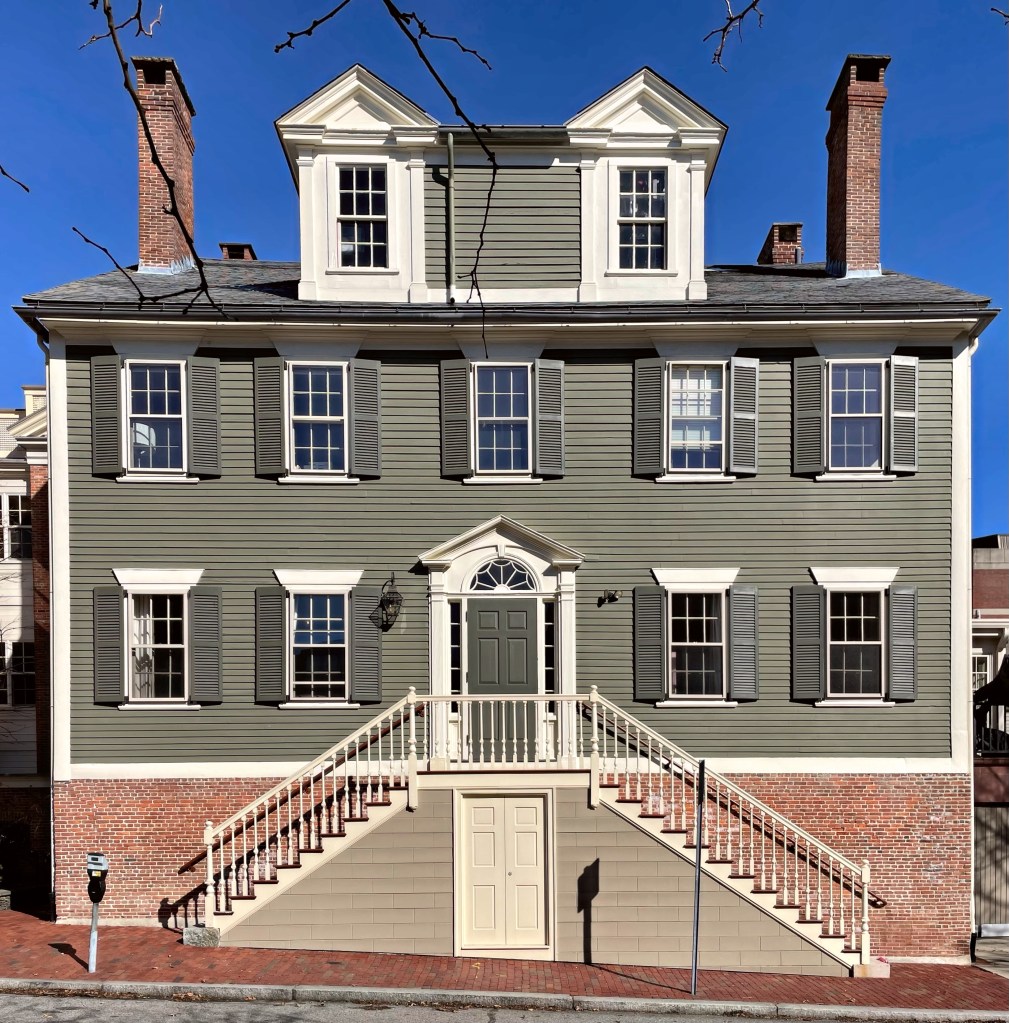
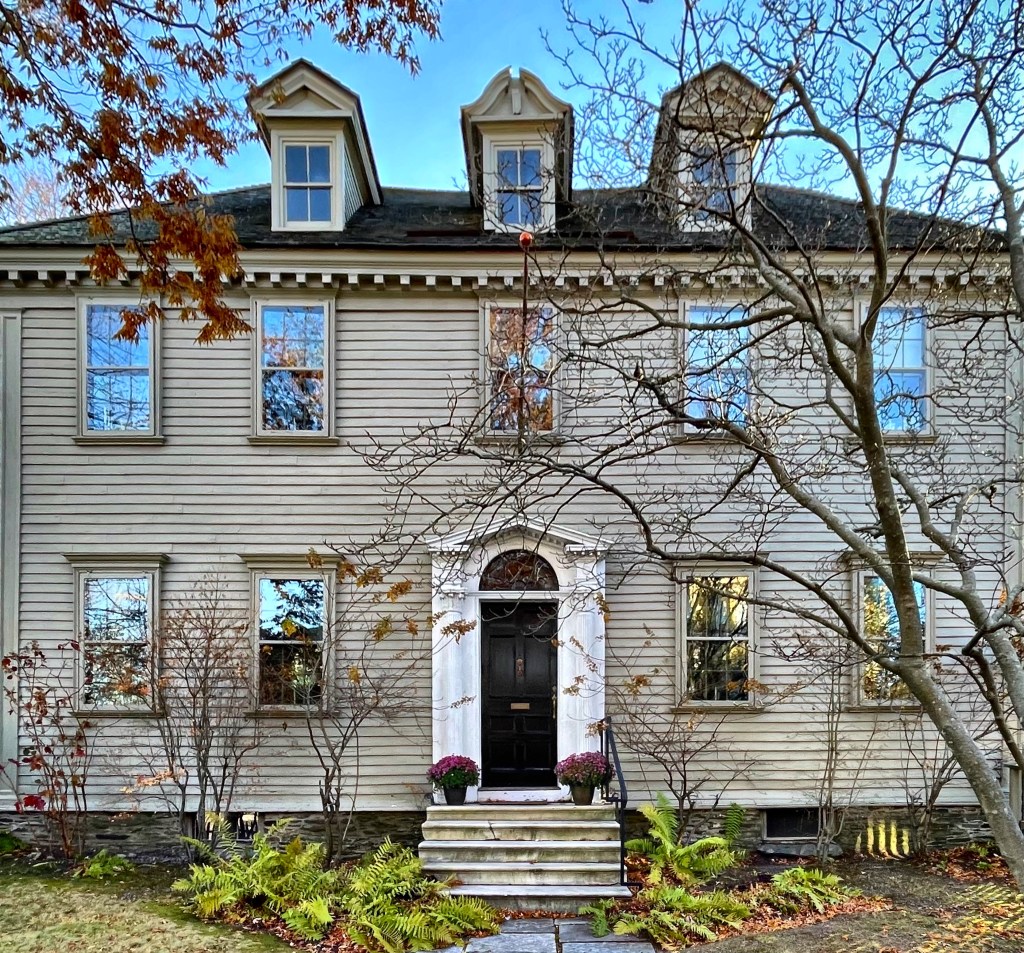
When visiting Downtown Providence, I couldn’t help myself but to cross the river into College Hill, a neighborhood of such architectural diversity I could run this entire page just featuring that area. This beautiful Federal style home was built onto the downward slope of the hill in 1798 for William Holroyd, a merchant and active Baptist in town. The home sits atop a raised basement with brick end walls and clapboard siding on the front and rear. The property exhibits a symmetrical facade, splayed lintels above the windows, and a perfect center entry with fluted pilasters and pediment containing a fanlight. The building today appears to be a part of the Brown-RISD Hillel.
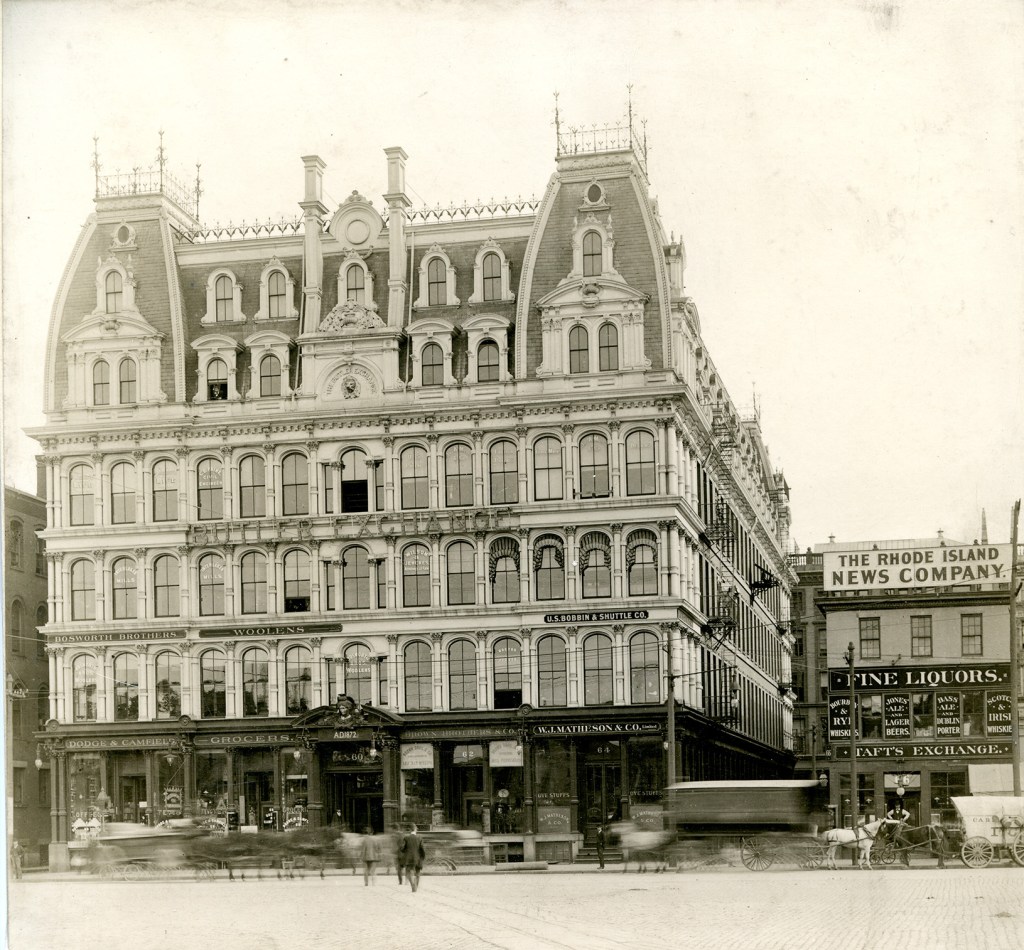
Image Courtesy of Providence Public Library collections.
This magnificent structure formerly in Downtown Providence would likely still exist today had a devastating fire not destroyed it in 1925. When construction on the Butler Exchange began 1871, the area we know today as Downtown was only a cluster of small wooden and brick residences with commercial operations on the ground floors; the key retail shopping districts were across the river around where Brown University is today. The first major commercial development in modern-day Downtown was the Providence Arcade (featured previously), built in 1828, by Cyrus Butler. The Arcade languished in tenants and shoppers earning it the name, “Butler’s Folly”. A half-century later, a new Butler project was about to take off. Cyrus’ heirs built the Butler Exchange, which upon completion in 1873, was the largest building in Providence and its splendid French-inspired two-story mansard roof was a nice pairing with the City Hall being built nearby. The Butler Exchange saw commercial use, offices, and a school before a fire destroyed much of the building, leading to its demolition. The building was later replaced by the Industrial National Bank Building aka the “Superman Building”.
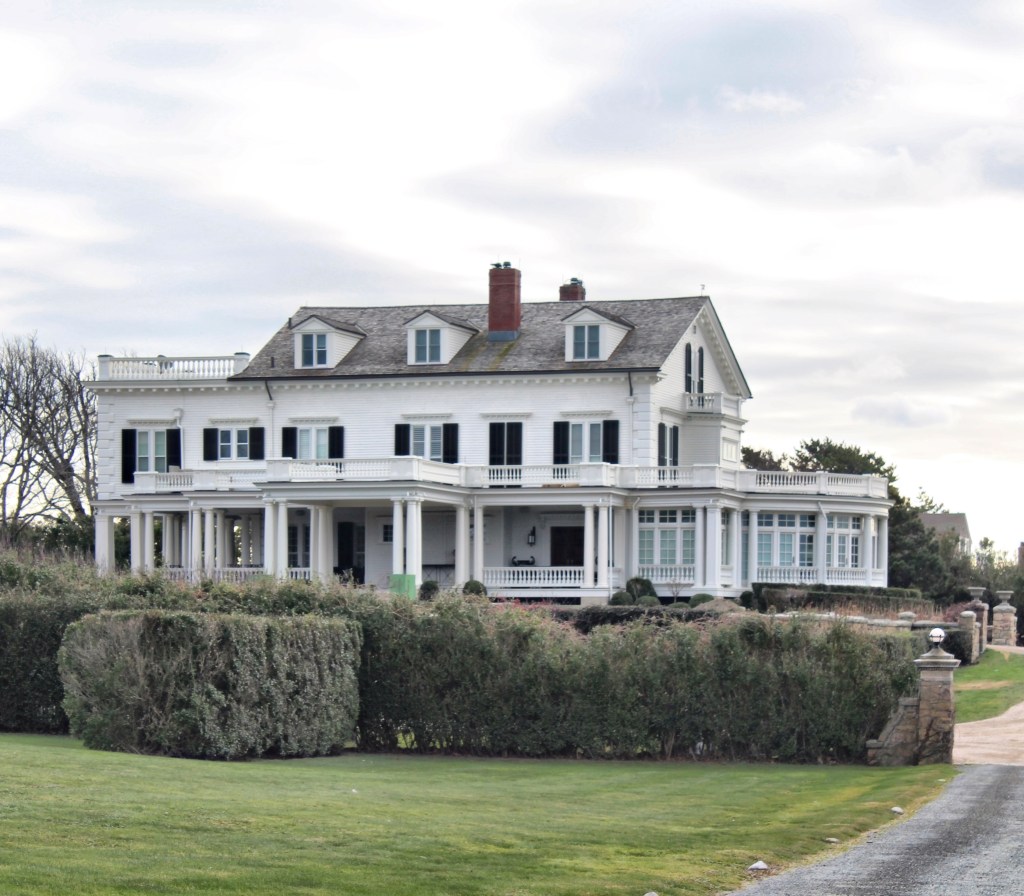
Built at the tail-end of the Gilded Age in Newport, this turn-of-the-century mansion evokes feelings of country estates in England. “Clarendon Court” was built in 1904 for Edward Collings Knight, Jr. (1863-1936) and his first wife, Clara W. Dwight (1862-1910). Edward C. Knight was a railroad executive and amateur artist who “exhibited more talent at spending money than making it”, which was evident from his architectural taste and timing for building such an expensive home in Newport, which was beginning to wane in popularity at the time. Clarendon Court was actually designed in the 18th century by Colen Campbell, a renowned Scottish architect. The country estate was never built, but Gilded Age architect Horace Trumbauer, found the design in one of Campbell’s old books, and except for removing the cupolas over the wings either side of the central block, he reproduced a perfect copy. Trumbauer had just a year before designed a townhouse for the couple in Philadelphia. Edward Knight originally named the mansion “Claradon Court” after his wife Clara. In 1930, Claradon Court was purchased by Maisie Caldwell (1878-1956) and her third husband, Colonel William Hayward (1877-1944), legendary commander of the “Harlem Hellfighters” during World War One. Maisie had inherited a fortune of $50 million from her second husband, Morton Freeman Plant, a railroad and steamship magnate. The couple renamed the mansion Clarendon Court, a more traditional name.
Clarendon Court was later purchased by Claus von Bülow and Martha Sharp Crawford, who was known as “Sunny von Bülow”. Sunny was worth over $75 million and updated the mansion and grounds to exceptionally elegant conditions. It was known that Sunny and Claus had a rough marriage, but it came to a head when on December 26, 1979, after the family had come together for Christmas at their mansion, she was found unresponsive and was rushed to the hospital where she slipped into coma but was revived. After days of testing, doctors determined the coma was the result of low blood sugar and diagnosed her as hypoglycemic, warning her against overindulging on sweets or going too long without eating. No foul play was suspected at the time. One year later, on the evening of December 21, 1980, while celebrating Christmas with her family at their mansion, she again displayed confusion. She was put to bed by her family, but in the morning she was discovered unconscious on the bathroom floor. She was taken to the hospital where it became clear that this time she had suffered severe enough brain injury to produce a persistent vegetative state. A hypodermic needle was found in a black bag in Bulow’s study and coupled with their maid’s testimony he was subsequently charged with her murder, accused of injecting his wife with insulin so he could live at Clarendon on her money with his mistress. His mistress was the actress Alexandra (Moltke) Isles, better known as “Victoria Winters” in Dark Shadows. In 1982, in a sensational case that gripped the country, Bülow was convicted. But, he appealed in 1985 and was acquitted. His stepchildren then filed a $56 million law suit against him, which was dropped two years later: Bülow agreed to divorce his comatose wife, relinquish all rights to her fortune, leave the country and never to profit from the story. Bülow moved to London where he kept a low profile for the rest of his life while Sunny remained in a vegetative state in New York until she eventually passed away in 2008.
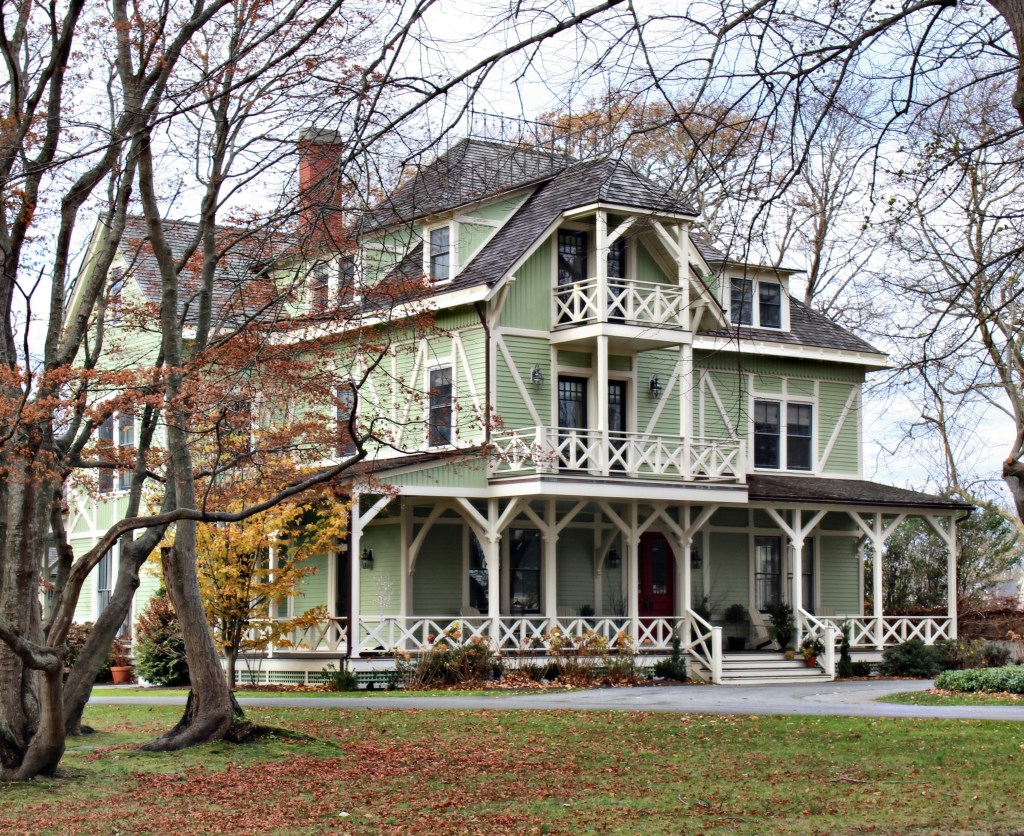
Bellevue Avenue in Newport is best-known for its massive summer cottages, many of which are built of stone and look more like art museums than a house. “Rest Haven” is one of the most stunning summer cottages in Newport and can stand toe-to-toe with the later mansions which neighbor it. The Stick style cottage was built in 1870 as a spec. house for merchant and financier John N.A. Griswold, who had his own cottage farther up the street (last post). Similar to his own house, he hired world-renowned architect Richard Morris Hunt to design the house, which was to be sold soon after completion for a profit to Anna Gilbert of New York, a wealthy widow who wanted to keep up with high-society in Newport. Anna Gilbert’s son, Charles Pierrepont Gilbert, was a New York architect who trained at the Ecole des Beaux Arts in Paris. He and his wife, Clara, summered at Resthaven until 1916. The home was likely renamed “Le Chalet” by a subsequent owner. The cottage was altered over the years, but restored a number of years ago by Newport Collaborative Architects and Behan Bros, and looks stunning!
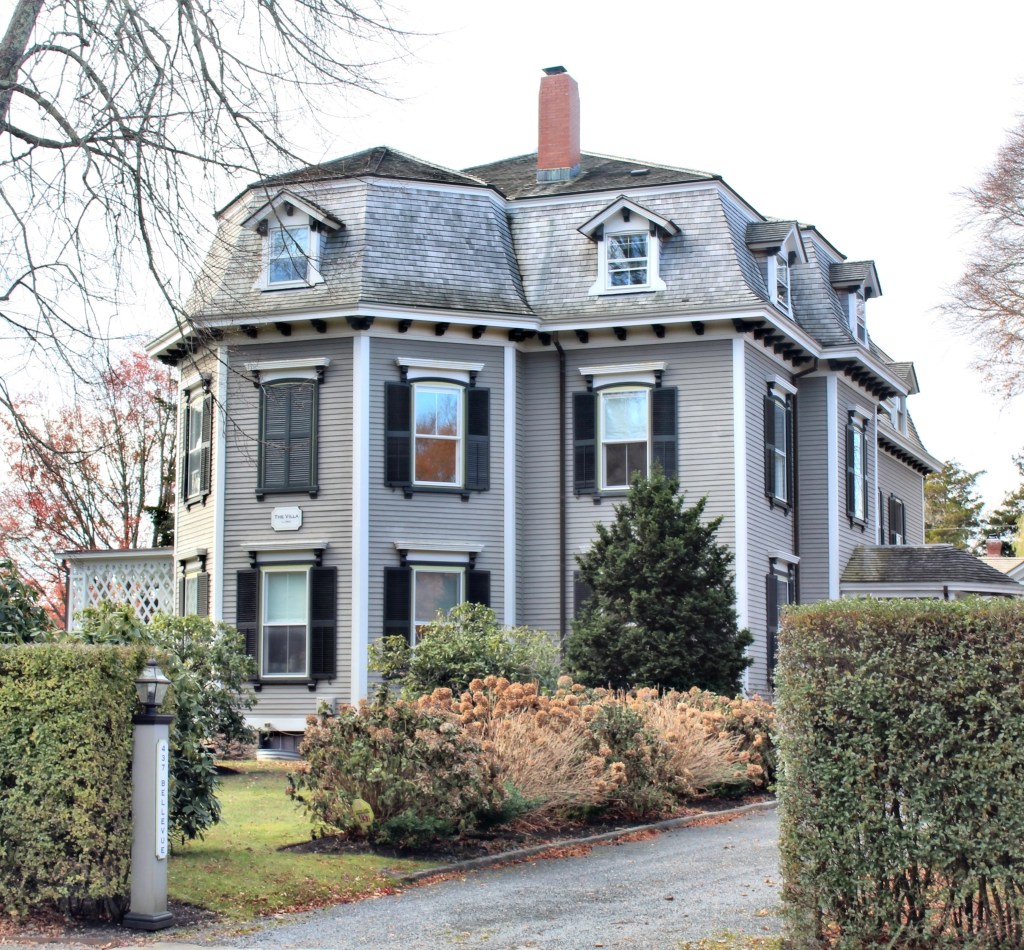
Margaret Barker Sigourney was the wife of Boston lawyer Henry Sigourney (1783–1849). In 1864, just as the Civil War was coming to a close, Sigourney purchased a piece of land on Bellevue Avenue in Newport soon after the time that Newport had been rediscovered as a tourist destination for the elite class. Sigourney wanted to make a splash as a single woman summering in Newport, so she hired local architect George Champlin Mason to design her cottage in the fashionable Second Empire style. The refined facade is more academic, while the rear and side facades exhibit porches with delicate bargeboards and trim. Sigourney spent summers at her cottage with her only son until 1873 when he and his family perished and were lost at sea aboard the Ville du Havre, when it collided in the Atlantic with another ship, killing a total of 226 aboard the ships, many of which drowned and their bodies never recovered. Alone, Margaret Sigourney continued to spend her summers in Newport until her own death in 1885.
Ochre Court, one of the grandest mansions in America was built in 1892 for New York banker and real estate developer Ogden Goelet (1846-1897) and his wife, Mary Wilson (1855-1929). In 1879, Ogden and his brother, Robert, inherited a real estate empire in Manhattan of 259 houses then worth a combined $40 million which was second only to the Astors. In 1892, Goelet and his wife Mary were included in Ward McAllister‘s “Four Hundred“, purported to be an index of New York’s best families, published in The New York Times, a position only solidified after his summer “cottage” was completed that year in Newport, Rhode Island. Named Ochre Court, the 50-room chateau overlooks the Cliff Walk and Atlantic Ocean and is the second-largest mansion in Newport (after The Breakers). Ochre Court was designed by architect Richard Morris Hunt, who also designed The Breakers, and summered in town himself. Shockingly, the Goelet’s only occupied the home during an eight-week summer season, and they spent the rest of the year in their homes in New York City, France, or London. The operation of Ochre Court usually required twenty-seven house servants, eight coachmen and grooms for horses and their carriages, and twelve gardeners for the grounds. In 1947 the Goelets’ son, railroad, hotel, and real estate developer Robert Goelet IV (1880-1966), gave ‘Ochre Court’ to the Religious Sisters of Mercy to establish Salve Regina College after it became too expensive to maintain. ‘Ochre Court’, which housed the entire college during its first years, is still in use and remains the heart of the greatly expanded Salve Regina University.
Built in 1887 for John O’Brien, a direct descendant of Brian Boru, the High King Of Ireland, “Inchiquin” in Newport stands out for its bold stone exterior and proper siting. The mansion was named after Inchiquin, a barony (or state) in Ireland, likely where O’Brien’s ancestors were from. The cottage was designed by John Dixon Johnston, a well-known Newport architect, who designed the stone mansion in a sort of hodge-podge of styles, which actually work well together somehow! In 1901, Inchiquin was acquired by The Baroness Seilliere, the adopted daughter of John O’Brien. She was a daughter of Mrs. O’Brien by a former husband. After her first husband died she married the Baron de Seilliere, brother of the Princess de Sagan. Like some other massive, expensive mansions in Newport, this home was converted to condos.
“Seaweed” is a spectacular oceanfront estate situated on Newport’s famed Cliff Walk and overlooking Bailey’s Beach. This home is three-stories with an enormous enclosed porch that offers sweeping views of the Atlantic from all windows. The house consists of 16 rooms including an inviting foyer, nine bedrooms, seven bathrooms, dining room, and living room, all with original fireplaces, flooring, and detail throughout. Views of the sea are from nearly every room. “Seaweed” was originally built and owned by Mr. Henry Howard in 1860-61. It was altered in 1867 by renowned architect George Champlin Mason. Within a decade it was sold to Mr. C. Davis who passed it on to George T. M. Davis. In the 1880’s the property became a rental property owned by Alfred Smith, a real estate agent who lived near the center of town. In the early 1900’s it was purchased by Thomas Dolan of Philadelphia who re-baptized the home “Seaweed” after having architect Horace Trumbauer bring it to its present Colonial Revival style. The name is one of my favorites! What do you think of the name Seaweed for a home?
One of the oldest houses in Rhode Island, this beautiful home has a full history that will be hard to fit in a post, but here goes! The earliest, two-room rear part of this house was built around 1680, probably by Jireh Bull near the time of his first marriage to Godsgift Arnold, the daughter of Benedict Arnold, the first Governor of Rhode Island. After Bull’s death, the wealthy businessman and privateer Captain John Mawdsley acquired the house and he enlarged it in keeping with his prominent social status, adding elements inspired by the Georgian classicism. Mawdsley in 1774 owned 20 slaves, many of which likely worked on his ships as crew or cooks. He was a Loyalist, and fled Newport during the American Revolution. During the winter of 1780-81, this was the home of French Major-General François chevalier Beauvoir de Chastellux, who was third in command of French forces in America under the French expeditionary force led by general Rochambeau. After the War, Mawdsley was actually allowed to return to Newport, and resided at the home until his death in 1795. In 1795, after Mawdsley’s death, the house was purchased by slave ship captain and wealthy merchant Caleb Gardner, who is said to have brought thousands of humans in bondage to the shores of Rhode Island and in the Caribbean. Gardner is responsible for the Federal period entry and marble front steps we see today. The home was purchased by Historic New England in the 20th century, and was documented as part of the Historic American Buildings Survey. It is now a private home.
‘The Reef’ a fabulous Gilded Age estate in Newport was built in 1885 for Theodore M. Davis by the Boston architectural firm of Sturgisand Brigham. The elegant shingle and stone Queen Anne villa was erected as both a summer house and to house some of Davis’s vast collection of paintings and Egyptian artifacts, collected during his excavations in Egypt’s Valley of the Kings between 1902 and 1913. Besides the architecture of the home, the Reef Estate was also famous for its walled gardens, greenhouses, and outbuildings, sitting upon eighteen acres. overlooking the Atlantic Ocean. Following Mr. Davis’ death in 1915, Milton J. Budlong of Providence purchased the estate. Milton divorced from his wife Jessie in 1928, and it was MESSY. Their Newport summer estate was placed in contention. The house, never again lived in by the family. During World War II, anti-aircraft gun emplacements were set up around the grounds, with the mansion housing gunnery personnel. After the War, the estate was given back to the Budlong heirs, who did not reside there. Vandalized throughout the 1950’s, the villa was set on fire in 1961 and demolished two years later in 1963. In 1969, the waterfront property came under the control of the State of Rhode Island and in 1976, became a state park. The old carriage house/stable and a later observation tower (possibly converted from a former water tower) stand today.





 Buildings of New England