When the Grindstone Neck Summer Colony of Maine was in full-swing, wealthy summer residents would frequent the colony’s Episcopal chapel (featured previously). What the summer residents did not really plan for was the influx of other residents as summer staff, largely Irish servants who in large part were Catholic. As a result, the St. Margaret Catholic Chapel was built to provide a house of worship, largely for those summer workers on Grindstone Neck. Keeping with the rustic architectural character of the colony, the chapel was designed in the Shingle style. I could not find any information on the architect, so any additional insight would be greatly appreciated!
Men from Philadelphia and New York gathered to establish the Gouldsboro Land Improvement Company in the late 1880s with the goal to develop an alternative, more quiet summer colony to rival Bar Harbor on Mount Desert Isle. Two of the early investors (and summer residents) were J. Bonsall Taylor and Carter Berkeley Taylor, brothers from Philadelphia. John Bonsall Taylor’s cottage (last post) and this cottage, built for C. B. Taylor, were constructed around 1891-2 and are typical examples of upper-middle-class summer cottages in Winter Harbor. Philadelphia architect Lindley Johnson designed John’s cottage, so it could be hypothesized that he was also architect for C.B. Taylor’s here. The house as originally built was enlarged in the early 20th century, but maintains the rustic quality and charm that so many of these Shingle style cottages possess. And that red trim really pops!
In 1891, a proposal was made to build a summer Episcopal chapel, to be known as St. Christopher’s by the Sea, on Grindstone Neck in Winter Harbor, Maine. This project was supported by local area residents and by the summer community on Grindstone Neck. The construction of the church started in 1892, but it was not until August 6, 1893 that the first service was held in the chapel. The Rev. Julius Atwood, rector of St. James’ Church in Providence, Rhode Island, officiated and preached the first sermon. The church was designed by Lindley Johnson, a Philadelphia-based architect who also summered in a cottage on Grindstone Neck and designed other cottages in the colony. The Shingle style chapel is architecturally unique and rustic, a quality which is also visible at the interior, which is rustic in appearance with exposed beams and shingled walls.
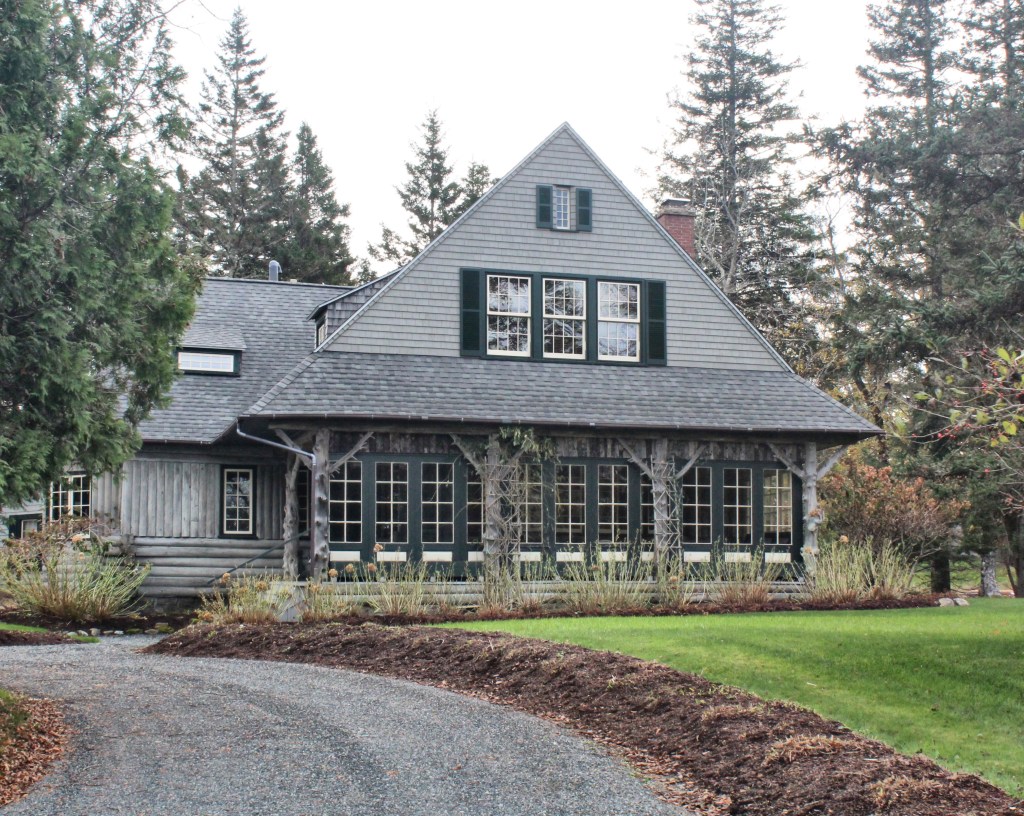
In 1889, the Gouldsboro Land Improvement Company, bought 300 acres of farmland to build a residential summer colony as an alternative to the busy Bar Harbor across the bay. They hired landscape architect Nathan Franklin Barrett to design the subdivision of 198 cottage lots of at least one acre and arranged them on roughly parallel roads, with a primary road (Grindstone Avenue) running the length of the peninsula’s spine through woodlands to dramatic ocean views at the tip. The summer colony has many great cottages and chapels tucked away on rocky outcroppings with towering spruce trees all around. This charming cottage was built for Charles Avery Doremus and his wife Elizabeth Ward Doremus around 1892. Charles was a scientist, the son of chemist and physician Robert Ogden Doremus. He graduated from the College of the City of New York in 1870. He became a professor in chemistry and became a leading specialist on toxicology, often called into court cases to help solve crimes. Elizabeth was a playwright from Kentucky and her father and his brother owned plantations in Mississippi before the American Civil War. The couple summered at this cottage on Grindstone Neck until Charles’ death in 1925. It is a great example of a rustic Shingle style summer cottage.
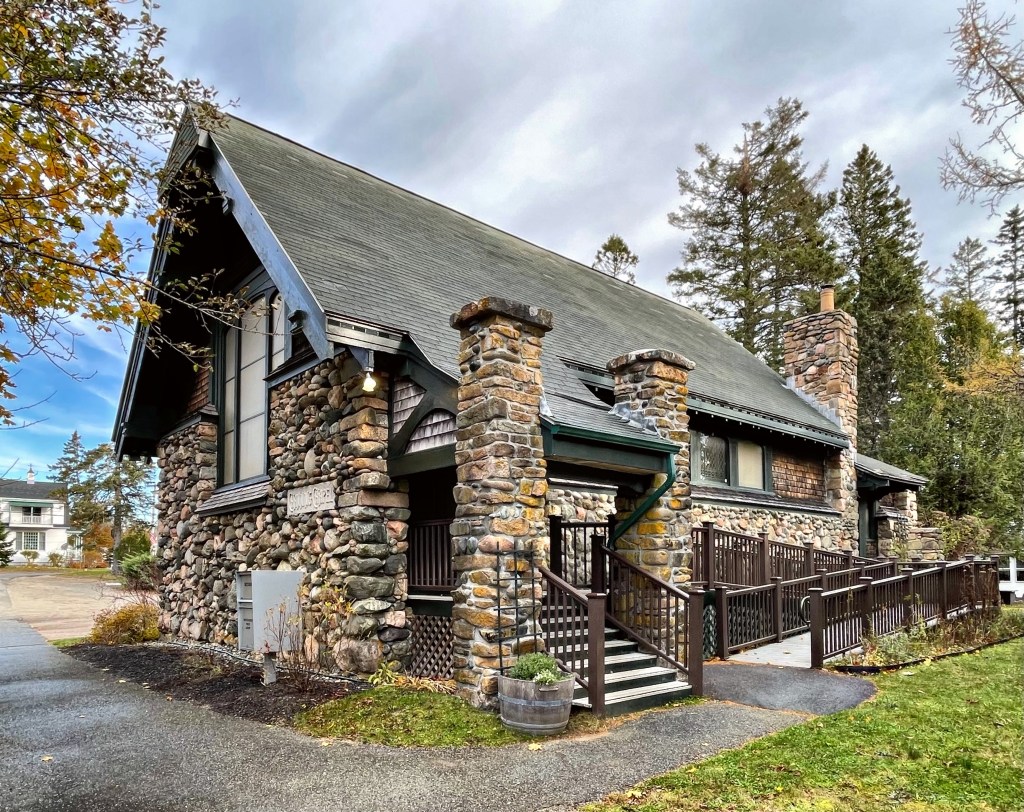
At a time before women could vote or be admitted to the American Medical Association, Almena Guptill (1842-1914) left her small home on Harbor Road to graduate from Boston University of Medicine in 1876 and become a respected Boston physician. She married David Flint (1816-1903), a successful lumber dealer and philanthropist. Almena met David when treating his late wife in Boston. The two, both widowers, married in 1891. Being a staunch follower of William Ellery Channing and believing that there was sufficient interest in Unitarianism here, Flint felt that there was need for a meeting place in his summer town of Winter Harbor. He had this chapel built adjacent to his summer house in the winter of 1887-1888, having field stones brought to the site of the future chapel by people of the village sliding them over ice in the winter. I could not locate the name of the architect of the building. The chapel was deeded to the American Unitarian Association and was later gifted by the association to the Town of Winter Harbor in 1958, the town would sell the property that year. In 1993, a preservation group purchased the chapel and sold it in 1999 back to the town. It now houses the Winter Harbor Public Library. Talk about full-circle!
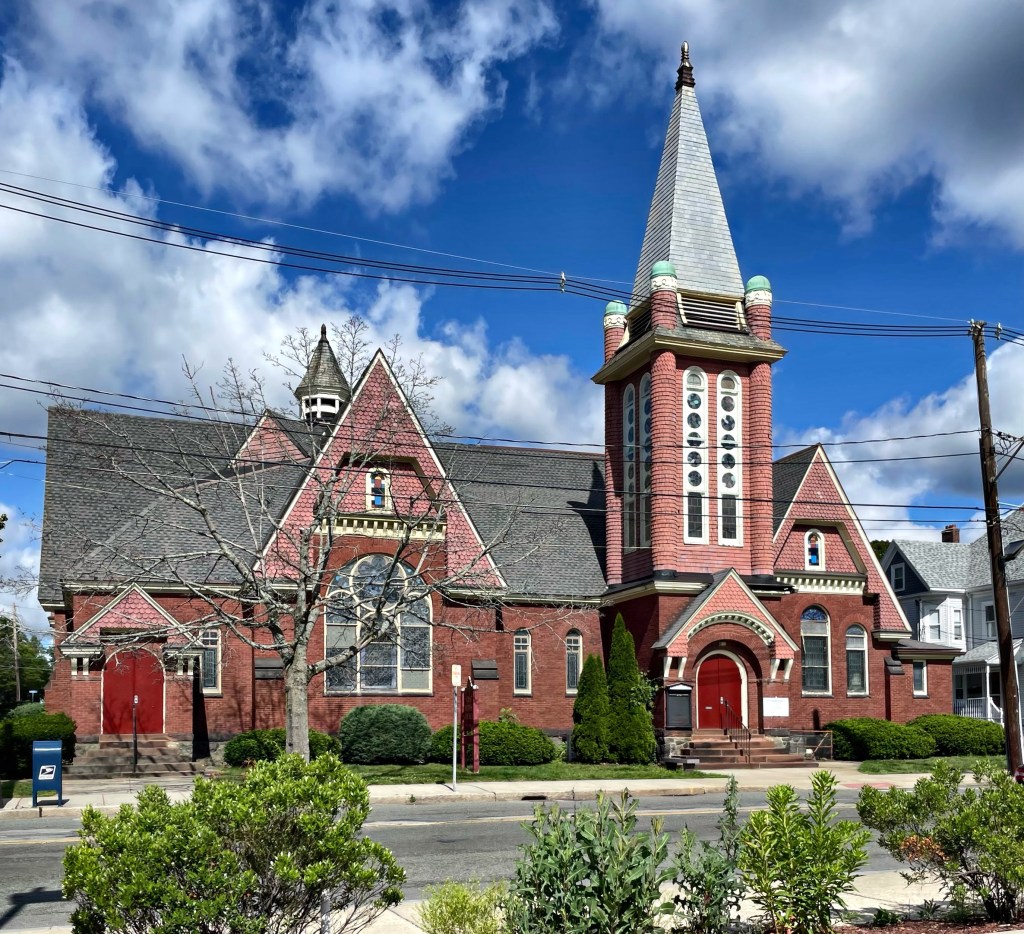
In 1891, the Baptist Society of Stoneham, Massachusetts unveiled that it had acquired funding and approved the plans for its first purpose-built church building in town. The organization met in a shared chapel in town since its founding in 1870. The new church would be unique in the Boston suburb as the only in town to be of the Queen Anne/Shingle style. A prominent site on South Main Street was acquired and work began in 1892 to erect the new house of worship. The design of the church is credited to the firm of L.B. Volk & Sons, a firm who specialized in church buildings with commissions all over the country. The church is complex in plan and combines brick and shingle siding in its construction with a prominent two-story tower with rounded corners and stained glass rondels (round windows).
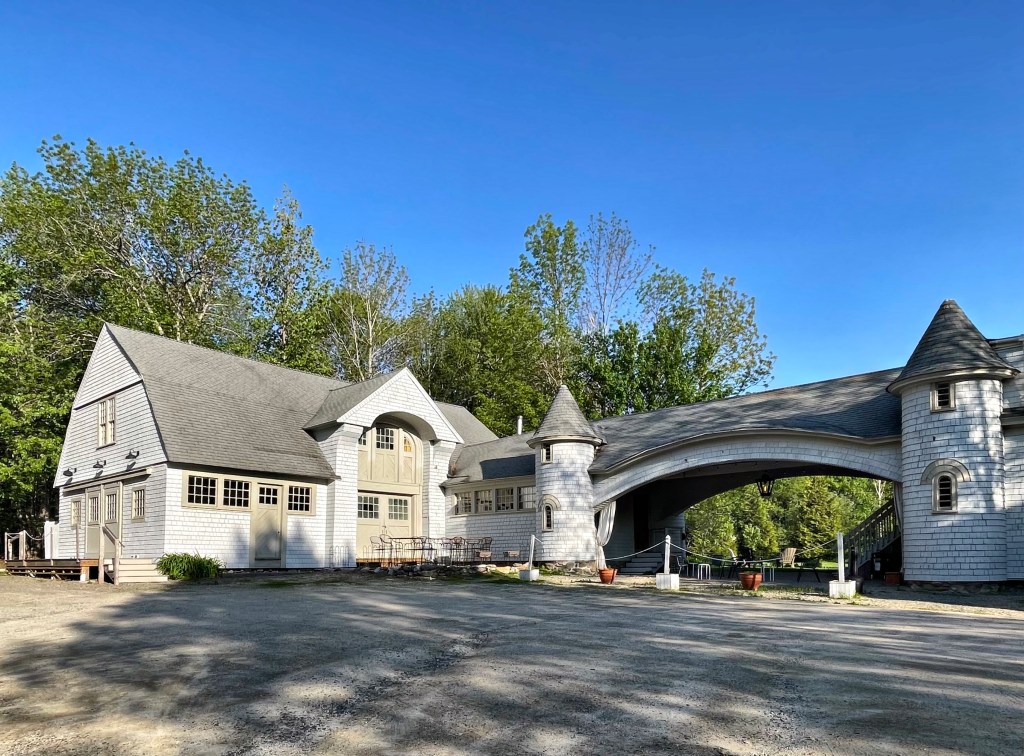
Barncastle, located in the Town of Blue Hill, Maine, is an elaborate and distinctive house. Designed by George A. Clough and built in 1884, the building is a sprawling complex in the Shingle style with additional eccentric details. As Blue Hill and other coastal communities of Down East Maine saw popularity as summer colonies of wealthy city-dwellers flocking to the rugged coastline, many new residents either built new “cottages” or renovated older (often ancestral) homes. Effie Hinckley Ober (1843-1927) who was born in town, married Virgil P. Kline, personal attorney to John D. Rockefeller, and for thirty years worked as attorney for the Standard Oil Co. of Ohio. Effie founded the Boston Ideal Opera Company in 1879 and traveled with the group extensively, retiring in 1885, upon that time, she would move into Barncastle for summers (then named “Ideal Lodge” after her opera company). In 1884, before her retirement, Effie hired her childhood friend, architect George A. Clough, who was born in Blue Hill and worked in Boston, to completely redesign her ancestral home. Clough’s design engulfed a smaller Cape Cod-style house owned by Effie’s mother Mary Peters Hinckley Ober Atherton, a descendant of early Blue Hill settlers, creating an absolutely elegant Shingle-style summer cottage. The house is highly visible on a main street, but what many do not see is the arch-and-turret link between kitchen wing and carriage barn. “Barncastle” is now home to an elegant inn and restaurant!
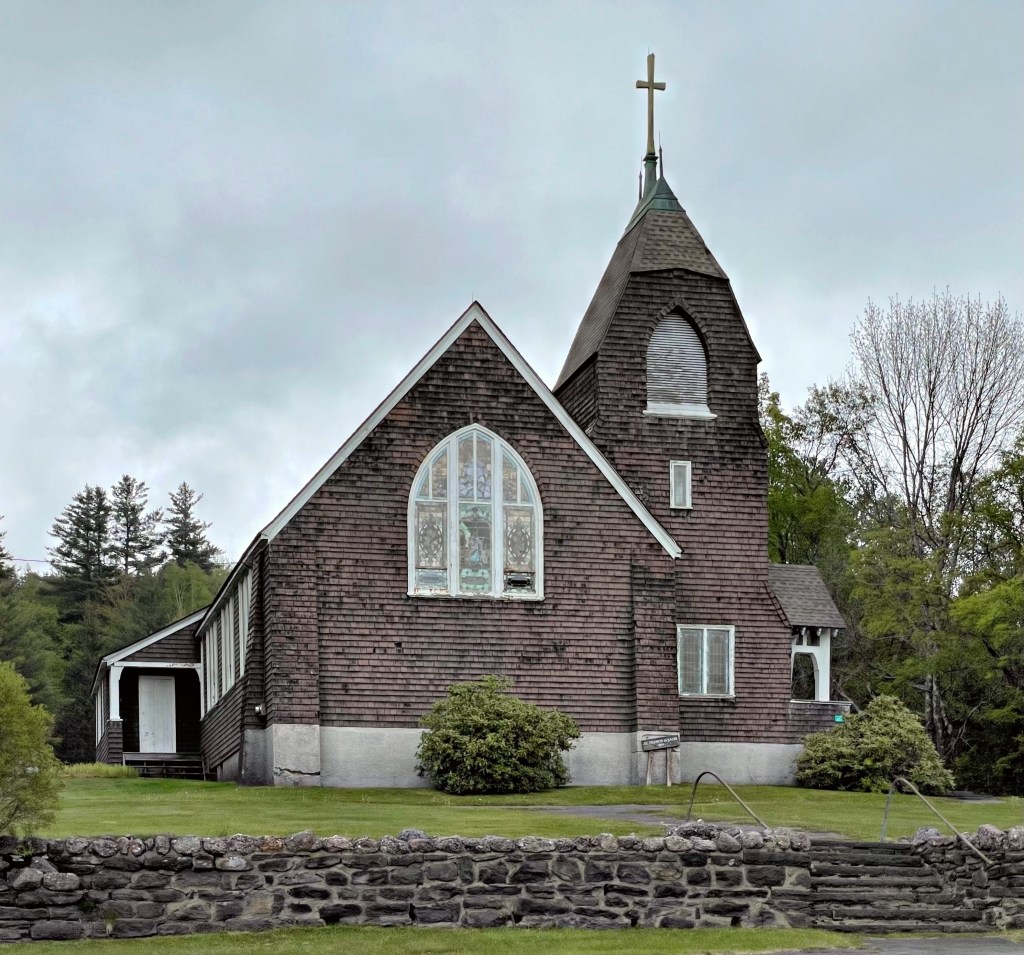
Down the street from the Old Platte Clove Post Office in Elka Park, New York, I stumbled across this large, shingled church with few houses nearby. I had to investigate! In 1888 parish lines for the Catholic church were redrawn in the area necessitating a new church near the summer colony of Elka Park. By 1891, a small, shed-like church was built here. By 1911, the small house of worship had outgrown its usefulness and it was considered a blight compared to the high-style homes nearby. A local summer resident, Francis H. Lewis funded $5,000 of the $6,500 cost of the building, and local carpenter Arthur Showers, was commissioned to erect the building. Father Keefe had conveyed to the builder some remembrances he had of a small church in France, and wished for it to be designed that way. Using local building traditions, the church was constructed of local lumber with shingled siding. The building and adjacent cemetery remain active to this day.
John Bach McMaster (1852 –1932) was born in Brooklyn, New York to a rich plantation owning father and mother who ran operations in New Orleans until the outbreak of the Civil War. After this, John graduated from the College of the City of New York in 1872, worked as a civil engineer in 1873–1877. Falling in love with the field of American History, he switched careers and in 1883, became professor of American history in the University of Pennsylvania. McMaster is best known for his History of the People of the United States from the Revolution to the Civil War (1883), a valuable supplement to the more purely political writings of earlier years. The book was a huge success and John was able to purchase house lots in the newly established Cape Arundel Summer Colony in Kennebunkport, Maine, a colony populated by many wealthy Philadelphians for summer homes. He first appears to have built “The Kedge”, a chunky, but beautiful cottage on a cliff. McMaster would also have this larger cottage built by the turn of the 20th century, which in design, appears to be a more eclectic Shingle style dwelling. Just a stone’s throw from the Atlantic, the house features continuous cedar shingle siding, sweeping porches to provide views of the ocean, a prominent chimney, and Colonial-inspired fanlight motifs.
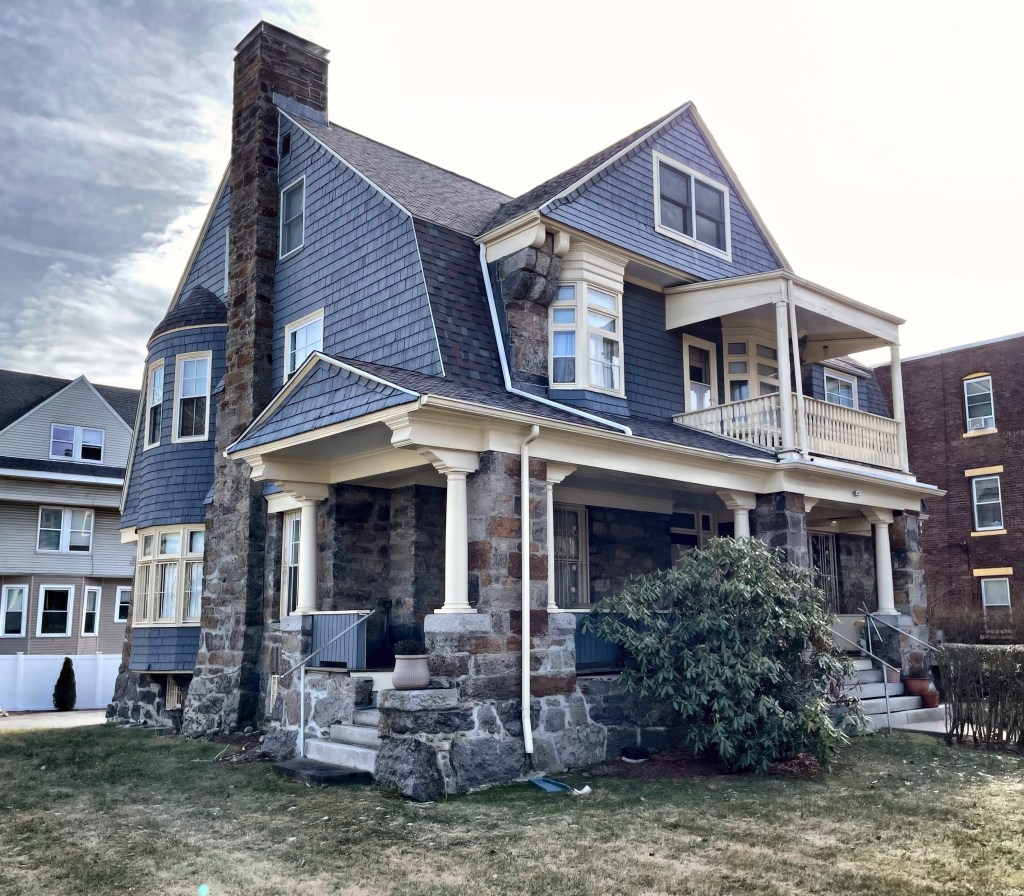
Roxbury is not well-known for its Shingle style architecture, but this example might change that! This dwelling was built around 1895 by the heirs of Horatio Harris on family land that was subdivided for house lots at the end of the 19th century. The expansive Harris estate was developed, largely on speculation and included some amazing single family homes, rowhouses and multi-family dwellings. This Shingle style home appears to have also been built on speculation and was owned by the Harris heirs for some time. The property was occupied for some time by Peleg E. Eddy and his wife Caroline in the earliest years of the house’s existence. I could not locate the architect, but it could be estimated as a design by J. Williams Beal, a local architect who was commissioned to design the nearby Harriswood Crescent development for the Harris family. The design features a Roxbury puddingstone first floor and chimney which contrast elegantly with the shingle siding.




 Buildings of New England