One of the finest Queen Anne style residences New England is this 1877 summer cottage, named “Snug Harbor”. The mansion was designed by architects William Appleton Potter and Robert Henderson Robertson for Charles H. Baldwin, a prominent admiral in the United States Navy. The design utilizes a brick first floor with shingle siding above, a high cross-gabled roof, panels and half-timbering, asymmetrical form, and a porte cochere at the entry. Later owner Arakel Bozyan, painted the entire exterior a deep red color and renamed the house “Gamir Doon”, Armenian for “Red House”. The house was restored back to a traditional color scheme and sold in 2020. The interiors are STUNNING!
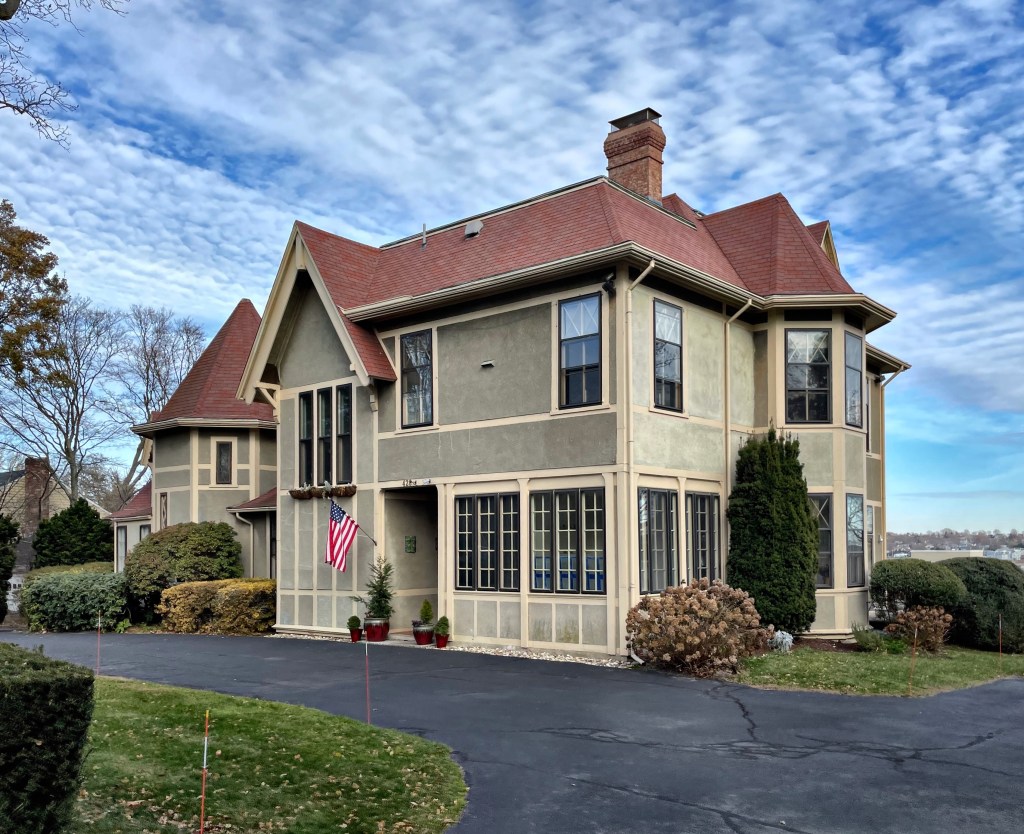
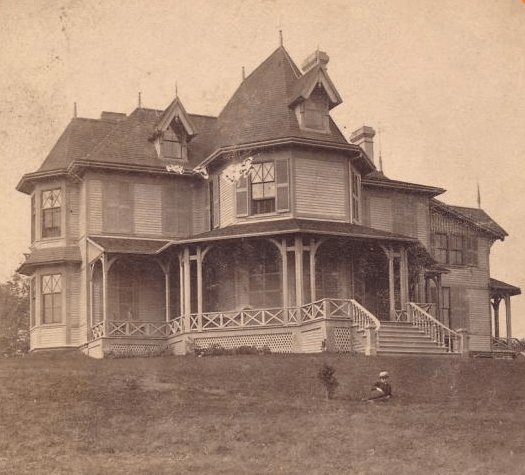
While many of the summer cottages in Newport retain much of their architectural and historical integrity, it is not always the case. This cottage, named “Morningside” barely resembles its original 1873 design. The summer home was built for William Barton Rogers (1804-1882), a scientist, educator, and best-known as founder of the Massachusetts Institute of Technology. He sought a place of rest and leisure, away from the stresses of Boston and running a new college, so he hired the Boston firm of Cabot & Chandler to design a Stick style cottage for him to spend the summer months at. In his diary for October 11, 1872, Mr. Rogers wrote, “Removed [from Cliff House Cottage] to our new home on Gibbs Avenue, at 4.30 o’clock. I have decided to name the place ‘Morningside.'” The house was his respite from stresses and he loved to spend time here with his family. President Rogers died after collapsing during a speech at MIT’s 1882 commencement exercises. His last words were “bituminous coal.” After the property sold out of the Rogers estate, the house was remodeled with stucco siding and much of the original Stick detailing was removed or covered. Morningside is now divided into condominiums.
This charming Victorian cottage in Newport was built in 1878 for Henrietta and Dr. Stephen Cambreleng Powell as their summer cottage. The well-connected couple hired New Haven architect David R. Brown to design the residence, which is an excellent example of the Queen Anne and Stick/Eastlake architecture styles. David Brown, the architect, apprenticed under the famed Henry Austin for years in New Haven, Connecticut before becoming a partner of the firm. As any good summer cottage needs a fun name, the couple named their cottage “The Anchorage”. The cottage is now known as the Old Beach Inn, and is among Newports many charming old inns.
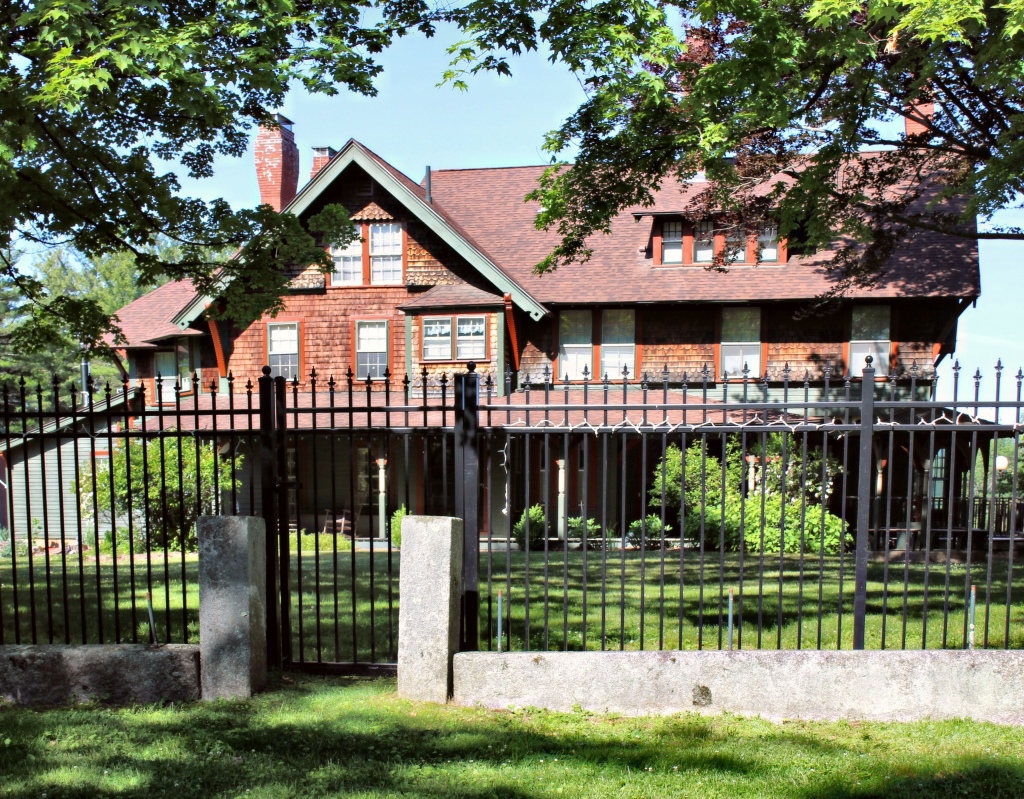
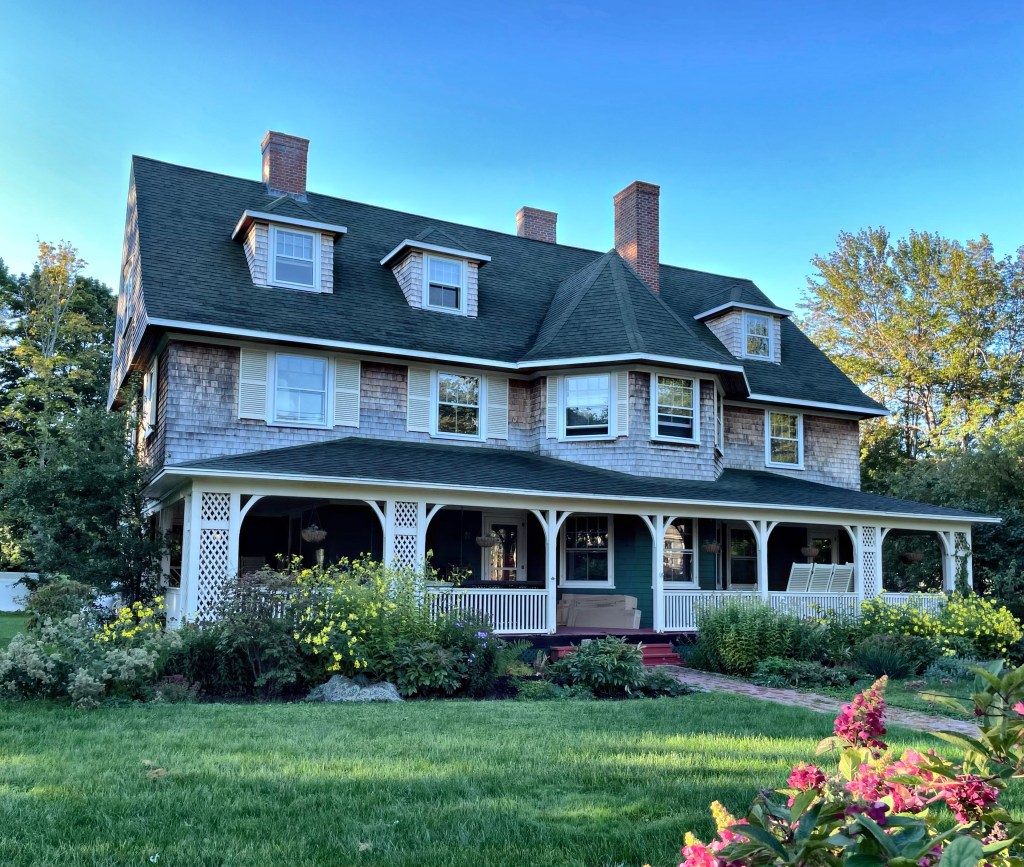
The earliest of Wilton New Hampshire’s summer “cottages” is Moors Manor Cottage, a turn-of-the-century mansion set on former farmland with views of the mountains in the distance! While Wilton never compared to Newport or Bar Harbor as the major summer resort towns for the wealthy, the upper-middle class would sometimes build summer homes in their familial towns where they would escape the hustle-and-bustle of city life. Luckily, this home has been very well-preserved inside and out (but I wish that big fence was gone it really obscures the beauty of the house).
The most opulent of all summer ‘cottages’ in Newport is the iconic Gilded Age mansion, The Breakers. This mansion was completed in 1895 as a summer residence for Cornelius Vanderbilt II. Cornelius’ grandfather, Commodore Cornelius Vanderbilt (1794-1877) established the family fortune in steamships and later in the New York Central Railroad. Cornelius Vanderbilt II became President of the New York Central Railroad system in 1885, and bought a wooden summer house called The Breakers in Newport during that same year. The original Breakers Mansion burned in a fire in 1892 and was rebuilt, but more substantially. Vanderbilt commissioned famed architect Richard Morris Hunt to rebuild it. Vanderbilt insisted that the building be made as fireproof as possible, so the structure of the building used steel trusses and no wooden parts. He even required that the boiler housed in an underground space below the front lawn. The Italian Renaissance-Beaux Arts style mansion was likely the most expensive home constructed in New England at the time at a cost of over $7 Million USD (equivalent to over $150 million today).
Cornelius Vanderbilt died from a cerebral hemorrhage in 1899 at age 55, leaving The Breakers to his wife Alice Gwynne Vanderbilt. She outlived him by 35 years and died at the age of 89 in 1934. She left The Breakers to her youngest daughter Countess Gladys Széchenyi (1886–1965). In 1948, Gladys leased the near-impossible to maintain property to The Preservation Society of Newport County for $1 per year. The Preservation Society bought The Breakers and approximately 90% of its furnishings in 1972 for $365,000 ($2.3 million today) from Countess Sylvia Szapary, Gladys’ daughter, although the agreement granted her life tenancy. Upon her death in 1998, The Society agreed to allow the family to continue to live on the third floor, which is not open to the public. The last-remaining family members residing there were evicted from the third floor due to safety concerns, but others state it is retaliation for the Szápárys’ opposition of the controversial Breakers Welcome Center, the plan for which other members of their family, including Gloria Vanderbilt, also opposed.
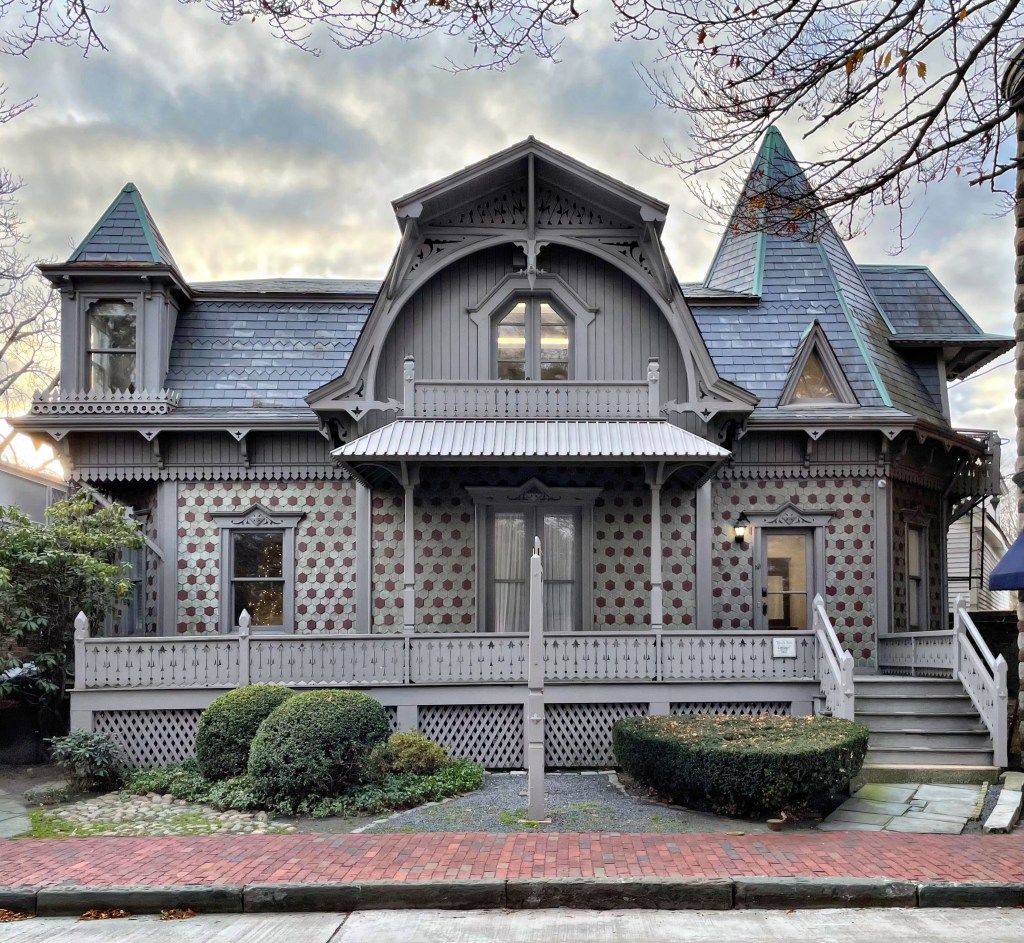
One of the more unique and relatively modest summer cottages in Newport, Rhode Island is Bird’s Nest Cottage on Bellevue Avenue. The cottage was built in 1871-2 for Samuel Freeman Pratt, who lived his early life in Boston. The son of a carpenter, Pratt was was working as a carver in Boston, where he saw success as an inventor with several patents to his credit. From the success of one of his inventions, a device for sewing machines, the invention gave him the financial freedom to explore other interests, namely architecture. In Boston, he likely learned his craft from partner John Stevens, before setting out on his own. He designed buildings in Oak Bluffs on Martha’s Vineyard, but decided to reside in Newport. While many state that this cottage for Pratt was designed by the Newport resident and star-chitect Richard Morris Hunt, the design and the fact that it was his own cottage lead me to believe it was designed by Pratt himself. The eclectic cottage features complex gable shapes, fancy stickwork under the eaves, projecting corner bays, and a wall covering of multicolored slate roof shingles. It is now a professional office.
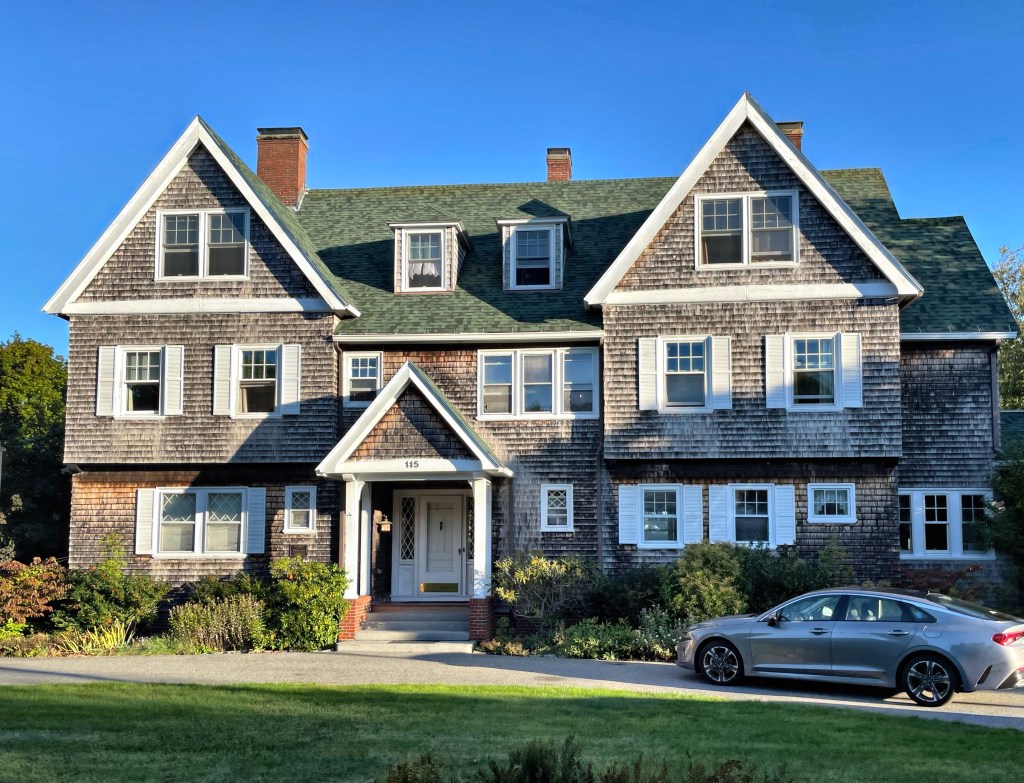
Built in 1901, “The Crossways” is one of Bar Harbor’s most stunning summer cottages built in the 20th century. The home was designed by the illustrious Boston architectural firm of Andrews, Jaques and Rantoul, possibly as part of the of the William B. Rice estate. The home appears to have been rented in early years until it was occupied by Edward and Esther Mears. Edward ran a hotel in town during the summer months before getting involved in real estate, where he made much more money. The home blends together the best of architectural styles of the time from Queen Anne to Shingle Style, and remains in an excellent state of preservation.
Sunset Cottage was designed by local architect Milton Stratton and cost $20,000. The cottage was constructed for New Yorker Gertrude Stevens Rice, a decade after the death of her husband William. She and her husband formerly resided at The Tides, a home nearby, but she decided to construct a new home to summer at with her sister. The shingled home originally had half-timbering in the gables, but other than that, looks almost identical to when it was built 110 years ago!
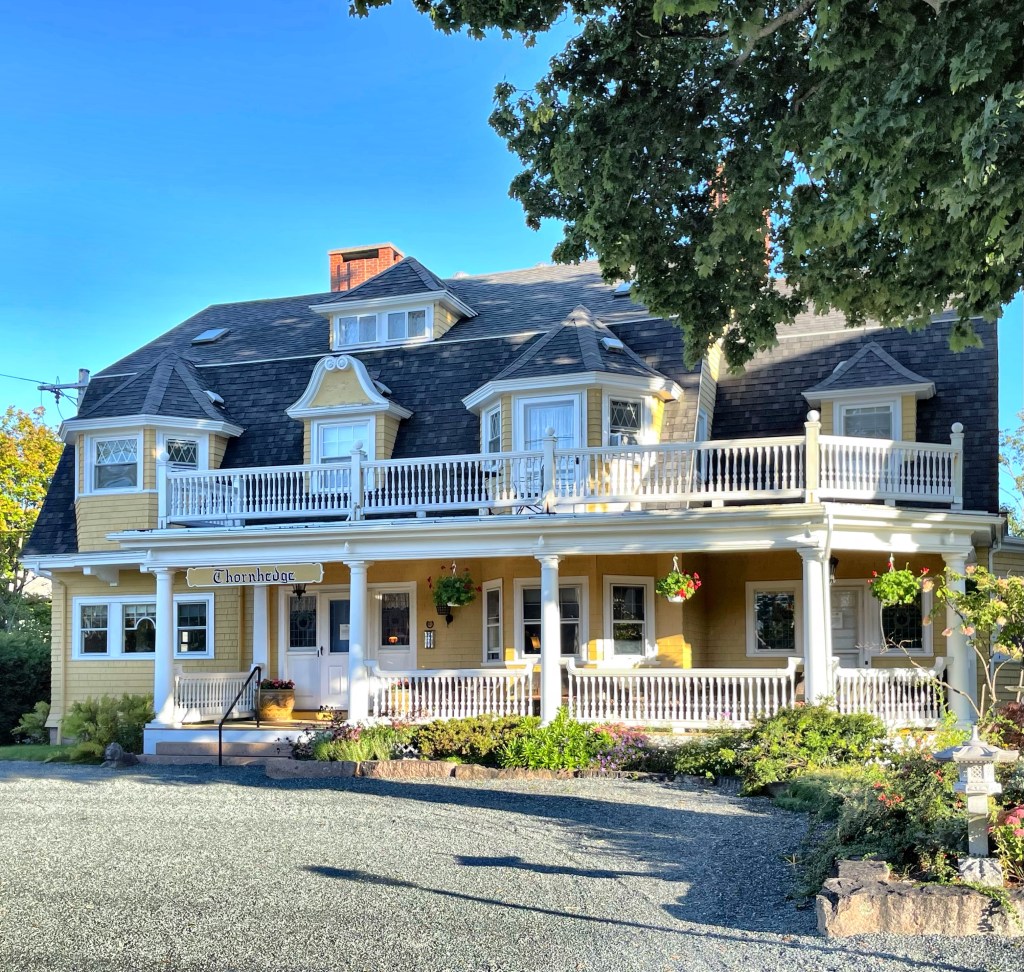
Located next door to “The Poplars” (last post), another summer cottage Thornhedge, stands out for its architectural splendor and great state of preservation. Similar to “The Poplars”, the home was built in 1900 for Lewis A. Roberts, a retired book publisher from Boston. Roberts ran the publishing house with his brothers, and they published work by authors including Emily Dickinson, Fyodor Dostoyevsky and George Sand, the first American edition of Treasure Island by Robert Louis Stevenson, and had their greatest commercial success with Little Women by Louisa May Alcott. The business was purchased by Little and Brown Publishing in 1898. Lewis Roberts died in 1901, only a year after completing Thornhedge, and the house came under the care of his son, Lewis Niles Roberts. Mr. Roberts kept the house as a summer residence until 1920, then sold it to the family of William F. Frick, a prominent judge from Baltimore. The home became an inn by the 1970s. Thornhedge is a Queen Anne style cottage which was originally organized with the first and second floor serving as the living quarters and the top and bottom floors for the servants. The laundry, servants dining hall, and kitchen were out of sight in the finished basement, with a dumb-waiter to bring hot food to the butler’s pantry. The third floor was the servants’ living quarters.




 Buildings of New England