Sullivan Three-Deckers // 1895

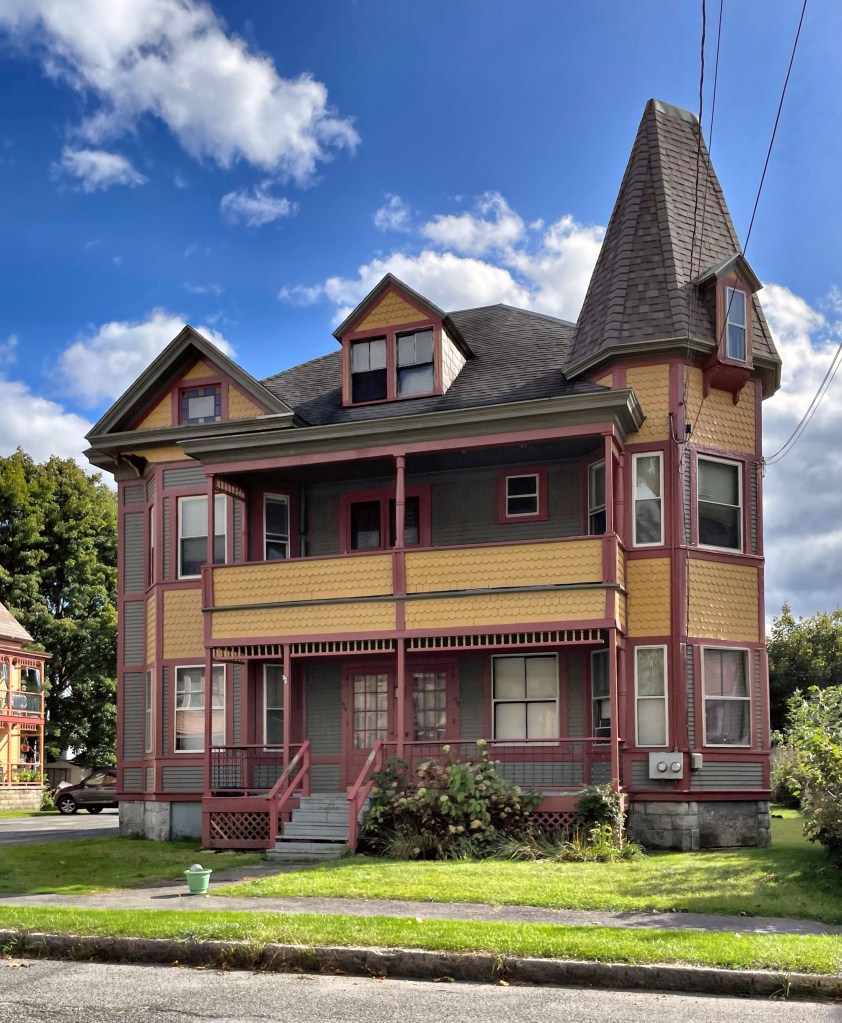
The three-decker is a commonly found housing type in New England’s urban industrial cities. These buildings are typically of light-framed, wood construction, where each floor usually consists of a single apartment, and frequently, originally, extended families lived in two, or all three floors. These were affordable housing, largely built by and for first- or second-generation immigrant families who could build a home and rent the other two units to family or friends to offset the steep cost of a mortgage. These three buildings were constructed around 1895 by David Sullivan, a cabinet-maker in North Adams, Massachusetts. They are all Queen Anne in style with applied stickwork, gabled roofs, and multi-story porches. Housing like this is what keeps so many New England towns and cities (relatively) affordable with increased density without sacrificing character or charm.

Merrill Whitney Tenements // 1897

In the late 19th century, Merrill Whitney, a former stone mason, and his wife Harriett, built a dozen multi-family housing units or “tenements” for the surge of working-class residents moving into the City of North Adams, Massachusetts. As the factories and mills were overrun with immigrant workers, rental units were built to provide housing for them and also lined the pockets of established residents of the city who could supply the much needed housing there. Some landowners like the Whitney’s built high-style housing that rivaled some of the single-family homes there. This was a two-family home that was rented through the early 20th century, and still features front porches, a tower, and Victorian-era detailing.

Samuel Dearborn House // 1886

Queen Anne perfection! The Samuel Dearborn House sits at the beginning of Concord Avenue in Nashua, New Hampshire and is among the city’s finest examples of the great architectural style. Samuel Gerrish Dearborn was born in Northfield, New Hampshire, August 10, 1827. His father was an industrious farmer and allowed Samuel to be educated at Sanbornton Academy and the New Hampshire Conference Seminary. He graduated from Dartmouth in 1849 and began practicing medicine in various New Hampshire towns. He served as a surgeon during the Civil War and after, settled in Nashua, remaining a prominent doctor. He and his family were avid travelers and had trips to the Pacific northwest and Mexico. He had this stately Queen Anne style residence built in 1886 which exhibits all the hallmarks of the style. Varied materials and siding types, asymmetrical plan, ornate turned columned porch, gables with detailed shingling, and complex roofline are all so eye-catching.

Dana King House // 1879

Another stately Victorian-era house on Nashua’s Concord Street is this brick beauty, known as the Dana King House. The property was constructed in 1879 for Dana William King (1832-1912) who had quite a history. He was born in Alstead, New Hampshire where he lived until he was 19, moving to Boston to “make his fortune”. In 1852, he shipped aboard a whale boat in East Boston, and realized that whaling wasn’t for him. He was persuaded by his brother to move in with him in Detroit, where he worked as a grocery clerk before moving back to New Hampshire, settling in Nashua, where he did make his fortune. He began working at a local mill until the outbreak of the American Civil War, where he enlisted in the First Regiment of New Hampshire, eventually rising to the rank of Lt. Colonel. He was captured during the war and held in prison in Shreveport for over seven months, failing at least one prison escape. He was eventually included in a prisoner swap and returned to Nashua in 1865. Upon his return, King used his war stories to gather favor locally, and he was elected Register of the Hillsborough County of Deeds, a position he held for over 30 years. The King House is a great, and rare example of the Victorian Gothic style of architecture in Nashua, notable for its steeply pitched slate gable roof with octagonal corner tower serving as a belvedere or cupola.

James Tolles House // 1890

WOW! Would you just look at this absolute stunner in Nashua? The town is not necessarily known for its historic architecture, but like most New England towns and cities, there are some amazing buildings to check out. This example, the James Tolles House, was built in 1890 and is one of the finest residences in the city. The stately residence was built for Mr. Tolles who served as Nashua’s 23rd mayor. The Tolles House stands out for the use of sandstone ashlar construction on the first floor with shingle siding above, carved terracotta panels, and a large, rounded corner tower capped with a domed copper roof. This one is pretty close to perfect!

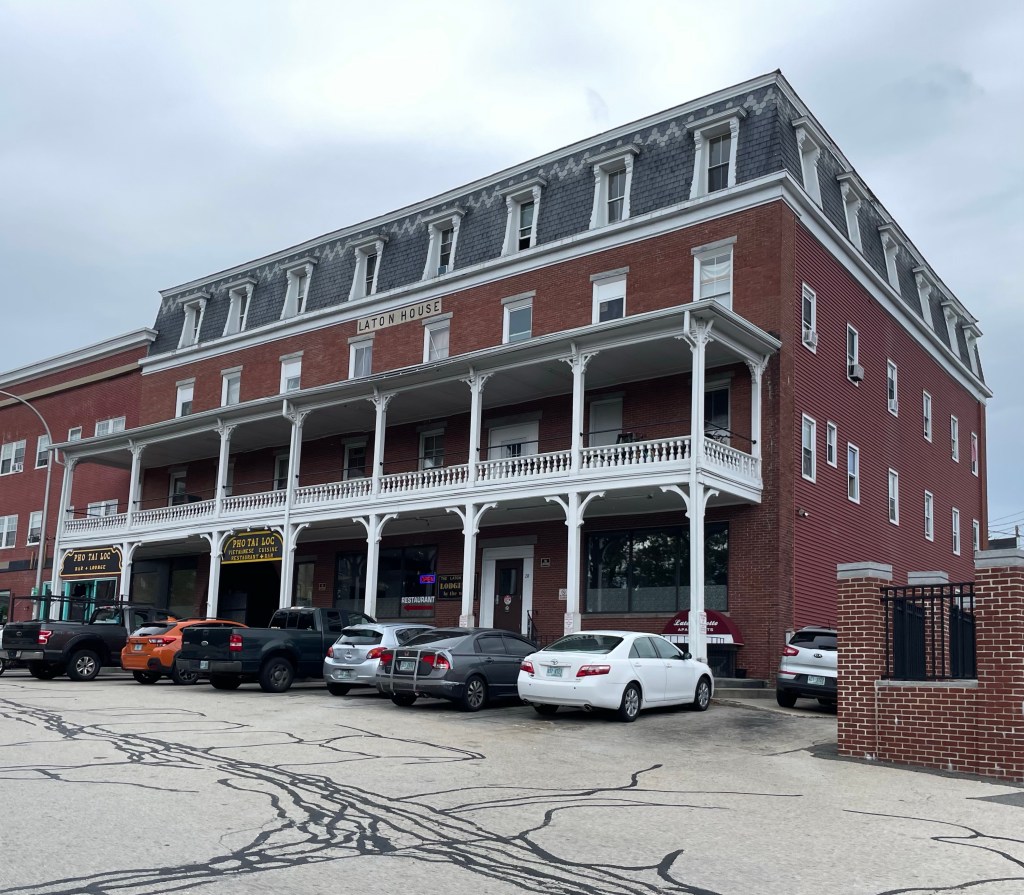
Laton House Hotel // 1878

A late example of Second Empire style architecture, the Laton House in Nashua, New Hampshire, is a 3 ½ -story brick hotel building with a slate-covered mansard roof pierced by regularly spaced dormers. The facade is dominated by a two-story porch with decorative railings and brackets. The hotel was developed between 1878-1881 when Railroad Squareserved as the central square in town. The hotel thrived, allowing visitors cheap rooms while doing business in the manufacturing hub of Nashua. Eventually, the hotel closed and was converted to housing. Today, it houses commercial space on the ground floor with low-income housing above.

Dr. Eugene F. McQuesten Residence // 1887

Dr. Eugene Forrest McQuesten was born in Litchfield, NH, on October 11, 1843. He enrolled at local schools before graduating from theJefferson Medical College in 1866. He practiced medicine in Lynn, Massachusetts for two years before moving to Nashua, New Hampshire to run a medical office. He worked in Nashua for years, later being nominated President of the New Hampshire Medical Society. In 1886, he purchased a house lot on Nashua’s Concord Street and razed the existing dwelling, building this stunning brick residence a year later.

Elijah Shaw House // 1889

This Queen Anne Victorian residence sits at 85 Concord Street in Nashua, New Hampshire. Built in 1889-90 for Elijah Shaw, the house is one of a dozen or so well-preserved Victorian-era mansions along the prominent street. Elijah Morrill Shaw (1826-1903) was born in Kensington, NH and spent many of his early years working at woolen mills all over the Northeast until the outbreak of the American Civil War. Obeying his country’s call to arms, at the time of the Rebellion, he entered the army in 1861 and was later promoted to Captain in 1863. After the war, he continued working at mills all over the region until 1888 when he was hired by the Nashua Manufacturing Company. He built this house soon after his arrival and remained there until his death in 1903. The dwelling and rear carriage house are clad in shingles with the house built with a brick first floor.

Charles Hoitt House // 1895

Charles William Hoitt (1847-1925) was born in Newmarket, New Hampshire, the son of William K. A. and Sarah C. (Swain) Hoitt. His father was a descendant of John Hoyt, one of the original settlers of Salisbury, Massachusetts. On the maternal side he is a descendant of Phineas Swain who served at Bunker Hill on the American side. Charles enrolled at Dartmouth College in 1867, and was graduated in the class of 1871. He moved to Nashua to work as Master of the Mt. Pleasant School and later worked as an usher at the Lincoln Grammar School in Boston. He eventually gave up teaching as a profession and returned to Nashua and worked at a local law office. He was admitted to the Hillsboro bar in 1877, and worked as a City Solicitor and later as Justice to the Nashua Police Court. With his standing, he erected this fine house on Concord Avenue, with a deep lot where he raised rare exotic birds. Judge Hoitt served in the New Hampshire House of Representatives in 1901 and in 1907, was appointed by Theodore Roosevelt to be the United States Attorney for the District of New Hampshire. His residence in Nashua blends Queen Anne, Shingle, and Colonial Revival styles elegantly. The property was purchased in the 1920s by the Unitarian Universalist Church of Nashua as a parsonage, a use it held until it was sold in 1977 to a private homeowner. The shingled porch was removed during the time it was a parsonage, but the house remains in excellent condition today!

Stephen & Maria Mansfield House // 1888

The Stephen and Maria Mansfield House is located at 70 Concord Street in Nashua, New Hampshire, and is one of many stunning old houses along the largely residential street. The dwelling was built in 1888 for Stephen Willard Mansfield, a shoe dealer in Nashua, and his wife, Maria. The Mansfield House is a great example of a more modestly sized Queen Anne style house, which is typified by the asymmetrical plan, varied siding types, and intricate carvings and turned posts. This house is dominated by a two-story rounded bay which is capped by a conical roof. She could definitely use a good paint job but it’s a really sturdy old home built from old-growth lumber. She’s here to stay!