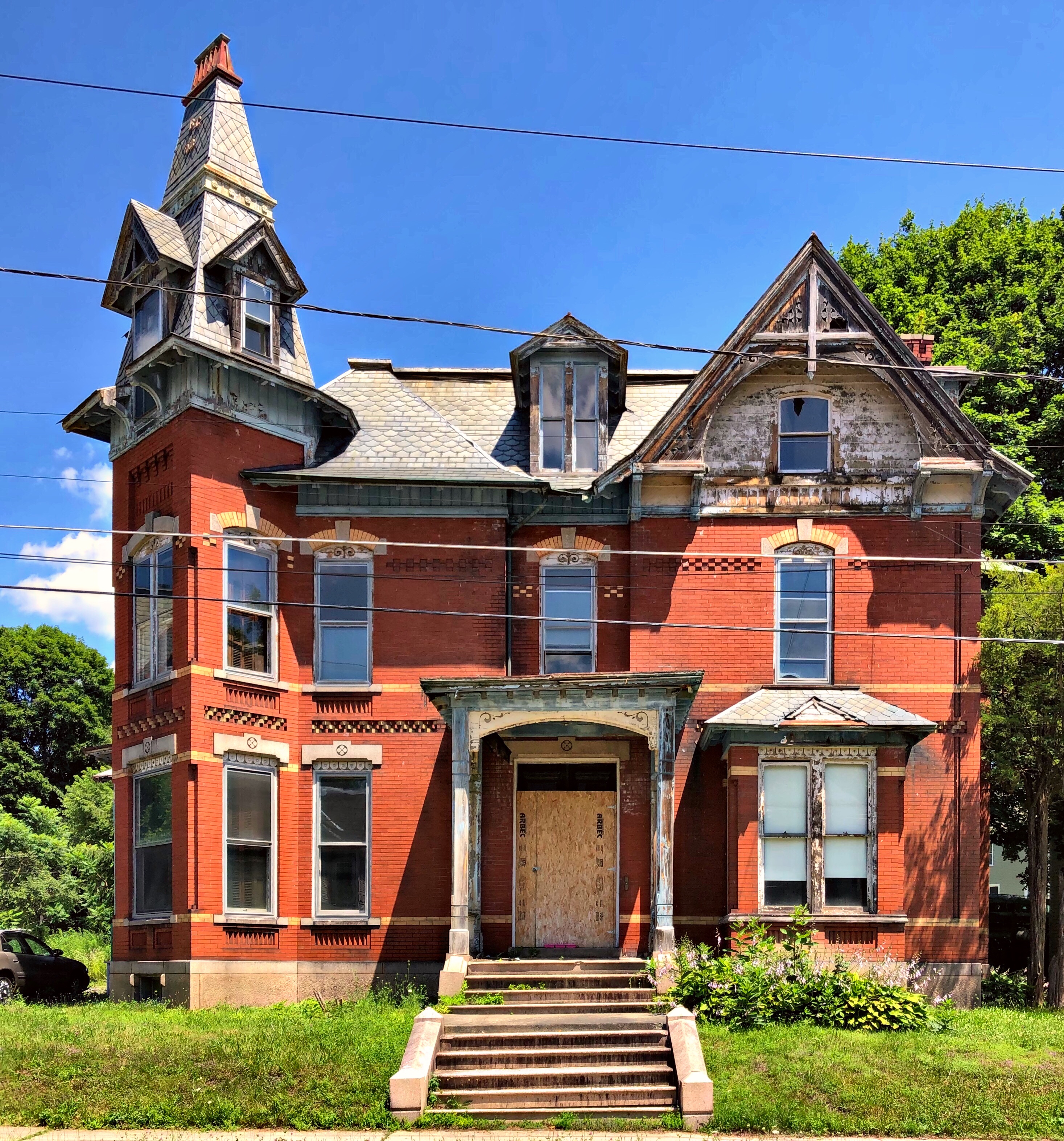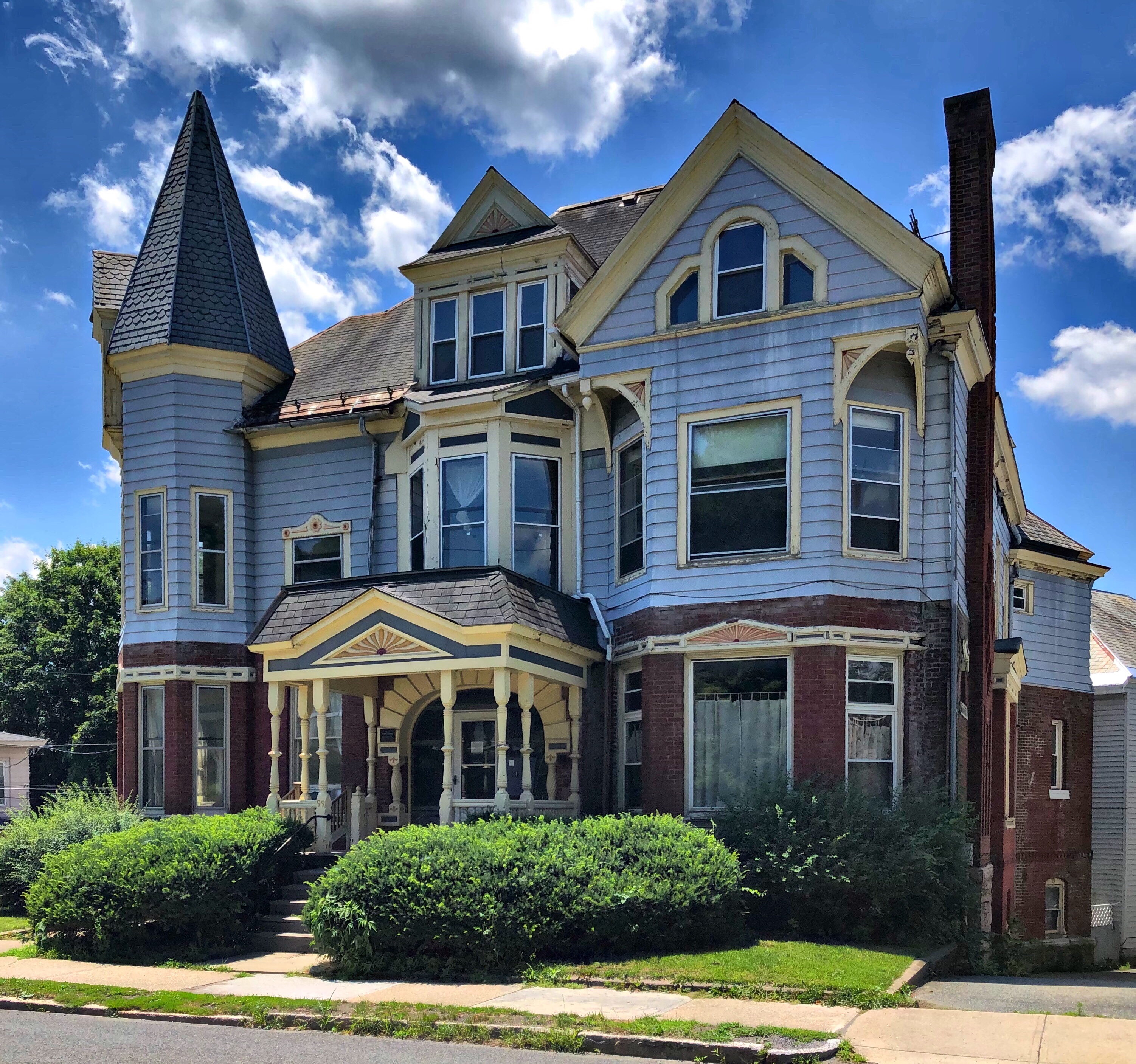
This house was built in 1882 for Frank Walker, a merchant who owned a feed and grain store in Downtown North Adams, Massachusetts. The Stick and Queen Anne style home was designed by architect Marcus F. Cummings, who also designed the Blackinton Mansion. The brick and freestone home was converted to multi-family sometime in the mid-20th-century due to the changing demographics of the town. Since then, the home has seen weathering and deferred maintenance, but retains much of its original detailing and character.
Edmund Burke Penniman (1841-1929) was born in North Adams, a son of Mr. and Mrs. Edmund B. Penniman. His father an established lawyer, and mother died, leaving the young boy with a sizable estate. Just before the Civil War broke out, he developed a mill, which had to shut down when the war began. After the war, the company had no orders to fill and they sold the property. Penniman became treasurer for the North Adams Manufacturing Company, and later served as President of the Hoosac Savings Bank. He and his family resided in this Stick style home until his wife’s death in 1909. The home features a brick ground floor and clapboards (now aluminum) above. The Victorian home has a rusticated arched entryway protected by a projecting porch with stickwork. A large corner tower gives the house a large street presence.
Prior to 1866 the area now called Oak Bluffs was largely undeveloped with the exception of the famed Methodist meeting camp at Wesleyan Grove that had been established in 1835. By the 1860s the meeting camp was attracting large numbers of middle class visitors from Boston and surrounding towns who came for summer retreats; in 1868 approximately 600 tent and cottage lots were being leased in the Methodist compound. The Land & Wharf Company catalyzed this success into profit, by developing a more commercial presence on Circuit Avenue and developed housing on large lots to the east.
The first major structure built by the Land & Wharf Company was the Arcade Building. In it, they established their office from which they directed development of the resort. The central open arcade provided access to the campground from the heart of Oak Bluffs’ commercial area. The Arcade was designed by Boston carpenter/architect/inventor Samuel Pratt (1824-1920) who was also responsible for many of the cottages in Oak Bluffs. The Arcade remains a historically significant and well-preserved commercial building in town. My bad photo doesn’t do it justice! 😦
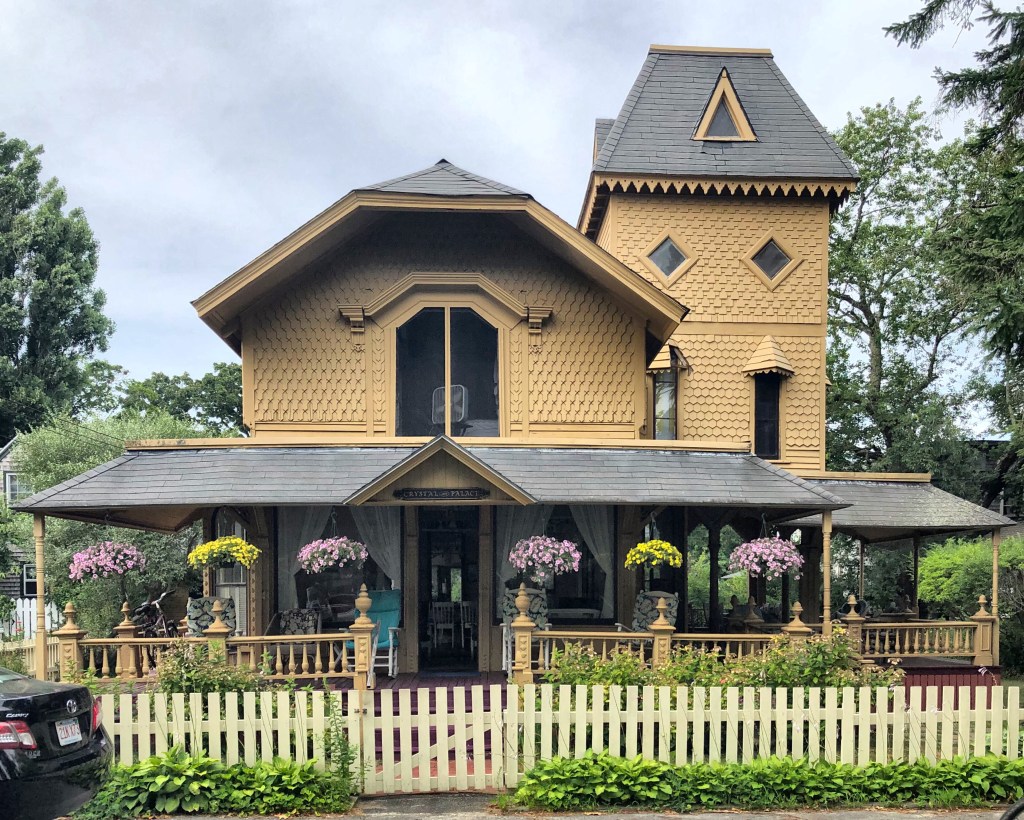
The Crystal Palace cottage Pequot Avenue in Oak Bluffs was built by Henry Clark, a local builder of many summer homes on the island of Martha’s Vineyard. The cottage is a charming blend of Stick, Shingle, and Queen Anne styles, which works perfectly. The wrap-around porch is supported by turned posts with a balustrade capped by urns, the square tower has two elongated windows with eyebrow lintels resembling a face with bushy eyebrows. Oh the charm of Oak Bluffs, architectural eccentricity on every street!
Located on Trinity Park in Wesleyan Grove (aka the Martha’s Vineyard Camp Meeting Association), this 1878 church served the year round Methodist community in Oak Bluffs. The Trinity Methodist Church is a towered, Victorian Gothic structure of some distinction. Edward M. Hyde, a Methodist minister who had trained in architecture and art, designed it. The property that the church and Parish House sit on belongs to the Association, but the buildings are maintained by the congregation. Interestingly, should the congregation disband, the buildings would return to the Association.
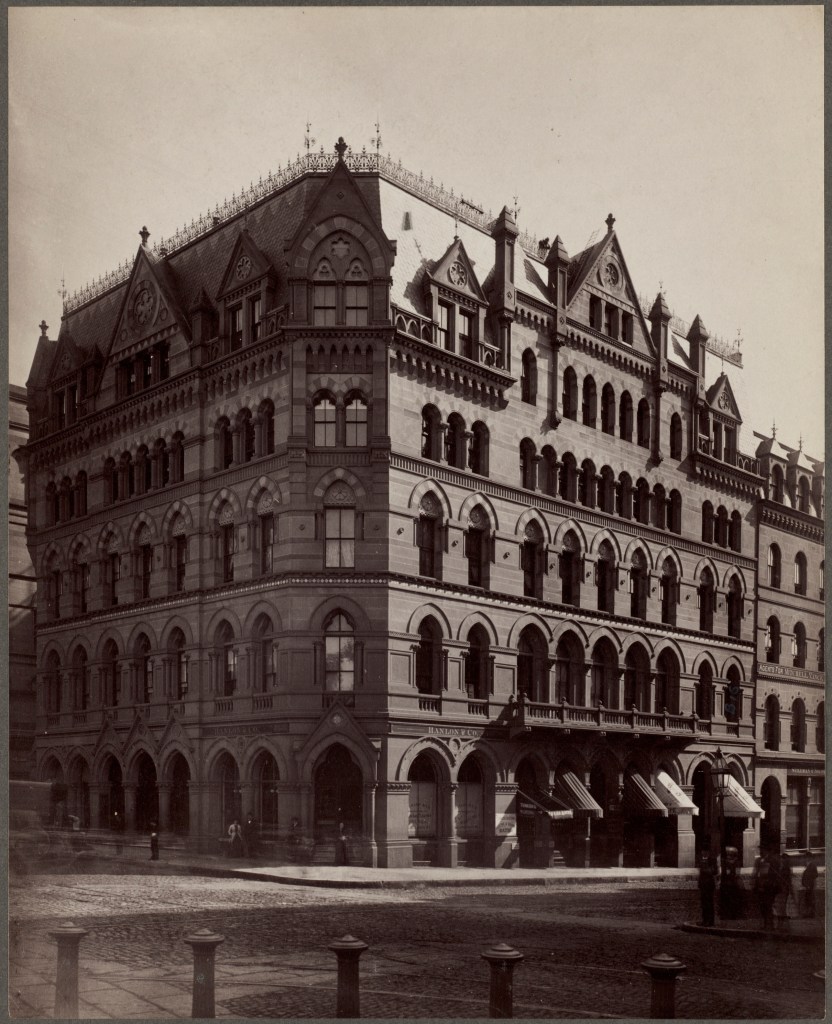
Standing just 24 years, the Hotel Boylston at the corner of Boylston and Tremont Streets, evoked the Victorian-era grandeur of Boston. Built in 1870, the Victorian Gothic hotel (what we consider apartment building today) was designed by the architectural team of Cummings and Sears, who were very busy at the time in Boston and beyond. The 5 1/2-story building was constructed of sandstone and featured Gothic arches, dormers of varied sizes and shapes, and a mansard roof with iron cresting. The building (and the three others on Tremont Street) was razed in 1894 and replaced with the Hotel Touraine a few years later.