Pardon Miller, a watchmaker and silversmith in Providence had this Federal style home built in 1822 in Providence’s high-value College Hill neighborhood when he was in his 20s. The home and its neighbor were built at the same time, seemingly by the same builder as they share a lot of similarities in design and detailing. The house remained in the Miller Family until 1882, and it is now owned by the Rhode Island School of Design (RISD). The homes on the northern side of Angell Street, like this house, are largely built on a raised foundation with high retaining walls, which showcases the “hill” in College Hill.
Located next door to the William Holroyd House (last post) in Providence’s College Hill neighborhood, this Federal style home appears to have been constructed by the same builder just a year apart, but in brick! This house was constructed in 1797 for Samuel Eddy, an attorney, congressman, and later served as Chief Justice of the Rhode Island State Supreme Court. Similar to the Holroyd House, the property was later acquired by a member of the Brown Family, and has since become part of the Brown-RISD Hillel.
Image Courtesy of Providence Public Library collections.
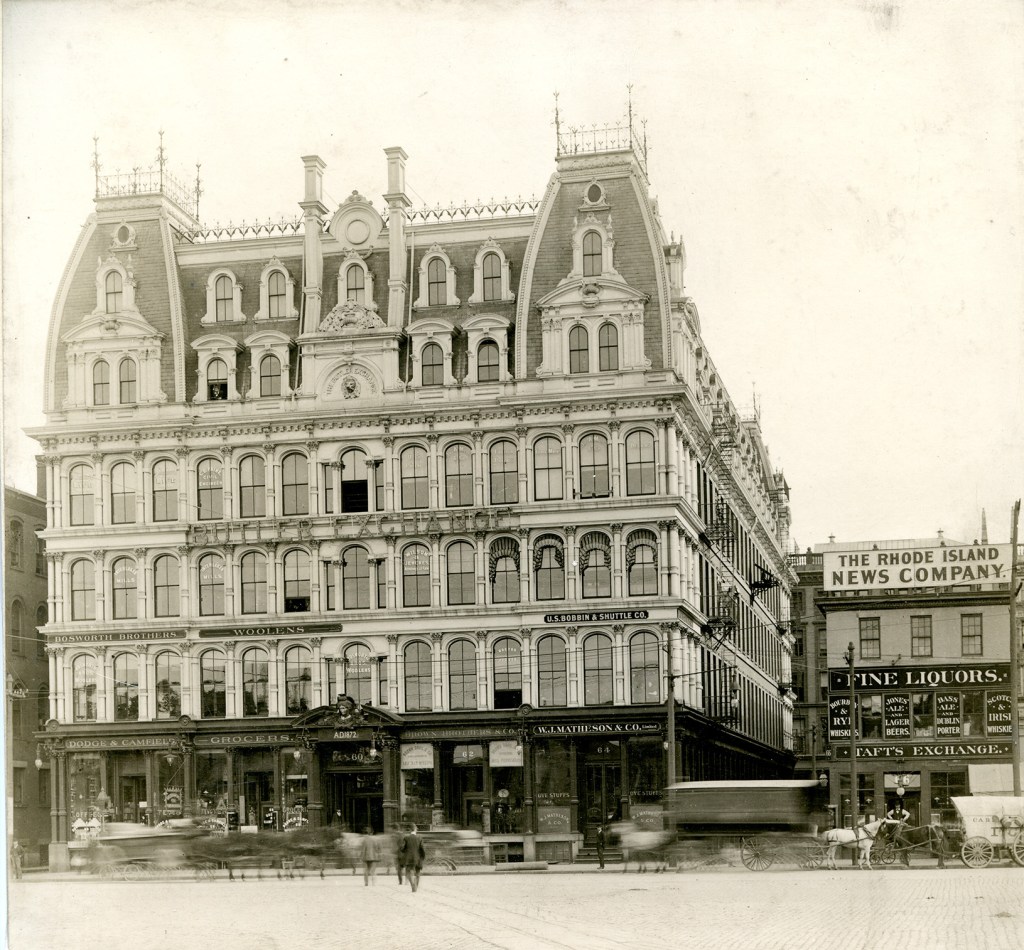
This magnificent structure formerly in Downtown Providence would likely still exist today had a devastating fire not destroyed it in 1925. When construction on the Butler Exchange began 1871, the area we know today as Downtown was only a cluster of small wooden and brick residences with commercial operations on the ground floors; the key retail shopping districts were across the river around where Brown University is today. The first major commercial development in modern-day Downtown was the Providence Arcade (featured previously), built in 1828, by Cyrus Butler. The Arcade languished in tenants and shoppers earning it the name, “Butler’s Folly”. A half-century later, a new Butler project was about to take off. Cyrus’ heirs built the Butler Exchange, which upon completion in 1873, was the largest building in Providence and its splendid French-inspired two-story mansard roof was a nice pairing with the City Hall being built nearby. The Butler Exchange saw commercial use, offices, and a school before a fire destroyed much of the building, leading to its demolition. The building was later replaced by the Industrial National Bank Building aka the “Superman Building”.
‘The Reef’ a fabulous Gilded Age estate in Newport was built in 1885 for Theodore M. Davis by the Boston architectural firm of Sturgisand Brigham. The elegant shingle and stone Queen Anne villa was erected as both a summer house and to house some of Davis’s vast collection of paintings and Egyptian artifacts, collected during his excavations in Egypt’s Valley of the Kings between 1902 and 1913. Besides the architecture of the home, the Reef Estate was also famous for its walled gardens, greenhouses, and outbuildings, sitting upon eighteen acres. overlooking the Atlantic Ocean. Following Mr. Davis’ death in 1915, Milton J. Budlong of Providence purchased the estate. Milton divorced from his wife Jessie in 1928, and it was MESSY. Their Newport summer estate was placed in contention. The house, never again lived in by the family. During World War II, anti-aircraft gun emplacements were set up around the grounds, with the mansion housing gunnery personnel. After the War, the estate was given back to the Budlong heirs, who did not reside there. Vandalized throughout the 1950’s, the villa was set on fire in 1961 and demolished two years later in 1963. In 1969, the waterfront property came under the control of the State of Rhode Island and in 1976, became a state park. The old carriage house/stable and a later observation tower (possibly converted from a former water tower) stand today.
No structure in Newport is as hotly debated than the “Newport Tower” located in Touro Park. The old stone, cylindrical tower stands like an ancient relic of ancient Europe, just dropped in downtown Newport. For centuries, people have debated the structure’s history and use. Some say this structure was built by Viking masons who visited North America 1,000 years ago, while other theories (more rooted in fact) share another story. The tower was located at the upper end of the plot behind the now-demolished mansion built by Benedict Arnold, the first colonial governor of Rhode Island (his grandson was the infamous Benedict Arnold, the traitor who switched sides to fight with the British. In 1677, Arnold mentions “my stone built Wind Mill” in his will is evidence that the tower was once used as a windmill. However, some state that there is no reference to Arnold ever having the structure built, with some stating that he simply repurposed the building to be used as the base of a windmill. In 1837, Danish archaeologist Carl Christian Rafn proposed a Viking origin for the tower in his book Antiquitates Americanæ. This hypothesis is predicated on the uncertainty of the southward extent of the early Norse explorations of North America, particularly in regard to the actual location of Vinland, where Leif Erikson is believed to have first landed around 1000 CE, nearly five centuries before the voyages of Christopher Columbus and John Cabot.. Rafn’s popularization of the theory led to a flurry of interest and “proofs” of Norse settlement in the area. Mortar tests completed in the 20th century basically prove this theory to be false, and date the structure to the middle of the 1600s, but it is fun to imagine it is much older!
One of the more unique and relatively modest summer cottages in Newport, Rhode Island is Bird’s Nest Cottage on Bellevue Avenue. The cottage was built in 1871-2 for Samuel Freeman Pratt, who lived his early life in Boston. The son of a carpenter, Pratt was was working as a carver in Boston, where he saw success as an inventor with several patents to his credit. From the success of one of his inventions, a device for sewing machines, the invention gave him the financial freedom to explore other interests, namely architecture. In Boston, he likely learned his craft from partner John Stevens, before setting out on his own. He designed buildings in Oak Bluffs on Martha’s Vineyard, but decided to reside in Newport. While many state that this cottage for Pratt was designed by the Newport resident and star-chitect Richard Morris Hunt, the design and the fact that it was his own cottage lead me to believe it was designed by Pratt himself. The eclectic cottage features complex gable shapes, fancy stickwork under the eaves, projecting corner bays, and a wall covering of multicolored slate roof shingles. It is now a professional office.
Here is another of my favorite non-Gilded Age houses in Newport, the John Bush House on Mann Street! John T. Bush (1817-1881) was listed in directories as a “wool-puller” which clearly was a lucrative job, as he could afford to build this high-style Gothic Revival home. This house is heavily influenced by the publications of Andrew Jackson Downing first published in 1842, so the house is probably built within a couple years of that date. Hallmark features of the Gothic Revival style include: lancet windows, bargeboards, windows with drip molds, and steeply pitched roofs; this house has all of the above!
One of my favorite houses in Newport, Rhode Island is this amazing high-style Greek Revival mansion across from the Touro Synagogue. The house was built in 1835 for Levi Gale, and designed by esteemed Rhode Island architect Russell Warren. Gale was born in New Orleans and moved to Newport and is listed as a merchant. It is possible that Levi Gale was involved in the Triangular Trade, the trading of enslaved people, sugar (often in its liquid form, molasses), and rum between West Africa, the West Indies and Rhode Island. Many do not realize, but Rhode Island was heavily involved in the slave trade. The house follows the more traditional Federal form, but with two-story composite pilasters and flush siding, scored and painted white to resemble ashlar marble. The home is elegantly sited, but it is actually not on its original lot. It was actually built adjacent to Washington Square, in the place of the present Newport County Courthouse, and was moved to its present site in 1925. The mansion was cut in half, moved a block away, and re-assembled on a new foundation. It is now used as a Jewish community center, owned by the congregation that owns Touro Synagogue.
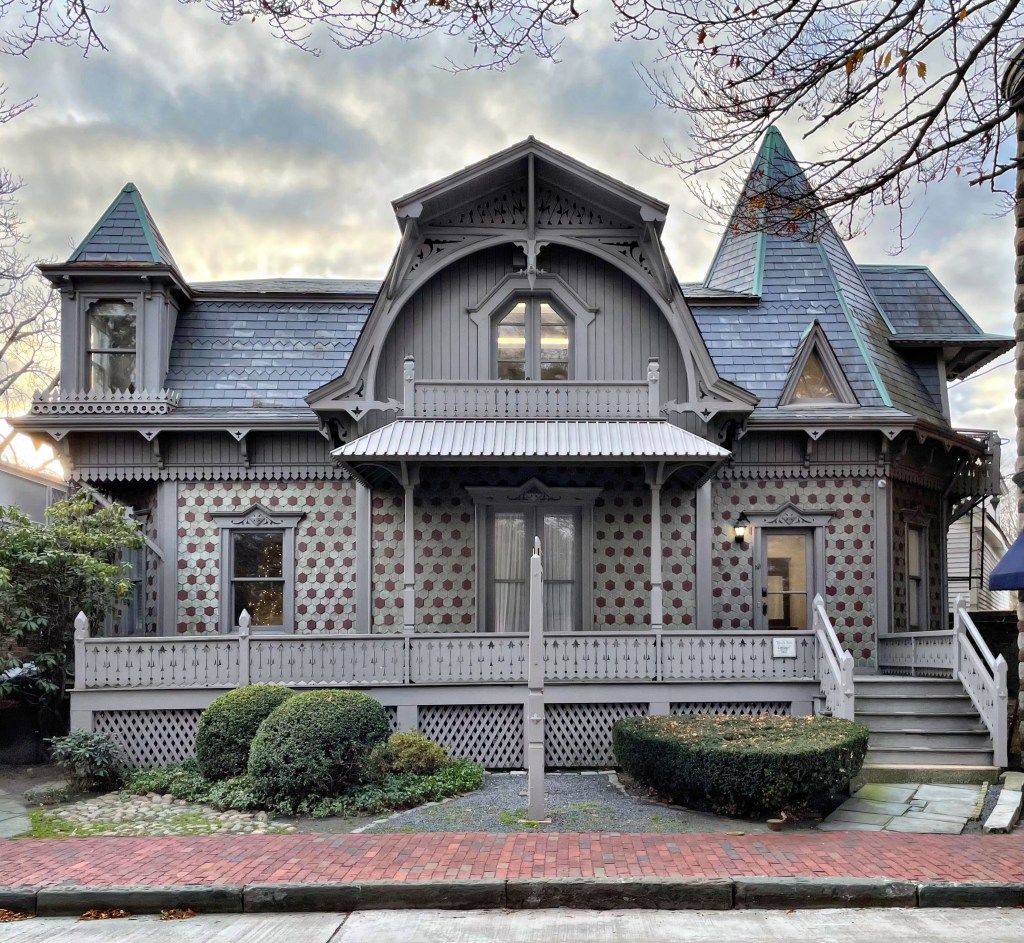
This beautiful mansard-roofed home in Newport was long the residence of the Armington Family. The history is a little murky, but deed research shows the property was purchased in 1863 by Horace E. Armington, a Boston tailor. Horace likely purchased an earlier home and from it, built this larger, Second Empire style house to serve as a summer retreat. The family eventually settled in Newport full-time and their son, also Horace, took a job as Assistant Librarian at the Redwood Library in town. The family owned the property for generations until it was converted to professional office use, likely due to the commercialization in the 20th century of the main streets in Newport. The house retains much of its original detailing including the rooftop belvedere. The later-added shingle siding adds a rustic touch.
Located just a short walk from the oldest extant Jewish synagogue in the United States, Touro Synagogue (last post), the Touro Jewish Cemetery and stately gate, showcase the significance and position Jewish residents held in Newport, going back to Colonial times. The earliest Jews in Newport arrived from Barbados, where a Jewish community had existed since the 1620s. They were of Spanish and Portuguese origin; their families had migrated from Amsterdam and London to Brazil and then to islands in the Caribbean. After the completion of the synagogue in 1763, the Jewish community in Newport realized the need to acquire land for a Jewish cemetery. Two of the original immigrants, Mordechai Campanal and Moses Pacheco purchased the lot at the corner of what is now Kay and Touro Streets for this purpose. In 1843, the cemetery funded the erection of a cemetery gate and fencing to surround the plot. They hired architect Isaiah Rogers to design the gate, which he took inspiration from his design at Boston’s Granary Burying Ground, completed just two years earlier. The Egyptian Revival gate is a very rare example of the style in the United States. On the granite gate, the torches turned to face downward are an acknowledgement of the ending of life’s flame.