Benjamin Bosworth House // 1800

One of the most unique houses in Connecticut is this massive Federal style residence located in the small town of Eastford. Built next to the Congregational Church of Eastford (1829-2023), which burned down in 2023 by arson, the massive house has been known as both the Benjamin Bosworth House and Squire Bosworth’s Castle due to its first owner, Benjamin Bosworth (1762-1850). According to the Bosworth Family, the house was built in 1800 by Bosworth was a wealthy merchant, who hired Vini Goodell, a local carpenter to design and build the large Federal home. The house was completed by 1801 when the local Masonic group met in the building. As Bosworth was also a merchant, he used the basement as a storeroom. The house is also unusual for its monitor roof, a rarity in Federal period construction, which reads like a second structure on the house, due to the building’s size. After Bosworth’s death, the house was occupied by his niece, and was later purchased by Elisha Grant Trowbridge in 1897. Trowbridge was a grand-nephew of General Nathaniel Lyon (1818-1861), a local hero who was the first Union general killed during the Civil War. Trowbridge, an engineer, lived here until he died in 1963 at the age of 96. Later owners have had the monumental task of restoring and maintaining this behemoth of a house, to great success.

Ivy Glenn Memorial Hall // 1847

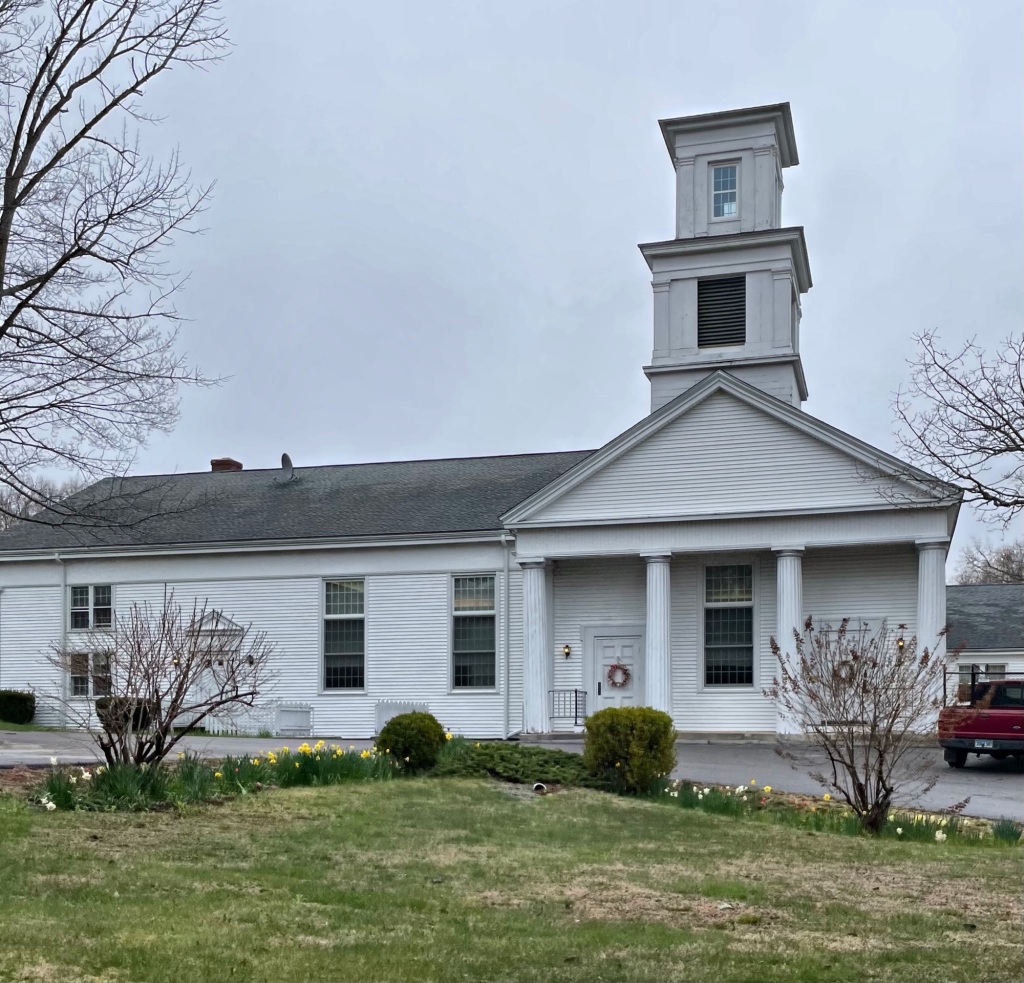
Methodists established a small congregation in Eastford, Connecticut by 1826, and by 1831, a new meeting house was built in the center of the village. The meeting house was used jointly by Methodists and Universalists, each having the right to occupy it half the time. By 1847, Methodists here were able to erect their own church, this building, in the Greek Revival style. Originally, the building had two doors on either side of a center window in the façade. There was a steeple and, rare in those days, a pipe organ in the sanctuary.  In 1916, the church joined with the nearby Congregational church, requiring them to sell the building ten years later. The town of Eastford bought the structure for $200 in 1926 for use as a town hall. In 1934, the Civil Works Administration provided funds to renovate the building with the town library being installed in a portion of the basement along with town offices and a vault. Town meetings were held in the former sanctuary space upstairs. When the space was outgrown for town offices, a new building was constructed elsewhere and this building transitioned to solely library use. The renovation project was paid for by money bequeathed by Wilmer Glenn, a New York stockbroker who spent summers town. He donated funds in memory of his late wife, Ivy.  The present-day name of the building came to be the Ivy Glenn Memorial and the library moved into its new spacious home in 1972.

Sumner-Carpenter House // 1806

I don’t think any state does the Federal style as well as Connecticut (Massachusetts is a close second)! This is the Sumner-Carpenter House, a high-style example of a Federal residence that is located on the backroads of the small town of Eastford, Connecticut. The house was built in 1806 for John Newman Sumner (1775-1831) who resided here until just before his death. The elaborate Federal period house was sold out of the family. After trading hands a half-dozen times, the property was purchased by David and Harriet Carpenter in 1881. The property remained in the Carpenter family for generations, and remained as such after Orlo Carpenter (1865-1938) was killed in the collapse of a barn during the hurricane of 1938. Architecturally, the house has all of the hallmarks of the Federal style, with the symmetrical main facade five bays wide, with a center entrance flanked by wide sidelights, and topped by a fanlight transom and corniced entablature. The window above the entrance is in the Palladian style, with a rounded center window flanked by narrower sashes. The house is very well preserved and was listed on the National Register of Historic Places for its architectural quality and preservation.

Eastford Baptist Church // 1843

One thing so many small New England towns have are charming wood-frame white churches from the first half of the 19th century, Eastford, Connecticut is no exception. In 1793, a Baptist Society was organized at Northford (then a part of Ashford), and the first pastor, Daniel Bolton, oversaw construction of the first church there. Fifty years later, the congregation grew and their finances allowed for the construction of this Greek Revival style church in 1843. The building was added onto for a Ladies Benevolent Society and a Sunday School, giving the structure its larger appearance today. While the church is today is covered in later siding, the building is well-maintained and the original siding is likely underneath for a future restoration.

Bartlett House and Barns // c.1840

We featured Ashford, Connecticut, so now it’s time to explore some of neighboring Eastford! Settled in the early 1700s, the eastern portion of Ashford separated from its parent town in 1847, and became the town of Eastford. Prior to this, light industry, such as the production of cotton batting, twine, and wooden handles, complemented what would remain a predominantly rural agricultural community well into the 20th century. The winding back roads are lined with charming farmhouses bounded by rugged historic stone walls, making the town retain its rural feel. When driving through, I stumbled upon this postcard-worthy historic farm complex. Historic maps show that the property was owned by D. Bartlett in 1869, which appears to be Daniel Bartlett (1812-1898). The Bartlett property is enhanced by two historic barns sited nearby on a bluff overlooking the fields, which were likely once lined with trees or crops. By the 1900s, the property was owned by Nicholas and Clementine Dechand, the small road leading up to the farmhouse was named after the couple.

Michael Richmond House // c.1814

When the town of Ashford laid out a road across the land of Abner Richmond, he saw it as an opportunity to gift the newly organized plot across the road to his eldest son, Michael and his new wife, Polly as a wedding gift. Michael Richmond (1786-1881) built this Federal style house across the street from his father (see last post), likely employing the same builder, who employed similar design elements for both homes. In early life Michael learned saddle-making and afterward engaged in the manufacture of cloth, also axes. He was also engaged in staging and turnpike building, and in the mercantile business, until he retired at 60 years of age. He was a man of all trades! The house is now home to BOTL Farm, a pasture-based, sustainability-focused livestock farm that raises pigs, lambs, goats, and chickens ethically. Gotta love seeing farming coming back to Connecticut’s “Quiet Corner”!

Westford Baptist Church // 1840

The Baptist church in Westford (a village in northern Ashford, yes it’s a little confusing) was formed in 1780. Its growth in the town can largely be attributed to Reverend John Rathburn, who had moved to town from Stonington, and was ordained as its pastor in 1781. A membership of fifty-four was reported in 1795. By the late 1830s, the village thrived due to the success of local businessmen and later, thanks to the Westford Glass Company, located nearby. Members donated to build this Greek Revival style church on a prominent corner in town, replacing the former meetinghouse. By the late 20th century, the church saw dwindling membership and merged with another in town. This church was sold to a neighboring property and is privately owned today.

Ashford Academy // 1825

Built in 1825, the Ashford Academy school building is the last remnant of what was Ashford, Connecticut’s once thriving town center. The taverns, church and businesses which were once located here have almost entirely been razed, leaving just this school building as the remaining structure. Ashford Academy was founded about 1825 when a group of citizens raised funds toward adding a second story to a schoolhouse then under construction in the town center. Only one teacher was hired per term, and some years there were no academy classes at all. The last academy session was held in 1875, though the building continued in use as a district school until 1949. The building is significant, not only for its siting and connections with the town’s early days, but also architecturally as a high-style school building for a more rural setting.

St. Philip the Apostle Church // 1937

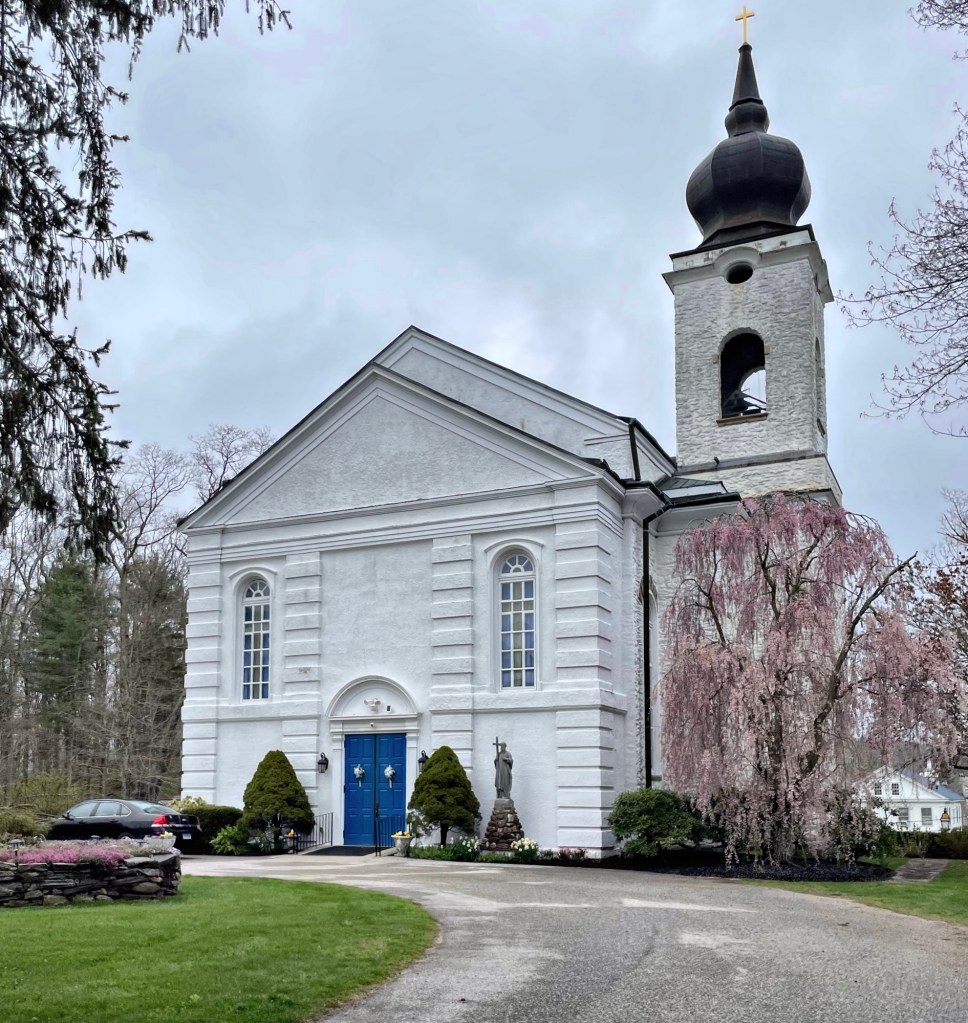
In 1921, the Catholic Diocese of Hartford purchased a Federal style farmhouse with 135-acres of land in Ashford, Connecticut, with the intention of establishing a new parish in the area. The Diocese assigned Father William J. Dunn, a Connecticut native and son of Irish Immigrants, to this daunting task. Since they had no church building at the time, Father Dunn partitioned off a section of his own home to serve as a chapel for about 100 worshipers, until the purpose-built St. Philip the Apostle Church was constructed in the 1930s. Father Dunn convinced summer resident Paul Chalfin to design the new building. Chalfin was not an architect, but he was an architectural designer whose best known building is the Villa Vizcaya in Miami, Florida. Chalfin was openly gay, and his hiring by the Catholic Church to design one of its churches in the 1930s is noteworthy. There were certainly several Irish immigrants and people of Irish descent in the congregation, but many parishioners came from small villages in Slovakia. The dome is a typical feature of churches in those villages and Chalfin included it in his design as a tribute to them. Due to material and construction costs during the Great Depression, members of the church largely built the church themselves with rocks acquired from stone walls and farms nearby. The church was completed in 1937.

Mathewson-Dunn Residence // c.1815

This Federal-style house sits on the heavily trafficked Pompey Hollow Road in the center of Ashford, Connecticut. Early history of the residence is sparse, but by the 1860s, it was the home to Charles Mathewson (1812-1880), who came to Ashford from Woodstock in 1850 and bought a saw and grist mill nearby. The mills were operated here until 1865, when he was succeeded by the firm of Lombard & Mathewson, manufacturers of fertilizers and wholesale dealers in agricultural implements. After successive ownership, the property, which included a 135-acre farm, was purchased by the Catholic Diocese of Hartford in 1921 with the intention of establishing a new parish in the Ashford area. The Diocese assigned Father William J. Dunn, a Connecticut native and son of Irish Immigrants, to this daunting task. Since they had no church building, he partitioned off a section of his own home to serve as a chapel for about 100 worshipers, until the purpose-built St. Philip the Apostle Church was built in the 1930s. The Federal style house here has an elaborated center bay which includes the entrance on the first story and a Palladian window on the second story. The main entrance is flanked by pilasters with Doric capitals which are replicated at the corners of the residence as well.