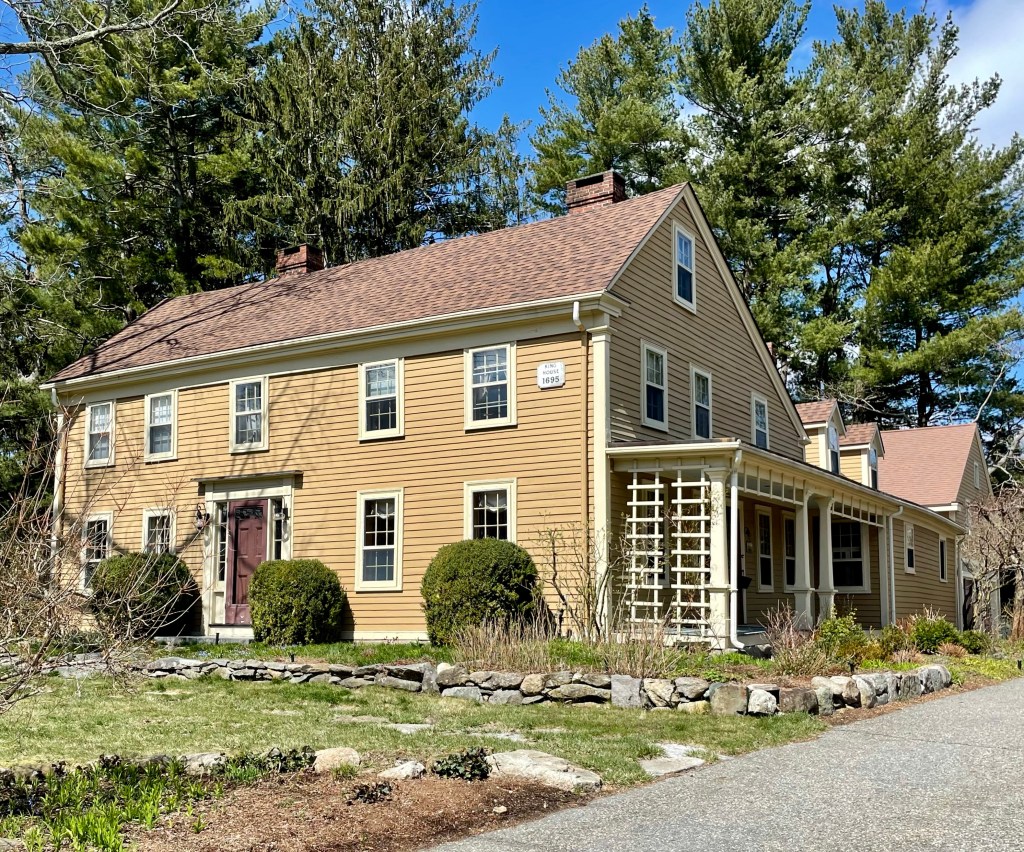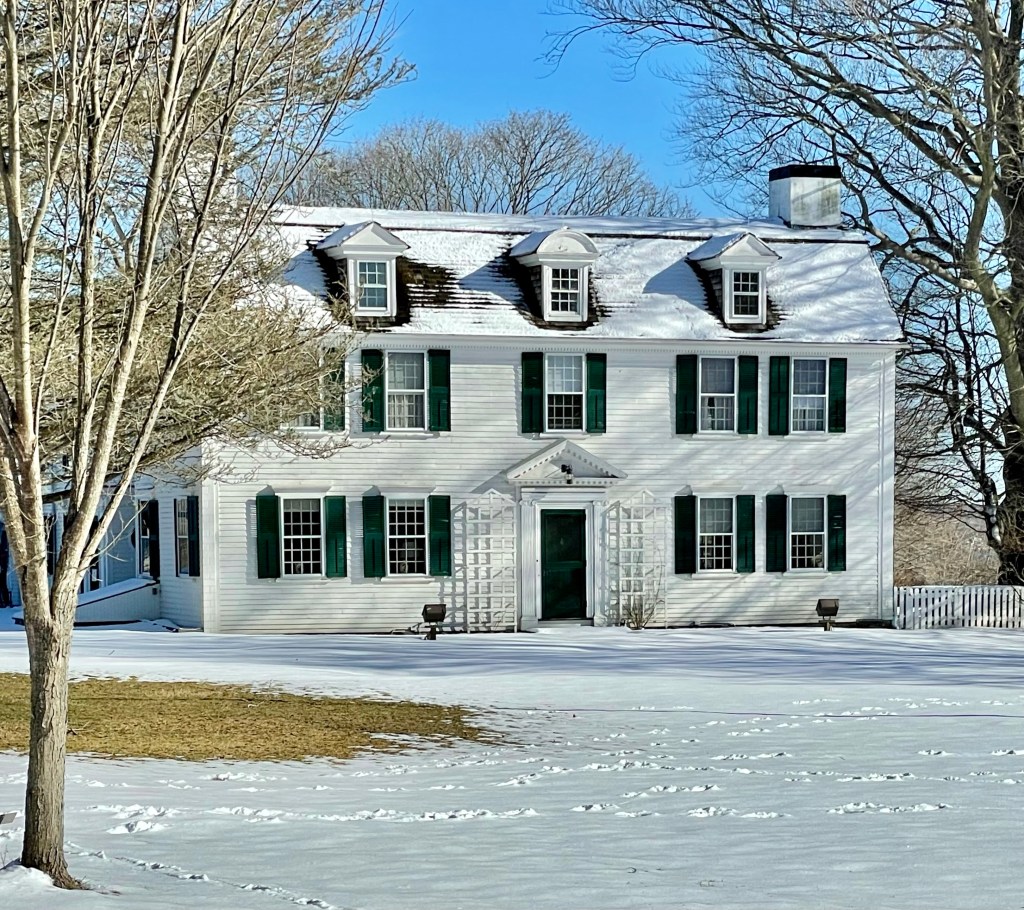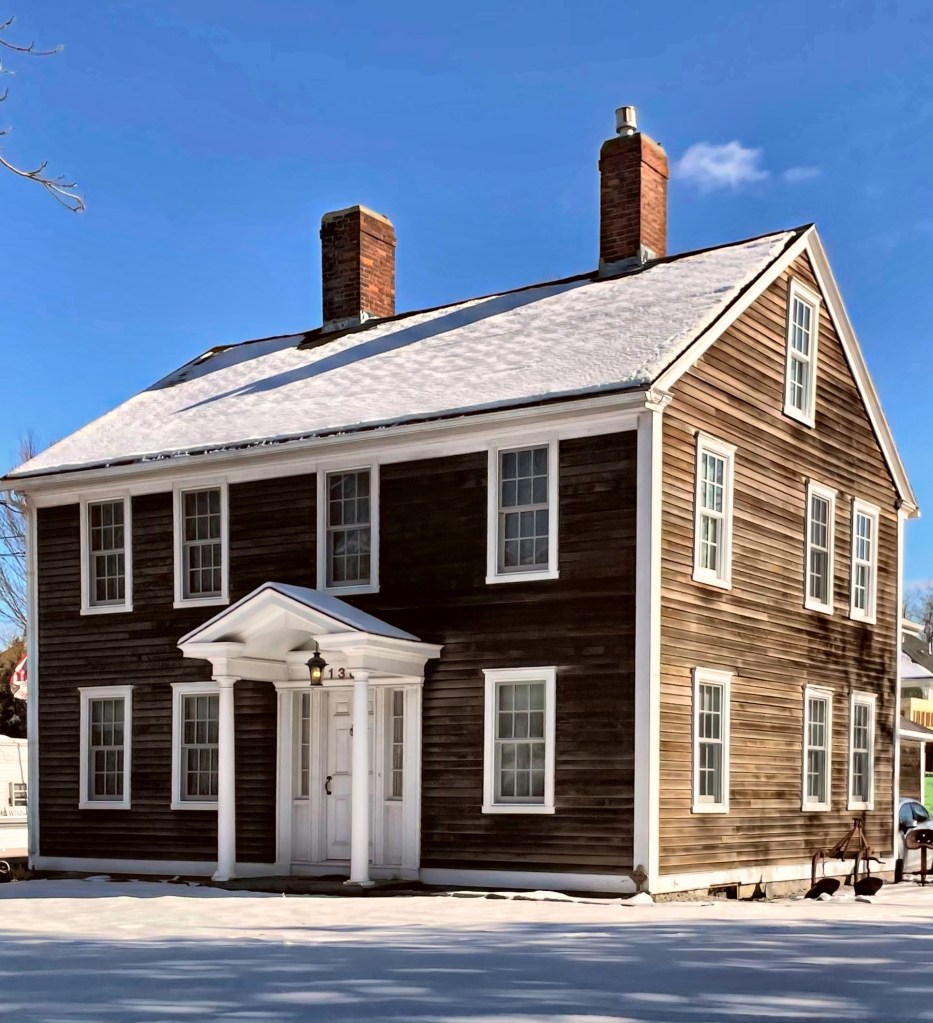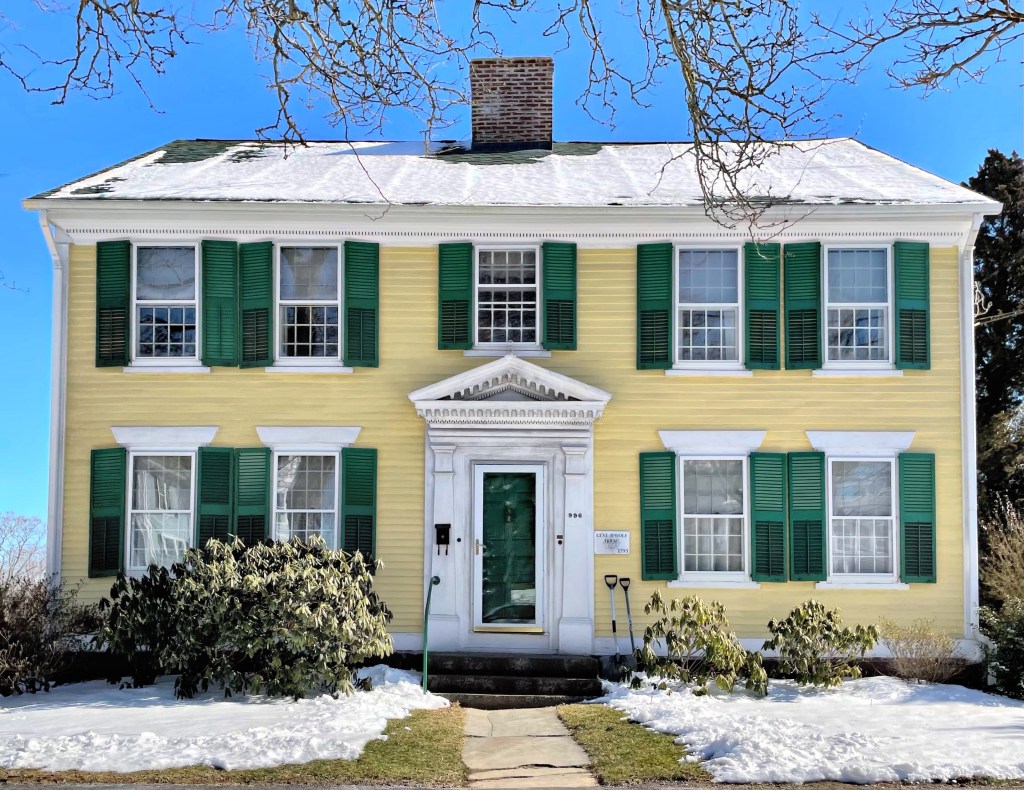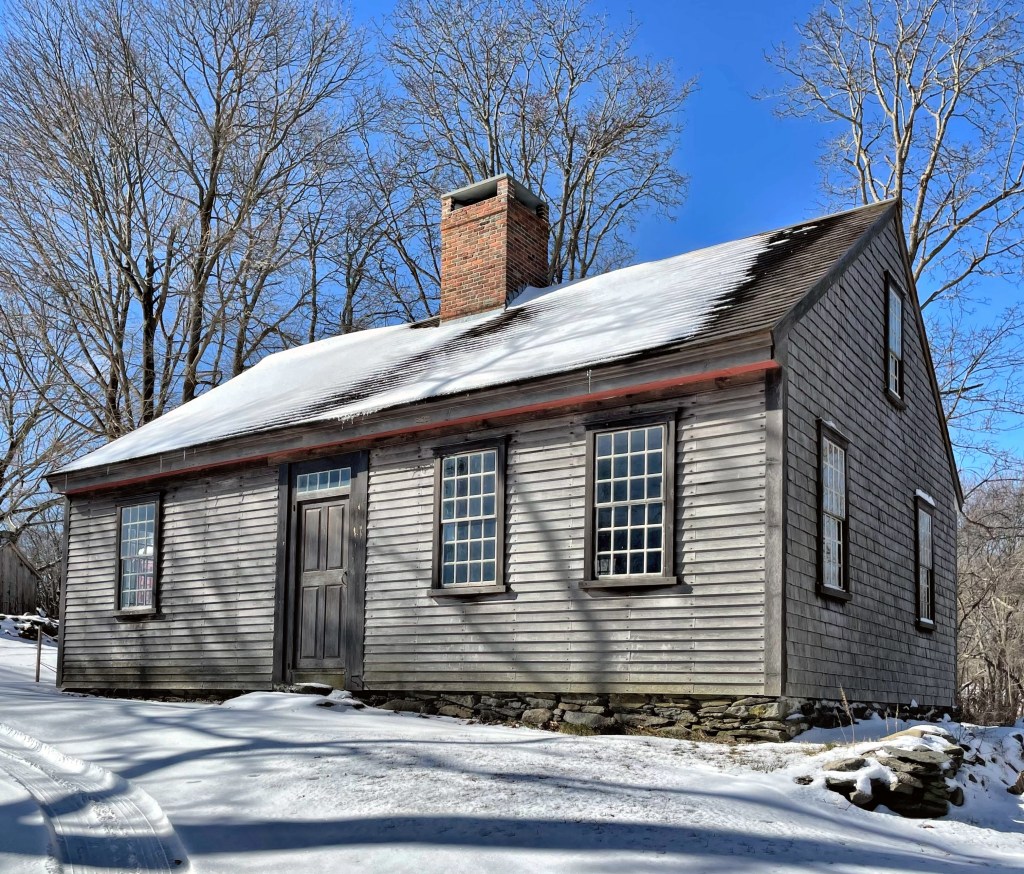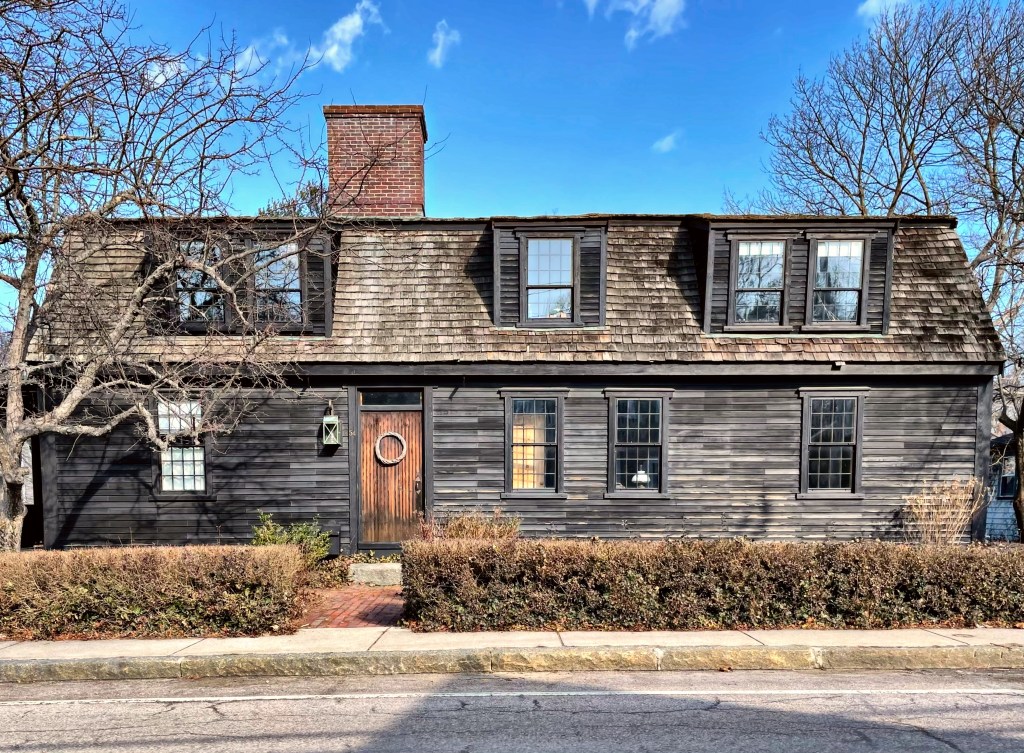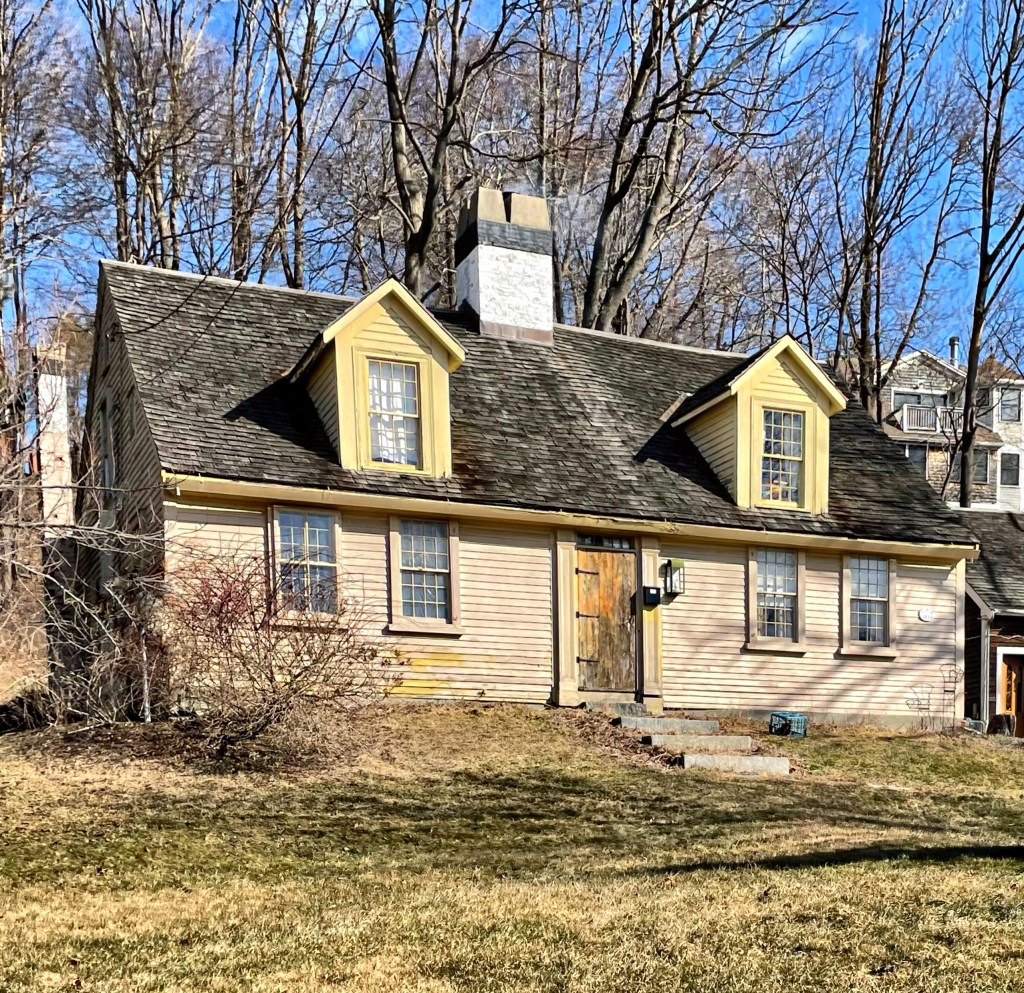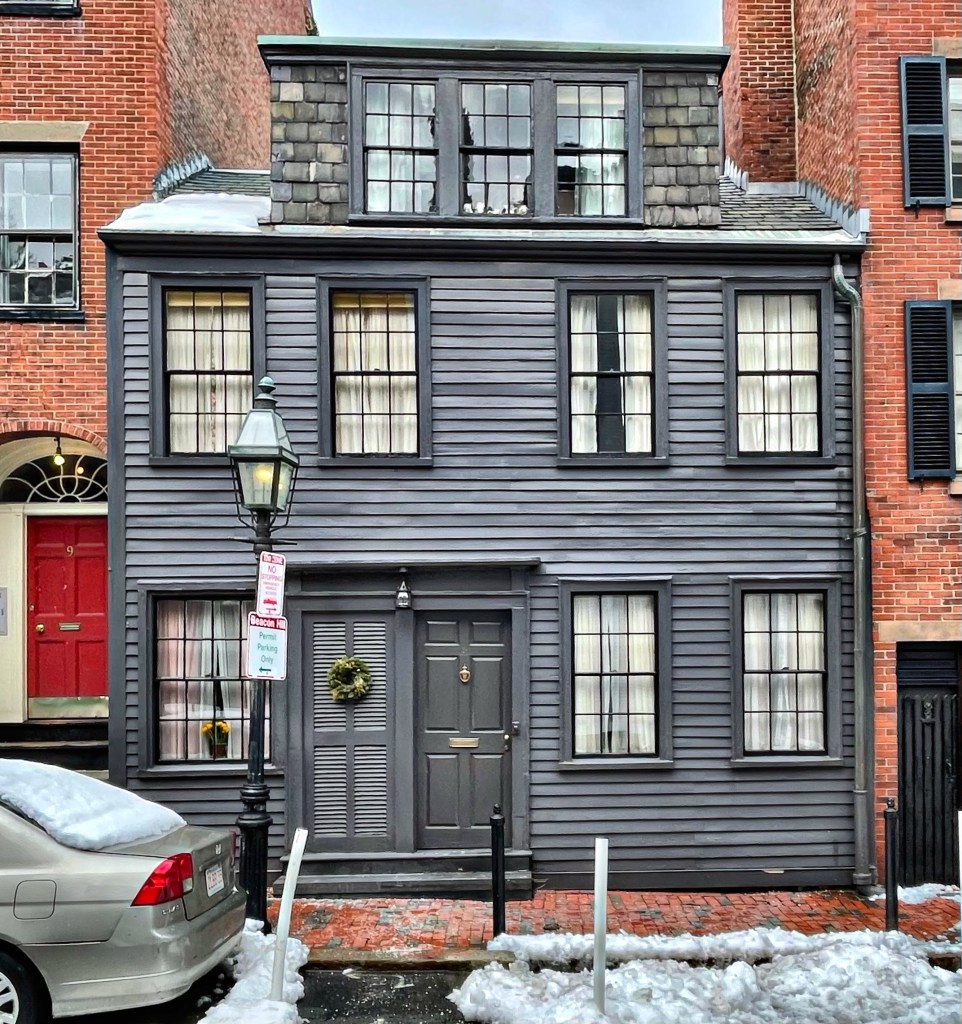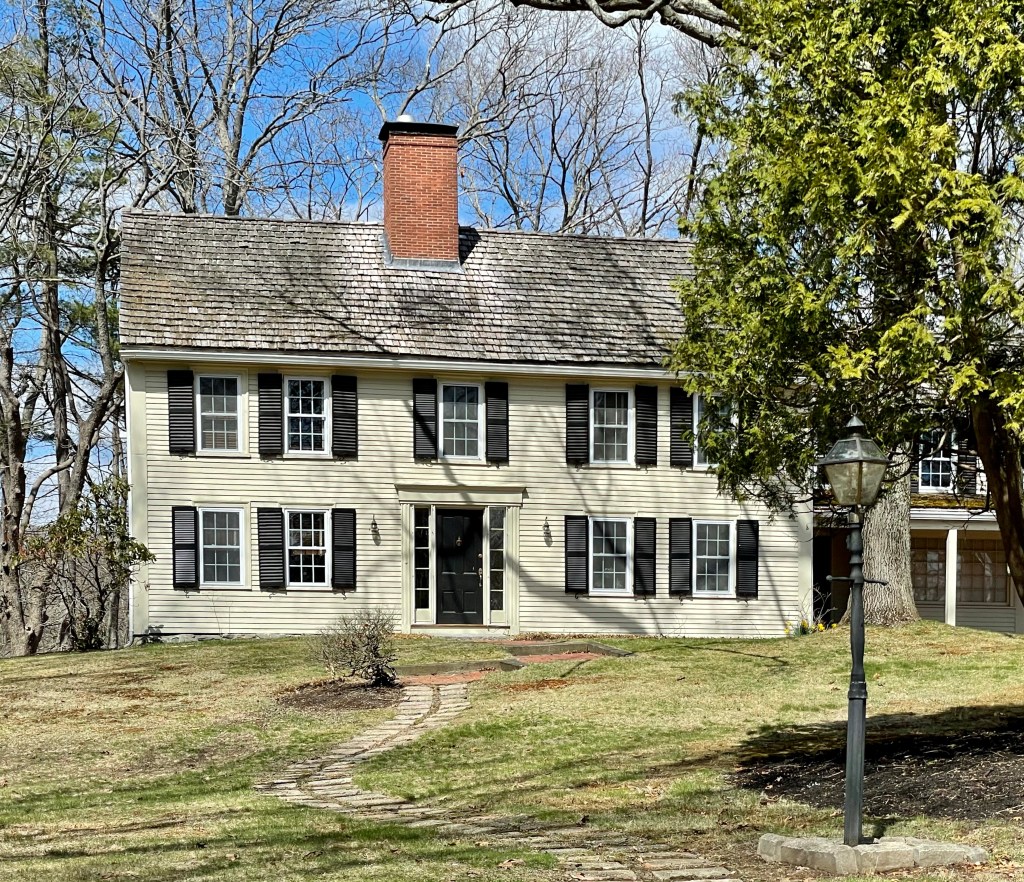
This gambreled Georgian cape house was built around 1744 and first occupied as a tavern. Local tradition holds that in this house, the town officials held meetings and managed governmental duties. After the Revolution, a new town hall was built and the tavern reverted back to its former use. It was occupied by Samuel and Olive Lovell until Olive’s death in the 1840s, she possibly ran the tavern alone for the thirty years she outlived her husband. The home is an excellent example of a pre-Revolutionary Georgian home, with a cedar shingle roof to top it all off!
One of the most stunning Georgian cape homes I have seen is this charming house in Hull, Massachusetts. Built in the mid-18th century, this house was acquired by Gideon Tirrell after the Revolutionary War. Gideon married Mary Loring, a descendant of John Loring, who built the home in my last post. The family appears to have occupied the home until the Cobb family acquired the house in about 1860, when Capt. Joseph Cobb and his wife, Eliza Turner settled here. He was the third “Keeper of the Lifeboat” from 1858-1876. In his role, he rowed out to sinking ships in the Boston Harbor and attempted to save any sailors still alive, often saving dozens of lives. The home was restored in the 1980s and remains one of the best-preserved in the town!
Likely the oldest home in the town of Hull, the Loring House has ties to the significant Loring Family, who’s descendants include individuals on both sides of the American Revolution, the US Civil War, and today live across North America, Spain, England and Australia. This house was built on land purchased by Thomas Loring (1600-1661) who came to Hingham in 1634 from England. He built a larger estate in town until a fire destroyed all his belongings, and he chose not to rebuild, but acquired property in the adjoining plantation of Hull. In Hull, he served as constable (court officer and tax collector), and raised his family there. His eldest son, John, married in 1657 and likely had this home built on his father’s vast land holdings within the year. John worked as a house-wright and likely built the home himself. He had two wives (his first wife Mary died at 39), and 15 children at the home, though some likely did not live past infancy as was common in early colonial days. John died in 1714, but left a lasting legacy in New England and beyond. Notably, his grandson was Joshua Loring, a British Loyalist who built the famous Loring-Greenough House in Boston. The old Loring House in Hull is very-well maintained inside and out and serves as a time-capsule of days past.
George Middleton and Louis Glapion built this two-family residence in Boston’s Beacon Hill neighborhood in 1787, which is now the oldest extant home on Beacon Hill. This wood structure is a typical example of late 18th century Boston homes built by African Americans. Louis Glapion worked as a hairdresser and may have been from the French West Indies. Glapion lived and ran his business out of 5 Pinckney Street until his death in 1813. His wife Lucy continued to live there until 1832. George Middleton was a “horse breaker” (horse trainer) by trade and was adored in the diverse community of Beacon Hill. Middleton was one of 5,000 African Americans to serve in the military on the Patriot side of the Revolutionary War, leading an all-Black militia called the Bucks of America. The group is believed to have guarded the property of Boston merchants during the Revolution. After the war, he became the third Grand Master of the African Lodge, later known as the Prince Hall Masons. In 1796, Middleton founded the African Benevolent Society, which helped orphans and widows through job placement and financial relief. He died in 1815, outliving his wife and apparently left no children when he died in 1815.
Located adjacent to the Washington Town Green, the Faxon House exemplifies the Georgian architectural style seen in small towns all over the region. The home was built in the early 1790s by a member of the Faxon family. By the early 19th century, the home was owned by Azariah Faxon a storekeeper and the schoolmaster at the District #1 School, which at that time was located between the Town Hall and the Congregational Church in the center of town before being replaced with a larger structure. In 1793, an eight-year-old Sylvanus Thayer moved up to Washington from his family home in Braintree, Massachusetts, to live with his uncle, attending school where he was a teacher. While there, impressionable Sylvanus met Benjamin Pierce, father of future President Franklin Pierce. Both General Pierce and Sylvanus’ Uncle Azaria, who had fought in the Revolutionary War, fed Sylvanus’ growing fascination with military matters, including the dazzling campaigns of Napoleon Bonaparte. Sylvanus later attended nearby Dartmouth College, and went on to become “the Father of West Point” as an early superintendent of the United States Military Academy at West Point and an early advocate of engineering education in the United States.
The Washington Town Hall, originally raised as a meetinghouse in 1787, is the civic and visual focal point of Washington Center in New Hampshire. Land here was first granted in 1735 by Colonial Governor Jonathan Belcher of Massachusetts. The town was one of the fort towns designated to protect the colonies from attack by Native peoples, and it was named “Monadnock Number 8”. The first permanent settlers arrived in 1768 and built log houses. By 1773, the community had 132 inhabitants. On December 13, 1776, the newly established American revolutionary government incorporated the town as “Washington”, after George Washington — one of the first named in his honor. A small townhouse was built but was replaced a decade later with what we see today. The current structure was originally a simple, two-story clapboarded structure, with east and west porches. The tower and belfry rising from the end were added in 1820. The building committee specified all details of the meeting house, including “that the windows should be glazed with squares of glass, seven by nine inches, forty panes to the window”. This attention to detail shows how the meeting house would be a source of pride for the new town and all details were to be discussed to the smallest detail.
The Mission House, erected by the Reverend John Sergeant in 1739 on Prospect Hill in Stockbridge, Massachusetts, is an excellent and little-altered example of Georgian architecture as constructed on the New England frontier. The home is a lasting remnant of early missionary efforts toward the local Mohican tribe. Reverend John Sergeant, the first missionary to the Housatonic Indians, moved to Stockbridge and preached to the native people here and at the Congregational Church. Sergeant and his wife Abigail moved to town, but she had made it clear that she wished to live on the hill, away from the village and the native people. Sergeant then built this home, a spacious and distinguished house for its frontier location. Though covered in part by a grant from the General Court, the cost of constructing such a house must have been a severe strain on Sergeant’s slender financial resources, as his salary at that time was 100 pounds per year. The home remained in the family until the 19th century. In 1928, long unoccupied and badly in need of repair, the house was purchased by Miss Mabel Choate, daughter of noted lawyer and former Ambassador to Great Britain, Joseph H. Choate. The house was taken down piece by piece, moved and reconstructed, on Main Street, in its current location. The Mission House was furnished with pieces appropriate to Sergeant’s economic status and his wife’s taste, many of them dating from the 1750’s or earlier. Since 1948, the home has been owned by the Trustees of Reservations.
Colonial-era one-room schoolhouses once dominated the landscape of New England, providing a learning space for young children. The number of these structures have plummeted due to changing development patterns and limited funding to preserve or adaptively reuse such buildings. In the town of Brookline, this c.1768 schoolhouse has been altered frequently, showing various styles and techniques in construction used during the eighteenth, nineteenth, and twentieth centuries. The original one-room school house was enlarged in 1840 by an addition to the rear to fit additional pupils. In 1847 a shed was built for storing coal or wood and providing an entry vestibule. According to town records, in 1855 the ceiling in the schoolroom was raised, the windows enlarged, and the desks and chairs repaired. The double privy was built around 1898, probably replacing an earlier single privy. There is some evidence that in 1938 the school was used temporarily as a Catholic church and at some time following World War II as a synagogue. In 1966, the school was moved from its original site on Grove Street to its present location at Larz Anderson Park for the future preservation of the building by the town and local historical society. The schoolhouse is normally open for tours at various points during the year or by appointment.
This cute little Georgian home in Brookline was built around 1772 for Hannah Winchester Harris, a widow at the time. Hannah’s husband, Timothy died in 1772 and it appears the widow had this small gambrel-roofed home constructed sometime soon after. Ms. Harris died in 1805 and the home was occupied by a new family, who added the saltbox addition. The home is today owned by the Town of Brookline, who maintain the building through the Brookline Historical Society. the home sits on the boundary of the old Weld Estate.
This house on a prominent lot opposite the Town Green in Hollis, NH, was constructed in 1794 for Reverend Eli Smith (1760-1847). In 1794, Rev. Smith married Ama Emerson, the daughter of Rev. Daniel Emerson, then the minister of the Congregational Church in Hollis. After Rev. Emerson’s death, Eli Smith took over the church and became the second minister of the town. Eli’s brother Andrew, a skilled carpenter, is said to have built the stunning Georgian house. After his death in 1847, the property was subdivided and another home was constructed, likely for a member of the family, while Joseph Emerson, one of Eli’s sons lived in the former family home. It remains one of the best-preserved late 18th century homes in the area.