Cheesman Mansion // 1887

Timothy Matlack Cheesman was born in New York City in 1824, a son of physician, John Cummins Cheesman. Following in the footsteps of his father, he graduated in 1859 from the College of Physicians and Surgeons, now known as Columbia University Vagelos College of Physicians and Surgeons. Timothy served as Surgeon in the 7th Regiment NY National Guard in 1853 and upon the start of the Civil War, he mustered into US service April of 1861 as a Surgeon. In the late 1880s, like many other wealthy New Yorkers, Dr. Cheesman and his wife, Maria, decided to build a country home in Ridgefield, Connecticut. They chose nearly 30 acres on the east side of East Ridge, an area that was being touted as “Prospect Ridge” for its view. Dr. Cheesman was ill with Bright’s disease and and may have been seeking the clean air of the country climate to help his health or at least as a place to rest. Sadly, he died one year later in 1888, and did not get to fully enjoy his country retreat. He was 63 years old. His widow Maria continued to use Matlack (the house’s name) until her death in 1903. In 1922, the estate was acquired by the Holy Ghost Fathers, who set up a school for new members of the order who would get their initial training to be priests or brothers there. Declining membership and costs required them to sell the campus, which was acquired by the Town of Ridgefield in 1971. Matlack is now the centerpiece of a large housing complex for the elderly in town and is managed by the local housing authority.

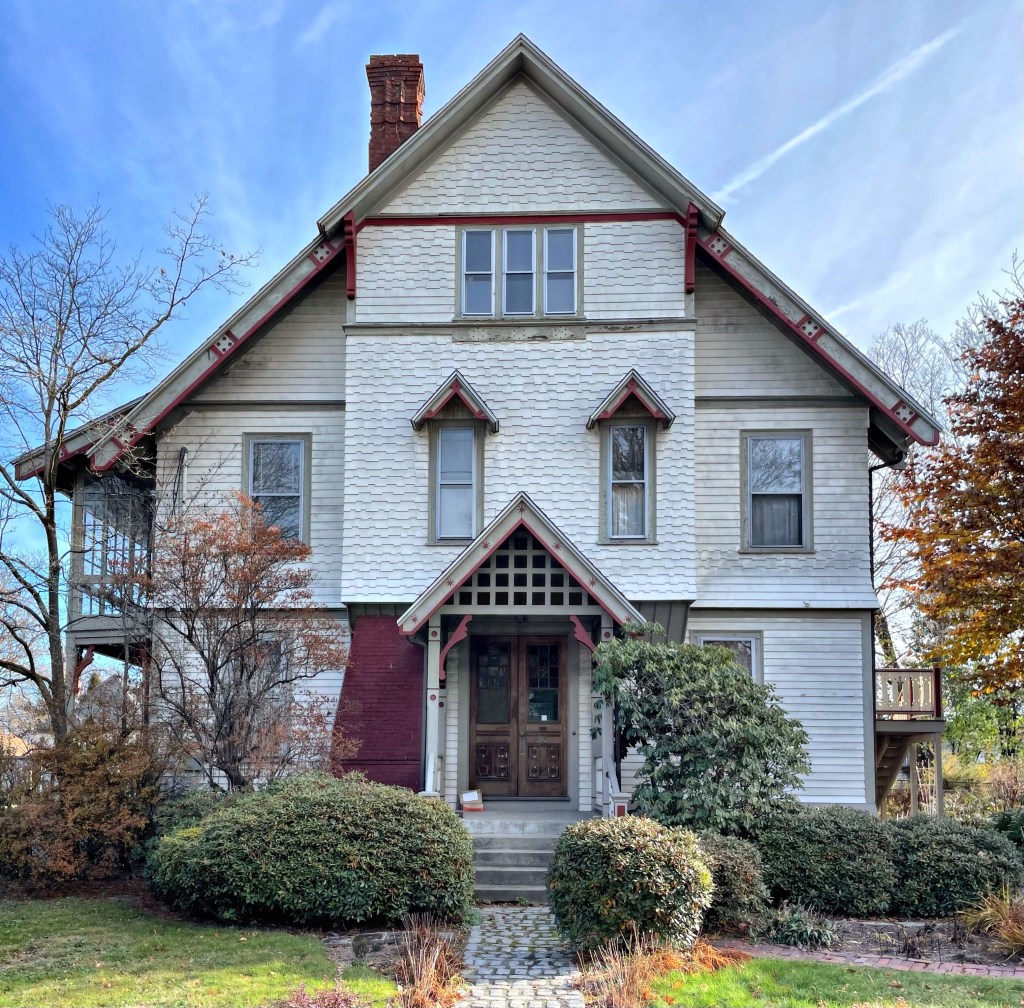
Ashton Croft Mansion and Carriage House // c.1892

Tucked behind the Jesse Lee Memorial Church on Main Street in Ridgefield, you will find this stately Queen Anne/Tudor Revival estate. The ‘Ashton Croft’ Manor House, now called Wesley Hall, is part of the Jesse Lee Memorial United Methodist Church complex and it has been modified several times blending two distinct styles into a single, pleasing composition. This house was originally constructed by Henry and Elizabeth Hawley circa 1892 in the Queen Anne style. The house was later sold to Electa Matilda Ziegler, a wealthy New York City widow in 1912, who reconfigured the structure to include half-timbering on the gables and upper story walls in the Tudor Revival style. She spent summers at a mansion in Darien, Connecticut, and would sell her Ridgefield property to Sanford H.E. Freund, a New York City attorney. The local order of Odd Fellows bought the estate from the Freund family in 1956. Three years later, the organization sold most of the property — retaining the carriage house for its lodge — to Jesse Lee Methodist Church, which planned to eventually build a new church there to replace the old one at Main and Catoonah Streets. Today, the entire former Ashton Croft estate is owned by the local Methodist Church and is known as Wesley Hall.

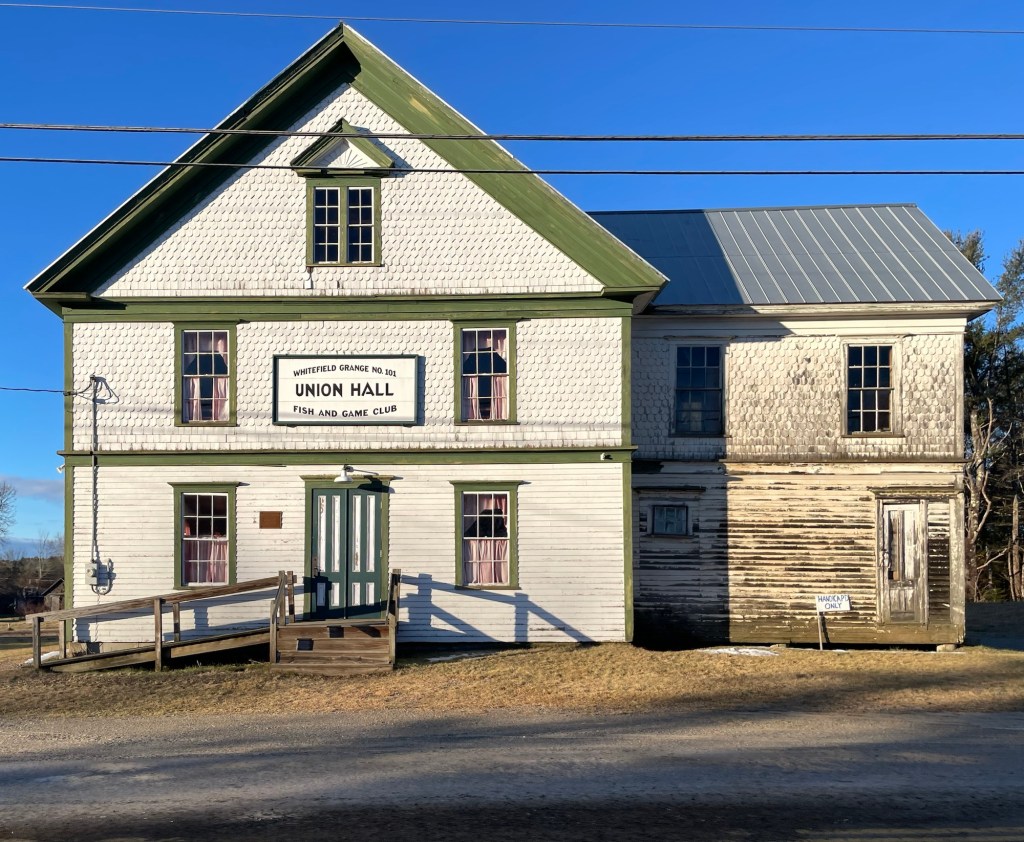
Whitefield Union Hall // 1900

Finding a Grange Hall in Maine are almost as common as finding an old church, they are everywhere! Located the next town over from Jefferson, Maine’s Willow Grange Hall, the town of Whitefield has an equally charming example. The National Grange of the Order of Patrons of Husbandry was established in 1867 to advance methods of agriculture, as well as to promote the social and economic needs of farmers in the United States. Communities all over built grange halls where farmers and residents could meet and discuss prices, trade, and share tips for larger crop yields. The Whitefield Union Hall was built in 1900, primarily under the auspices of the Whitefield Fish and Game Club, but with design input from the local Grange chapter, which contributed funds to its construction and was also a tenant. It was until 1919 the only public hall with a stage in southern Whitefield, playing host to dances, meetings of fraternal and social organizations, and other community events. The hall was managed by an association of the two organizations until 1947, and by the Fish and Game Club after the Grange chapter merged with another in 1969. The club closed down in 1974, and the hall is now managed by a union consortium of village community groups. The building is listed on the National Register of Historic Places.

Stephen S. Albro House // 1876

Stephen Stedman Albro (1817-1895) was born in Newport, Rhode Island, the son of James and Rhoda Albro. After attending local schools, he entered into a mason’s trade, eventually starting his own contracting business. He split his time as a contractor and as a Deacon of a local Baptist Church. He was engaged in local politics, serving as a alderman for Newport and even was a director of the National Exchange Bank in Newport for some years. He built this home on Green Street after his marriage to his second wife, Emma, possibly designing and constructing the house himself. The Albro House is a stunning example of a late-Italianate style dwelling with later Queen Anne/Colonial Revival embellishments. This is a special house!

Newport Old Fire Station No.1 // 1885

Central Newport, Rhode Island is best-known for its Colonial and early 19th century architecture, so when a Victorian-era building is spotted, it always stands out! This ornate building was constructed in 1885 as one of a half-dozen fire stations in Newport. This fire station housed one of the nation’s first organized fire companies known as Old Torrent No. 1. It was home to Newport’s first horse drawn steam engine until the steamers were replaced with motor-driven equipment in 1913. Unfortunately, these early model fire trucks weren’t designed to handle the steep incline of Mill Street. So, after 29 years of service, the station was closed and the horses, steamer, and the building were sold in 1915. The building saw numerous uses and deferred maintenance until 1991, when it was restored by local residents. Today, the one-of-a-kind features include original brass fire pole, private roof deck, and a 65 foot lookout tower with views of the Newport Harbor in the distance. It recently sold in 2022 for over $3 Million and is a residence!

Yale University – Warner House // 1887

Originally known as Cloister Hall, this ornate building on Hillhouse Avenue in New Haven, Connecticut is one of the most interesting I have seen. The building was constructed in 1887-8 as a residence hall for members of the Book and Snake, a secret society at Yale University. Architect H. Edwards Ficken designed the ornate brownstone Cloister which was completed in 1888. At the time, it was considered “one of the most picturesque buildings on the Yale campus.” The society added a matching rear addition in 1915, which is a heavier mass, but compliments the original structure. Yale University would eventually acquire the building after the society no longer needed a separate lodging house for members. Today, the building is called Warner House, and Yale does a great job at maintaining this beauty.

Krogman-McManus Mansion // c.1890

Built ca. 1890 for Boston salesman Washington Libby Krogman (1858-1894), one of Boston’s finest Queen Anne style homes can be found in the Clam Point neighborhood of Dorchester. The pronounced sculptural qualities of this residence, together with the juxtaposition of clapboards and patterned shingles, variety of window sizes, and ornamentation place this house squarely within the pantheon of important Queen Anne designs within the city of Boston. Painted in a manner that showcases its sheathing and ornament to great advantage, this well-preserved house is particularly noteworthy for its graceful verandah that encircles a distinctive, round, conically-capped tower at its northeast corner. The home was only occupied by Washington Krogman for less than four years when he died unexpectedly in 1894 at just 35 years of age. The property was deeded to his widow Carrie for a few years before she sold the property to Thomas Francis McManus, a noted naval architect (schooner designer). The home remains one of the finest mansions in Dorchester.

Wales House // 1883

Built in 1883 for a member of the Thomas Wales family, this house in Clam Point, Dorchester, possesses a compact essentially rectangular clapboard and wood shingle-clad form. The architect, John A. Fox, designed the main façade elegantly with an open Stick style porch projecting from the center of the first floor which is enclosed by a steeply-pitched roof. The pitch of the porch roof is echoed in the small and shallow gable-like lintels which are really unique to the area. The treatment makes the facade read somewhat like a face.

Whelen Cottage // c.1891

For the last cottage on Grindstone Neck, I present the stunning Whelen Cottage. Charles S. Whelen (1850-1910), a banker and philanthropist who served as one of the directors of the Gouldsboro Land Improvement Company and as one of several of its stock agents in Philadelphia, purchased a house lot for him and his wife Migonette Violett. The couple did not hire Lindley Johnson, like so many other cottage-holders did, but they worked with esteemed architect Wilson Eyre to design the home. The Whelens were typical of the type of person who chose to summer on Grindstone. While comfortably well off, they were not in a financial position to commission the sort of cottages built on an ever increasing scale in Bar Harbor. The property left the Whelen’s ownership in 1897, and the house was altered and enlarged in 1900. The large porte cochere, porch, and additional rooms added at this time by William Winthrop Kent, an alumni of H. H. Richardson’s office.

Far From The Wolf Cottage // 1891 & 1902

John Godfrey Moore (1847-1899) was born in Steuben, Maine, a small town just east of Mount Desert Island, the son of a ship captain. He moved to New York City at 18 and would become was a wildly successful businessman, financier and Wall Street stock market promoter during the Gilded Age. He gained fame by successfully suing the United States government in 1893, to stop the new income tax Act from coming into effect, delaying it by 20 years. Oh how the rich stay rich… He purchased a 2,000-plus acre estate on the Schoodic Peninsula and formed the Gouldsboro Land Improvement Company, which sought to develop the peninsula into a summer colony that would rival Bar Harbor. As part of this, Moore was a huge reason for Winter Harbor separating from Gouldsboro, to lower his and his neighbors’ property taxes. He built a cottage here in 1891 and named it “Far From The Wolf” a cheeky reference to its comfortable distance from Wall Street. He died unexpectedly in 1899. His second wife Louise and daughters Ruth and Faith did not share his aspirations for Winter Harbor, and their visits to the area became less frequent. A large portion of his land on the Schoodic Peninsula became a part of Acadia National Park. His property in Winter Harbor was sold, expanded in 1902, and renamed “Ingleside” by Frank B. Noyes, a publisher and later founder of the Associated Press. The home was for a time operated as an inn, and was recently sold for $1 Million at auction. What a steal!