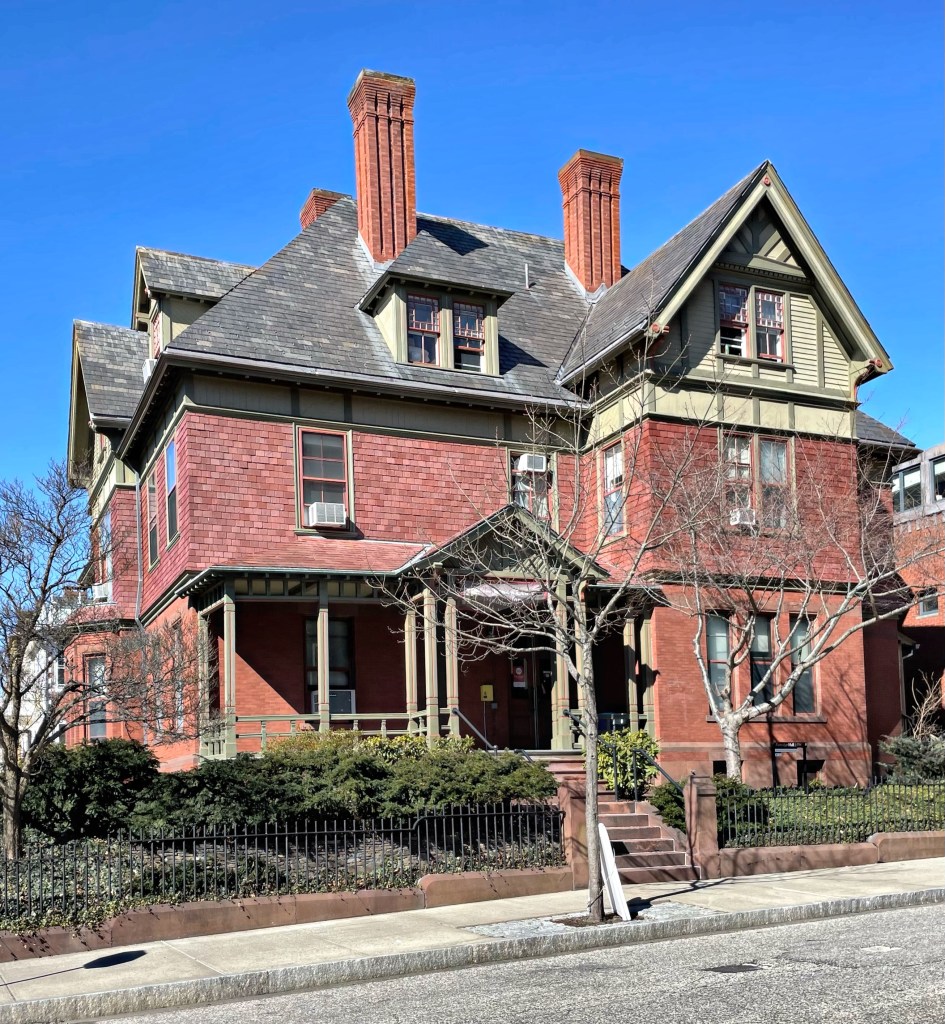
Beckwith House – Partridge Hall // 1882

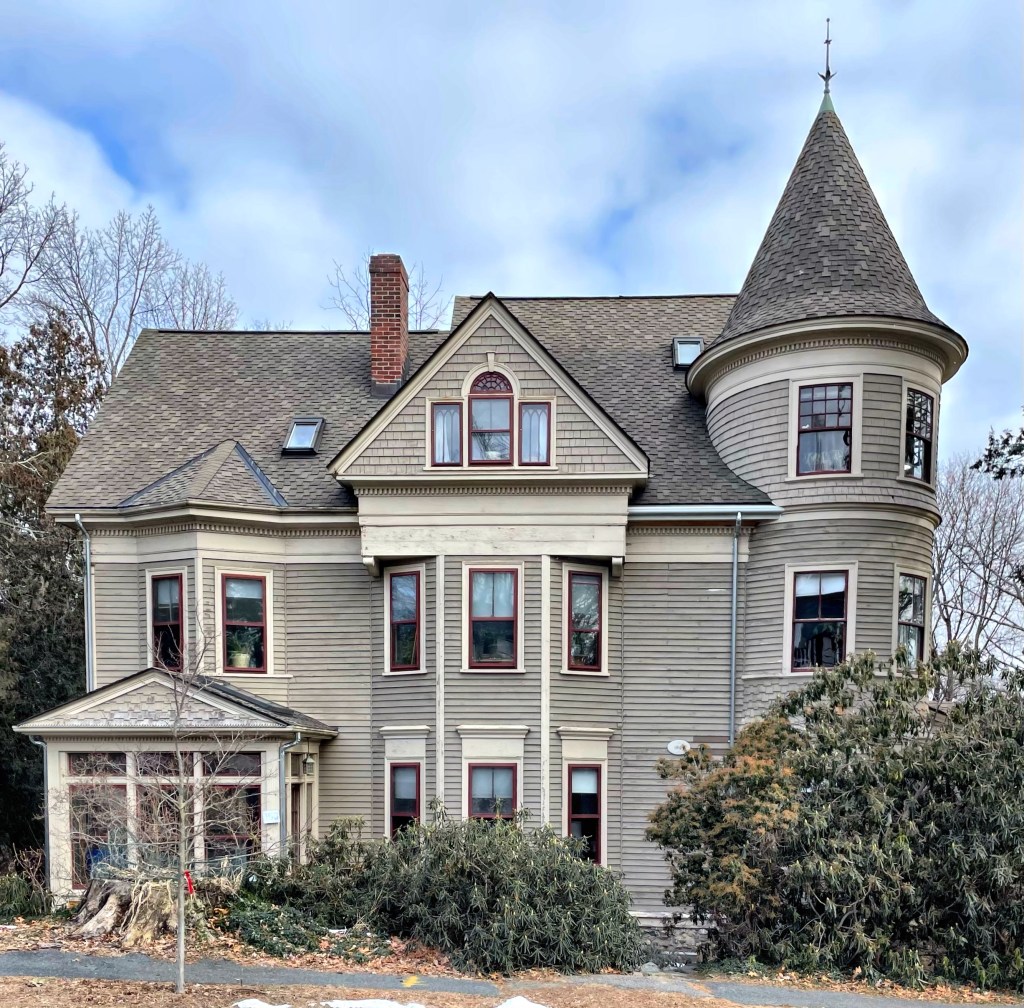
Henry Truman Beckwith (1808-1893) was born in Providence and (of course) enrolled at Brown University. He left school after two years and wished to see the world. He began to work as a cargo clerk aboard ships for a cotton merchant of Macon, Georgia. He traveled between Boston and Calcutta at least twice, bringing aboard novels from American and British authors, spending much of his time reading. Being well-read and without a family of his own (he never married), he devoted much of his time to clubs and organizations including: the Providence Athenaeum, Rhode Island Historical Society, and the Rhode Island Horticultural Society. In the later years of his life, Henry had this Queen Anne style home built in College Hill, on the same block as the Historical Society where he was a member. The Beckwith House was eventually acquired by Brown University and has since been known as Partridge Hall. The building is now home to the Brown Center for Students of Color, an organization that was established after a series of student protests in 1968 and 1975. Amid the civil rights movement of the late 1960s and 1970s, a group of Black students walked out of Brown University in December 1968 in protest of fierce racism on campus. The mission of the Brown Center for Students of Color has evolved over the years, but its current mission statement reads “Visualize. Vocalize. Mobilize”, they remain an integral piece of the campus and provide much-needed space for students of color to build a sense of community on campus.
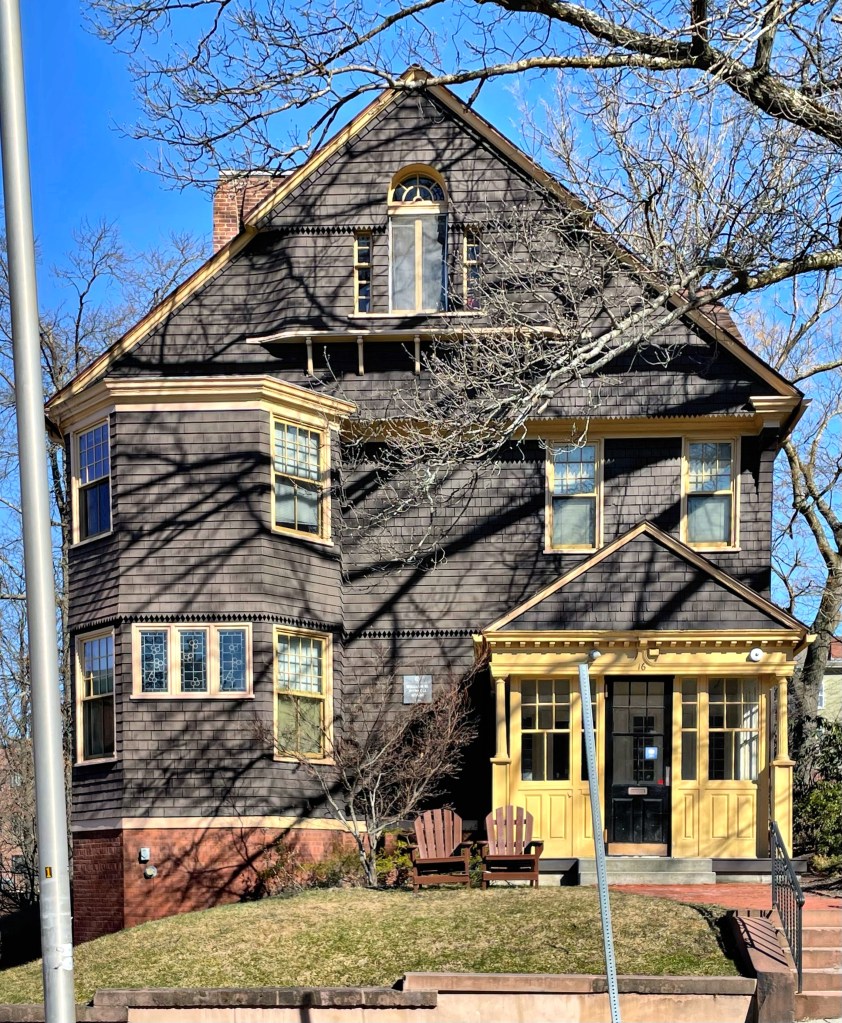
Dunnell House // 1884

William Wanton Dunnell (1850-1933) was born in Pawtucket, Rhode Island and was educated in Rhode Island schools. He eventually helped run his family’s cotton goods business, which grew over the next decades. The Dunnell Finishing Works factory was a success in Apponaug (Warwick) Rhode Island, and he had over 500 employees turning out over 1,000,000 yards of printed cloth a week! Before all this, William had this amazing house built in College Hill, Providence for his family. The local architectural firm of Stone, Carpenter & Willson was hired and blended Shingle, Queen Anne, and Colonial Revival styles elegantly under one roof. I am particularly fond of the sawtooth shingles, Palladian motif windows in the gable, and undulating facade. The house is owned today by RISD.

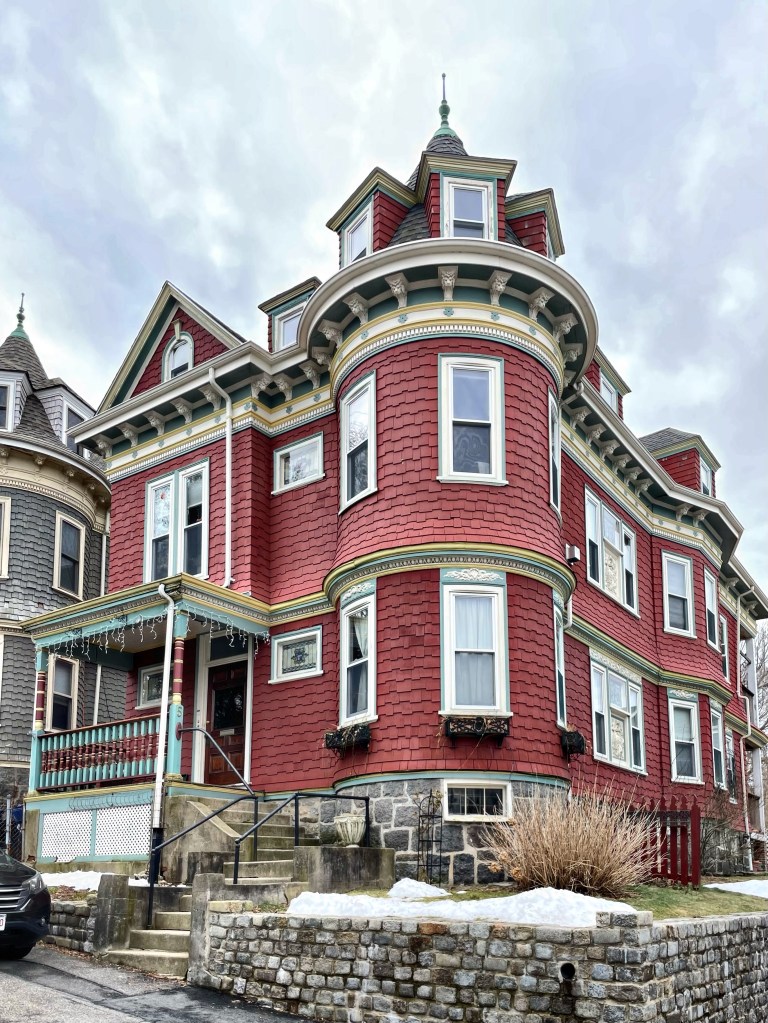
Emmel Rental Houses // 1896

Tucked behind the massive Emmel Building (last post), you will find these two charming houses on the dead-end street in Jamaica Plain, Boston. Like the Emmel Building, these two homes were built by Charles Emmel, an architectural sculptor and real estate investor, who hired local architect George Zimmer to furnish plans for the buildings. The two transitional Queen Anne houses feature some of Emmel’s architectural decoration, from the lion’s head corbels to the decorative lintels above the windows, these homes really stand out!

Stetson House // 1897

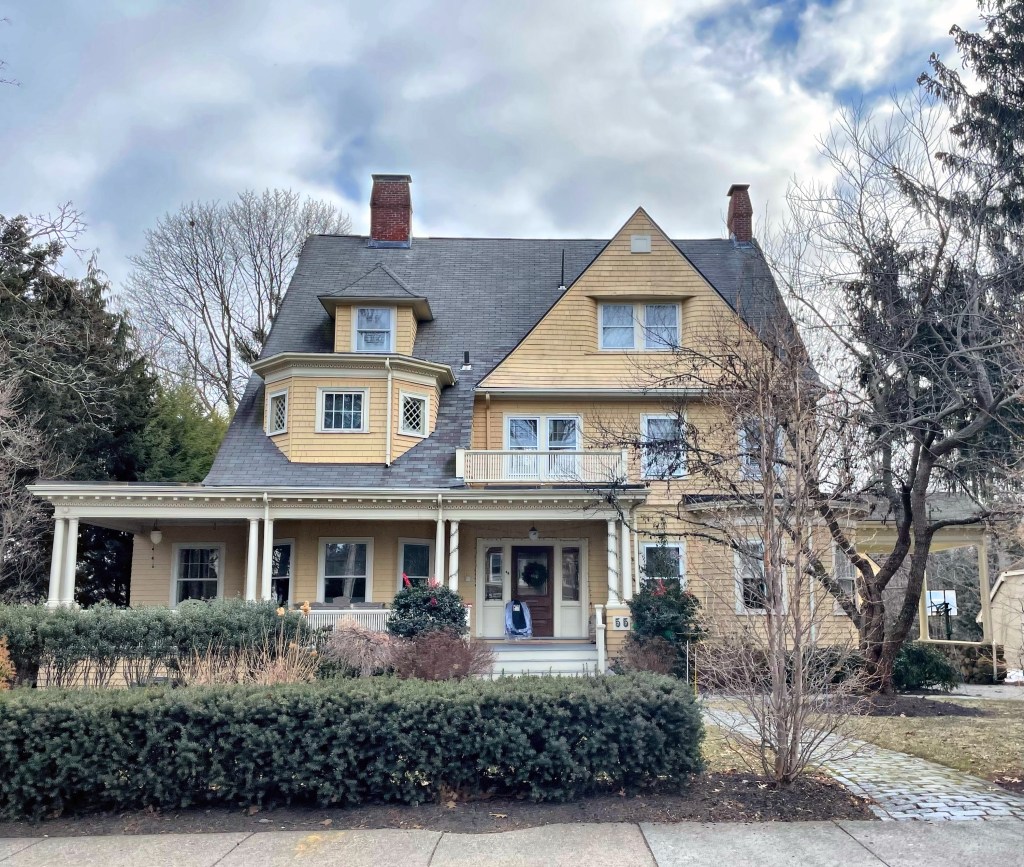
Waban is full of eclectic homes from the end of the 19th century, and this example is probably my favorite! The Herbert and Georgia Stetson House was built in 1897 and demonstrates how elements of the Colonial Revival style were incorporated into a less rigid Queen Anne style plan. Herbert was a lumber dealer, and likely used his own product in his home. The mixture of ornament includes Colonial
Revival style pedimented dormers, a Palladian motif window, oval windows, and a modillion cornice in combination with bays, oriels, a dramatically overshot gable roof, and a swept dormer reminiscent of the Queen Anne style. Together, the composition is perfection, and really makes you stop and analyze all the details!

Hovey House // 1897

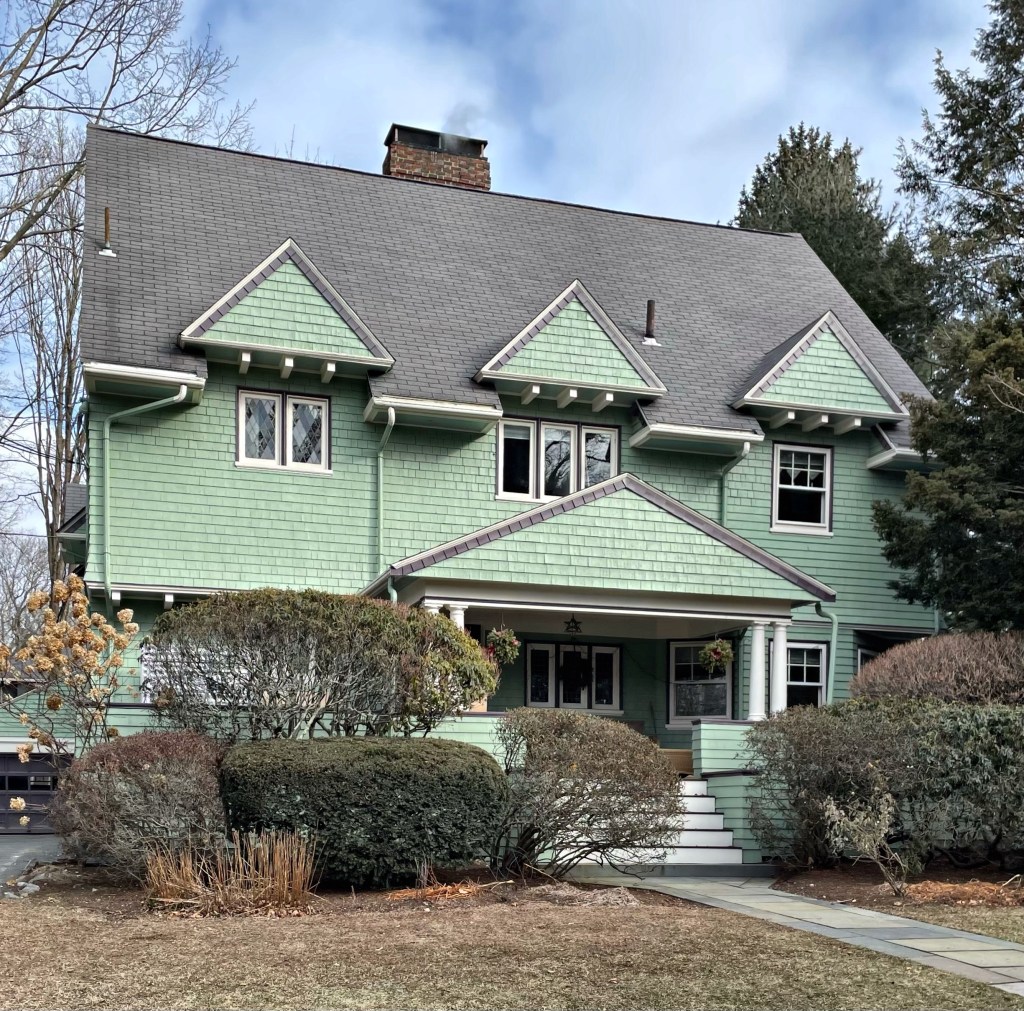
In 1897, tailor Charles L. Hovey and his wife Bertha, had this house in Waban built for their family. The architecture really stands out as an eclectic blending of styles, common at the end of the 19th century, when architects and builders would design homes to exhibit architectural details from multiple styles, all under one roof. The shingled house has a steep gable roof and three gabled dormers, which reflects Queen Anne theme. The diamond-pane windows and the technique of cantilevered dormers and the second floor overhanging the first, is First Period-Medieval in style, a unique interpretation of American architecture. What do you think of this home?

Louis K. Harlow House // 1888

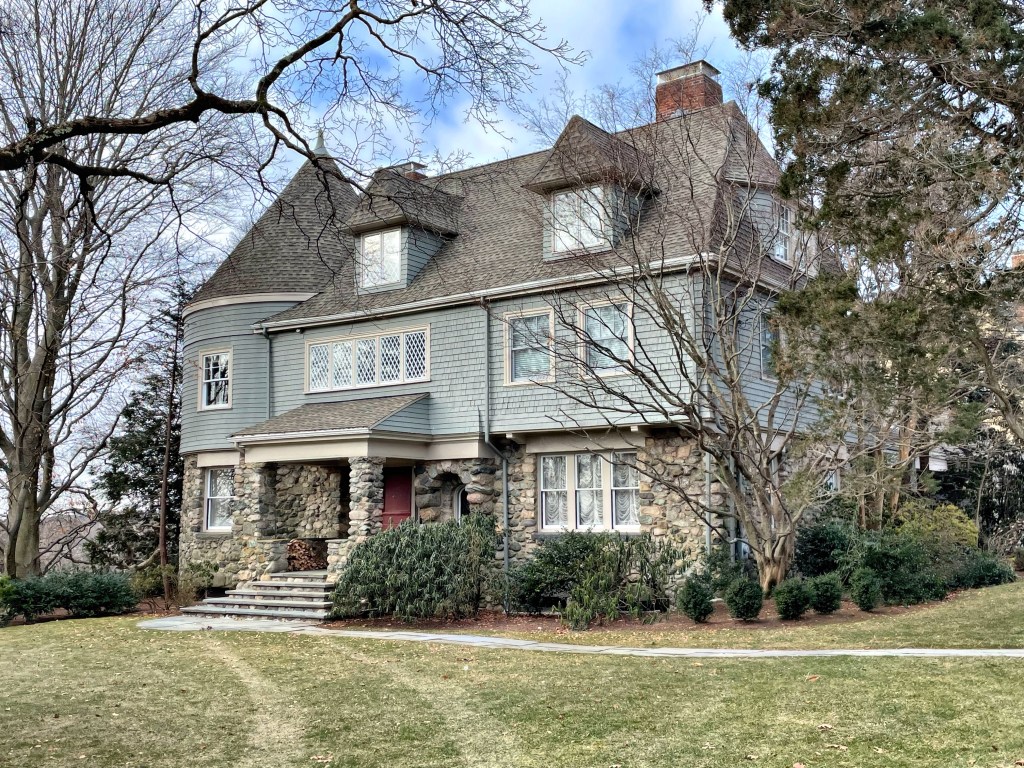
One of the best houses in Waban Village in Newton is this absolutely stunning Shingle style/Queen Anne home perched high on Moffat Hill. This house was built in 1888 for Louis K. Harlow, who began his career as a professional artist in 1880 and traveled Europe to study the work of prominent painters. Back in the Boston area, Harlow painted nature and landscapes and produced etchings that were shown in the Boston Art Club and sold worldwide. He later got into poetry and published multiple works. Harlow hired the firm of Longfellow, Alden, and Harlow, to design this country retreat. I assume there is a relation between Louis K. and the architect Alfred Branch Harlow, but I would love to find out the connection! The design is quintessentially Queen Anne, with the asymmetry, complex roof form, varied siding types, and diamond window sashes. The shingled second floor overhangs the fieldstone first floor which to me, evokes the Shingle style where the house seems to have grown out from the earth. I can only imagine how spectacular the interior is!

Winfield S. Carr House // 1896

In 1895, Winfield S. Carr (1849-1911) purchased land on Windsor Road for a residence from William S. Strong, a horticulturist and developer of Waban Village. The lot is located at the peak of Moffat Hill, and provided sweeping views of undeveloped farm and marshland and possibly Boston in the distance. As a young man, Carr moved to Fall River from Maine, and was employed in the dry goods business. He eventually moved to Boston and opened up a toy shop, which clearly became a large success. The firm sold fireworks and children’s toys from the downtown location. The Queen Anne style home was occupied by Carr and his wife (they don’t appear to have had children) for less than a decade, when the couple downsized and moved to an apartment on Comm. Ave. in Allston.

Dr. Sarah Crawford House // 1897

Dr. Sarah Marcy Crawford was a graduate of the Woman’s Medical College of the New York Infirmary for Women and Children and long devoted herself to her patients. She eventually settled in the Boston area, working in Roxbury as a physician until she took up a residence in Waban Village of Newton. She worked locally at the New England Hospital for Women and Children and served as a deputy superintendent of the State’s minor wards for the old Massachusetts Board of Charity and was an active member of the Massachusetts Medical Society. She had this eclectic home built for her and her family, but they later relocated to another home in town. The house is a great example of the convergence of architectural styles, common at the end of the 19th century, this one being a blending of Shingle, Queen Anne, and Colonial Revival styles.

Evans-Cummings House // 1855 & 1890

The most iconic house in Norway, Maine has to be the Evans-Cummings House (also known locally as the Gingerbread House) on Main Street. The ornate Victorian era home was originally built in 1855 for Richard Evans, who was born in Portland in 1805 and after training as a carpenter, moved to Norway in 1833 for work. He and his wife, Mary Warren Hill, had eight children and they resided in the home until their death. In 1890, Charles B. Cummings bought the house in 1890 and hired local architect John B. Hazen to remodel the house. Hazen added the gingerbread adornments for which the house is now known colloquially. The home attracted a lot of attention in the region, and the later heirs continued that whimsical appeal. When the home was willed to Fred and Cora Cummings, they were said to have kept a stuffed peacock at the top of the stairs, which delighted children when they toured the home. The house eventually became used as storage by the owners of the local Advertiser Democrat newspaper, and its future was threatened. Since 2012, a local group, Friends of the Gingerbread House, have poured tens of thousands of dollars and an equal amount of time restoring the iconic home to her former glory! Preservation is important!

‘Mountain Aqua’ // c.1882

Located near the base of Pleasant Mountain in Denmark, Maine, you’ll find this stunning Victorian house, possibly the best example of Queen Anne architecture in town. Down the dirt road, you can imagine how shocked I was to stumble upon this beauty set back off the road, overlooking the White Mountains in the distance. The house was built around 1882 for the Warren Family, descendants of one of the first settlers in the town. Caleb Warren Jr., is likely responsible for this house, which served as a base lodge for the hotel once located at the summit. In 1845, Caleb Sr. built the first guesthouse atop the 2,200′ mountain, which was purchased just years later by a Joseph A. Sargent. Sargent converted the old hotel into a bowling alley and built a new hotel at the summit. That structure burned to the ground, and was replaced in 1873. The buildings at the summit were eventually purchased and demolished by 1908 when the mountain was sold to the Appalachian Mountain Club. Mountain Aqua would have served as a base lodge for the mountaintop hotel, and was a place where visitors could depart by foot or wagon to the summit. Mountain Aqua appears to be a single-family home today.