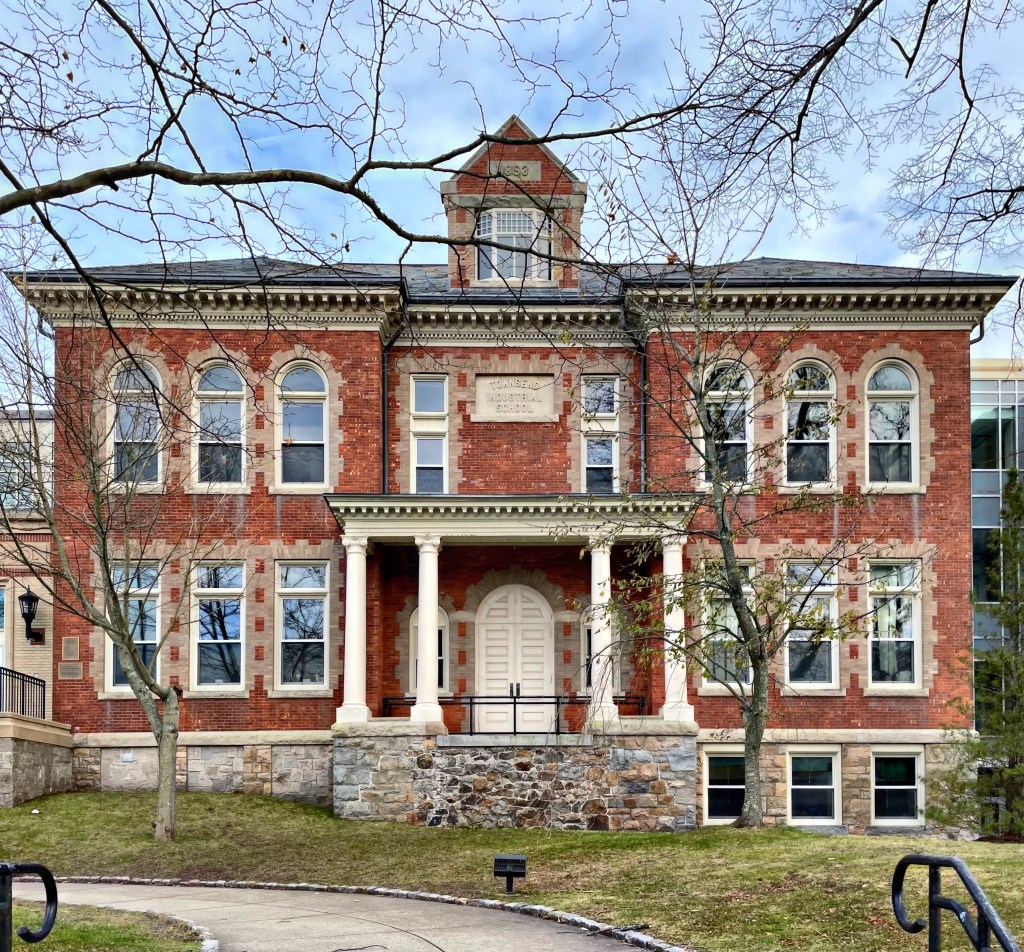
Townsend Industrial School // 1894

Located next to and predating Newport City Hall (a previous post), the Townsend Industrial School building is a great, eclectic Victorian-era building in Newport, that is often overlooked. The school itself evolved from a vocational school for women, that Katherine Prescott Wormeley began in town in 1872. The school taught pupils “not destined for classic education” but taught them skills that they would be able to use in the “real world”. The school was located next to the Rogers High School (demolished in 1957), which provided a more traditional education. The building was designed by Newport architect James C. Fludder and has maintained its stately presence to this day. The building has been acquired by the City of Newport, who added a Post-Modern addition, and it is now known as the Frank E. Thompson Middle School.
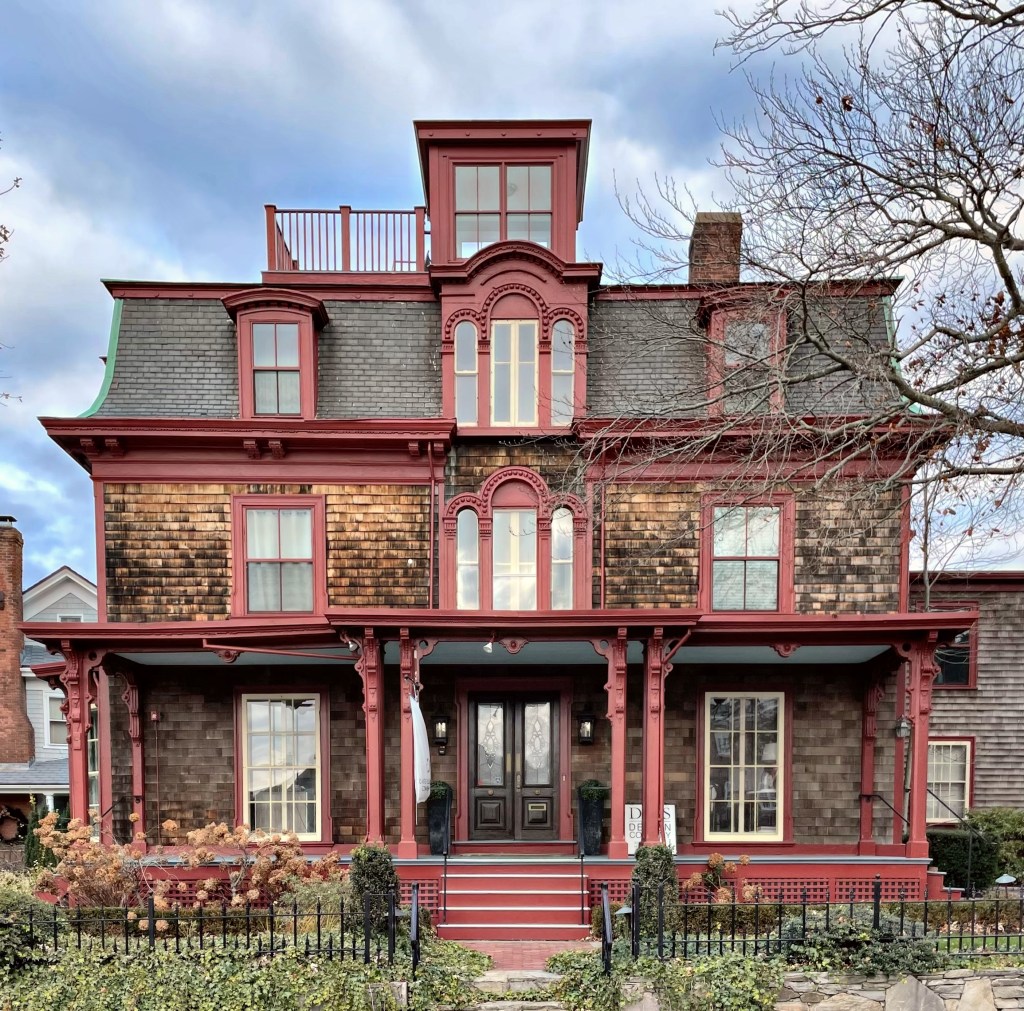
Armington House // c.1863

This beautiful mansard-roofed home in Newport was long the residence of the Armington Family. The history is a little murky, but deed research shows the property was purchased in 1863 by Horace E. Armington, a Boston tailor. Horace likely purchased an earlier home and from it, built this larger, Second Empire style house to serve as a summer retreat. The family eventually settled in Newport full-time and their son, also Horace, took a job as Assistant Librarian at the Redwood Library in town. The family owned the property for generations until it was converted to professional office use, likely due to the commercialization in the 20th century of the main streets in Newport. The house retains much of its original detailing including the rooftop belvedere. The later-added shingle siding adds a rustic touch.

Touro Jewish Cemetery and Gate // 1677

Located just a short walk from the oldest extant Jewish synagogue in the United States, Touro Synagogue (last post), the Touro Jewish Cemetery and stately gate, showcase the significance and position Jewish residents held in Newport, going back to Colonial times. The earliest Jews in Newport arrived from Barbados, where a Jewish community had existed since the 1620s. They were of Spanish and Portuguese origin; their families had migrated from Amsterdam and London to Brazil and then to islands in the Caribbean. After the completion of the synagogue in 1763, the Jewish community in Newport realized the need to acquire land for a Jewish cemetery. Two of the original immigrants, Mordechai Campanal and Moses Pacheco purchased the lot at the corner of what is now Kay and Touro Streets for this purpose. In 1843, the cemetery funded the erection of a cemetery gate and fencing to surround the plot. They hired architect Isaiah Rogers to design the gate, which he took inspiration from his design at Boston’s Granary Burying Ground, completed just two years earlier. The Egyptian Revival gate is a very rare example of the style in the United States. On the granite gate, the torches turned to face downward are an acknowledgement of the ending of life’s flame.

Touro Synagogue // 1763

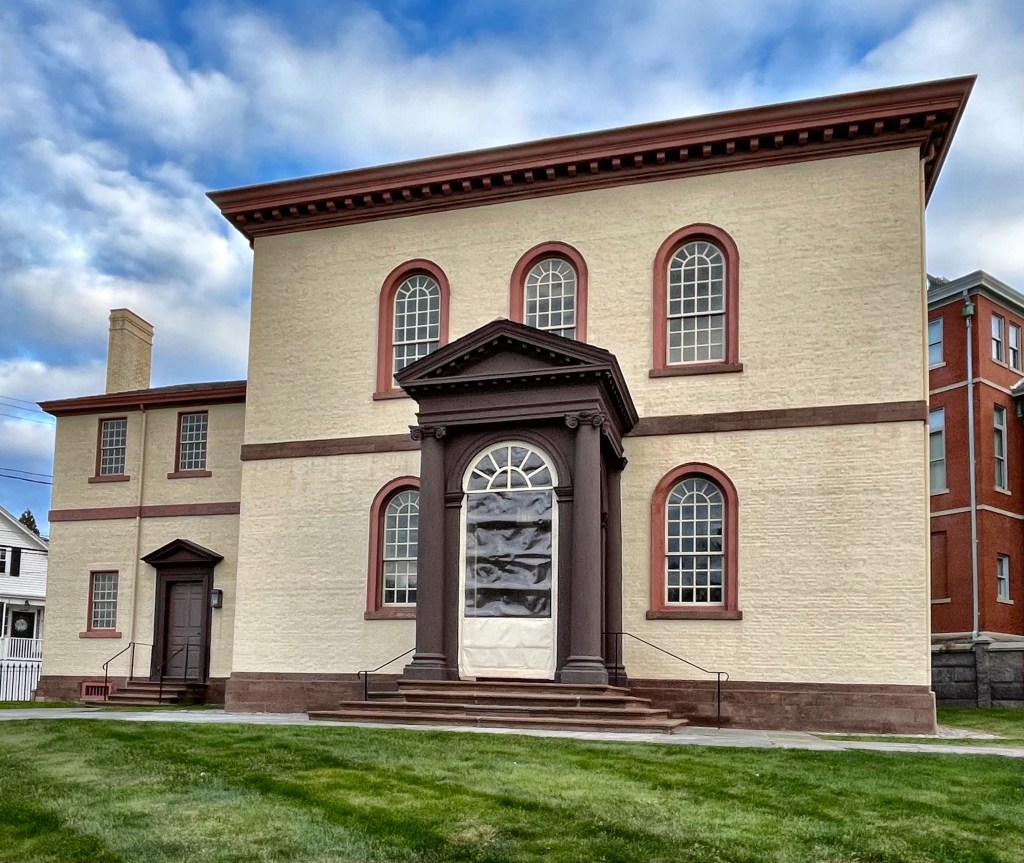
While Newport is arguably best-known for the Newport mansions from the Gilded Age, there are soooo many amazing buildings from the Colonial era, including some of the most significant and historic in the United States. Touro Synagogue in Newport is the oldest synagogue building still standing in the United States, the only surviving synagogue building in the U.S. dating to the colonial era, and the oldest surviving Jewish synagogue building in North America (for reference, second-oldest extant synagogue in North America was built in 1833, seventy years later)! Its history begins in the 17th century when the small but growing colony of Newport received its first Jewish residents possibly as early as 1658. The earliest known Jewish settlers arrived from Barbados, where they participated in the triangular trade along with Dutch and English settlements. By 1758, the Jewish population had grown sufficiently that there was a need for a house of worship. The Congregation now known as Congregation Jeshuat Israel (Salvation of Israel) engaged Newport resident Peter Harrison to design the synagogue. Harrison, a British American merchant and sea captain, who was self-tutored in architecture, studying mostly from books and drawings. By the time he designed Touro Synagogue, he had already completed iconic buildings including Newport’s Redwood Library and King’s Chapel in Boston. Construction began on the “Jews Synagogue” in 1759, which was completed years later in 1763. The building is one of the most significant buildings in America, and is open to tours where you can see the immaculately restored interiors.

Alfred Smith House // c.1843

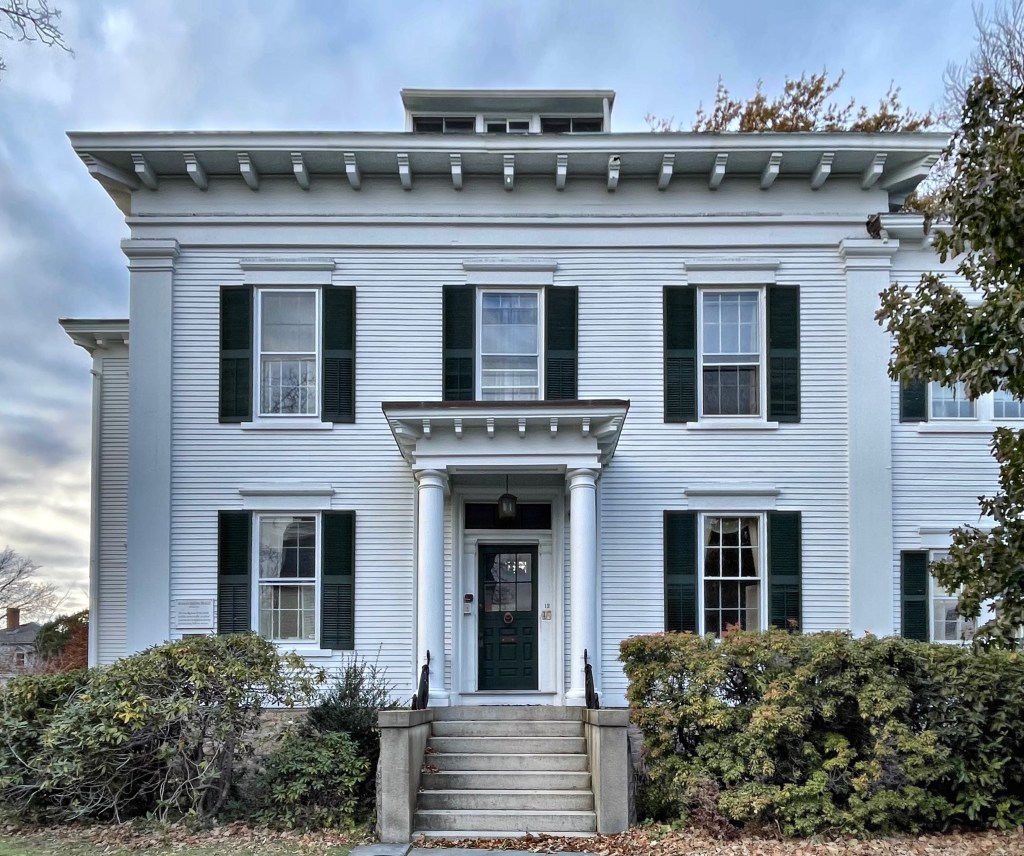
Alfred Smith (1809-1886) was known as “Newport’s Millionaire Real Estate Agent”, working in the mid-late 19th century to get some of America’s most well-connected upper-class acquire properties to build their summer cottages. In his early days, he prospered by assisting prospective developers and buyers to purchase house lots on newly platted streets, including Bellevue Avenue. By the time of his marriage in 1843, he built this stunning Greek Revival mansion, equipped with stunning proportions and corner pilasters. Decades later, to “keep up with the Joneses”, he modernized the house by extending the eaves and adding brackets and the addition of a belvedere at the roof. He was instrumental in much of Newport’s later development, even bankrolling the erection of a stone bridge on Ocean Avenue, to allow carriages and subsequent developable lots to extend in the previously untouched land in south and west Newport. He suffered a stroke in 1886, and died a year later, two years after his late wife. He funded a monument to the family, hiring Augustus St. Gaudens to furnish a stunning memorial “Amor Caritas” which stands in Island Cemetery in Newport. Mr. Smith’s estate was mentioned in the New York Times and stated there was no will, and his four living children would each get upwards of $1 Million (nearly $30 Million a piece based on inflation today)!

Newport City Hall // 1900

Newport, Rhode Island was settled in 1639 from colonists, who took land from the Narragansett people, who had lived on the land for generations. Newport eventually grew to be the largest of the original settlements that later became the Colony of Rhode Island and Providence Plantations. Newport served as the seat of Rhode Island’s government until the current Rhode Island State House in Providence was completed in 1904. Newport was a major center of the slave trade in colonial and early America, active in the “triangle trade” in which slave-produced sugar and molasses from the Caribbean were carried to Rhode Island and distilled into rum that was then carried to West Africa and exchanged for captives. In all, about 60% of slave-trading voyages launched from North America – in some years more than 90% departed from the tiny state, many of which left from Newport. Beginning in the mid-nineteenth century, wealthy southern planters seeking to escape the heat began to build summer cottages. By the end of the 19th century, a large number of America’s elite would build summer “cottages” in the town, transforming much of it to the Gilded Age splendor we see today. Stay tuned for a sampling of Newport buildings.

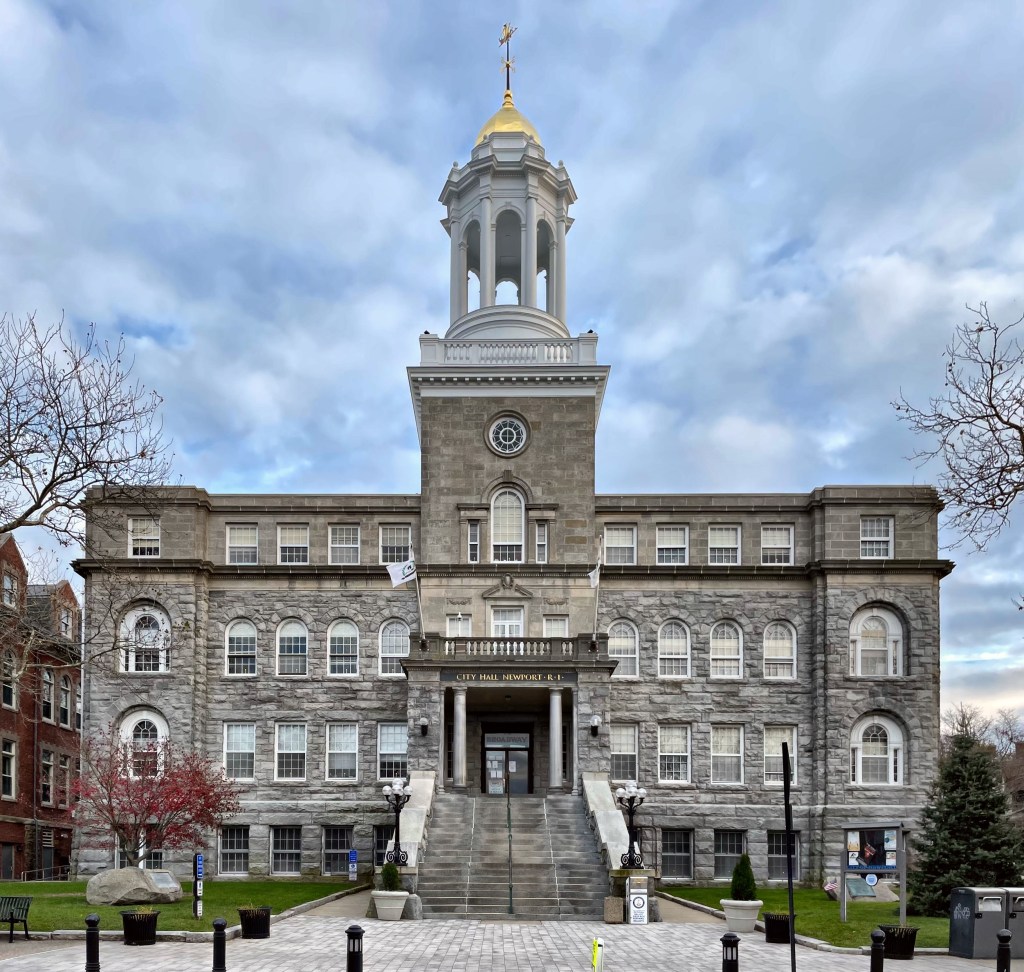
Newport City Hall was completed in 1900 from Newport-based architect and builder John Dixon Johnston. The massive Beaux-Arts style building was constructed of granite block and capped with a mansard roof with iron cresting. Tragically, a fire destroyed much of the interior and the roof in 1925, leading to a re-imagining of City Hall. In the 1920s, Colonial design prevailed in New England, and architect William Cornell Appleton envisioned the building with more Colonial features. Palladian windows and a boxed-off fourth floor were added, along with a towering cupola.

Unity Church Parsonage // 1878

Architects William Robert Ware and Henry Van Brunt designed this parsonage in Easton, Massachusetts for the Unity Church in town (featured previously). The Victorian Gothic house is constructed of polychromatic stone, wood trim, slate and copper roof surfaces, and terracotta finials. The architecture is very well-developed and stands toe-to-toe with the other architectural landmarks in town, just a short walk away.

Queset House // 1854

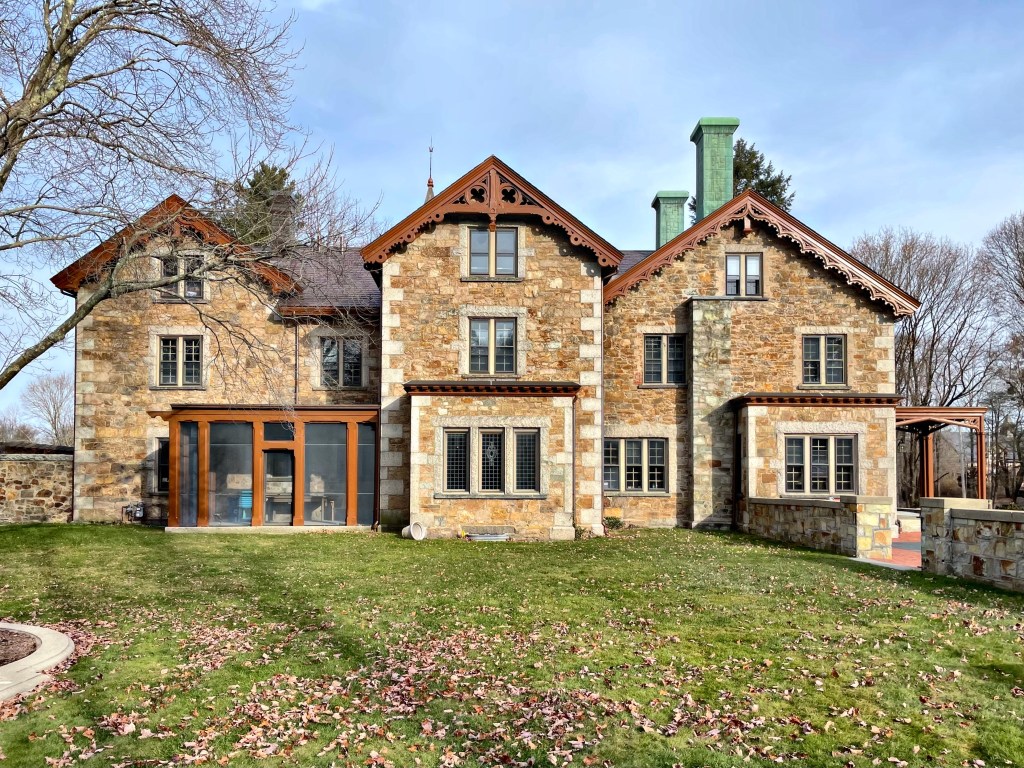
Tucked away behind the Ames Free Library in Easton, you will find one of the most stately examples of Gothic Revival architecture in a house in New England. The house is known as Queset House. Queset was commissioned to be built in 1853 and it was completed the following year for Oakes Angier Ames, of the wealthy Ames Family, who ran a shovelworks in town, and built some of the most handsome structures in the state. The house’s front portion design was drawn from a plan by noted architect Andrew Jackson Downing (who died in 1852). Downing collaborated with Alexander Jackson Davis who provided architectural drawings. The two architects created pattern books which greatly influenced Gothic Revival and Italian Villa style architecture for the next decades, with many wealthy people hiring builders to complete homes in their designs. Queset House is different than most in that the house is constructed of local stone. Oakes would later hire Harvard-educated architect John Ames Mitchell, (a first cousin of Oakes Angier and architect of the nearby Unity Church in Easton) designed the rear addition in 1873, adding the copper-clad chimneys. In the later years of his life, Oakes wanted to help further-improve his town and worked with his family to consult with starchitect H. H. Richardson and landscape starchitect Frederick Law Olmsted on projects in town (the Library, Town Hall, Rockery). After his death in 1899, the home was occupied by his son, famous theatrical producer Winthrop Ames, and his wife. The family would eventually gift the property to the Town of Easton, who today occupy it as an extension of the Public Library, open to the public!

Side view.

Ames Gate Lodge // 1880

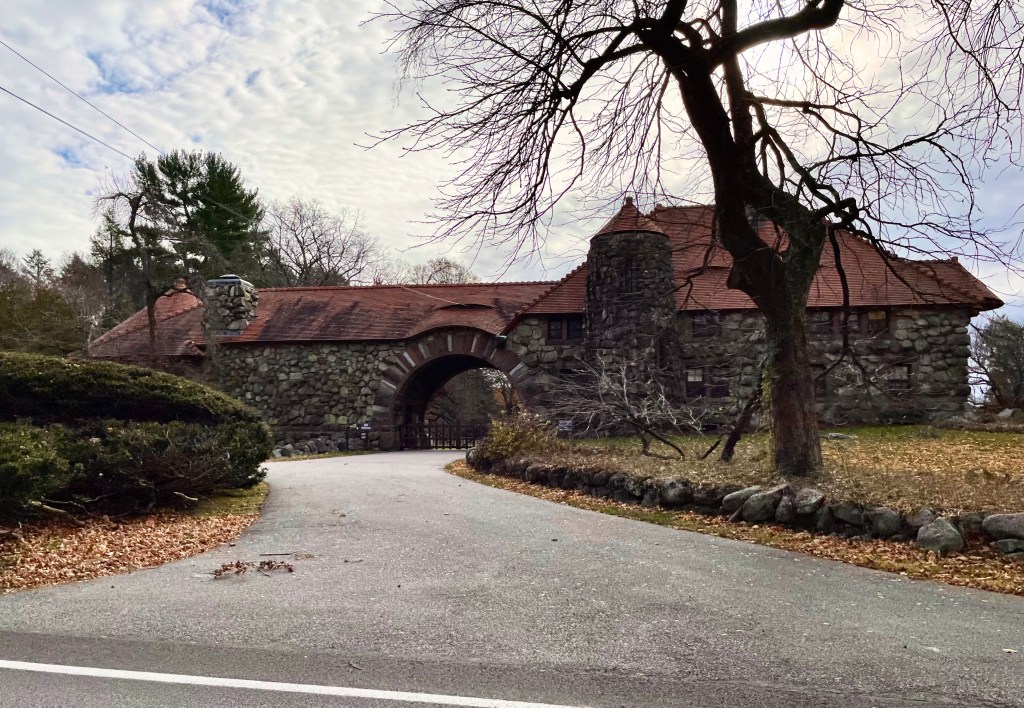
In 1880, twenty years after Frederick L. Ames built his rural estate “Langwater”, he felt the need to give the property more rural character, especially given the close proximity to the Ames Shovel Works. Emulating old European estates with gatehouses, Ames hired star-chitect Henry Hobson Richardson, to design a gate lodge at the entrance to his property, fitting of one of the richest men in Massachusetts. Richardson’s design for the gate lodge was oriented longitudinally and is bisected by the arched entry to the estate. The large room on the left was intended to serve as a storeroom for flowering plants, and the two-story portion had a caretaker’s residence on the lower floor and a “bachelor hall” for men’s socializing and spill-over bedroom. The building uses glacial boulders found on the expansive grounds and older stone walls, with trim of Longmeadow brownstone. The bright red terracotta roof contrasts boldly with the rough stone walls. The building is one of the most beautiful structures I have seen, but can be difficult to photograph without trespassing. Ugh!

Langwater // 1859

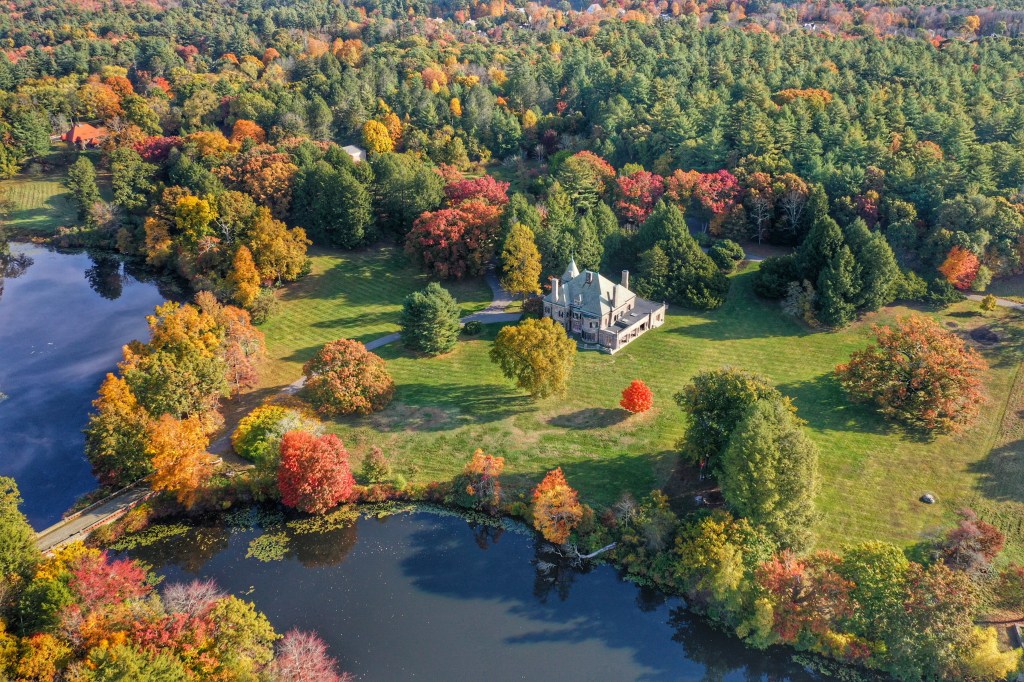
The country estate of Frederick Lothrop Ames (1835-1893), “Langwater” sits in North Easton amongst a collection of some of America’s greatest architectural treasures, all thanks to the Ames Family. The Ames family was a wealthy family which had lived in Easton for many generations. Frederick’s grandfather Oliver Ames Sr. founded the Ames Shovel Works in Easton, Massachusetts. The Shovel Works earned the family a huge fortune, during a time when aggressive canal and railroad expansion was built by the hands of thousands of men using shovels. Frederick’s father Oliver Jr. was president of the Union Pacific Railroad during the building of the transcontinental railroad. Frederick’s cousin Oliver Ames was governor of Massachusetts 1887–1890. Frederick himself was Vice President of the Old Colony Railroad and director of the Union Pacific railroad. At the time of his death, Ames was reported to be the wealthiest person in Massachusetts. With this immense wealth, Frederick built a castle where he would spend most of the year, overseeing his various businesses, in his hometown of Easton, Massachusetts. The mansion was designed by architect George Snell and built around 1860, with a couple additions and updates until Frederick’s death. A few years before his death, Frederick hired famed architect Henry Hobson Richardson, who he already worked with in designing the Oakes Ames Memorial Hall(Easton’s Town Hall), to design a gate house leading to Langwater (more on that later).