The Octagon form of architecture was conceived in 1848 in the prolific mind of Orson Squire Fowler, phrenologist and author of books on sex, family relations, and many other subjects. His book A Home for All, or, the Gravel Wall and Octagon Mode of Building struck the fancy of a certain few, and Octagon homes were built across the country, for just about a decade until they fell out of favor almost overnight. This home in West Gardiner, Maine, was built by Jesse Tucker in 1856 on land his father had cleared, replacing a more standard structure. The new octagon house was being constructed as a gift to Jesse’s soon-to-be wife, but tragically fell from the roof of the barn when building, and died. The home was completed, and it was seemingly acquired by Jesse’s twin brother David. The home remained in the Tucker family until the 1950s.
One of the most unique buildings on the grounds of the Harkness Estate has to be the most functional, the 1910 water tower. The structure was designed by architect James Gamble Rogers, a really under-appreciated architect who was commissioned by Edward and Mary Harkness to revamp their summer compound. The water tower features a skeletal frame with concrete block tower protecting it, surmounted by a shingled water tank which once had a functioning wind mill on it! Nearby the water tower, a garden designed by female landscape architect Beatrix Farrand frames the tower very well. In that garden sits a 110+ year old Japanese Thread Leaf Maple tree, which is probably the most beautiful tree I have ever seen.
Another of the handful of original structures extant on the Seaside Sanatorium campus in Waterford, Connecticut, is this gorgeous Tudor Revival style duplex constructed for medical staff housing. Like the Main Building and Nurse’s Residence, this duplex is credited as a design by the great Cass Gilbert. While the building was constructed after Gilbert’s death in 1934, the plans were likely all drawn up at the time the Maher (main) building was in 1933. The duplex residences feature a symmetrical facade with two main entranceways, located in slightly projecting pavilions, and are set within basket-arched openings, detailed with alternating brick and granite voussoirs. There are three-part windows above the doors which project from the wall plane and have cross-braced faux balustrades of wood below. Identical sun porches are recessed at either end of the house. The small associated garage to the immediate northeast has a simple design, but one that reflects the style of the houses. Like the other buildings on the campus, this structure is vacant and is slowly rotting away. So sad to see.
In the 1890s, Charles Strong Guthrie and wife Frances Amelia Lampson Guthrie began vacationing at Pequot Colony, a resort community in New London, CT, with considerable social cachet and popular with wealthy New Yorkers like themselves. Charles Guthrie was an industrial mogul who served as President of the Republic Iron and Steel Corporation. In 1901, the couple acquired 12-acres of land overlooking the Long Island Sound, and hired renowned Summer home architect William Ralph Emerson to design a mansion with the Olmsted Brothers commissioned to design the site and landscaping. Upon completion in 1902-03, the estate became known as “Meadow Court”, taking its name from the six-acre wildflower meadow overlooking the Sound. The home was a landmark in the Mission/Spanish Revival style, which became popular in the early 20th century, coinciding with other architectural revivals. Charles Guthrie died prematurely in 1906 at age 46, and not long after, Frances began spending summers on Long Island. In the 1920s, she sold off some of the land to a developer, who constructed more modest summer cottages, and sold the mansion, which soon after re-opened as the Lighthouse Inn. The summer hotel flourished through the mid 20th century, boosted by great management and luxury events. A fire in 1979 destroyed some of the building, but it was restored. It closed in 2008 and sat vacant until recently, when a new owner has begun the long process of restoration, looking to restore the light back to the Lighthouse Inn.
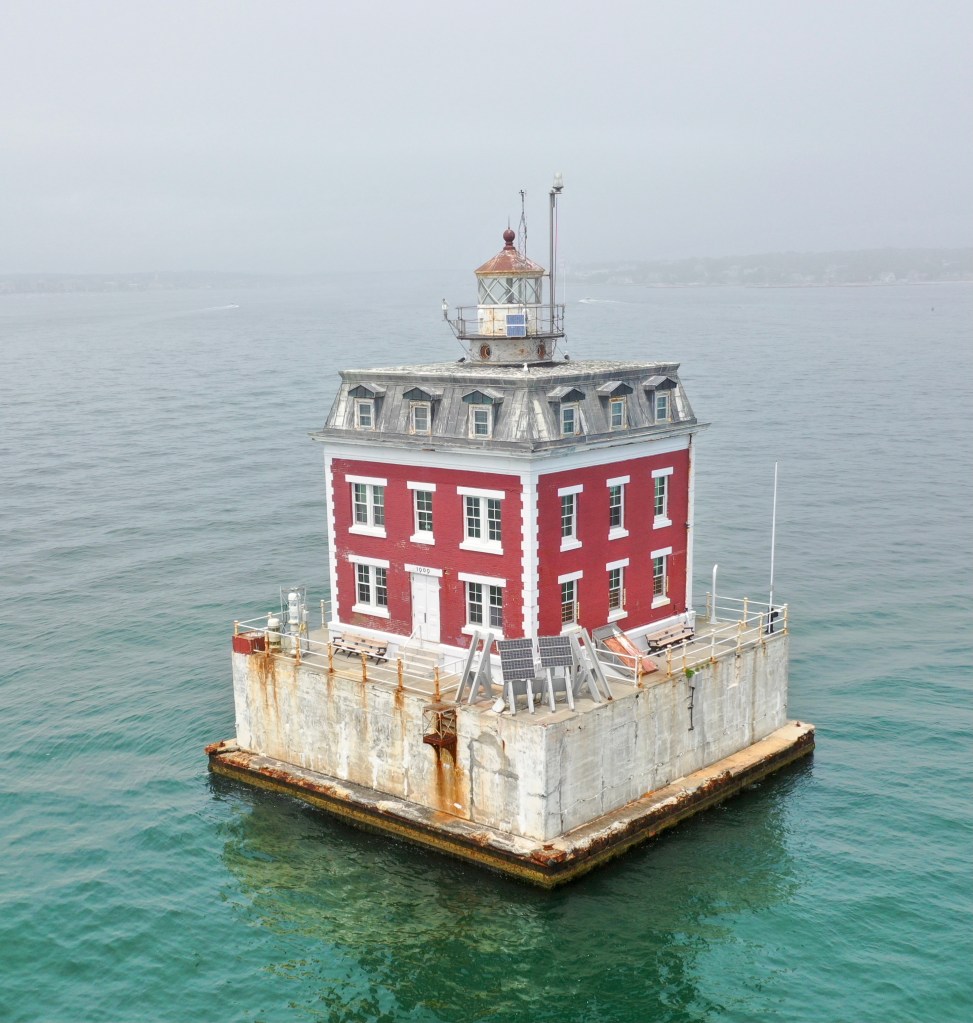
Set way off the coast of Connecticut at the eastern end of Long Island Sound, sits this stunning lighthouse which appears more as a Second Empire style home than a lighthouse! By the early 1900s, New London, with its protected harbor at the mouth of the Thames River, had made the transition from whaling center to industrial city. New London Ledge Light was built because New London Harbor Light wasn’t sufficient to direct vessels around the dangerous ledges at the entrance to the harbor. The New London Ledge Lighthouse was completed in 1909, built by the Hamilton R. Douglas Company of New London and is an architectural antique as its Second Empire style is about 50 years past the time the style was popular in American architecture. The lighthouse reportedly owes its distinctive French Second Empire style to the influence of the wealthy home owners on the local coast, who wanted a structure in keeping with the elegance of their own homes. Sadly, many of the large homes near the shore in the area were destroyed in the Great Hurricane of September 21, 1938. Coast Guard crews lived at the light until it was fully automated in 1987. The lighthouse today is owned and operated as a museum by the New London Maritime Society.
This shingled beach cottage on the southern tip of New London, Connecticut sits in the Neptune Park community, which was laid out by real estate speculators as summer homes, primarily for local families. The Post Hill Improvement Company made up of professionals, purchased the beach and the surrounding land for $25,000 and began selling off the land adjacent to the beach. Then, once developable lots were sold and many cottages were built, they sold the beach alone back to the City for the same sum of $25,000. Like many such developments, deed restrictions were placed on properties, and ensured that only a dwelling house, with a minimum value of $2,500 if not waterfront and $3,000 if waterfront, could be constructed on the lots. This formerly Colonial Revival cottage was built in 1911 for Mary R. English, and would have cost at least $3,000. The shingled home was later given the tower and other details, but retains much of its charm.
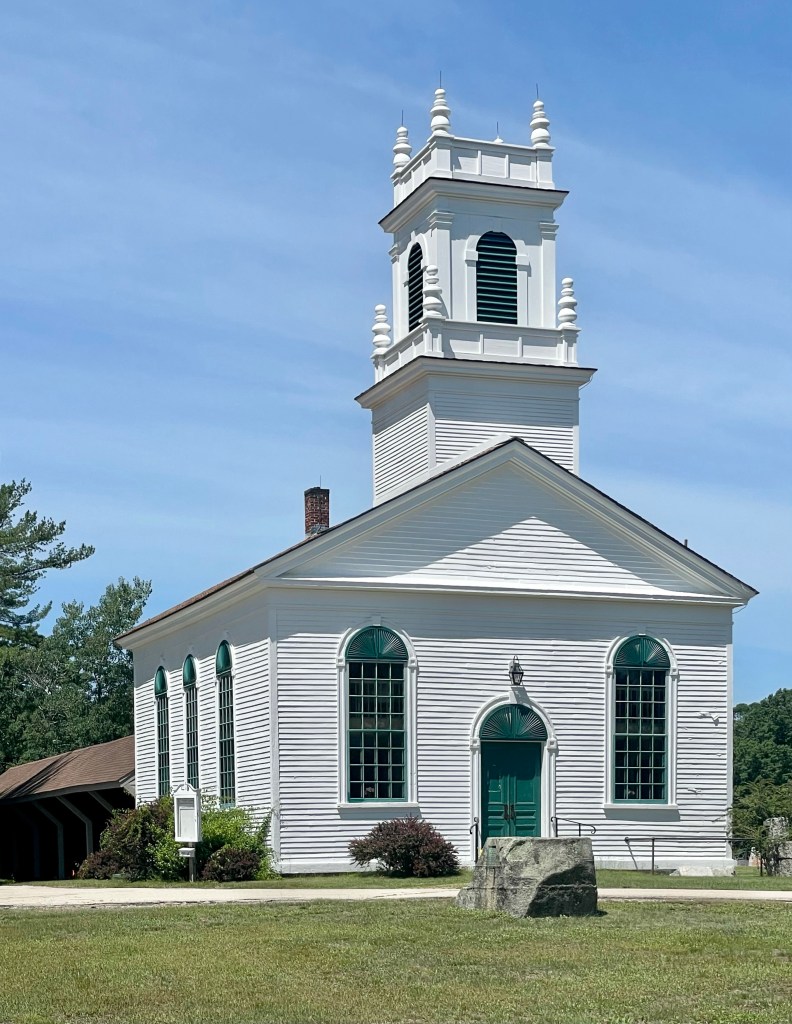
This old meetinghouse predates the Town of Newington having been erected when the area was known as “Bloody Point,” which was claimed by both Dover and Portsmouth. Surrounded on three sides by the Piscataqua River and the Great Bay estuary, early residents of Bloody Point found it difficult to attend town meeting or church service in either Dover or Portsmouth. Bloody Point residents soon decided to establish a parish, independent from both Portsmouth and Dover. The granting of a separate parish with town privileges in the early 1700s required the construction of a village meetinghouse, and the establishment of a church with a settled minster. There was no requirement for separation of church and state at that time, so a meetinghouse would serve the dual purpose of being both a place for feisty town meetings and solemn worship. Construction of the Bloody Point Meetinghouse began in 1712, and the first meeting was held in it in January, 1713, even though the building was far from completed. There were no seats, and the windows were only holes in the walls. On August 6, 1713, a meeting was held to organize the parish in the new building. The name “Newington” was chosen after an English village that provided a bell for the new meetinghouse. Rev. Joseph Adams was the first settled minister in the new meetinghouse, and he preached there for 68 years. Rev. Adams was the uncle to John Adams, second president of the United States, and great uncle of John Quincy Adams, the sixth president. The building was modernized in 1838-39 to its present church-shape appearance. Windows were reconfigured, the main entrance was moved from the long south side to the east gable end, and the freestanding belfry was relocated onto the roof of the east gable end, effectively rotating the building 90 degrees without moving it. The present-day Greek Revival building remains as a highly significant relic of the founding of Newington.
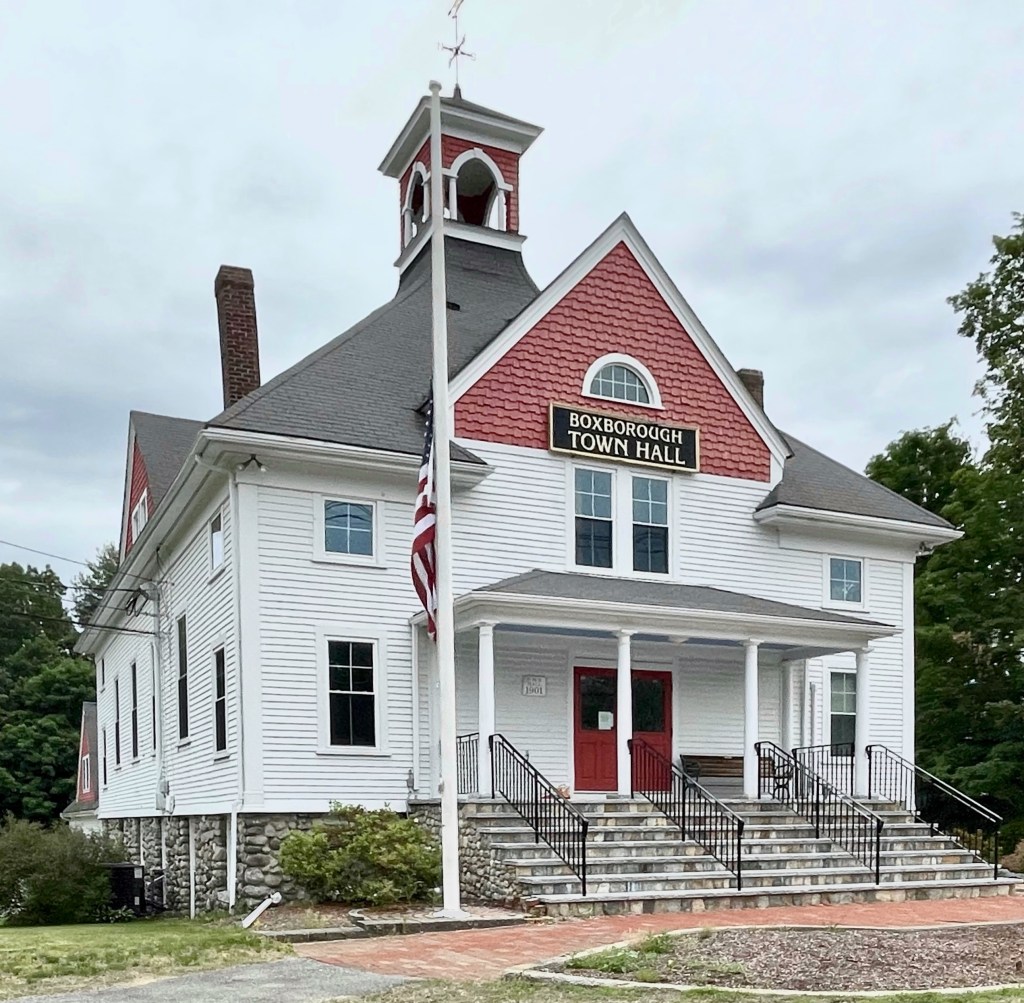
The area which became the town of Boxborough, Massachusetts, was first inhabited by the Native Americans of the Nipmuc and Pennacook tribes. Land in Boxborough was not settled by colonists until the beginning of the eighteenth century by farmers looking for fertile land to establish farms, who branched out from nearby Acton. Boxborough was formed from Harvard, Littleton, and Stow in 1783 and was incorporated as its own town. With the exception of small local industries including gristmills, sawmills, and cooperages as well as some minor boot and shoemaking, comb-making, and a lime quarry and kiln, Boxborough’s economy remained almost entirely agricultural through the 19th century. The town grew steadily and a Town Hall building was funded by the turn of the 20th century. This Queen Anne/Colonial Revival Town Hall building was constructed in 1901, atop the foundation which was constructed of locally gathered cobblestone by local volunteer farmers. Today, the town retains much of its agricultural heritage, but it is definitely under threat by subdivisions and Neo-Colonial mansions further contributing to Bostons suburban sprawl.
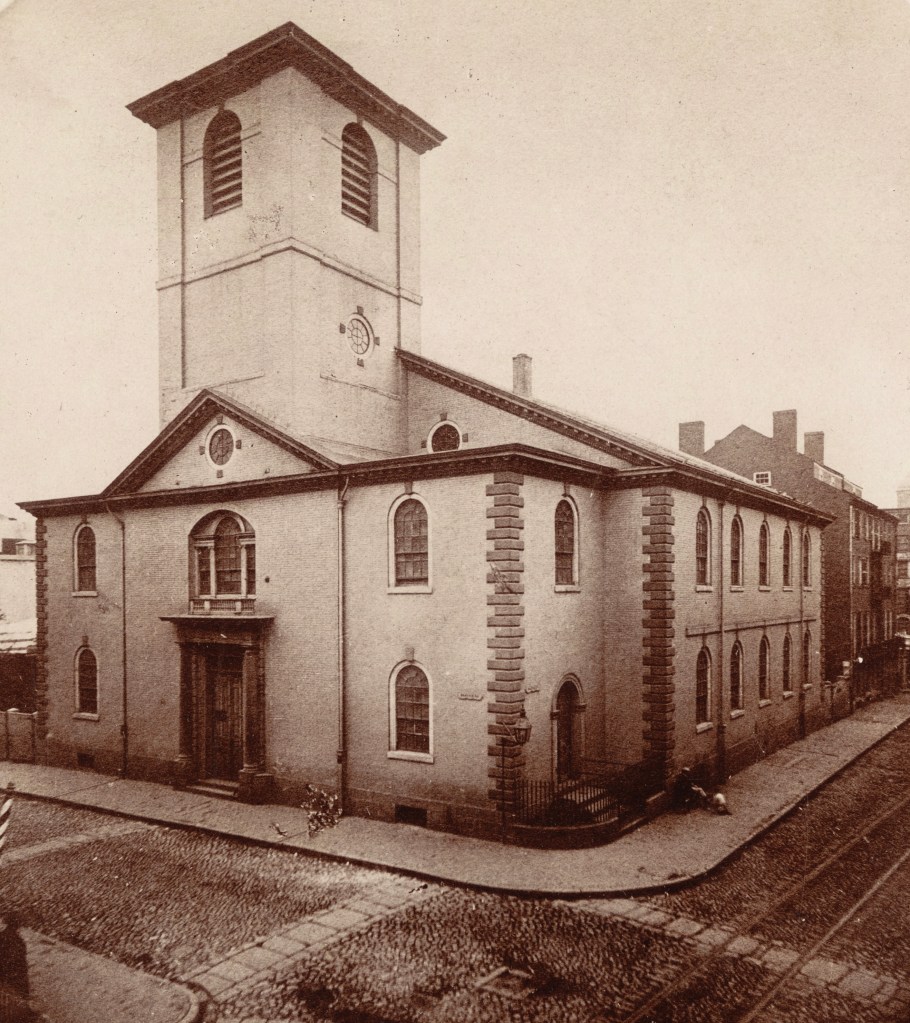
Boston’s constant churning of development has given us amazing architectural landmarks, and incredibly unfathomable architectural loss. One of such cases of loss is the former Brattle Street Church which was located on Brattle Street, roughly where the main entrance to Boston City Hall is located today. Demolition of significant architecture in Boston began way before the period of Urban Renewal in the mid-20th century, and the loss of the Brattle Street Church in Downtown Boston showcases this. The Brattle Street Church had been founded in the 1690s by a group of merchants seeking an alternative to the authority exercised by Increase and Cotton Mather in Boston’s existing congregations. Despite these beginnings, the church remained Congregational through the 18th century. At the time of the Revolution, Brattle Street counted such figures as John Hancock, Samuel Adams, Joseph Warren, and John and Abigail Adams among its parishioners. The original wooden church was replaced in 1772 by this stunning brick building, designed by Thomas Dawes. Just years after the doors opened, the American Revolution upended life in Boston. This building was a survivor, and was apparently hit by cannon-fire by the American batteries at the siege of Boston. A cannonball can be seen lodged into the building at the second floor, to the right of the Palladian window. After the American Civil War, development of the Back Bay led to a shifting population away from the downtown core, and a new church was erected for the congregation, the Brattle Square Church, designed by Henry Hobson Richardson. This church was demolished in 1872, just 100 years after it opened its doors and took a cannon for America.
George Otis Draper (1867-1923) was born in Hopedale and attended MIT to prepare to help run the extremely busy Draper Corporation in town, a family business (featured previously). With his position at the company, he had the money in the late 19th century to build a massive country estate known as The Larches. The shingled Colonial Revival style home featured a massive castellated tower and appeared like a castle in the countryside. George O. Draper sold this home to his aunt Hannah Thwing Draper Osgood in 1909, and within a month, the home burned to the ground. Around the time her husband died, she rebuilt the Larches and lived here with her daughter until they both died in 1929. The “new Larches” is a stunning blending of Colonial Revival and Craftsman styles. The home was likely designed by Robert Allen Cook, who was based out of nearby Milford, MA. The property today is run by Crossroads Clubhouse, an employment and recovery center that offers people with mental health conditions opportunities to achieve their full potential.