Arthur Blanchard House // 1892

I do not feature enough Queen Anne style buildings on my account, as penance, I present this beautiful example of the style with a painted lady color scheme! Located on Windsor Avenue in West Acton, Massachusetts, this house was built in 1892 and has all the hallmarks of the Queen Anne style. The use of varied siding materials and forms, asymmetrical form, applied ornament, and large five-sided tower capped by a conical slate roof with weathervane. The home was built for Arthur F. Blanchard, a local businessman who operated an apple farm and marketing business opened by his father. Mr. Blanchard was a philanthropist in town and used his wealth to enhance his hometown by funding the Blanchard Auditorium at the Acton High School (1925) and was a benefactor of the West Acton Women’s Club in 1925. He and his son, Webster, also founded the Blanchard Foundation in town in 1946, an organization which funded and sponsored educational projects for the community.
George and Effie Mead House // 1911

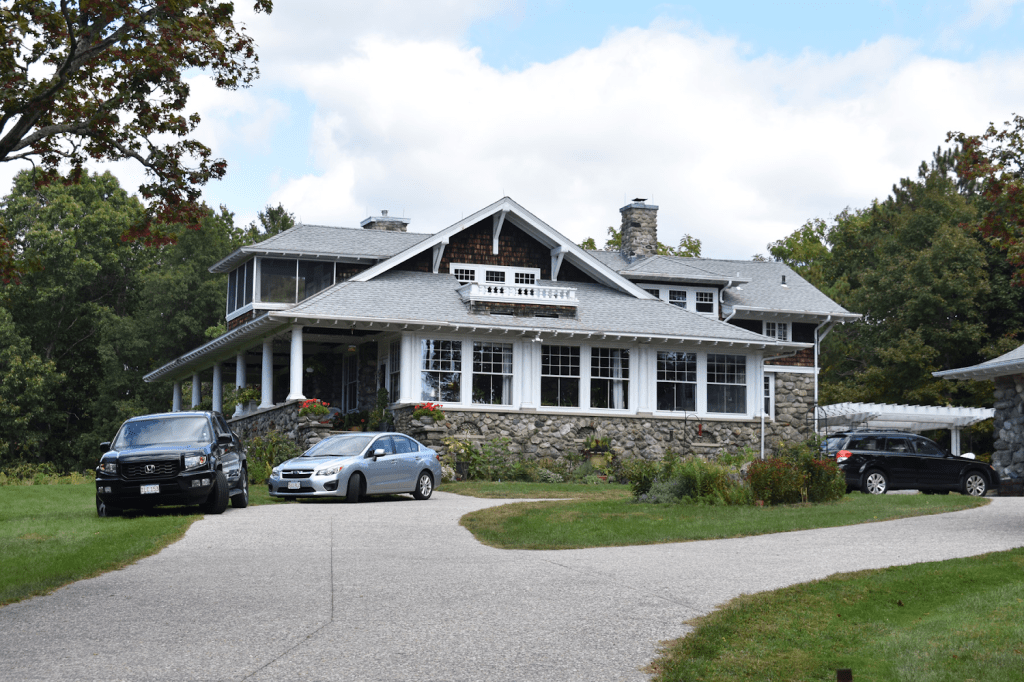
Prominently sited upon a hill on a dead-end street in West Acton, Massachusetts, this Craftsman Bungalow is a very elaborate and well-preserved example of the style. The house was built in 1911 for George Varnum Mead (1861-1940) and his wife Effie Wright Mead (1860-1926) as their summer home when they weren’t living in Somerville. Mr. Mead was born in West Acton to Varnum Balfour Mead, who operated the A. O. W. Mead Company, a produce marketing business in Acton and Boston. Varnum’s brother built an elaborate Second Empire style mansion in town which was featured on here yesterday. George Mead followed his father’s footsteps and worked in the family business, which was in operation starting in the 1840s. The A. O. W. Mead Company gathered produce from farmers all over West Acton, kept the produce in cold storage facilities erected by the family, and sent it to Boston for sale at Quincy Market until George’s death in 1940. The Craftsman style house has a fieldstone base, low, overhanging flared gable roof, and is sheathed in shingle siding. Characteristic features include the multiple dormers, exposed rafter tails, grouped windows, and the large fieldstone chimney.

Oliver Mead Mansion // c.1870

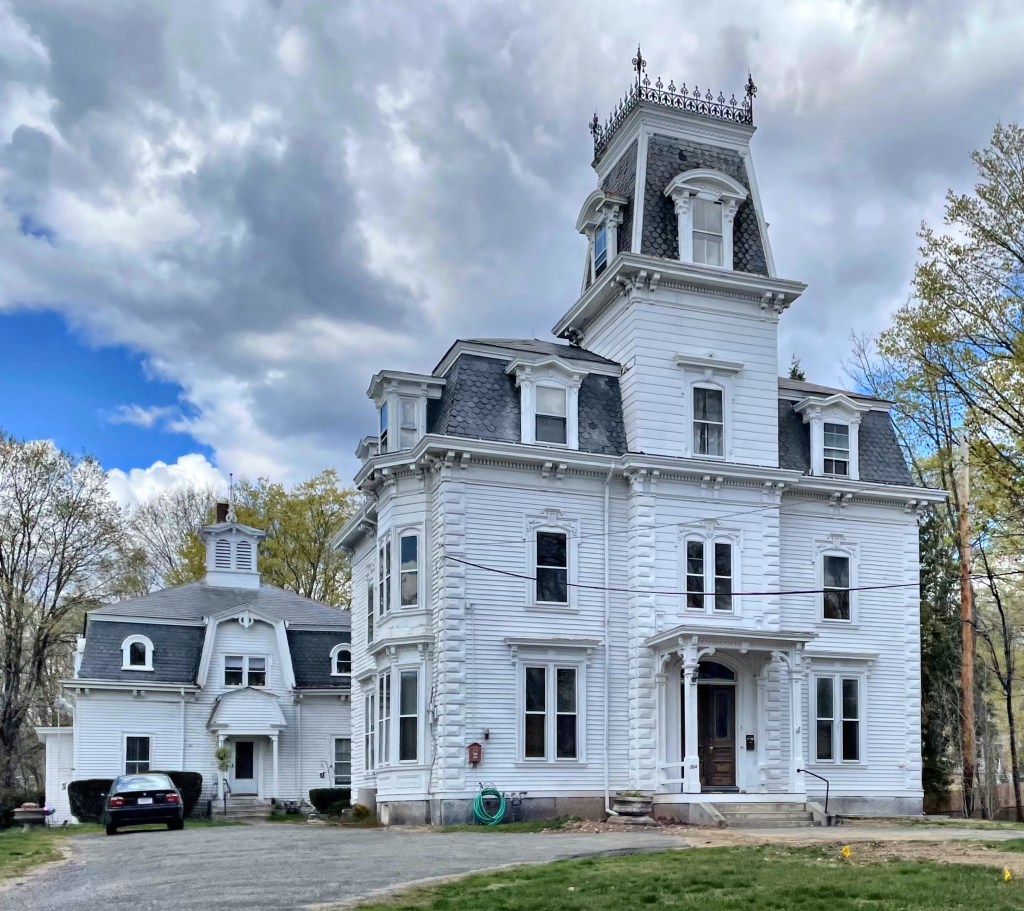
Acton, Massachusetts is one of the more underrated Massachusetts towns for great old buildings, many of which are well-preserved and taken care of by their owners. The Oliver Mead Mansion in West Acton Village is among the largest in this part of town and is a stellar example of the Second Empire style. The house and adjacent carriage house was built around 1870 for Oliver Mead (1823-1912), who co-owned the A. O. W. Mead Company with his two brothers, a successful produce marketing company where they sold poultry, eggs, cheese, fruit, and other goods from farms in Acton and Boxborough to their shop on Market Street in Downtown Boston. The company did well, and Oliver and his brother Adelbert built matching mansions in West Acton after the Civil War and business picked up. The house exhibits a central projecting tower bordered by quoins and topped by a mansard roof with iron cresting on top. The original carriage house remains in a great state of preservation as well. The Adelbert House and Carriage house nextdoor were demolished in the 1950s for the fire station on the site.

Sawyer Mansion // 1863 & 1914

Originally built in the Carpenter Gothic style in 1863, the Sawyer-Gillett Mansion in Whitingham, Vermont, is the highest-style house in town today. Indistinguishable from its Civil War-era original construction, the house was greatly expanded and altered into an elaborate take on Queen Anne / Shingle styles in 1914. The house was originally constructed by John W. Sawyer, but it was his son, Lincoln H. Sawyer who renovated the house and etched his name “L.H. Sawyer” on the glass of the new front door. The updated house style reflects a nostalgic Victorian preference by the owner, who sawed all the trim and materials on site at the family sawmill. It was recently sold and is now a B&B!

Green Mountain Hall // c.1860

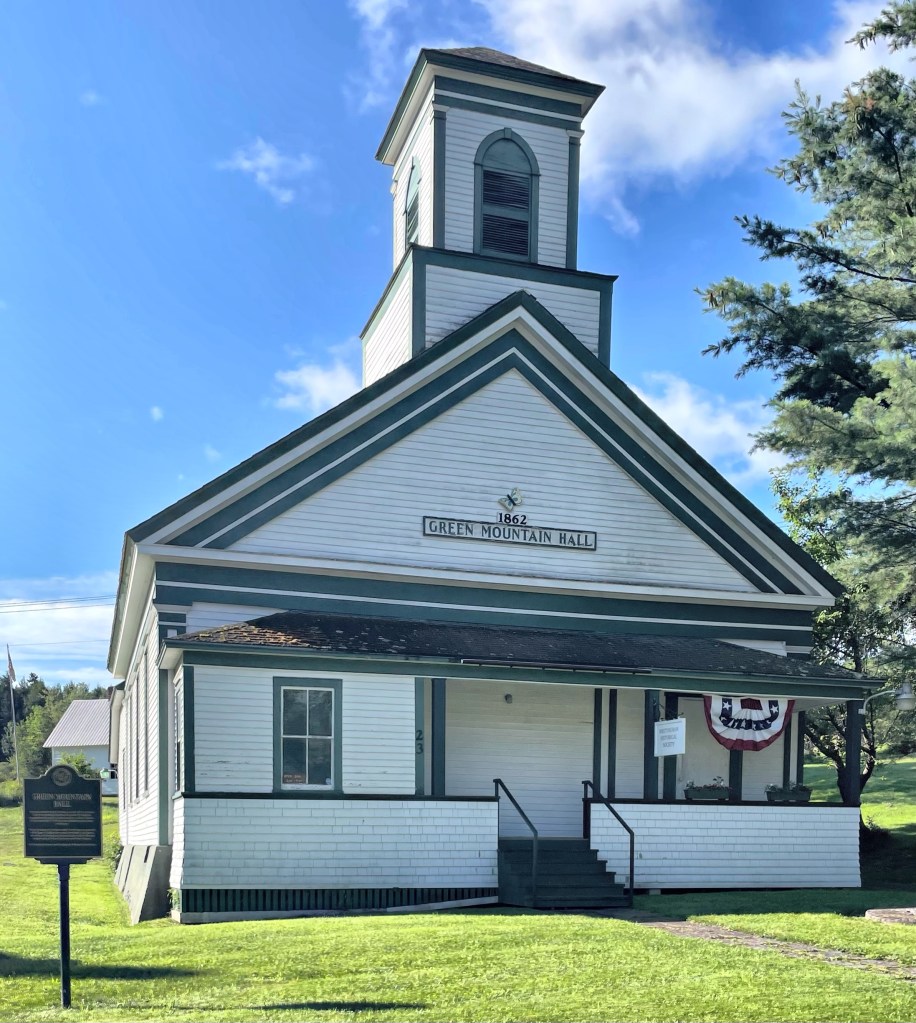
This simple Greek Revival style country church in Whitingham, Vermont is similar in form to the Methodist Church (last post) with a gable front double entry, large full pediment, corner pilasters, and centered two-tiered steeple. Also like the Community Church nextdoor, this was built circa 1860 as a church, but for the Universalist Unitarians in town. In 1892, the church was transferred to the Green Mountain Club, giving it the informal name “Green Mountain Hall,” and in 1905 the Town of Whitingham took it over. The building was used for dances, meetings, social gatherings, and other events until the Whitingham Historical Society took it over in a lease in 1971 to develop into a museum. The well-preserved vernacular building with its c.1920 front porch is a great representation of Vermont architecture, reuse for new uses and update. No waste, and a whole lot of charm!

Whitingham Community Church // 1862

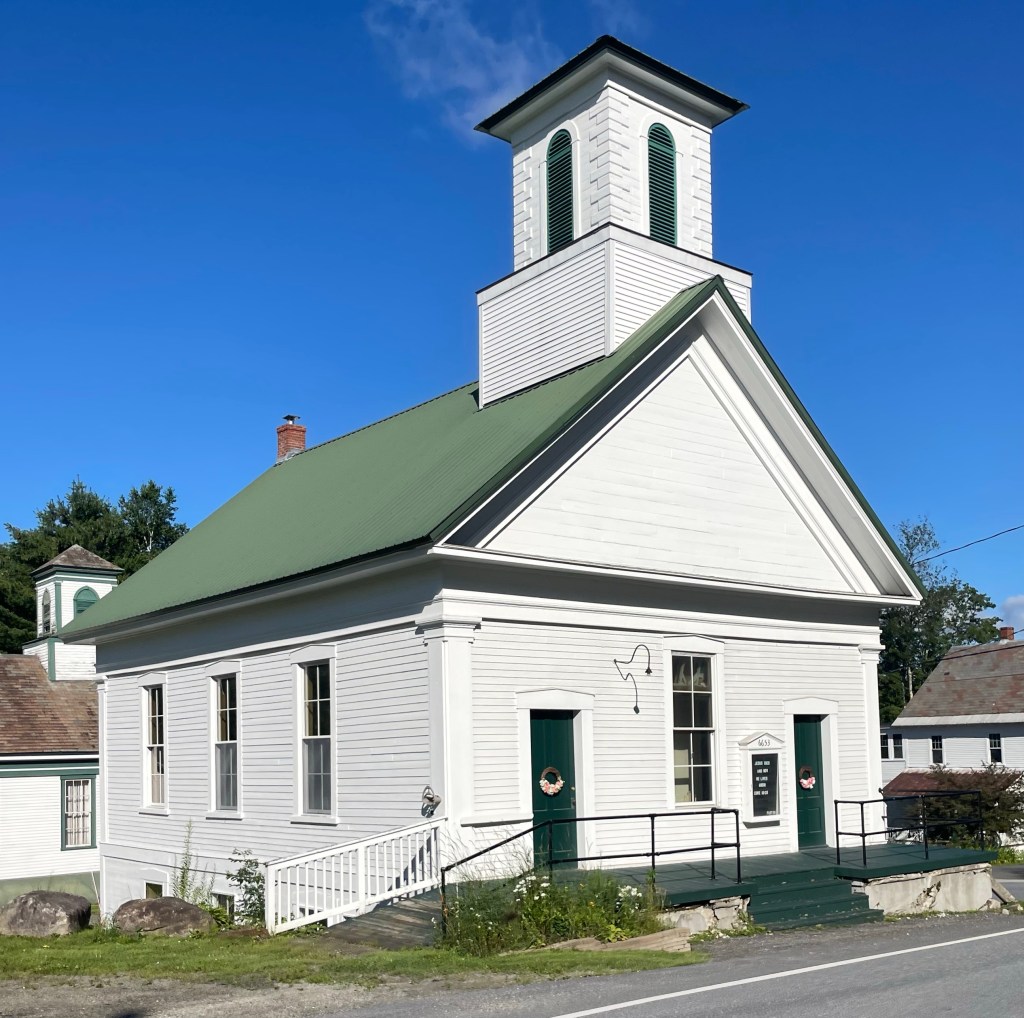
This simple, Greek Revival, frame church has a prominent pediment, corner pilasters, and two part steeple. It is built into a steep bank at the side of the road as it curves and descends into Whitingham Village, making it one of the most visible buildings in town. This church was originally built in 1862 by the Methodists who moved their congregation from their old and deteriorated church in the original Whitingham settlement on Town Hill. By the 1870s, the Methodist congregation was in decline. The Baptist congregation started holding meeting at this church regularly in Sadawga Village in 1879 and then purchased it. They made repairs and alterations in 1881. In historic photographs c. 1890- 1920s, the church’s steeple had third and fourth sections consisting of a narrow octagonal section topped by a small bell shaped dome. By the 1940s photographs show these had been removed. The building now serves as the Whitingham Community Church. My friends who tag along with me on visits throughout New England always say that every town has at least one old, white church. They aren’t wrong!

Abraham Chase House // c.1860

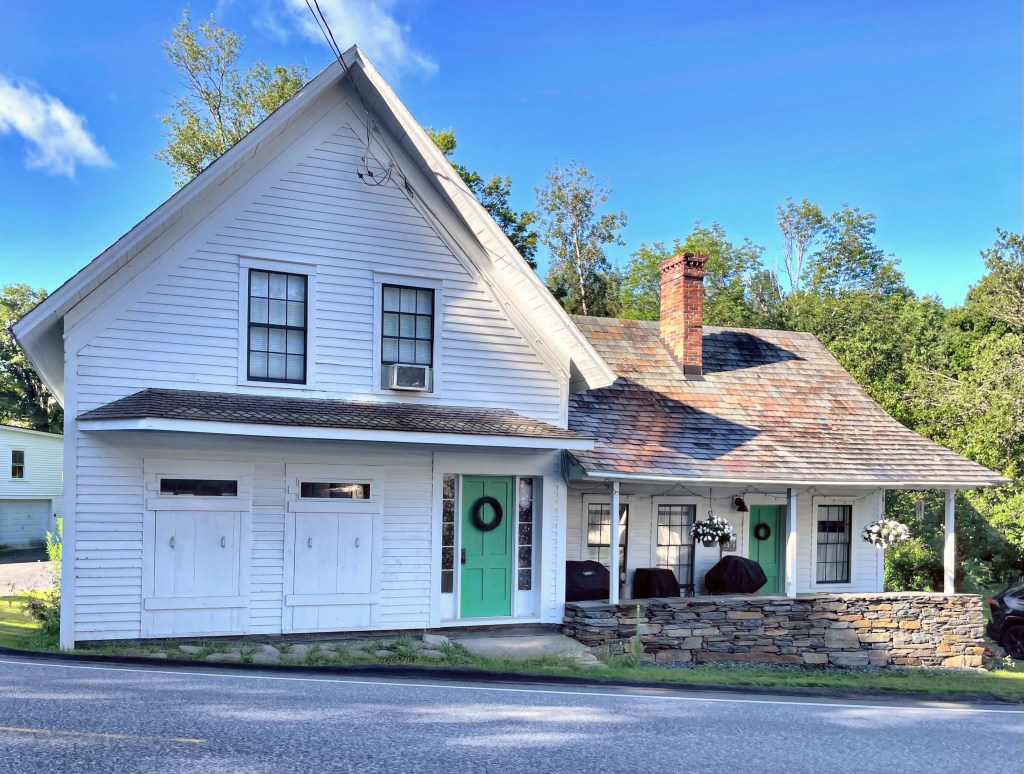
One of the cutest old houses in Whitingham Village in Vermont is the Abraham F. Chase House, just a stone’s throw from the country store and post office. Abraham Chase was a dealer in dry goods, groceries, boots, shoes, and hardware in this village, possibly from half of this building. The vernacular one-story clapboarded frame house has some Gothic details like the rear steep double gable wall dormer. I am actually a huge fan of the green doors and newer stone porch wall, they really make this cottage pop!

Reuben Winn House // 1840

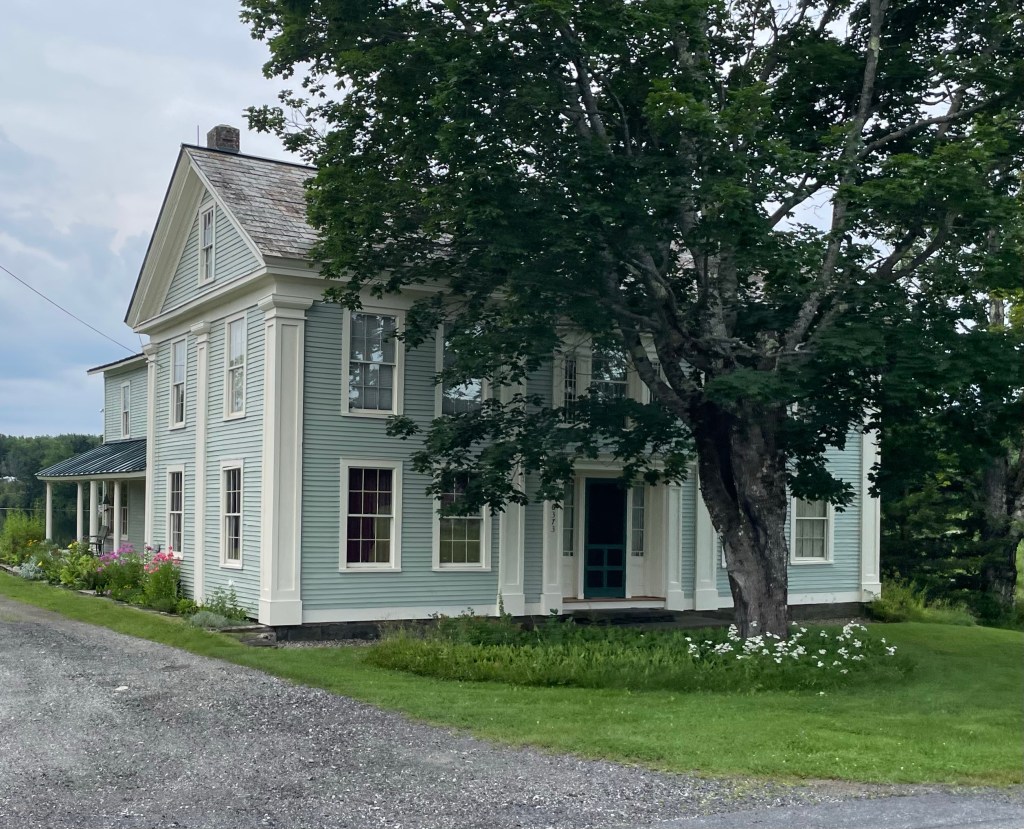
The main part of this stunning Greek Revival house in Whitingham, Vermont was built by Reuben Winn around 1840 and was originally located on the town common, southeast of the present village of Whitingham. The building was the only one to be moved from the hill to the valley as development shifted westward to the current town center and its access to water power for industry. This house was moved in 1889 and was run as the Sadawga Lake House hotel by Charles E. Putnam who also was listed in local directories as a slate dealer. The present slate roof was likely added by Putnam! The architectural element which stood out to me was the three part Palladian window directly above the front door that uses the motifs of the Greek Revival pilasters and entablature common to the other façade elements. The home is very well-preserved and even maintains a detached barn on the property!

Wheeler-Jillson Store // c.1905

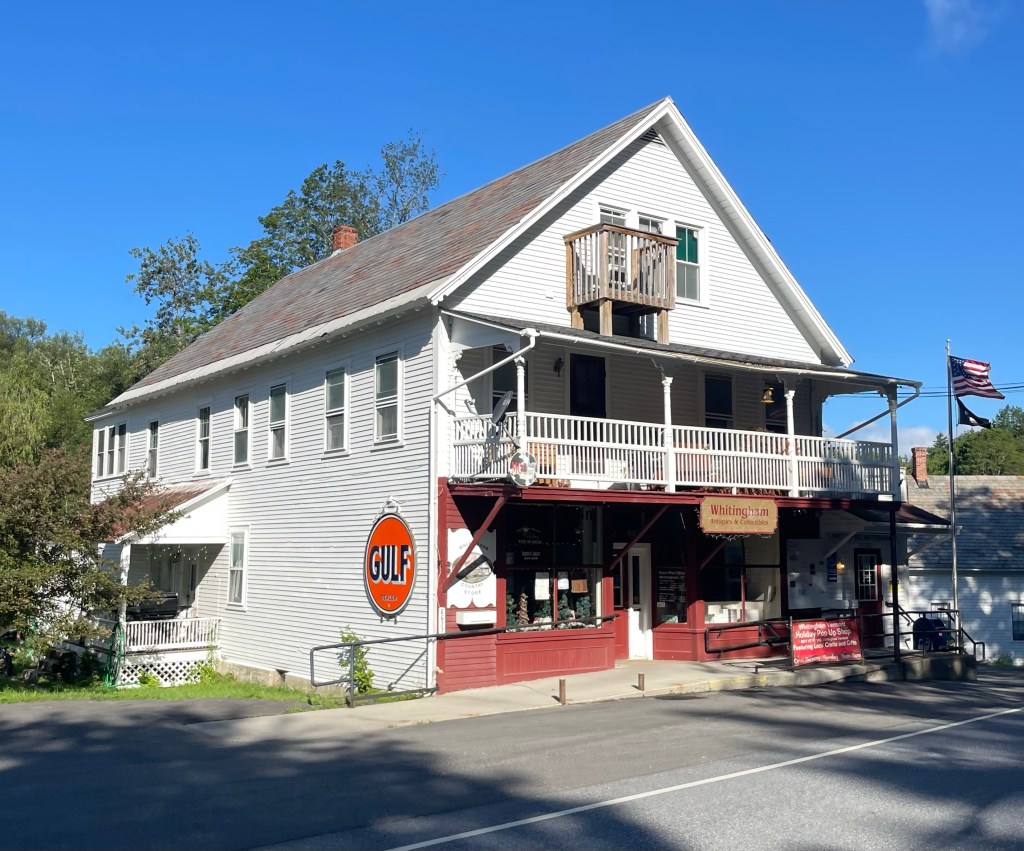
To me, Vermont is synonymous with Vernacular architecture. The state obviously has high-style and architect-designed buildings all over, but the character of the state (to me) is based around local builders, local materials, and local traditions. The patchwork of towns and villages in Vermont all have one thing in common, at least one general store. These buildings serve as an informal meeting place or community center where residents and visitors alike can hear the local gossip and events taking place. The general store in Whitingham, Vermont is located in the middle of the village, perfect for stopping in. The building was constructed in the first decade of the 20th century, replacing a former hotel/tavern on the site. The late-folk Victorian style store exhibits some decorative columns and storefronts, likely produced at one of the working lumber mills in town at the time. The store was originally built by Arthur and Carl Wheeler as the “Wheeler Brothers Store” but after 15 years changed hands and became the “F.W. Jillson & Son Store”. Since then, the Jillson’s opened up an antique store in the building which serves as a multi-use facility (collectively as a country store). Keep it local Vermont!

Tower Records Building // 1918 & 1986

New England is home to just three projects by world-renowned (and sometimes maligned) architect Frank Gehry. To me, architecture is best when it makes you stop, look, critique, and comment on it. Architecture is an art, and it should evoke emotion and discussion. Gehry’s work does just that. His only project to date in Boston is located at the corner of Newbury Street and Massachusetts Avenue in the Back Bay, a project I would assume most don’t realize was a Frank Gehry design. The building was originally built as a seven-story office building (originally planned as eight stories) over an MBTA station lobby in 1918. Designed by Arthur Bowditch, the building was completed a year later, built of buff brick and concrete. The Boston Elevated Railway Company (BERy) moved into the top floors of the building and it became known as the Transit Building. The construction of the Massachusetts Turnpike in the 1960s removed neighboring buildings to the south, exposing the southern, unadorned façade of the building. By 1986, owner-developer Richard Cohen began a major renovation of the building with Tower Records as the main tenant. Gehry worked with local architects Schwartz-Silver who added an eighth floor with a cornice support by angled struts. The south and east sides of the building were sheathed in lead-coated copper with the street-facing west and north sides retaining their original brick and stone, but with added glass canopies supported by more angled struts. As housing became more desirable, the top five floors were converted into 54 condominiums. The design is timeless and showcases how new and old can work together in a juxtaposition of styles well! What do you think of the building?