William Bottomore House // c.1750

This well-kept Federal home in Newport was apparently built pre-Revolution, but it was likely significantly altered in the early 1800s for its namesake, William “Billy” Bottomore. “Billy” was born in Bologna, Italy, and moved to Salem, MA, where he possibly met Michele Felice Cornè, a prolific painter and who is credited in making tomatoes mainstream… seriously. In early 19th century New England tomatoes were thought to be deadly poison. Cornè was accustomed to eating tomatoes in his native land of Italy and would regularly eat them without ill effect and, thus, allayed the fears of the residents of his adopted country. Cornè became friends with Bottomore and they both moved to Newport. Bottomore likely modernized this house with help from his friend and ran a confectionery store in the home.
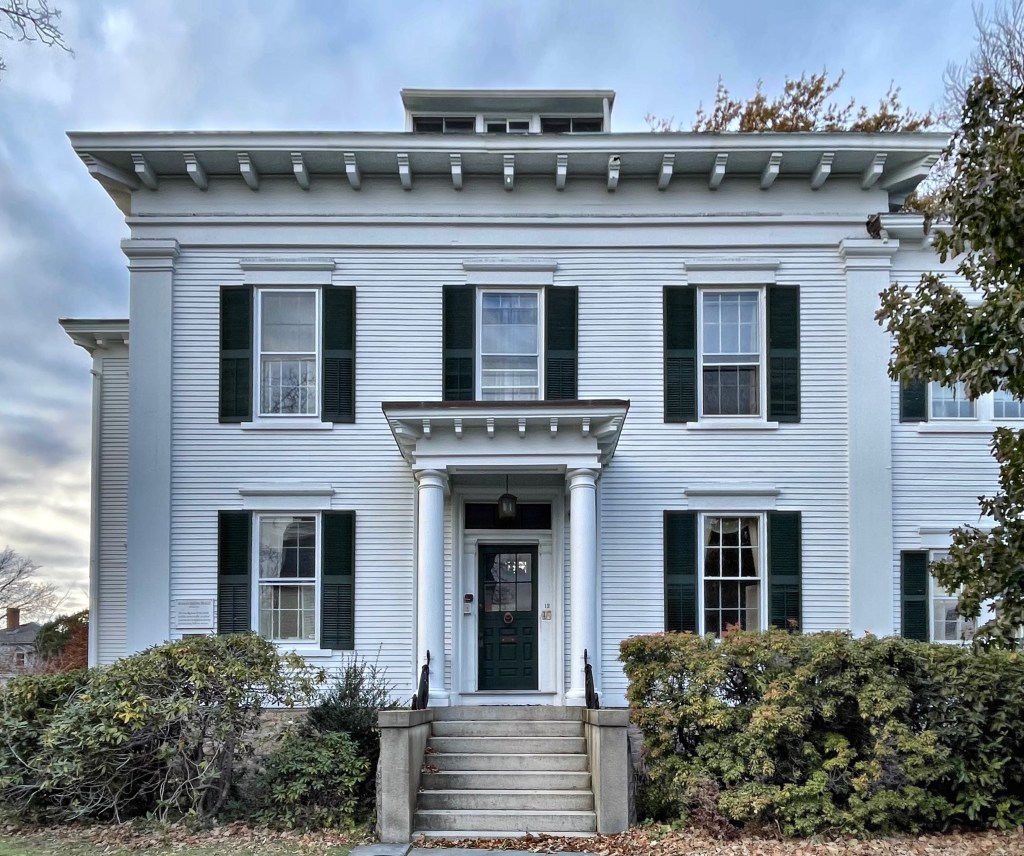
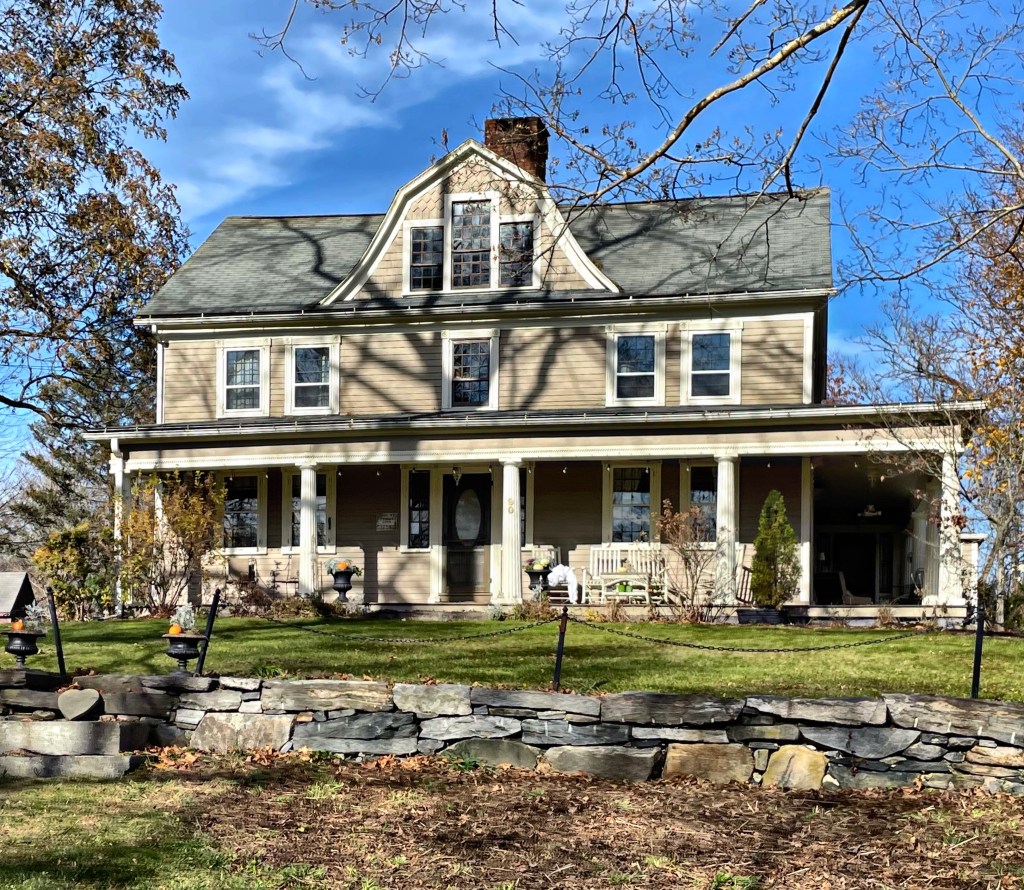
Alfred Smith House // c.1843

Alfred Smith (1809-1886) was known as “Newport’s Millionaire Real Estate Agent”, working in the mid-late 19th century to get some of America’s most well-connected upper-class acquire properties to build their summer cottages. In his early days, he prospered by assisting prospective developers and buyers to purchase house lots on newly platted streets, including Bellevue Avenue. By the time of his marriage in 1843, he built this stunning Greek Revival mansion, equipped with stunning proportions and corner pilasters. Decades later, to “keep up with the Joneses”, he modernized the house by extending the eaves and adding brackets and the addition of a belvedere at the roof. He was instrumental in much of Newport’s later development, even bankrolling the erection of a stone bridge on Ocean Avenue, to allow carriages and subsequent developable lots to extend in the previously untouched land in south and west Newport. He suffered a stroke in 1886, and died a year later, two years after his late wife. He funded a monument to the family, hiring Augustus St. Gaudens to furnish a stunning memorial “Amor Caritas” which stands in Island Cemetery in Newport. Mr. Smith’s estate was mentioned in the New York Times and stated there was no will, and his four living children would each get upwards of $1 Million (nearly $30 Million a piece based on inflation today)!

“Brookmeade” // 1756

Built by Benjamin Dyer for his son Thomas in 1756, this mansion is believed to be the oldest extant house in Canton, Connecticut. The most famous resident of the house was William Edgar Simonds (1842-1903) who married Sarah Jane Mills, a descendant of Dyer. Simonds was a prominent patent attorney who was awarded the Congressional Medal of Honor for his heroics at the Civil War battle of Irish Bend, Louisiana. After his military service, he attended Yale University, was admitted to the bar and commenced the practice of law in Hartford, Connecticut. In 1883 and 1885, he was a member of the Connecticut State Legislature. In 1889, he was elected as a Republican to the 51st US Congress served until 1891 and was a United States Commissioner of Patents (1891-93). He died at age 60 in Hartford, Connecticut.

Elias Danforth House // 1832

On the southern end of Center Village in Lancaster, MA, this gorgeous late-Federal style home holds a stately presence built into and atop a sloping hill. The home was built for Elias Danforth (1788-1868) in 1832 and has been so little-altered in the nearly 200 years since. The house features amazing full-length side porches with bold columns, an early sign of the emerging Greek Revival style. The home sold a couple years ago for just over $600,000, which is a STEAL for the location and high-quality house and interior. Wow!

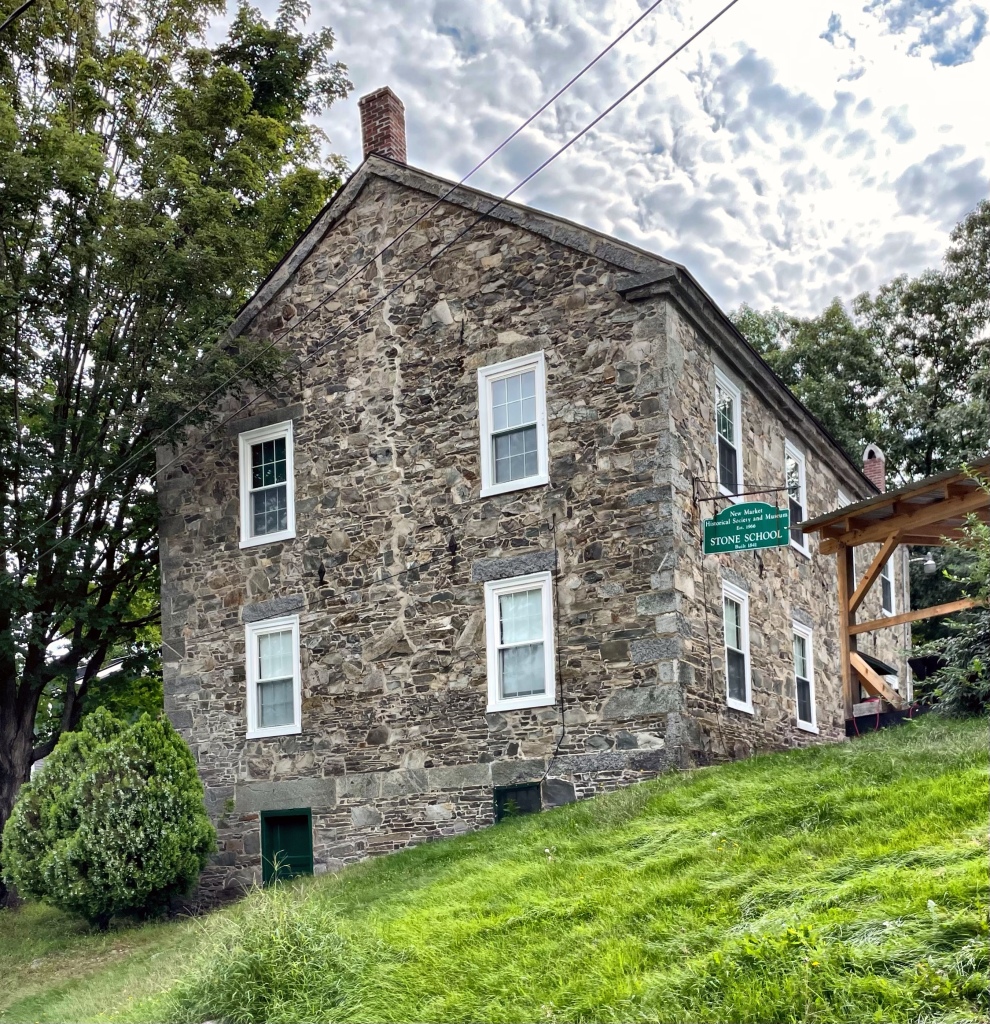
Old Stone School, Newmarket // 1841

Perched high on a hill, next to the Stone Church (featured previously), the old Stone School in Newmarket is one of a handful of iconic stone buildings in the town. Built in 1841, its stonework executed by William and Robert Channel, local farmers and stonemasons, who likely got their skill from building stone walls on farms. The building was used continuously as a school until 1966, when it was given to the Newmarket Historical Society, which now operates it as a local history museum.

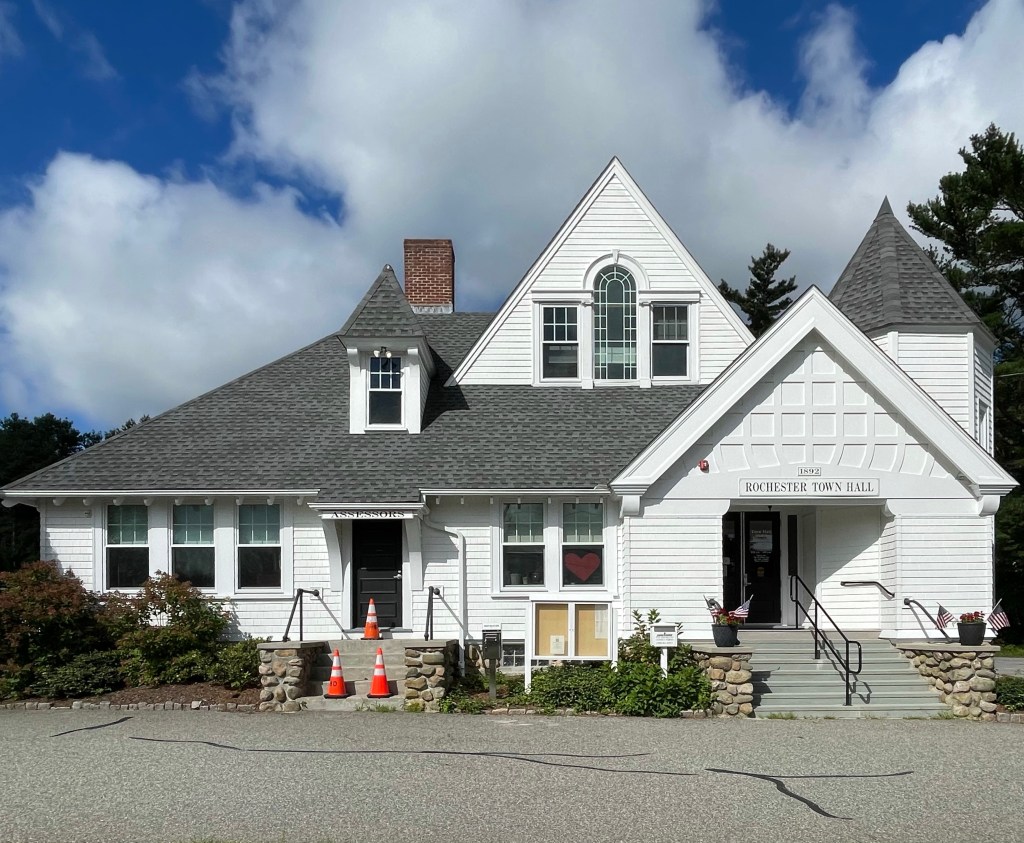
Rochester Town Hall // 1892

In 1679, three years after the end of King Phillip’s War, an armed conflict in 1675–1678 between indigenous inhabitants of New England and New England colonists, land that would become Rochester, Mattapoisett,
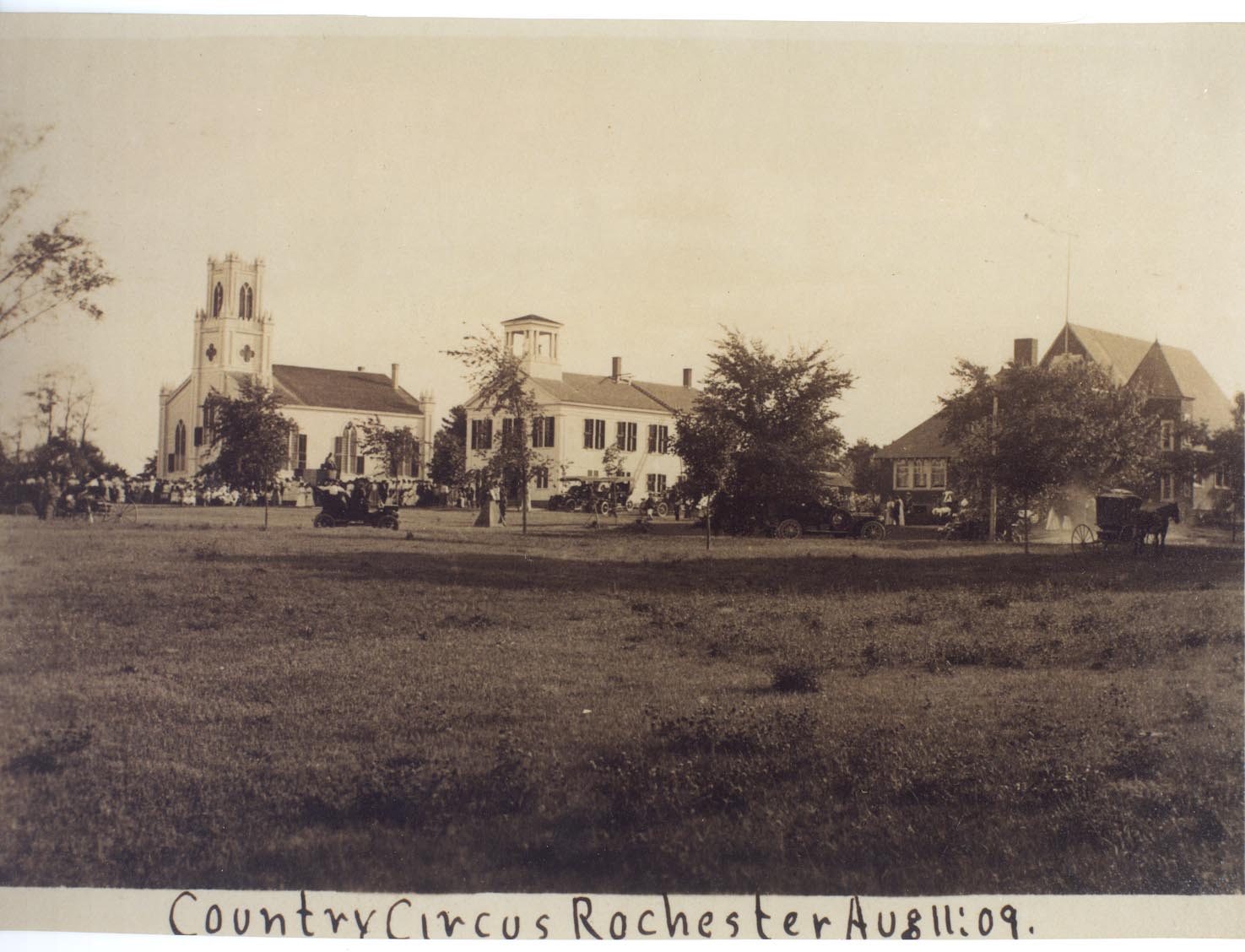
Marion, and Wareham was purchased from King Phillip, and immediately divided among 32 proprietors of “Old Rochester.” The first white settlers took up residence in 1680, and the Town of Rochester was incorporated in 1686. Rochester town center was formally established in 1697 when land was set aside for a meetinghouse, burying ground and training field. Rochester’s first meetinghouse, built in 1699, served as a church and town building. A larger meetinghouse was built in 1717, and a third in 1760, doubling in size every time as the town’s population grew. The old buildings were insufficient for the growing farming town, and wealthy widow Elizabeth Leonard funded half the cost of a new town hall building. The current structure on the town green was built in 1892 and is an uncommon example of a Queen Anne style town hall in Massachusetts. The building originally was painted a darker color, common in the style, but was given a bright white paint scheme to blend in with the older buildings on the Green.

Chester Tin Shop // c.1830

Located on the edge of the Chester Town Green, you can find this beautiful Federal style commercial building. The use of blind arches at the facade is a fairly common feature found in brick Federal style buildings in Vermont. The structure was built around 1830 and has served a variety of uses through its existence, the most notable being the tin shop owned by various members of the Miller and Hadley families that sold stoves and hardware during the latter half of the 19th century. The tin business in New England grew rapidly after 1820. Tin shop owners imported tinplated sheet iron from Great Britain, shaped it into a variety of forms, and distributed their finished goods through peddlers and country stores. They also sold tinware in their shops. Colanders, dippers, dish kettles, funnels, measures, and pans were in greatest demand. Other common items included lanterns, foot stoves, teapots, coffeepots, “tin kitchens”, skimmers, and sconces. After its use as a tin shop, the building was occupied as a telephone exchange and electric utility company office. It presently is home to an antique store.

Captain Richardson Tavern // c.1785

The Richardson Tavern on Main Street in Durham, NH, was built shortly after the conclusion of the Revolutionary War by Captain Joseph Richardson (1756-1824). The tavern was sited on a rise, providing views of Mill Pond in the distance. The tavern provided meeting spaces for town officials and juries to meet and discuss important city matters before the construction of the first purpose-built town hall just a block away. The Federal style tavern was “modernized” in the early 20th century with Colonial Revival dormers and eventually was converted into apartments as the ever-growing University of New Hampshire brought more students into town.

“Old Parsonage” // 1813

The “Old Parsonage” was built in 1813 by Capt. John Pitcher, brother of Elizabeth Pitcher Taber, benefactress of the town of Marion. The side of the building that faces the street (what we see) is actually the back of the original dwelling. The Federal period house sits on a raised stone foundation with a central door and shingle siding above. Behind his home, a large pasture was situated where his sheep and cows grazed on fields. Pitcher used to hang a ship’s bell from the branch of an oak tree and ring it every evening at 9 p.m. as a curfew bell for the town. The bell is now located in the Marion Natural History Museum. When Capt. Pitcher died, he left his house to the Congregational Church, which used it as a parsonage for many years. It was sold in May of 2021 and is likely a private home now.

Governor Henry Lippitt Mansion // 1865

North (secondary) facade

New England is lucky to have so many diverse house museums where architecture and history nerds like me can tour old houses and envision what it was like to live in that era. The Governor Henry Lippitt mansion in Providence stands out as one of the most significant Victorian-era homes in Rhode Island, and contains one of the best-preserved Victorian interiors in America. The mansion was likely designed by local architect Russell Warren, and modified by Henry Lippitt (1818-1891), heir to one of Rhode Island’s leading textile manufacturing families, for his wife Mary Ann Balch (1823-1889) and their six children who survived to adulthood. While Henry was a prominent businessman, his wife Mary may have been even busier. Mary owned and managed rental properties in Providence, including this mansion, giving her husband Henry life tenancy. She oversaw day-to-day running of the mansion, supervising the servants while teaching her daughter Jeanie, who became deaf at age four due to complications from scarlet fever, to read lips and continue to develop her speech. The Lippitt Mansion is an early, and high-style example of an Italianate Villa/ Renaissance Revival design, which moved away from the more prescribed forms of architecture towards the more eclectic, Victorian-era mode. The home features two main facades, with the smaller, west (main) facade featuring a central pavilion with ornate foliate frieze and Corinthian columns, and the north (side) facade – my favorite – with a more commanding presence with a bold porte-cochere. The home remained in the Lippitt family for 114 years, and was later acquired by Preserve Rhode Island, who opened it to the public as a museum in 1993.