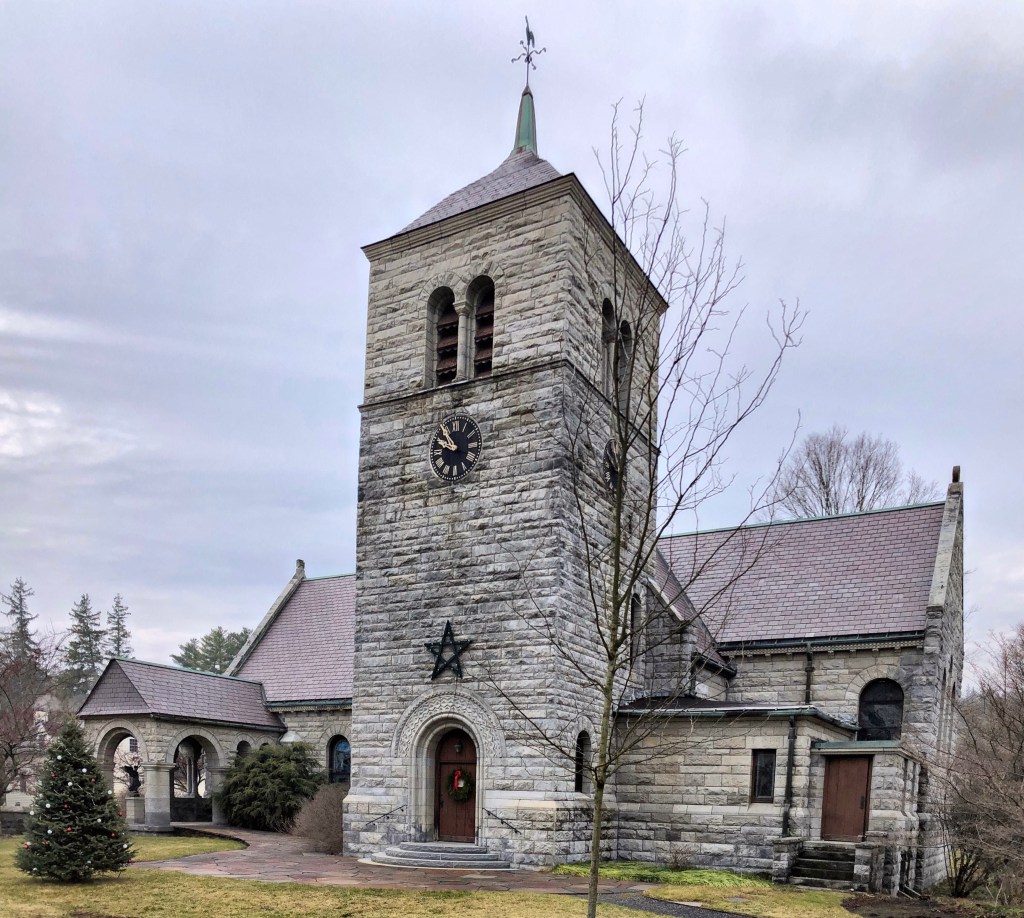
Located on the idyllic Main Street in Stockbridge, MA in the Berkshires, this stone church marks the emergence of the once sleepy town into a summer retreat for wealthy citizens, escaping the cities in the late 19th century. This building is Charles Follen McKim’s first church design, a building reflecting his early training in the office of H. H. Richardson with the use of Romanesque detailing, though with a hint of Norman design. St. Paul’s Church is constructed of gray Berkshire granite with stained glass windows by John La Farge. The church replaced an older wooden church building designed by Richard Upjohn in the Gothic Revival style. The church was almost entirely funded by Charles Butler, a New York lawyer who wanted to honor his late wife Susan Ridley Sedgwick Butler, a descendant of Theodore Sedgwick, whose home I featured not long ago.
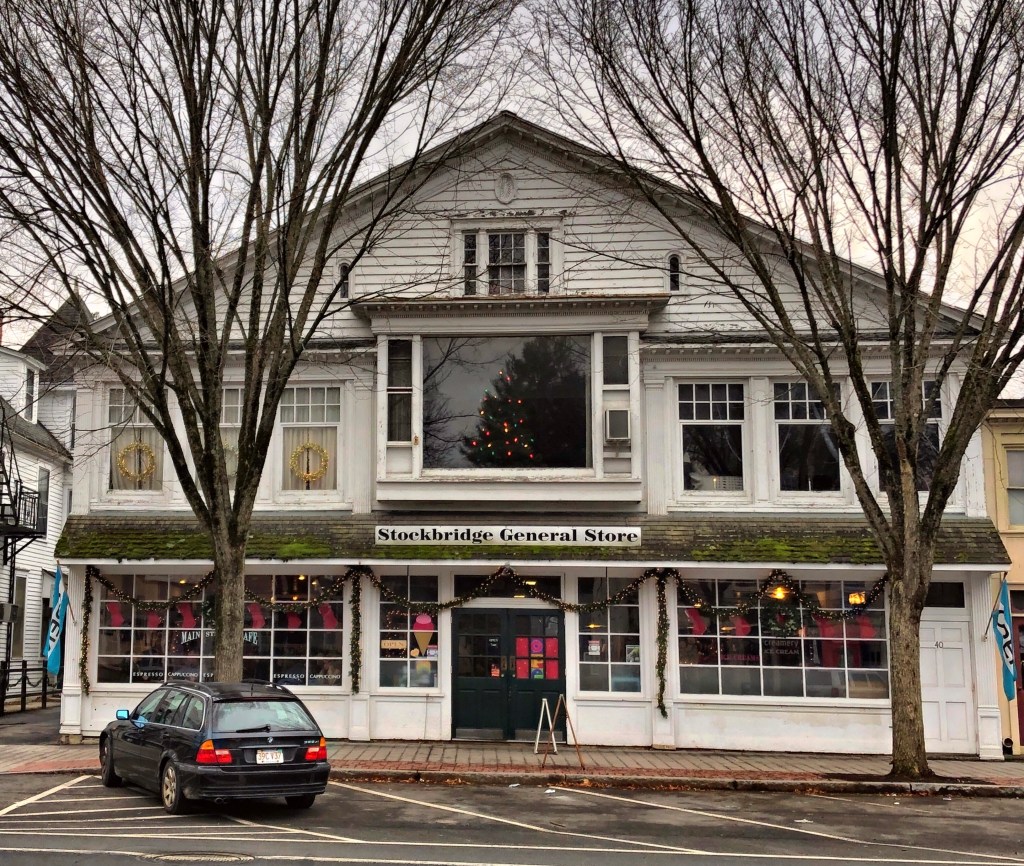
Norman Rockwell‘s ‘Home for Christmas’ painting in 1967 depicts the Main Street scene in Stockbridge, Massachusetts, and epitomizes the essence of Christmas in small towns across the country. In the iconic painting, you can find many landmarks (including the Town Offices building) that make up the quaint main street, that typifies many small New England towns. At the center of his painting, the Guerrieri Block can be seen with a Christmas tree lit up in the window on the second floor. The Guerrieri Block was built in 1921 by Antonio Guerrieri, a skilled woodworker who sold and repaired antiques in one of three street level shops in the block. He and his family lived in an apartment on the second floor. The next year he completed construction of a shop behind the block where he worked out of. In 1953, Norman Rockwell moved to Stockbridge and spoke with Antonio about using the second floor of his building as a studio. Antonio constructed a large central bay window with plate glass to flood the space with light and allow Rockwell to work while observing the street below. Rockwell used the space as his studio until 1957. The building has since been occupied as a general store.
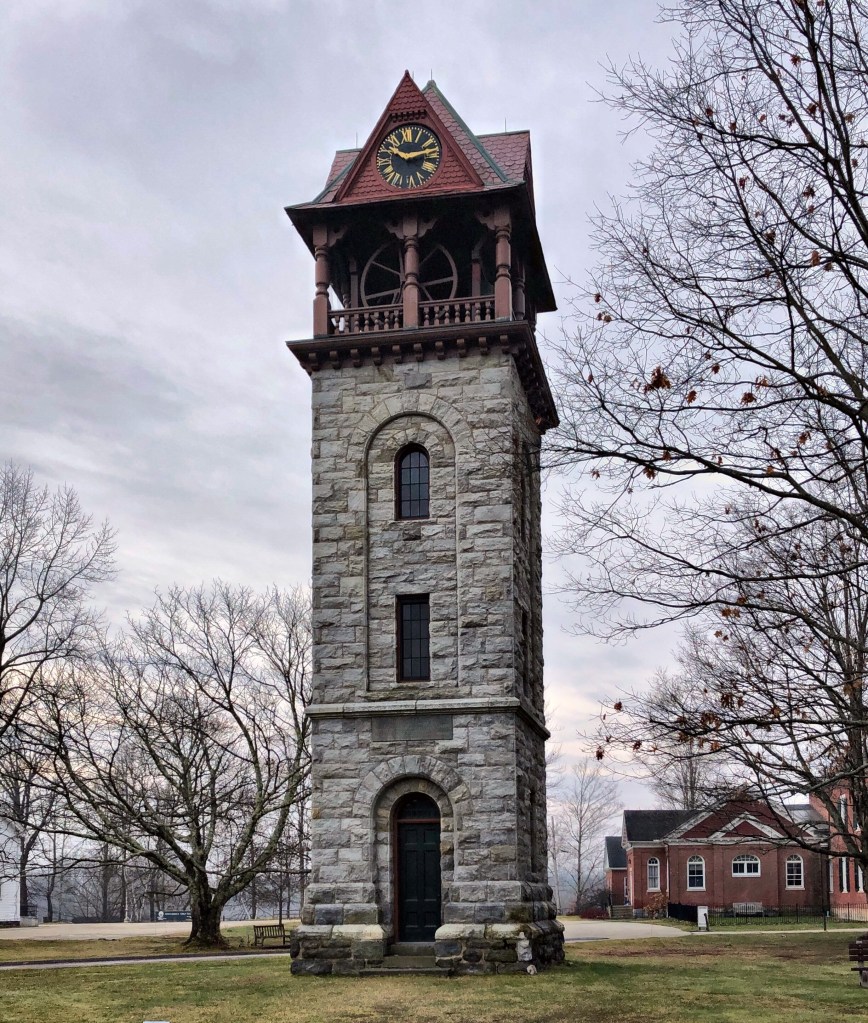
Located in front of the old Town Hall and Congregational Church in Stockbridge, this tall carillon (bell tower), was gifted to the town by David Dudley Field, Jr. in memory of his grandchildren. His one condition was the chimes were to be rung everyday at 5:30 p.m. between, “apple blossom time and the first frost on the pumpkin”. The tower has a stone base and wooden belfry surmounted by a pyramidal roof with clocks on all four sides. The tower remains a gift, not only to the memory of his grandchildren, but to passersby who are lucky enough to hear the bells toll.
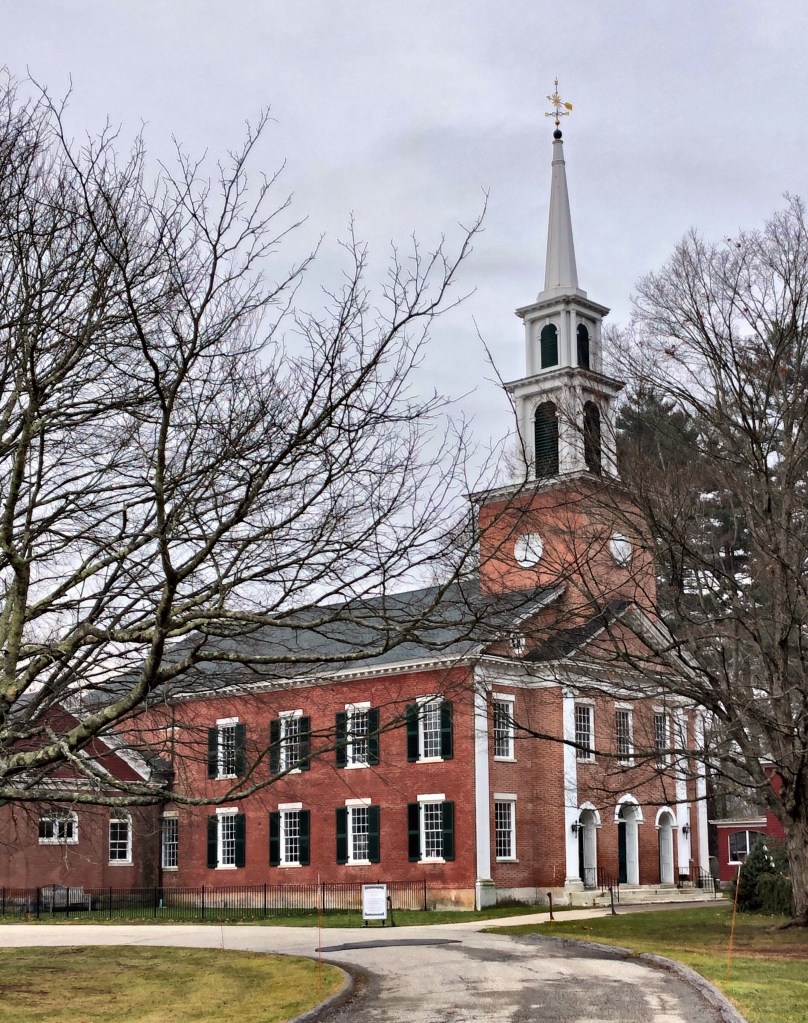
The Town of Stockbridge, MA was incorporated on June 22, 1739. After that time the town held meetings and conducted business in the First Congregational Meeting House until 1840 when this Greek Revival town hall building was erected on the church’s property as a gift. A stipulation was made that if the Town government constructed or moved to a new town hall building, the property ownership would revert to the Church. The town outgrew the building and constructed a new building toward the center of town, but named it Town Offices, a cheeky way to retain ownership of this building. Eventually, that building too was outgrown, and the town hired Pittsfield-based architect Harry E. Weeks to modify and enlarge the building in 1903, in the Neo-Classical style to compliment the original Greek detailing. As expected, the town moved again in the 2000s to a former school, on Main Street, but again retained the building.
Stockbridge, Massachusetts was settled by English missionaries in 1734, who established it as a praying town (an effort to convert the local Native American tribes to Christianity), for the Mohican tribe known as the Stockbridge Indians. The township was set aside for the tribe by English colonists as a reward for their assistance against the French in the French and Indian Wars. From this, a Yale-educated missionary, John Sergeant began converting native people to Christianity, essentially stripping them of their own religious culture and practices. Although Massachusetts General Court had assured the Stockbridge Indians that their land would never be sold, the agreement was rescinded. Despite the aid by the tribe during the Revolutionary War, the state forced their relocation to the west, to New York and then to Wisconsin. The village was then taken over by British-American settlers who created the township.
The first congregational church here was formed by Sergeant in 1734, and later succeeded by Jonathan Edwards, another minister. During his time in Stockbridge, Edwards wrote his masterpiece, Freedom of the Will, which remains one of the most studied works in American theology. Edwards later left the church to become the President of The College of New Jersey, now known as a little school by the name of Princeton. The first church was built in 1739, later replaced by a second church building that stood from 1785 to 1824. The present brick building was built in 1824 in the Federal Style. The space was occupied for town functions until the 1840s, when an official town hall was erected next door, demarcating the separation of church and state. The stunning church marks the immense influence religion had in the early colonial days of New England and the impact it had on native peoples (for better or worse).
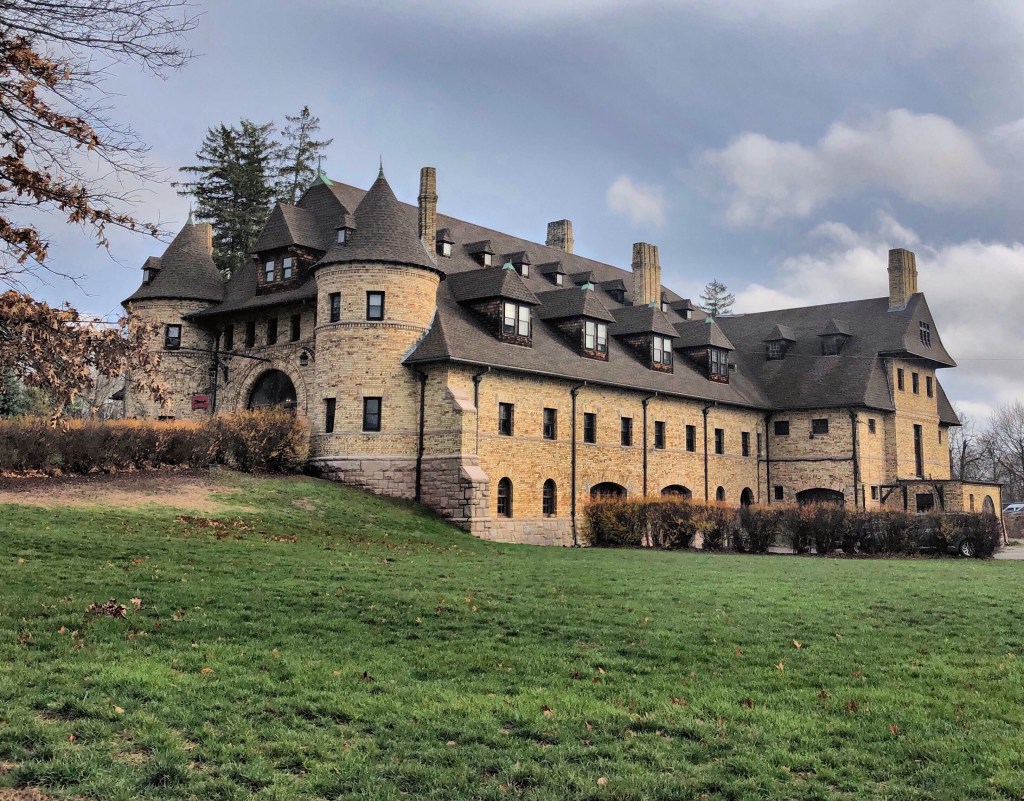
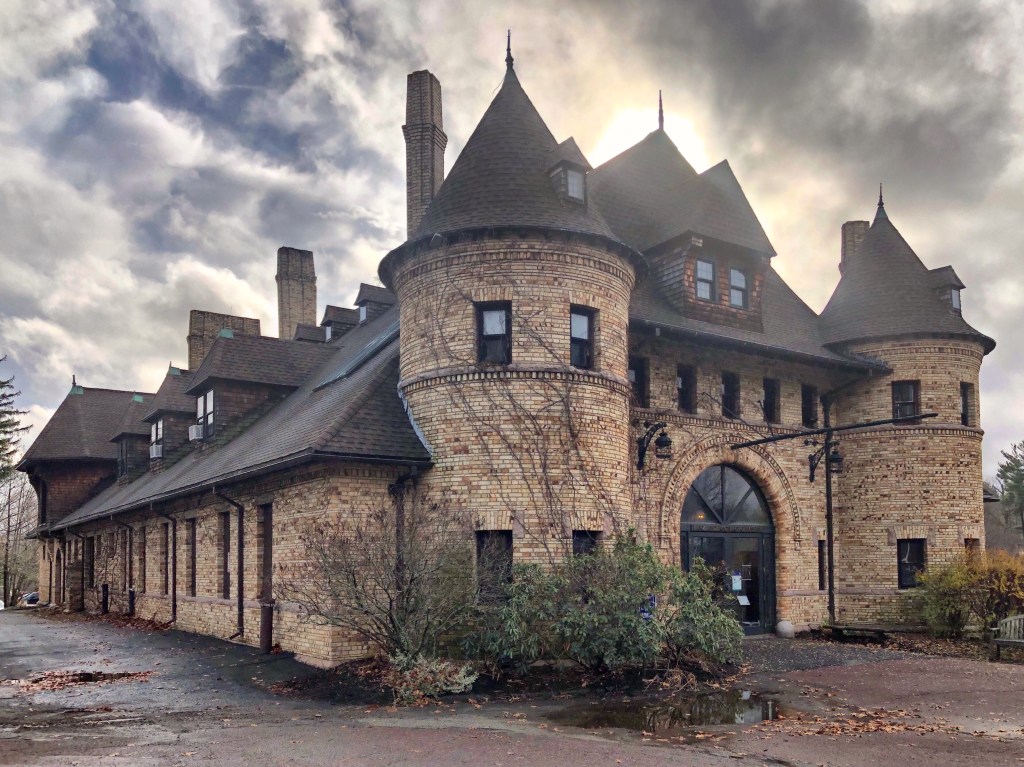
This large and imposing brick and stone structure, located in Larz Anderson Park in Brookline, was once the carriage house of “Weld”, the estate owned by Larz and Isabel Weld Anderson. Constructed in 1888, it was inspired by the Chateau de Chaumont-Sur-Loire in France and designed by Edmund M. Wheelwright, the city architect of Boston. First constructed to house a working stable, it later served to house and maintain the Andersons’ growing automobile collection. After Isabel Anderson’s passing in 1948, the collection was entrusted, at Isabel’s bequest, to the Veteran Motor Car Club of America. The VMCCA then established the nonprofit organization that is now known as the Larz Anderson Auto Museum. The former mansion suffered from vandalism in the 1950s and caught fire, later demolished by the Town, who could not afford to rebuild the home.
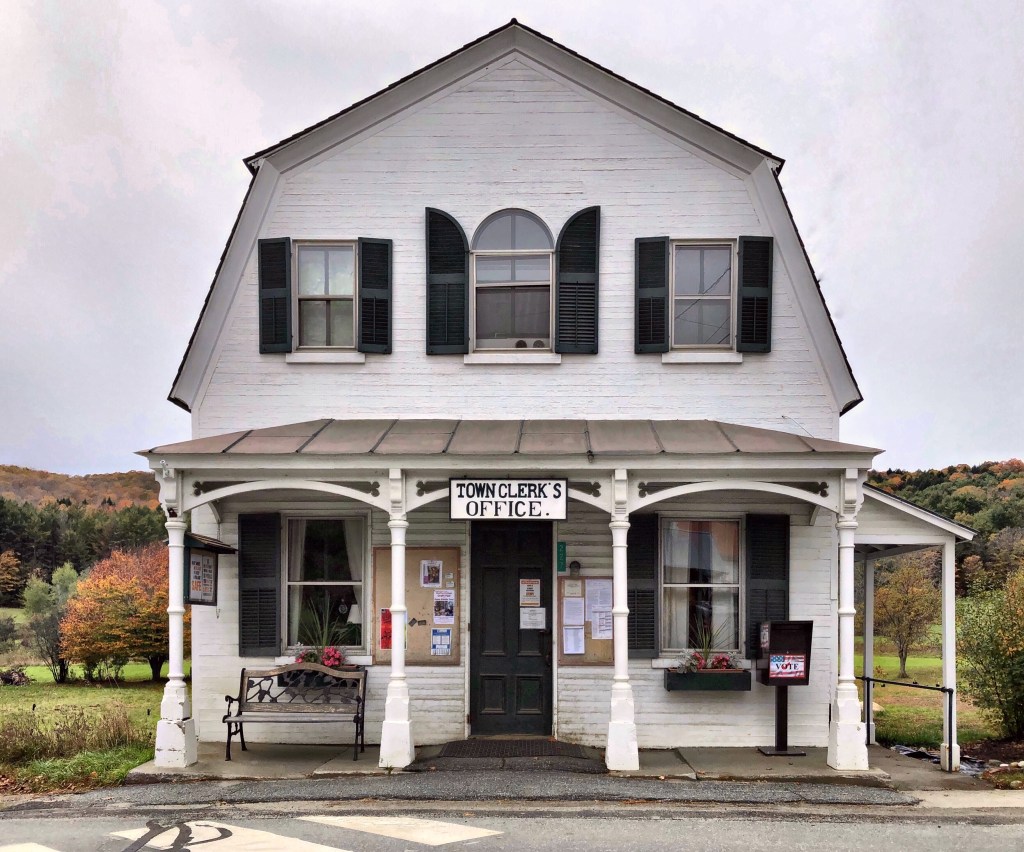
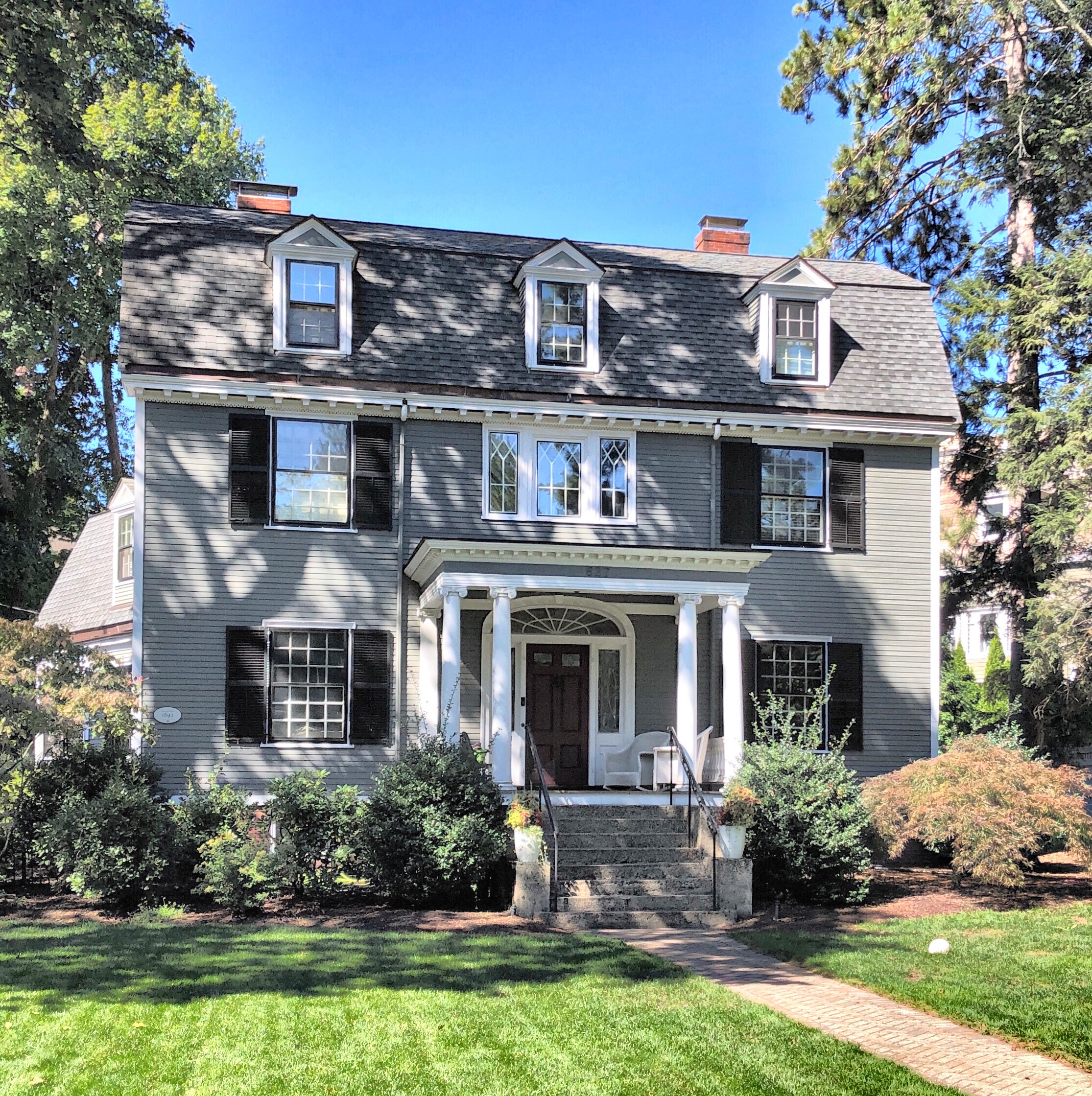
Designed and built by Senator Justin Morrill in 1883, this building was donated to the town of Strafford by Morrill in memory of his mentor Jedidiah Harris. It was given to the town as a public library in part to house the Harris Library, which in turn had been created by a bequest from Harris. This structure remained a library until the Morrill Memorial Library building was completed in 1928 and its collection was joined with Morrill’s. It is currently used as the Town Office building providing space for the Town Clerk/Treasurer and Town Records, and town boards. The white clapboarded building has Victorian detailing with the spindled posts at the porch with a prominent gambrel roof covered in slate. Cute!
Joel Farist (1832-1904) emigrated to America with his family by the way of Sheffield, England, working originally as a laborer as a child. By his thirties, he formed the Farist Steel Company in Springfield, MA, later relocating to Bridgeport, CT in 1872. Due to his prestigious role and success, he became well-connected in Bridgeport, later becoming the first President of the Bridgeport Electric Light Company and Vice President of Bridgeport Hospital. He built this massive home in nearby Fairfield, CT, likely to get away from the polluted Bridgeport air, for a more bucolic area. The massive Queen Anne home he had built (likely as a second home) features prominent towers, a full-length porch, and a porte-cochere off the side. The home has been restored a few times recently, and a new (hopefully not final) paint scheme in yellow was recently painted on the front facade.
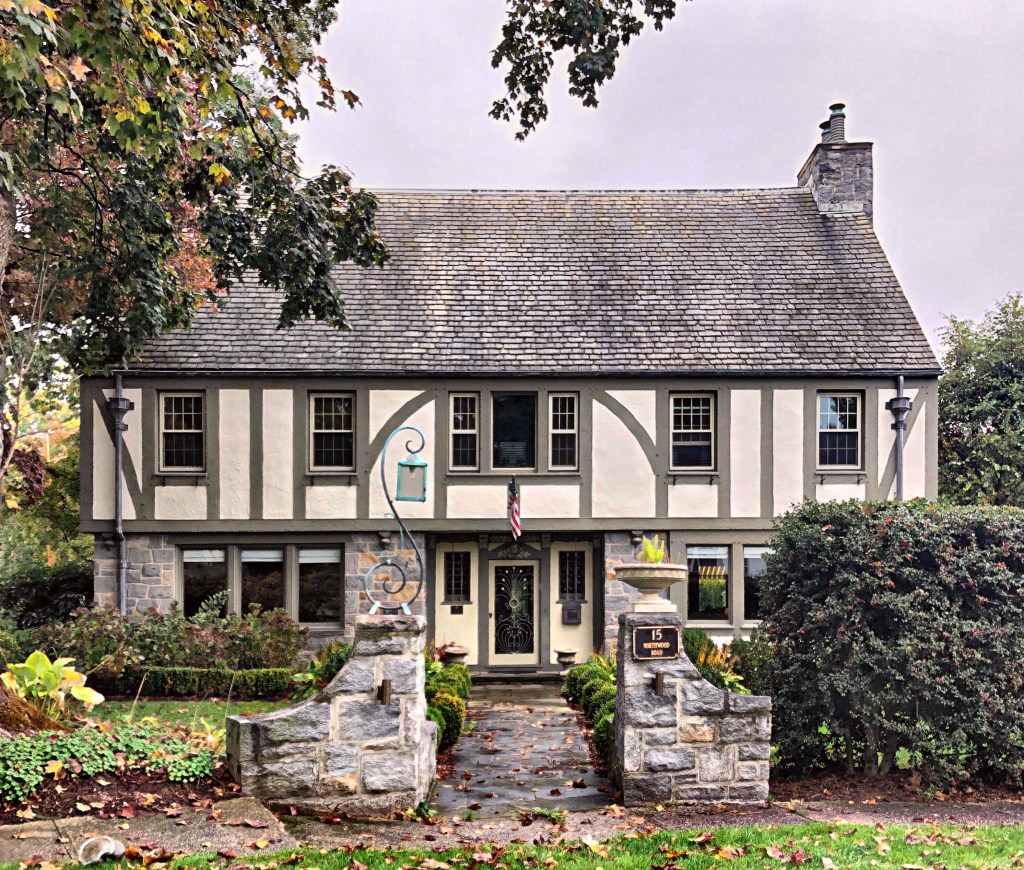
Herbert Almon Chaffee and Irma Chaffee had this Tudor home built by 1931 for their family in Fairfield, Connecticut. Mr. Chaffee was the Vice President and Assistant Treasurer of the City Savings Bank of nearby Bridgeport. Chaffee also at that time worked as Vice President of the A.W. Burritt Company, a lumber mill that produced building supplies and also operated as a real estate company that bought land and constructed on it. The home he had built clearly showcased the company’s work and features hallmarks of the English Tudor Revival style, with half-timbering, slate roof, and jettying (upper floor slightly overhanging the first).
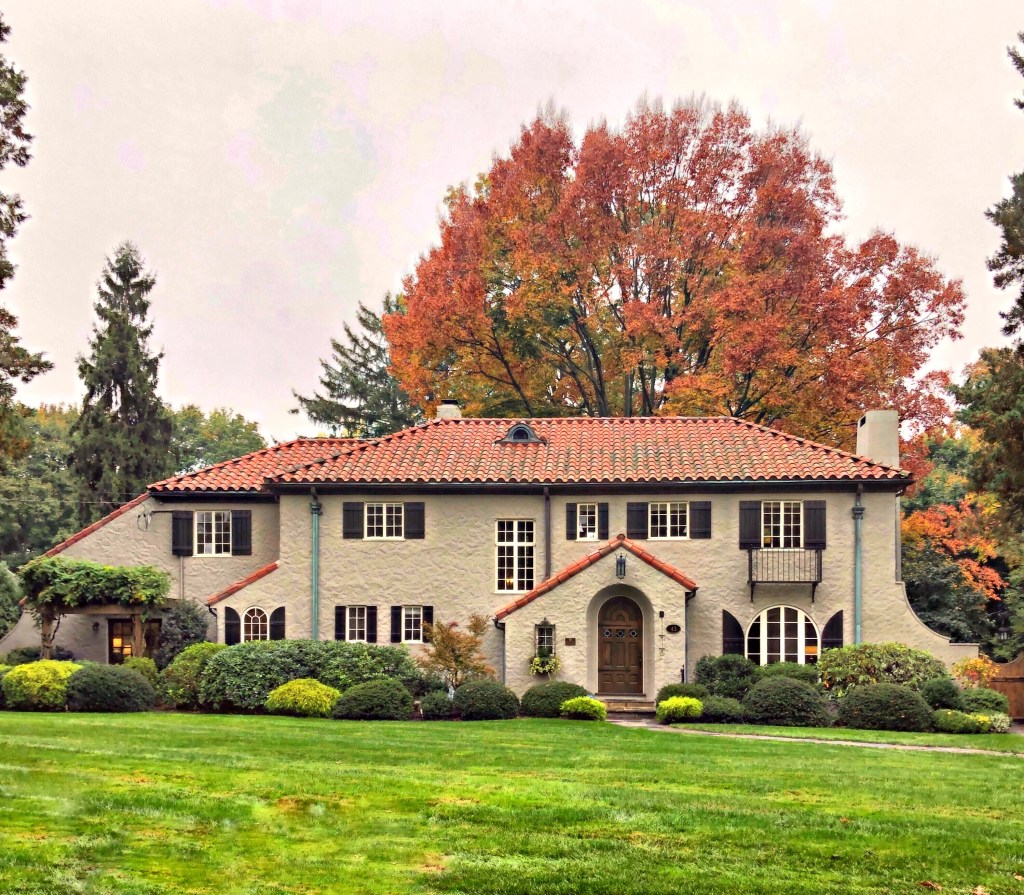
Fairfield in the early 20th century began to shift as a suburban town with neighborhoods of large homes in planned districts. The proliferation of the personal automobile led to the “suburbanization” past streetcar suburbs closer to downtowns. Howard Greeley Lee (1893-1965) worked as Vice President of the Lee Brothers Furniture Co. based out of nearby Bridgeport. The company clearly did well as Howard had this large home built in the fairly uncommon (in New England) Spanish Revival style. It features a red tile roof, stuccoed siding, metal casement windows, and arched windows and front door, all commonly found in the style.
The First Church Congregational in Fairfield, Connecticut is the sixth church to occupy this site! The first structure was built in 1640, and the current building was constructed in 1892. The third version of the church was burned by the British in 1779, while the fourth “meeting house” took nearly 42 years to finish and was partially funded by the sales of properties which formerly belonged to Tory sympathizers. The Romanesque Revival church was designed by architect J. Cleaveland Cady, who is best known for his design of the south entrance of the American Museum of Natural History on the Upper West Side of Manhattan.
I’m starting to see a trend in Easton, almost everything is named after the Ames Family! In 1893, Oliver Ames (1831-1895), a grandson of shovel company founder Oliver Ames and son of Oakes Ames, offered to fund the construction of a new high school building if the town would pay the cost of building its foundation and grading the site. While governor of the Commonwealth of Massachusetts (1887-90), Ames had hired Boston architect Carl Fehmer as consulting architect to the State for the extension to the Massachusetts State House, and it was Fehmer who secured the design contract for the new school in Easton. The refined Colonial Revival school building features a central pavilion with an entrance set within an ornate stone architrave with a Classical entablature with central pediment. The school was outgrown in 1957 and became the town’s middle school, outgrown again in the 1990s. The town sold the school to a developer with preservation restrictions and it is now used as apartments!
Another architect-designed home for their own use in Waban Village in Newton, is this house on Chestnut Street. Built in 1892, the Colonial Revival home is set far off the street with a commanding presence and symmetrical facade. The home was designed and occupied by Lewis Howard Bacon (1857-1941), a former chairman of the Newton board of appeals and a member of the school committee and the board of aldermen in Newton, also a practicing architect. He studied architecture in the office of Samuel Lane, architect of Cleveland, 1877-80, when he moved to Boston as a draughtsman and supervisor of construction for the firm of Sturgis & Brigham, 1880-1886. For four years he was a member of the firm of Morrison & Bacon (1888-1892), before embarking on his own practice in an office in Downtown Boston. He resided in this home until his health failed and he moved to a nursing home where he died.
For middle-class families in North Adams, some residents could afford to move out of workers housing but not yet afford single-family homes, the best option was for apartments. Seeing the demand for this housing type increase with the booming industrial development in town, businessman and real estate developer, Martin Crafts Jewett developed some of his land with a luxurious apartment building. This six-unit building has beautiful poly-chrome brickwork and corbeled chimneys, mansard roof with wall dormers, and flared turrets, typical of its architect, Marcus F. Cummings who also designed the Blackinton Mansion (now North Adams Public Library).
Located on Main Street in North Adams, you’ll find this monstrous commercial block looking like it belongs in New York, not in Western MA. North Adams in the early 20th century was booming as an industrial center with a rapidly growing population. Due to this, business owners had the capital and clientele needed to erect large commercial buildings. A man named Jencks Kimbell owned a couple large parcels of land on Main Street and ran a livery stable there until his death in 1858. The business was ran by his sons until their death and the property was willed to their widows Clara and Lydia who saw the potential for the site to make them money. In 1902, the two widows erected this magnificent block on Main Street, with a stone facade. Built on top of a quicksand pit, it was the first building in North Adams to be built on steel pilings. I could find no information on the architect, but it is Eclectic to say the least! It has Romaneque arches, monumental pilasters with Corinthian capitals, and a Swan’s neck broken pediment at the parapet.






 Buildings of New England