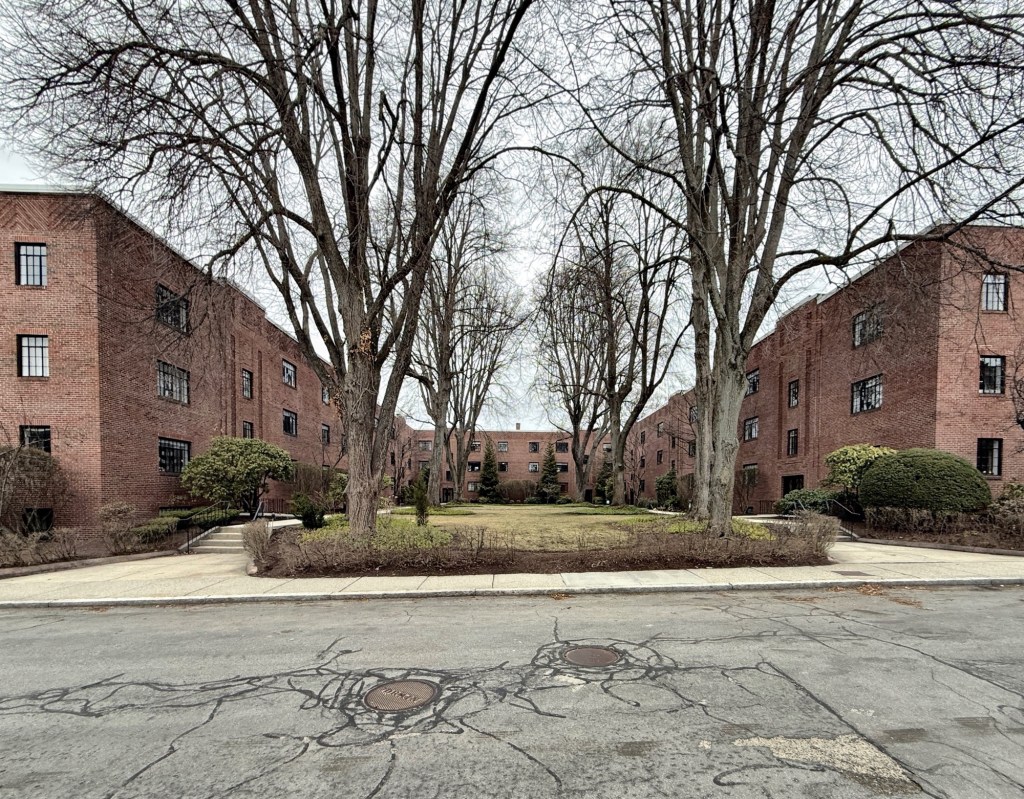
Sewall Apartments // 1938

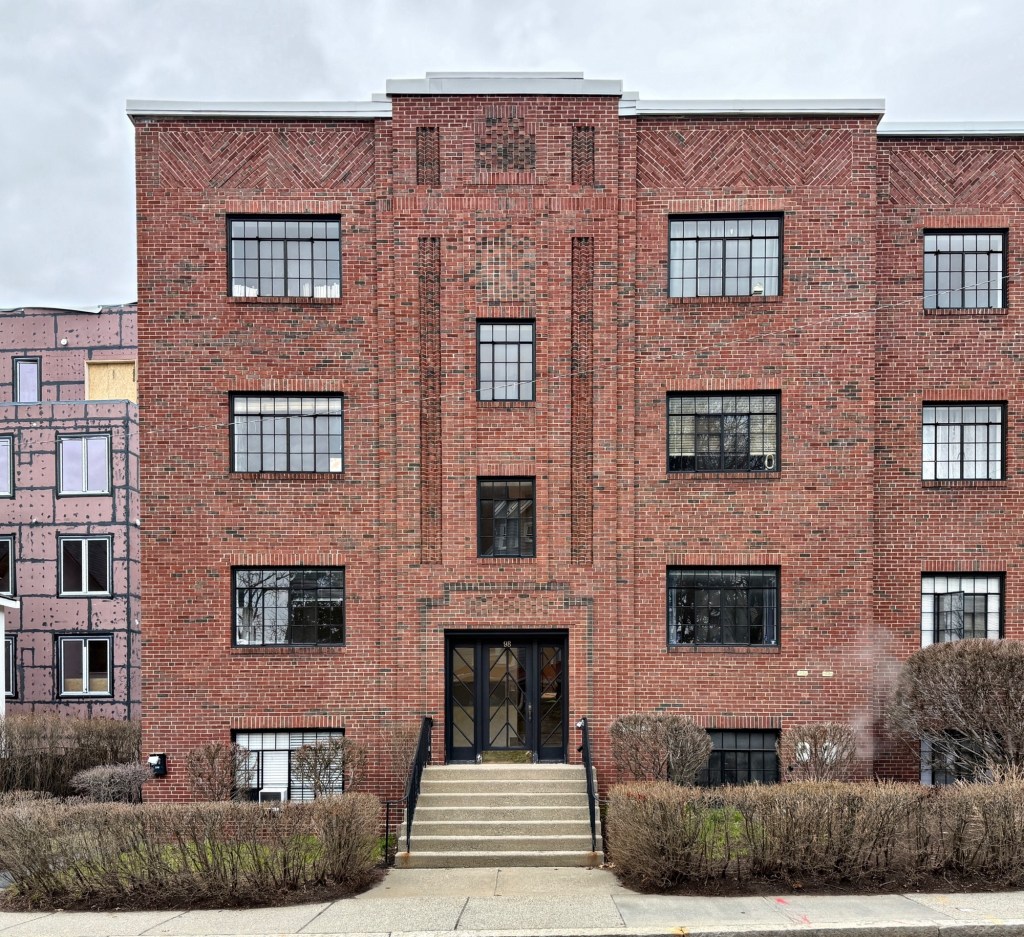
This garden apartment complex at 98-116 Sewall Avenue in Brookline is an excellent example of the Art Deco style which reached its height in popularity in the midst of the Great Depression, so fewer examples of the style are typically found. Here in Brookline, the city was seeing rapid development in the early decades of the 20th century, where large estates were subdivided and commercial areas expanded into once residential neighborhoods. U-shaped in plan and standing three-stories, this complex replaced a large property owned by the Stearns Family, a prominent local family with many properties around present-day Coolidge Corner. The apartments were developed by the G & S Investment Company, a real estate development firm, who hired architect, Saul Moffie, to design the building. Completed in 1938, the complex has richly articulated facades with a variety of geometric brick patterns, including chevrons, diapering, header courses and soldier courses with each entryway identified by a projecting pavilion with a stepped stone parapet above. The doors and sidelights are wood with glass panels in a chevron motif similar to the brickwork and all residential units have steel multi-pane windows. What a gem!
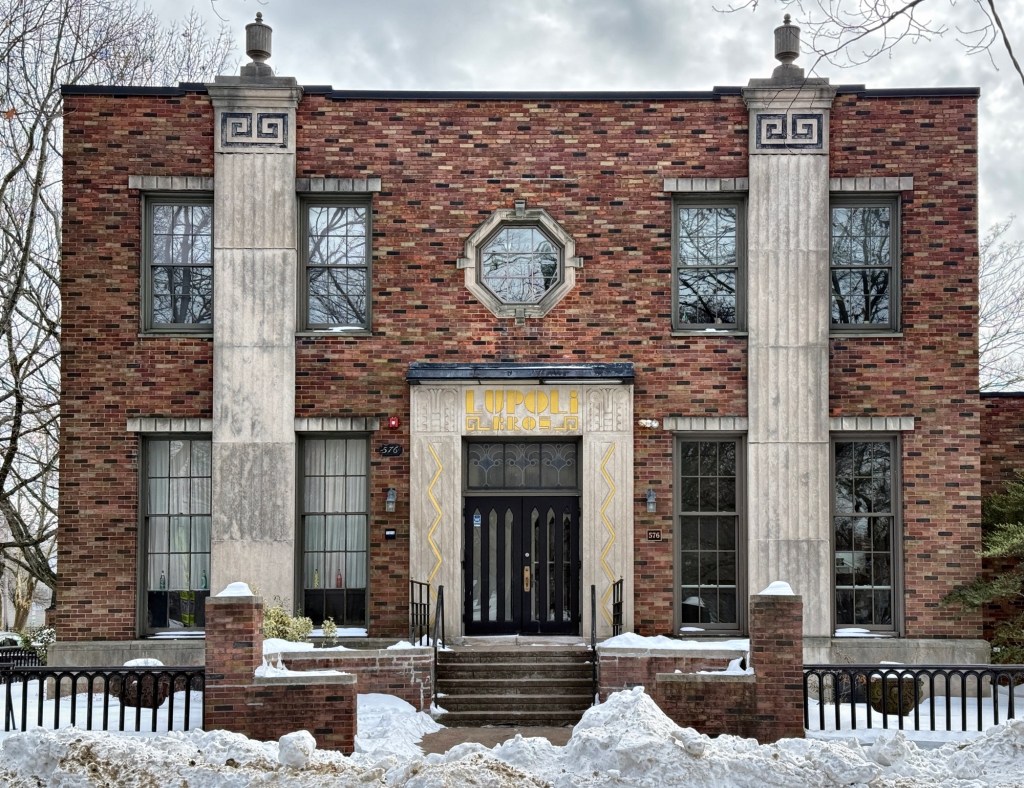
Former Lupoli Brothers Funeral Home – H. L. Hotchkiss House and Stable // 1841 & 1935

A rare example of the Art Deco architectural style in New Haven, the former Lupoli Brothers Funeral Home on Chapel Street in Wooster Square is more than meets the eye! This Art Deco jewel box was originally constructed in 1841 as a large, single family home and modernized nearly 100 years later in its current design. In 1841, Henry Lucas Hotchkiss (1810-1861), a businessman and president of the L. Candee Rubber Company, had a two-story Greek Revival style home built on this lot for his wife, Lucy. The home was originally two stories, but a third floor was added in the 1860s, around the time the rear stable (still extant) was constructed, for another owner. In the early 20th century, as the Wooster Square neighborhood became a center of Italian-American life and business in New Haven, the property was purchased by Liberato Lipoli (1862-1934) who moved to Connecticut from the Piedmont region of Italy. A year after their father’s death, sons Mario, Gennaro, Antonio and Louis Lupoli, established a funeral parlor catering to the local Italian American community. In 1935, the Lupoli Brothers hired local architect, Lester Julianelle to reimagine the former Hotchkiss House in a modern style. The result is the refaced building with Classical Revival and Art Deco elements including the iconic entry reading, “Lupoli Bros” in the iconic lettering. The Lupoli’s closed the parlor here in 2008 and the building was converted to eight condominium units.

Derby Gas and Electric Company Offices // 1931

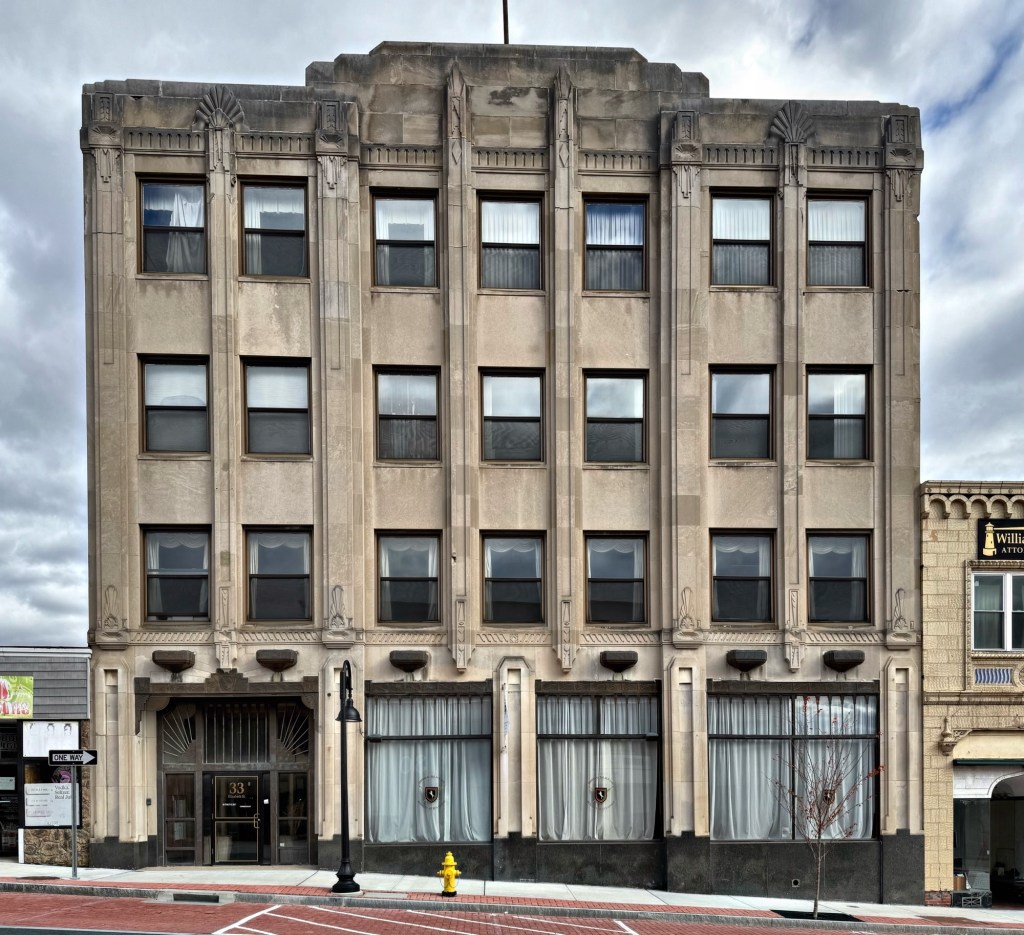
The former Derby Gas and Electric Company offices are located on Elizabeth Street in Derby, Connecticut, and stand as one of the great Art Deco buildings in New England. Built in 1931, the four-story office building features a limestone facade with bronze storefronts and light fixtures which were illuminated from the company’s plant nearby. In the 1950s the company was acquired by the United Illuminating Company.

Woodrow Wilson School // 1932

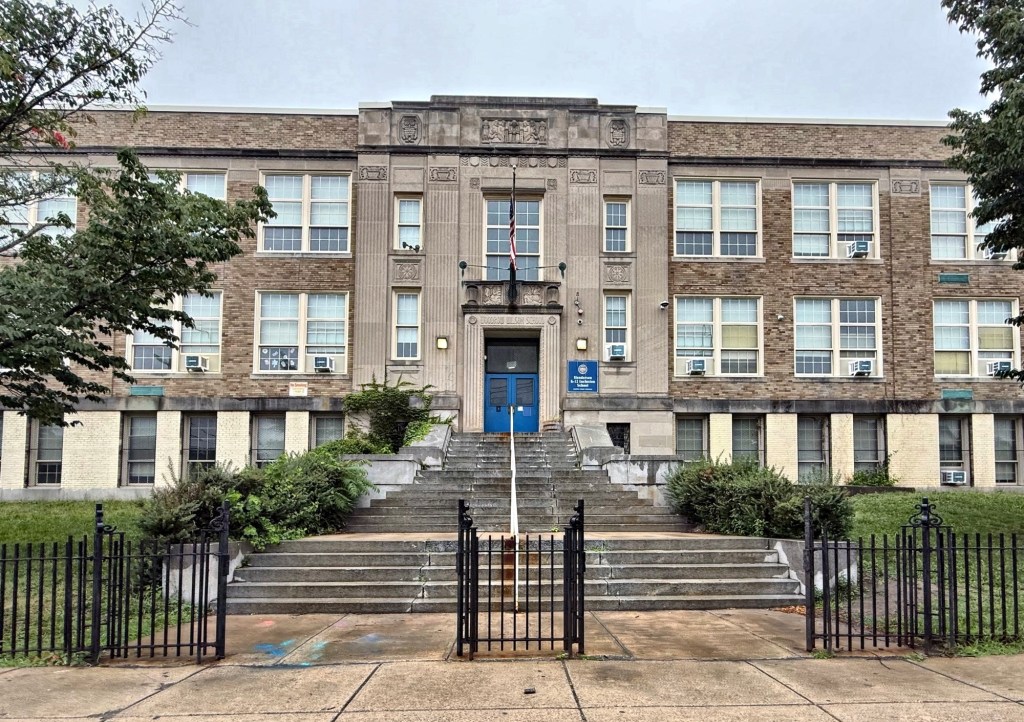
The Woodrow Wilson School, now Dr. William W. Henderson K-12 Inclusion School, is located at 18 Croftland Avenue in the Ashmont neighborhood of Dorchester. The school was built in 1932 to accommodate increased development and population growth in the immediate area in the interwar period and was designed in a blending of Classical Revival and Art Deco styles, both popular at the time for such academic buildings. The building was named for Woodrow Wilson (1856–1924), the 28th President of the United States and was designed to comfortably accommodate 1,600 students. Architect, John Matthew Gray designed the building to conform to a plan drafted by the City of Boston in 1923 to standardize all new school construction down to the precise dimensions of windows and hallways. The permitted flexibility for hired architects was strictly on the exterior, where architects were free to create individual character in the designs of entryways, auditoriums, and exterior architectural styles and decoration. The entry of the Woodrow Wilson School depicts Art Deco motifs including lettering and inlaid carved panels over the door of a child reading and a child holding a globe. The school was renamed the Dr. William W. Henderson K-12 Inclusion School after the innovative educator of the same name.


Wales-Amory Townhouses // 1860

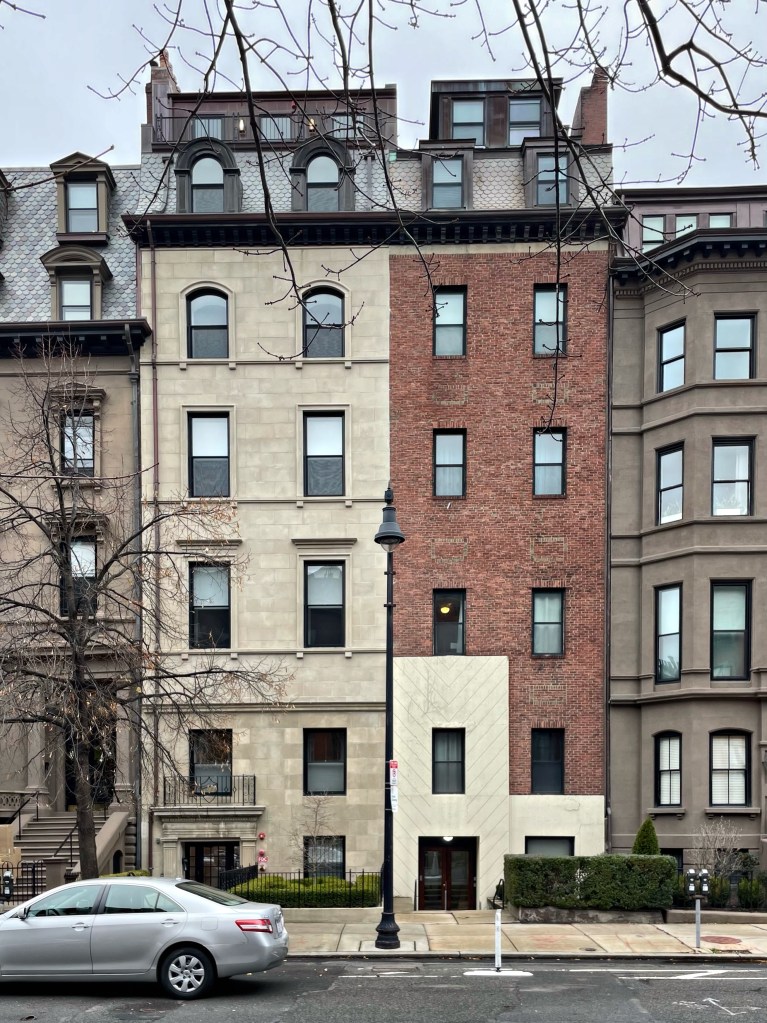
This is why preservation matters! These two townhouses on Beacon Street in the Back Bay of Boston were constructed in 1859-60 for Gardner Brewer (on the right) and George W. Wales (left). Brewer, an extremely wealthy merchant built the house on the right for his son-in-law and daughter, William and Ellen (Brewer) Amory, as a wedding gift following their February 1860 marriage. The symmetrical pair of houses were both originally clad with a brownstone facade with Second Empire style trim details and a continuous mansard roof. Both houses were renovated by the early 20th century with Colonial influence, as Victorian styles started to wane popularity amongst wealthy circles. The former Amory house (right) was purchased by Della Saul and was operating as a boarding house by the 1930s. It was converted to an apartment building (like condos) and the building was renovated with a new facade in 1935 by brothers and architects George Nelson Jacobs and William Nelson Jacobs with a more modern/Art Deco appearance. The house on the left remained with its more Colonial facade until a 2018 renovation by architect Guy Grassi giving it a cast stone facade, restoring the three-condo house closer to its original appearance.

Waterbury Dam // 1938

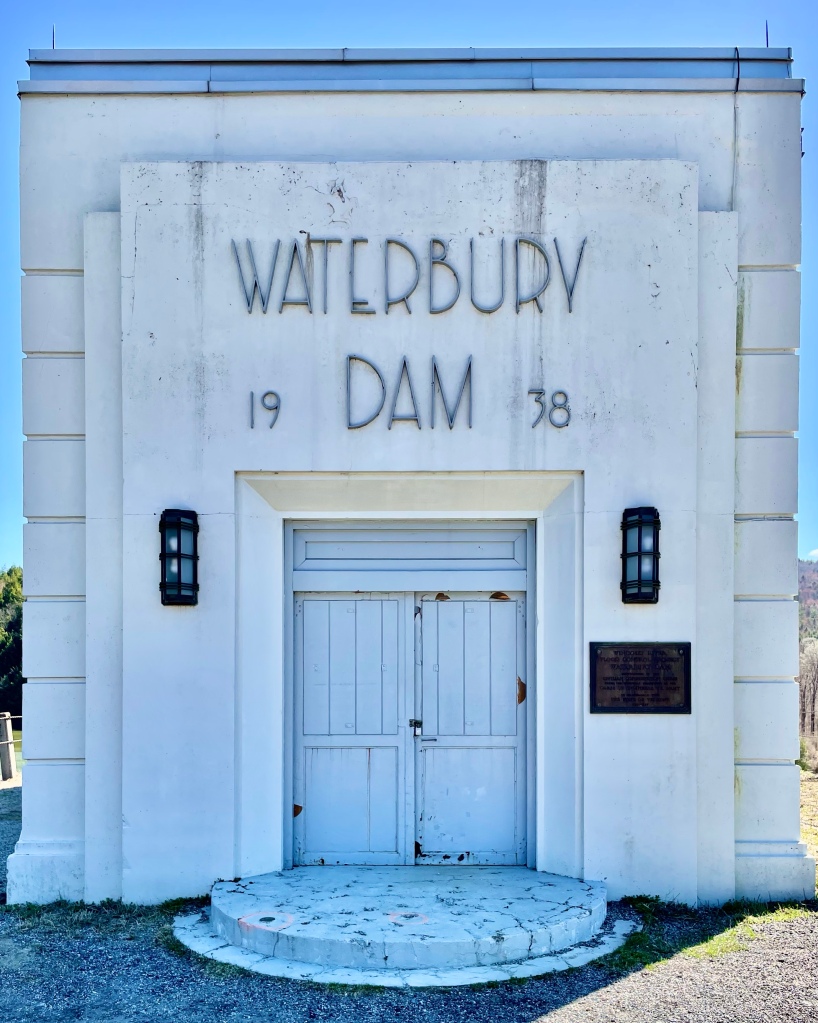
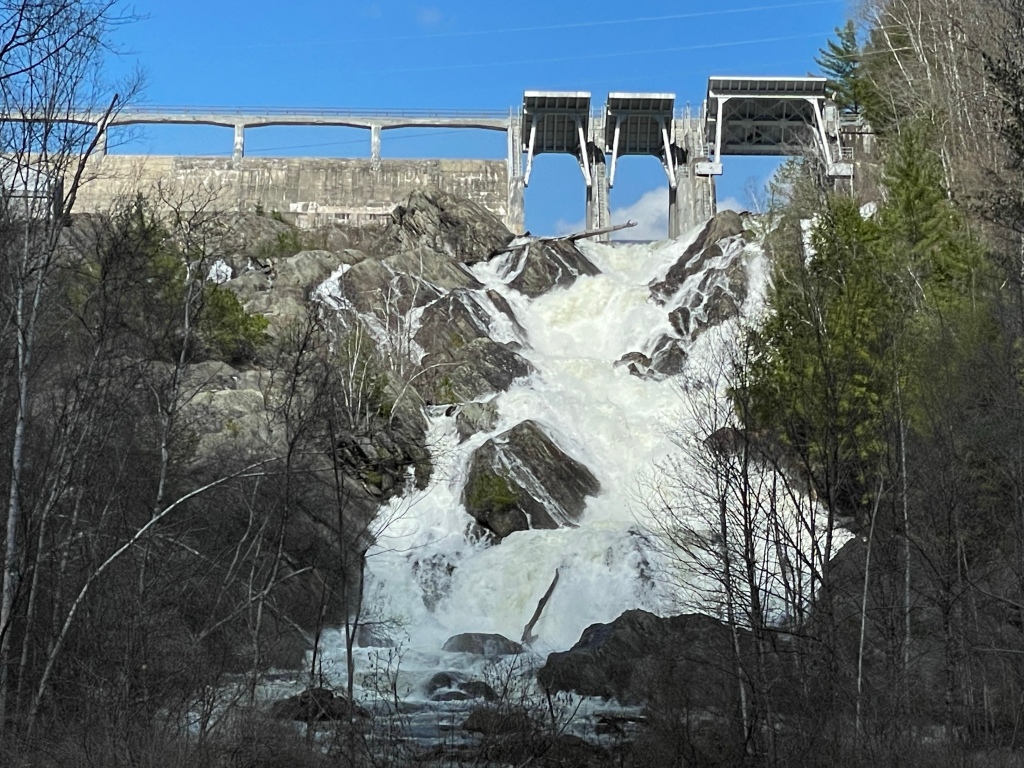
In November of 1927, a disastrous storm hit the State of Vermont. Severe flooding in the Winooski River Basin area resulted in the loss 55 lives and damages totaling over $22 Million. A Corps of Engineers study was initiated soon thereafter to investigate “the improvement of the Winooski River for the purposes of navigation in combination with the development of waterpower… and the control of floods.” The report presented a comprehensive plan for flood control and power development, consisting of: the construction of seven reservoirs; the installation of seven new hydropower plants, and the enlargement or improvement of 12 existing plants. Construction of the Waterbury Dam and Reservoir began in 1935 and was completed in 1938. The dam and reservoir were designed and built by the Corps of Engineers using contract services and Civilian Conservation Corps (CCC) labor, all thanks to the New Deal legislation enacted by President Franklin D. Roosevelt. The gatehouse at the top of the dam’s embankment is a rare example of Art Deco architecture in the state of Vermont and was completed in 1938 as the last piece of the project. The building and dam remain today as part of the Little River State Park and are a great example of Engineering History and a look into human intervention in the natural landscape.

Everett Savings Bank // 1930

Located next door to the First Congregational Church of Everett, you can find one of the finest eclectic commercial buildings in the region, and it is one that is often overlooked. The Everett Savings Bank was built in 1930 from plans by architect Thomas Marriott James for the Everett Savings Bank, which was established in 1889. This building was constructed just at the beginning of the Great Depression, at a time when banks and American citizens were penny pinching. The budget was likely set before the Stock Market Crash of 1929 as the relatively high-style bank building would have been a big expense at the time. The bank blends Art Deco and Spanish Renaissance Revival styles elegantly. The structure is constructed with sandstone walls that are decorated with figured panels and semi-circular multi-pane windows are outlined by rope molding. Crowning the building is a bold arcaded frieze with Moorish inspired cornice. Swoon!

Hatch Memorial Shell // 1940

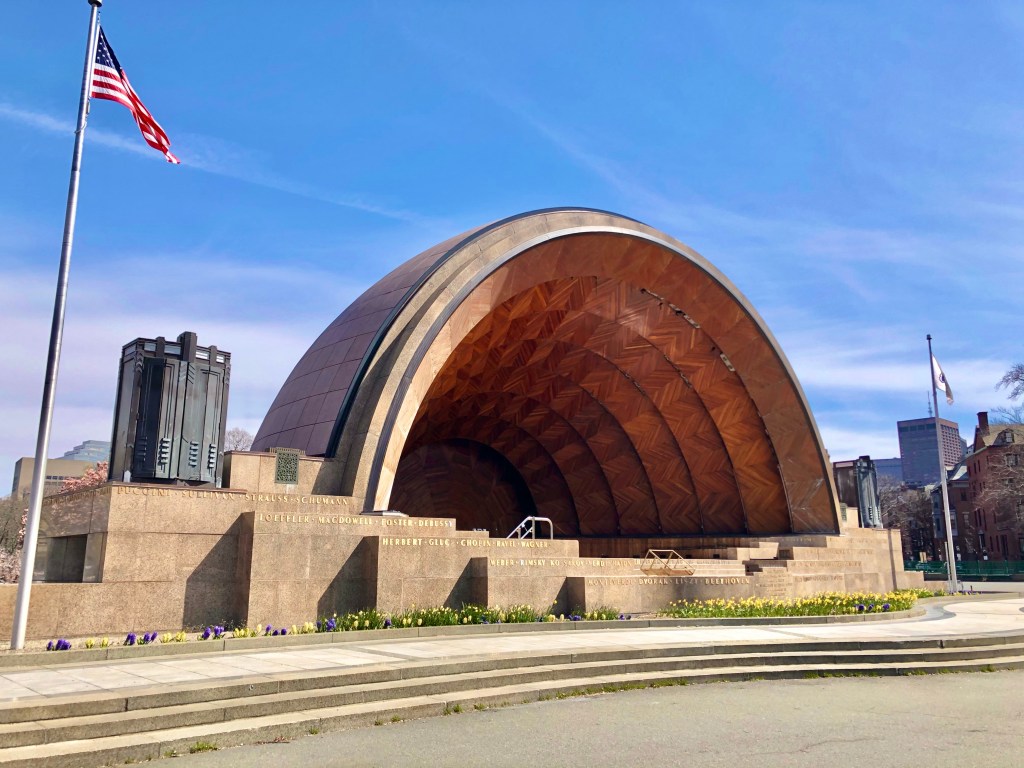
Located at the Charles River Esplanade in Boston, the Hatch Memorial Shell has long been an iconic landmark and meeting place for Bostonians and tourists alike. Built in 1940, this outdoor amphitheater structure replaced an earlier 1920s shell, envisioned by Arthur Fiedler, the first permanent conductor of the Boston Symphony Orchestra. Construction began on the first shell in 1928 and Arthur Fiedler conducted the first Boston Pops concert there on July 4, 1929, followed by a month of concerts during that first summer, a tradition that has continued to this day. A second temporary shell was constructed of metal in 1934, which was unsatisfactory for the famous orchestra. In 1940, the construction of the new music shell took place, donated by benefactor Maria Hatch, to build a memorial for her late brother, Edward, who it is named after to this day. The permanent shell was designed by Richard J. Shaw, a Boston architect known for designing churches. The Art Deco design, with intricate woodwork adorning the interior and a terrazzo tile roof, was dedicated on July 2, 1940, just in time for Independence Day celebrations.

New England Telephone Building // 1947

The New England Telegraph and Telephone Company Building was erected in 1947, just north of the Western Union Art Deco building (last post) to serve as the company’s headquarters. The steel-frame, polished granite and limestone-sheathed Art Deco skyscraper was designed by Alexander Hoyle, a partner in the firm of Cram & Ferguson. The stunning building takes the form of a stepped pyramid, or ziggurat, with successive receding stories rising from a four-story base, which diminishes its massing from the street. At the interior, a lobby mural on paper by artist Dean Cornwell (1892-1960), depicting “Telephone Men and Women at Work,” commissioned in 1947 and installed in 1951. The 190-foot mural told the story of the history of the telephone and was an artistic masterpiece, but was removed from the lobby during a recent renovation and subsequently sold.

Western Union Building // 1930

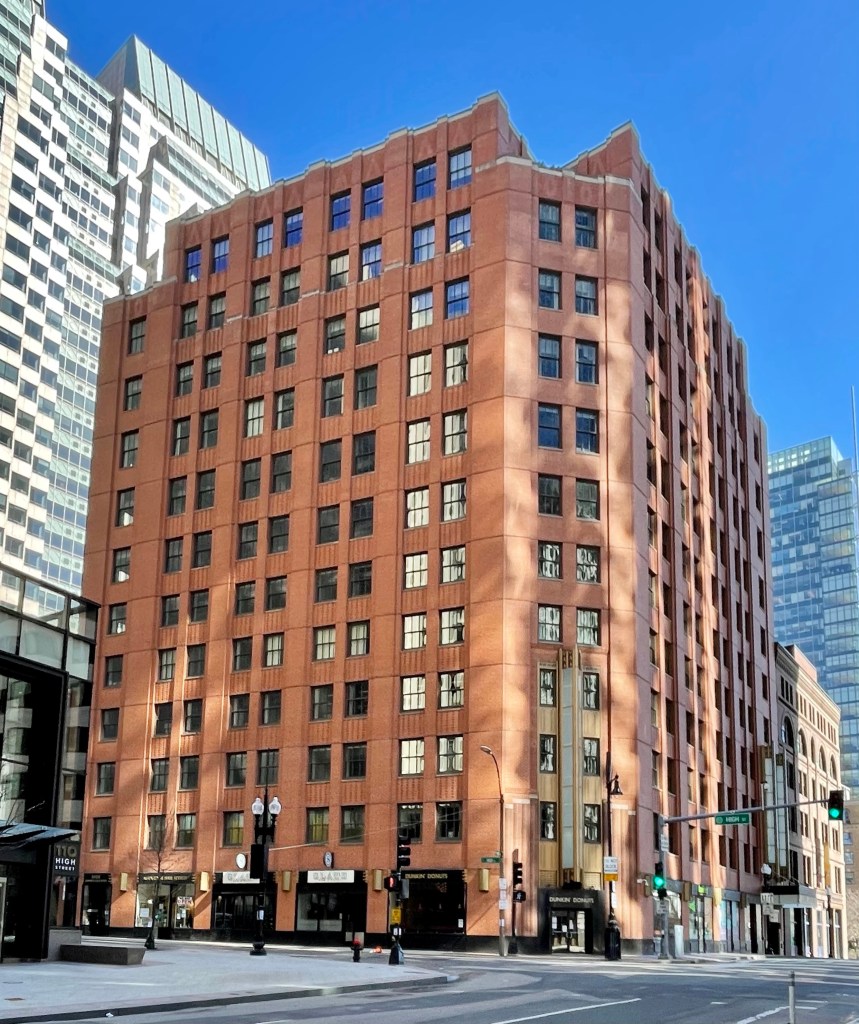
While Boston doesn’t have as many iconic Art Deco buildings as New York or Chicago, we do have some that pack a punch! Located at the southern end of Downtown Boston, the Western Union building at the corner of Congress and High streets served as a headquarters for the third district in Western Union’s eastern division. Western Union was founded in 1851, and ten years later, built the first transcontinental telegraph line. The company made a brief foray into the telephone field but lost a legal battle with Bell Telephone in 1879 and thereafter concentrated solely on telegraphy. In the 20th century, Western Union diversified its operations to include: leased private-line circuitry, a money order service, as well as telegrams and mailgrams. The company’s Boston building was designed at the same time as their New York City headquarters, designed by Ralph Thomas Walker, and the buildings are strikingly similar, just with the Boston building on a smaller scale. The building in New York is among my favorite Art Deco buildings ever, as the use of red brick in varied patterns creates such a stunning composition. Amazingly, in 2004, water infiltration behind the original brick façade of the Boston building necessitated the removal and replacement in-kind of the entire brick façade. The existing signage and light fixtures, designed in the Art Deco style were added at that time.