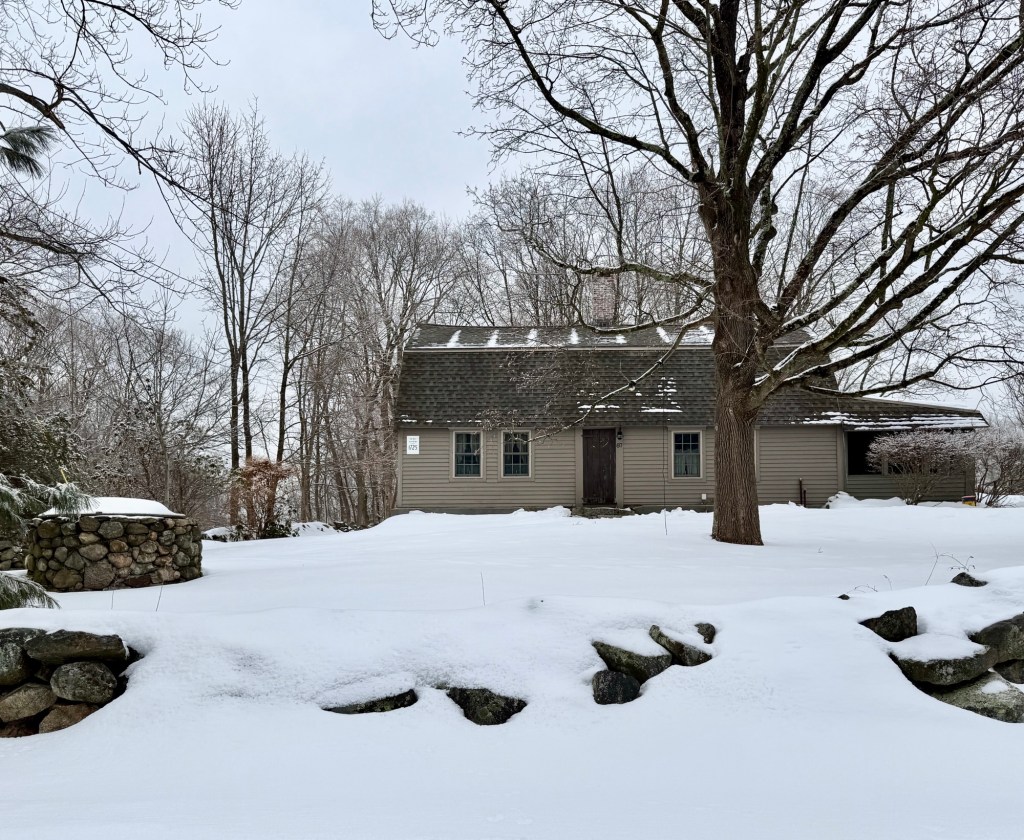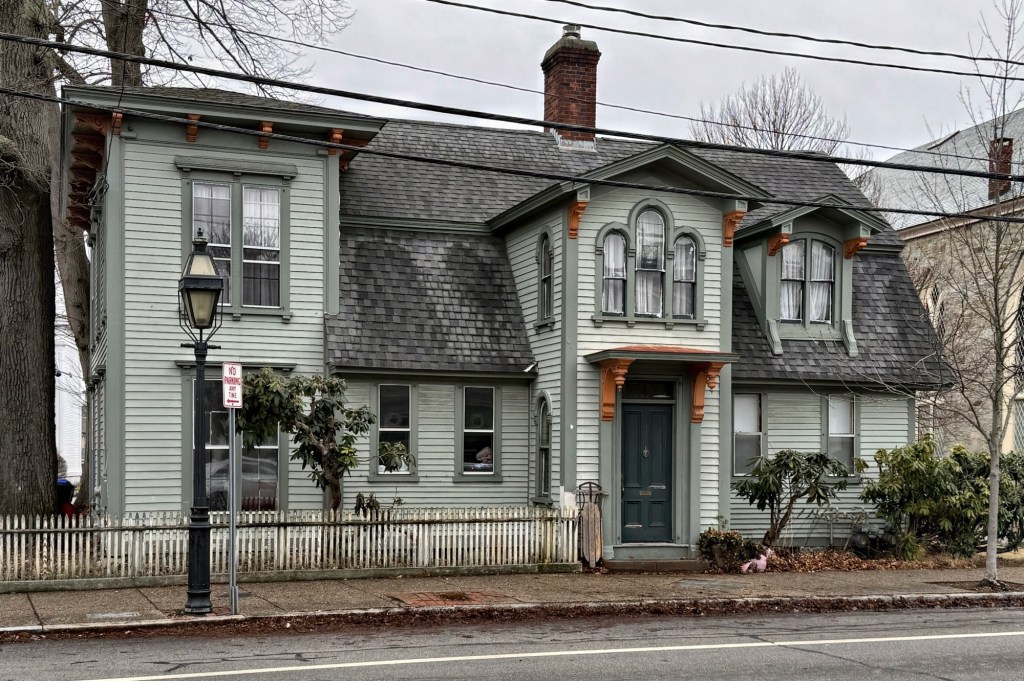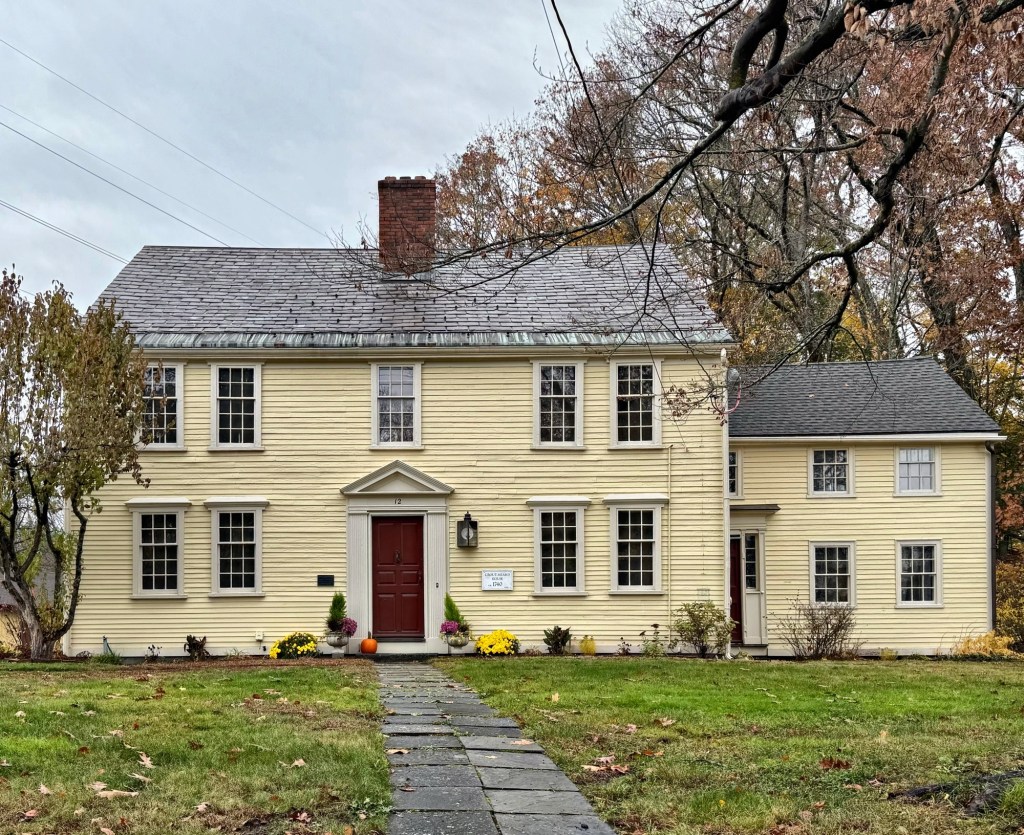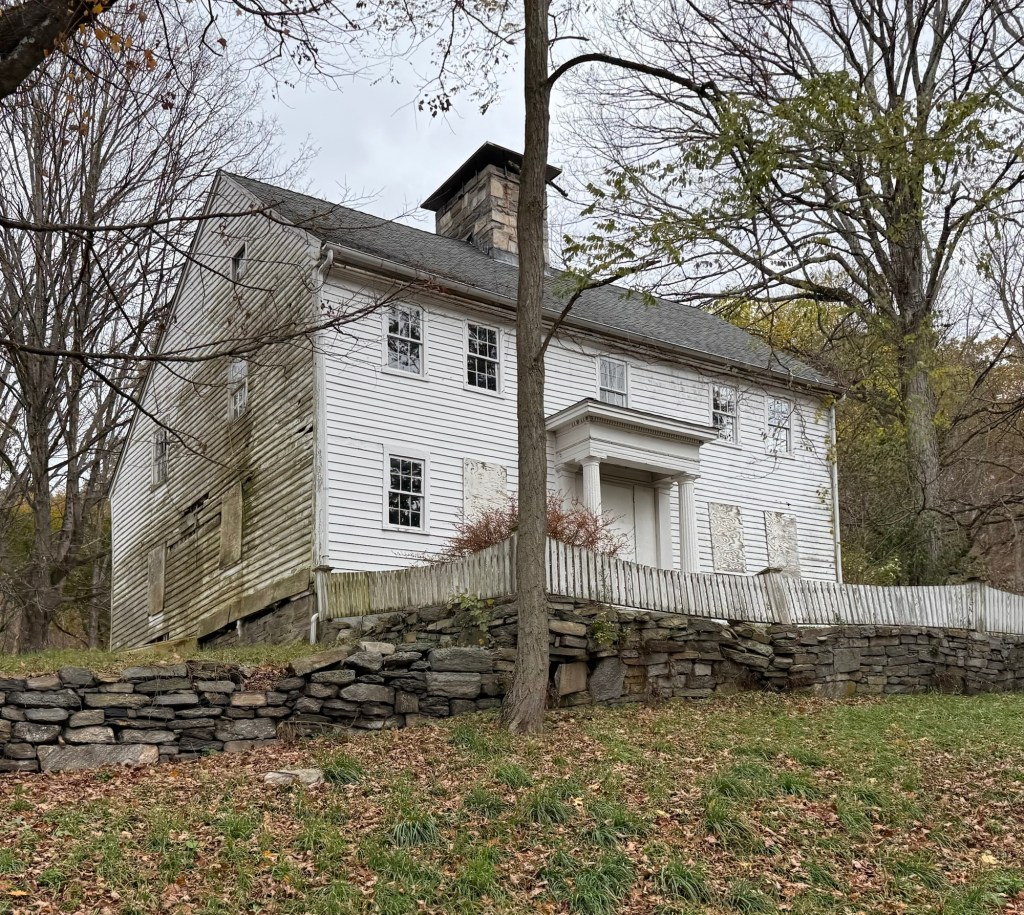
Grout-Heard House // c.1743

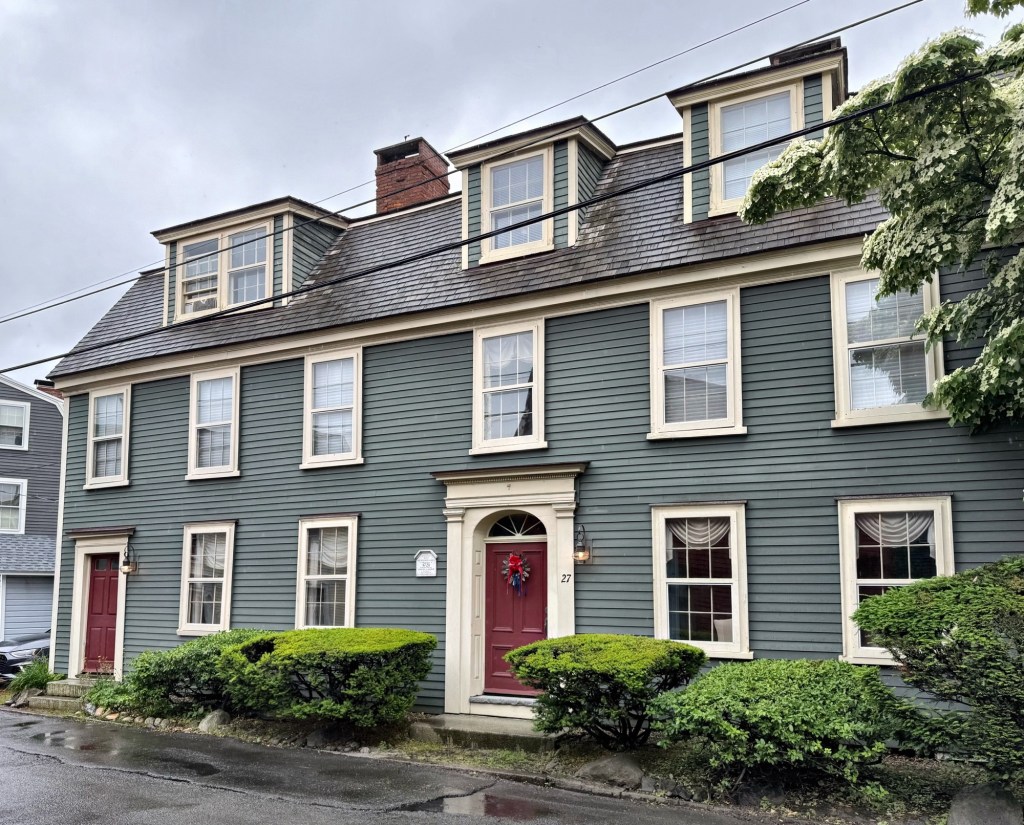
The Grout-Heard House on Cochituate Road in Wayland, Massachusetts, is one of the oldest extant residences in the community and architecturally significant as it shows the evolution of architectural tastes throughout the centuries. The house was built around 1743 for Jonathan Grout (1701-1748), a grandson of an original settler in the area, by the time of his marriage to Hannah Heard in 1743. Early records suggest that the house was originally just one bay deep and two-stories tall with a central entry. The property was sold in 1744 to Richard Heard, Jonathan’s brother in-law. In 1787, Silas Grout (1755-1820), a blacksmith, purchased the house and likely added rooms on the rear of the house. In 1822, Silas’ descendants added the side ell and the residence became a double-house in the mid-19th century. The house was moved from the site to make room for the 1870s Town Hall, and the rounded two-story side bay was added. After the Town Hall was razed in the 1950s, the Grout-Heard house was moved back to its original site in 1962. Since that date the Grout-Heard House has been the offices, research center, artifact repository and house museum of the Wayland Historical Society, who added a two-story Modern addition at the rear.

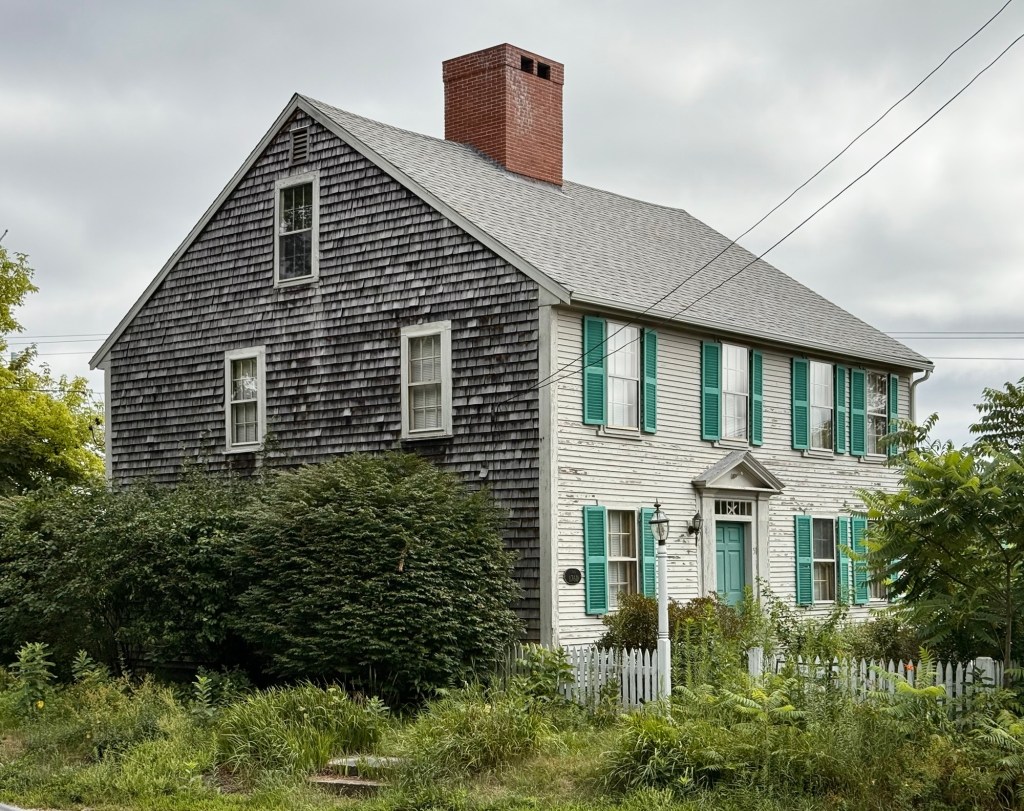
Smith-Curtiss House // c.1714

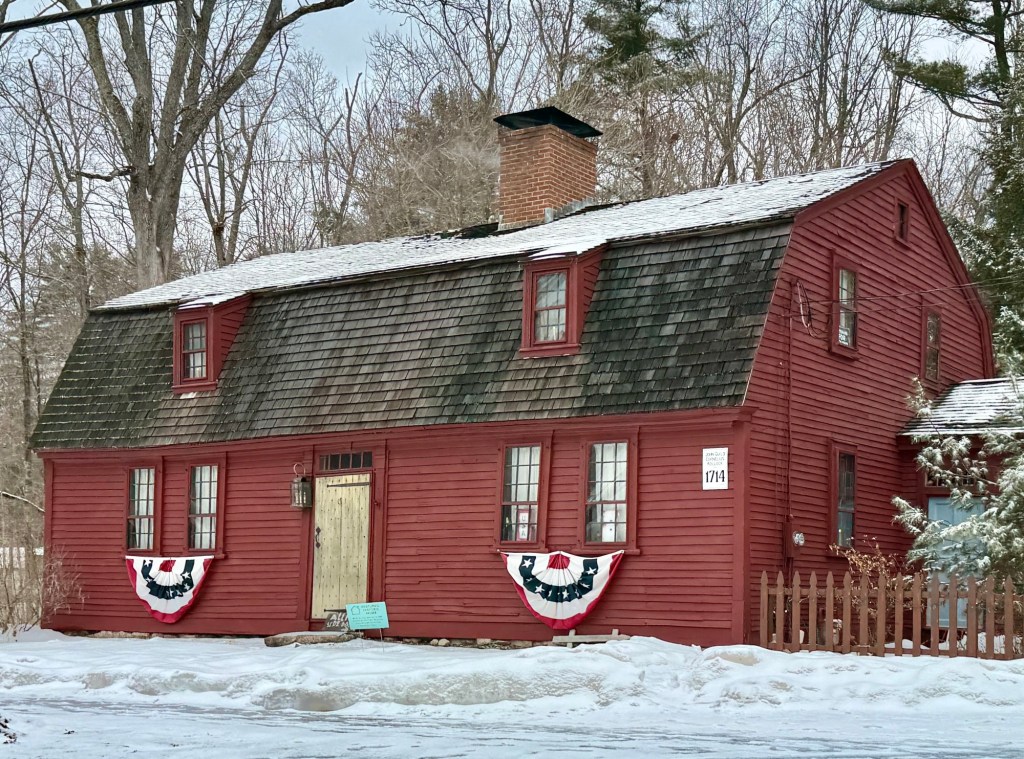
The Smith-Curtiss House, which is possibly the oldest extant building in Derby, Connecticut, has sat vacant and decaying for years and is owned by the State of Connecticut. Believed to have been built sometime between 1714 and 1740, this historic saltbox farmhouse at 411 Hawthorne Avenue is slowly decaying due to lack of maintenance and funding. Early ownership is difficult to determine, but by the 19th century, the property was owned by Ms. Alice E. Curtiss. The old estate was sold by Ms. Curtiss in 1913 to Frances Osborne Kellogg, a businesswoman, philanthropist and environmentalist, as part of her 350-acre dairy farm and land-conservation holdings. The Smith-Curtiss House was used as a residence for the herdsmen who ran the farm nearby. Before her death in 1956, Frances deeded the property to the state as a public park, and allowed her head herdsman life-occupancy of this house for the remainder of his life. The State of Connecticut assumed possession of this house in 1981. The building has suffered from deferred maintenance since this period, with the State attempting to lease the building to tenants. I hope that local and statewide preservation groups can mobilize to secure grants and funding to restore this important property.

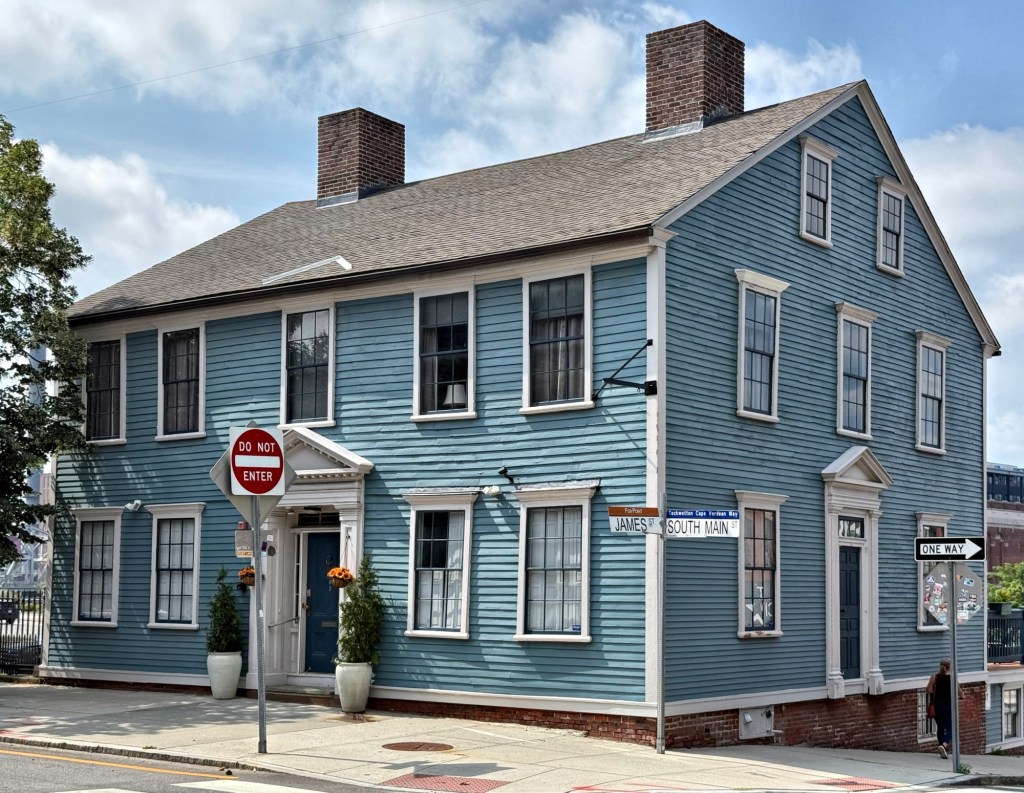
Captain Joseph Tillinghast House // c.1770

This Georgian house at 403 South Main Street in Providence’s East Side was built by Captain Joseph Tillinghast (1734-1816) a wealthy merchant and participant in the Gaspee Affair, a significant event in the lead-up to the American Revolution. The Gaspee Affair occured in 1772, when a group of men from Providence attacked and burned the British customs schooner, HMS Gaspee. The incident was fueled by colonial resentment towards British customs enforcement, and took place not too long after the Boston Massacre. Joseph built this house for his family on land he inherited from his family, who claimed the land in 1645. Tillinghast was also the owner of a line of packet boats (light shipping of domestic freight and mail) operating between Providence and Newport. After Joseph died in 1816, the property was occupied by members of the Tillinghast family until 1847. By the mid-20th century, urban renewal and the proximity to the new highways caused the surrounding area to suffer, with this historic home threatened. Throughout 2008, the building’s condition continued to rapidly deteriorate, and local preservationists advocated for the home’s future. After attention was brought to the residence and its significance, the house was restored with the assistance of the Providence Revolving Fund, including the stabilization of the foundation, roof and chimneys rebuilt, with clapboards and windows repaired.

Drew-Holmes House // c.1760

This charming Colonial house is located at 51 Landing Road, overlooking the banks of the Jones River in Kingston, Massachusetts. The house is thought to date to 1760, and by 1800, was likely owned by Stephen Drew a prominent local shipbuilder from a family of shipbuilders who operated a shipyard near the property. In 1810, the property was owned by Joseph Holmes (1772-1863), who also would build a wharf and dock on the riverfront of the property. The property remained in the Holmes Family when it was inherited by Edward Holmes, who worked in shipbuilding until the decay of the industry. The house is a great example of a 18th century residence with a 4×2 bay two-story form, clad with wood clapboards
and shingles with a large brick chimney at the roof. In 2018, Jones River Landing, a non-profit, purchased the house and ‘seek to provide seasonal lodging and accommodations for visiting students, interns, scientists and advocates who are studying and working in environmental programs in our region’. While there were plans were to restore the house, the landscaping and peeling siding appear to show some deferred maintenance.

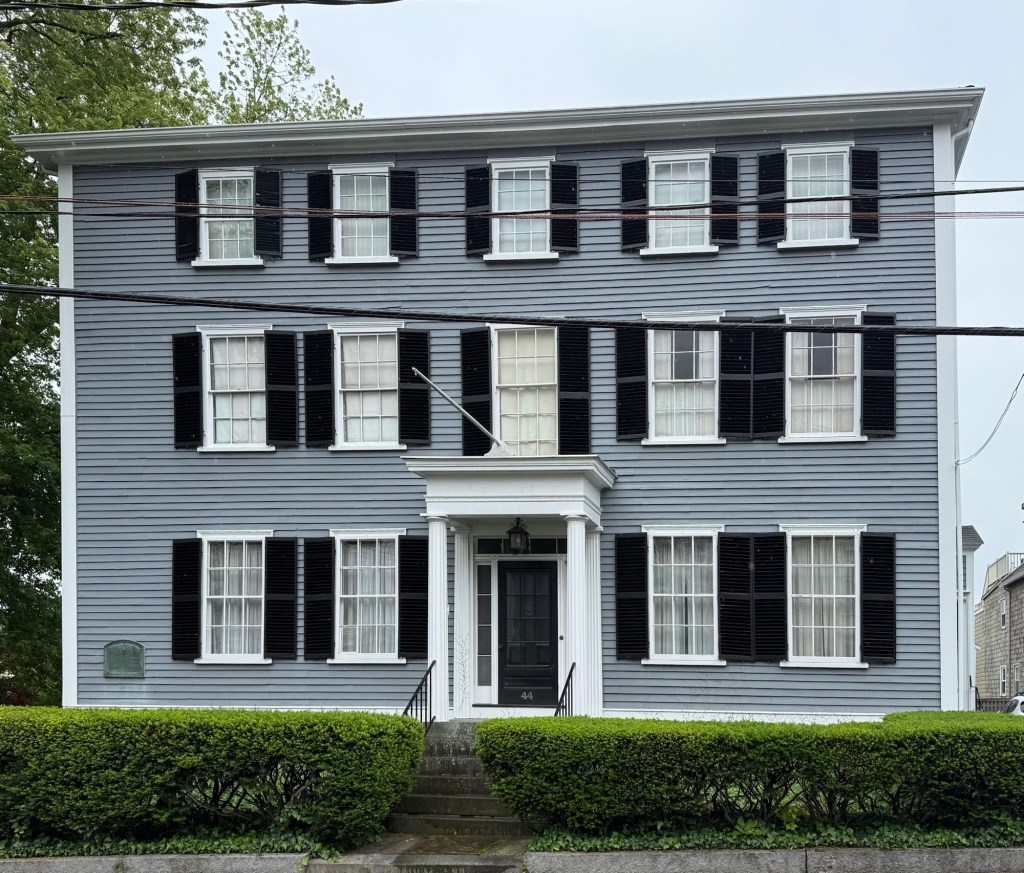
Elbridge Gerry House // c.1734

The Elbridge Gerry House is a historic house on Washington Street in Marblehead, Massachusetts that was built by local merchant, Thomas Gerry around the time of his marriage to Elizabeth Greenleaf. Architectural evidence suggests that the house was a two-story L-shaped Georgian frame structure, that in about 1820, was raised to its present three-story form in the Federal style. It was in this house that Founding Father, Elbridge Gerry (1744-1814) was born, and spent many formative years in. Gerry was a wealthy merchant, politician, and diplomat who served as the fifth vice president of the United States  under President James Madison from 1813 until his death in 1814, and is arguably best-known for Gerrymandering. The term, originally written as “Gerry-mander,” first was used on March 26, 1812, in the Boston Gazette — a reaction to the redrawing of Massachusetts state senate election districts under then-Gov. Elbridge Gerry. One of the remapped, contorted districts in Essex County (where Marblehead is located) was said to resemble the shape of a mythological salamander, hence the name “Gerry-mander”. The newly drawn state senate district in Essex County was lampooned in cartoons as a strange winged dragon, clutching at the region. Elbridge Gerry would live mostly in Cambridge and the family home was sold by around 1820 and modernized about that time.

Thomas Gerry House – Hearth and Eagle House // 1717

This house has a lot of history! Originally built around 1717 by Ephraim Sanders, this house on Franklin Street in Marblehead was later purchased by Thomas Gerry (1702-1774), a merchant who operated ships out of Marblehead, and father to Elbridge Gerry, the fifth Vice President of the United States. The home was likely a three-bay, side hall Georgian house and expanded to the current five-bay configuration by Thomas Gerry around 1750. Thomas Gerry was born in Derbyshire, England, but came to Marblehead by around 1730 and was active in local politics and had a leading role in the local militia, later speaking out against the Crown and sought independence. Thomas Gerry died in 1774, and did not get to see the Revolution nor his son become a Founding Father. The property was later the home of one of his granddaughters, Sarah Gerry Conklin, and her husband, Frederick Conklin, an infantry captain, who housed officers in command of nearby Fort Sewall during the War of 1812. In the 1940s, historical novelist Anya Seton after researching her genealogy, led her to base her 1948 novel, The Hearth and Eagle, on the history of the seaside town. She set the novel in the Hearth and Eagle Inn, based on the Gerry House here.

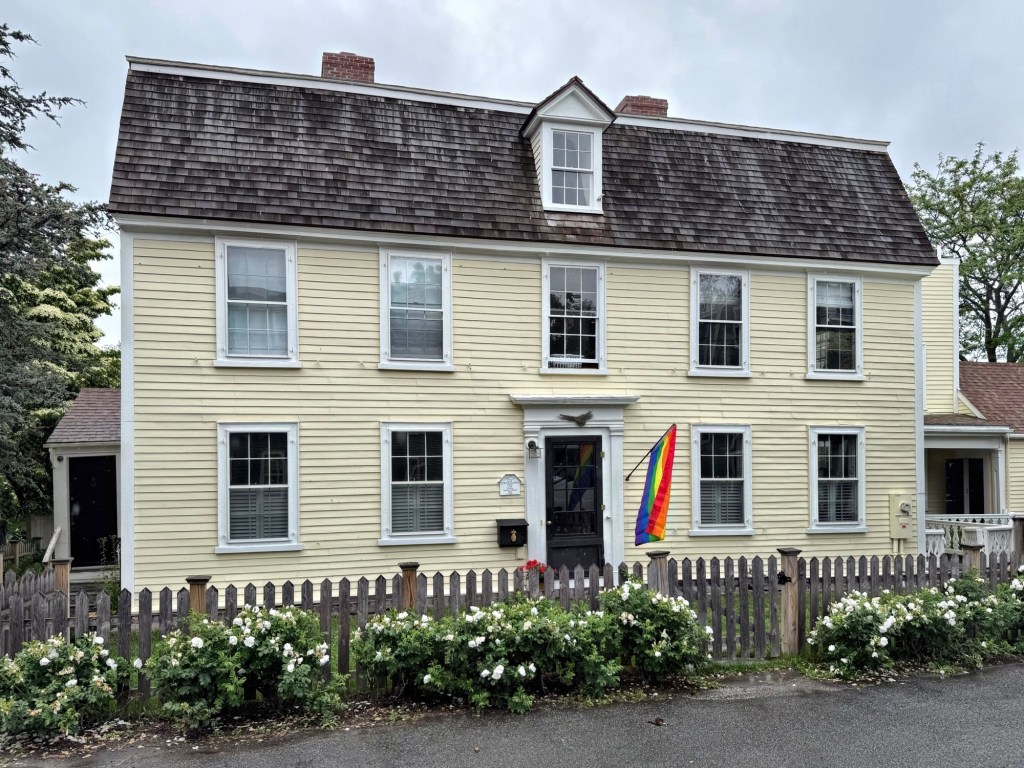
Glover Broughton House // 1721

This Georgian-era house sits on Franklin Street in the charming coastal town of Marblehead, Massachusetts. The residence was built in 1721 for Benjamin Gale, who worked as a shoreman at the nearby harbor. The original structure (likely the left half) was likely just three bays wide with a side hall entrance that was later expanded by a later owner in the Federal style with a fanlight transom over the new main entrance. In the 19th century, this residence was the home of Glover Broughton (1797-1869), the grandson of Nicholson Broughton, the first commodore of the American Navy and, as part of the Marblehead Regiment, commanded George Washington’s first naval vessel USS Hannah. Nicholson’s grandson, Glover Broughton, was also an ardent Patriot and at just 15 years old, joined the crew of the privateer America, and was serving on the ship when it was captured and its crew imprisoned at the infamous Dartmoor Prison in Britain, the principal location for American prisoners during the War of 1812. Broughton drew the world’s attention to the inhuman treatment prisoners were subjected to in a rhyming long form poem that detailed the April 6, 1815, massacre that took place at Dartmoor. He also drew a map of the prison from memory to accompany the poem. Once Glover Broughton returned to Marblehead, he became a successful merchant and also served the town of Marblehead in a variety of offices including town clerk and postmaster. In later years, Glover also used his time to help fellow veterans of the War of 1812 by writing letters for them to help them get benefits for their time in service to the United States, as many men at the time could not read or write. It is possible that Broughton had his house “modernized” with the Federal period doorway and gambrel roof addition.

Captain Knott Martin House // 1770

This gambrel-roofed Georgian house on Franklin Street in Marblehead was built before the American Revolution for Mr. Henry Lane, a sailmaker, but is best-known as being the home to Captain Knott V. Martin. Knott Martin (1820-1898) was born in town as was descendants from early settlers of Marblehead, and after attending local schools, became a shoemaker beginning at the age of just thirteen. After over a decade as a shoemaker, he began a butchershop and had a slaughterhouse to the rear of his property. When the Civil War broke out, Captain Knott was among the first to reach Faneuil Hall to begin duty. A Boston Globe article from 1918 detailed his finding out of the war, “Late in the afternoon of April 15, 1861, Lieut. Col. Hinks of the 8th Mass. Regiment rode into Marblehead to notify the Commanders to be ready to take the first train, the following morning to answer President Lincoln’s call for troops… I found Captain Martin in his slaughter house, with the carcass of a hog, just killed. On communication to the Captain my orders, I advised him to immediately cause the bells of the town to be rung, and to get all the recruits he could. Taking his coat from a peg… with his arms stained with blood and his shirt sleeves but half rolled down, he exclaimed, ‘Damn the hog!” In a battle at New Bern he was wounded by a spent cannonball and lost eight inches from the main bone of his right leg, becoming permanently disabled. Following his discharge from the War he was elected a member of the Massachusetts House of Representatives serving in that capacity during 1866 and 1867.  He was then appointed Messenger to the House of Representatives for two more years. In May 1869 he was appointed Postmaster in Marblehead, a position he held until he retired on May 16, 1885. Knott Vickery Martin died at his home in 1898, but it has been lovingly preserved ever-since.

Reverend John Barnard House // 1717

John Barnard (1681-1770) was born in Boston, Massachusetts, and received his degrees from Harvard in 1700 and 1703, reading theology under Cotton Mather. After graduating, he was appointed one of the five chaplains for the expedition against Port-Royal, a French-colonized settlement in present-day Nova Scotia. After time in Barbados and England, Barnard was ordained by the Marblehead Congregational church on in July 1716, and served that church for the rest of his life. Upon arriving to Marblehead, he had this Georgian residence built on Franklin Street, completed by 1717. The house is said to be one of the first Georgian facades in the town, showcasing Reverend Barnard’s standing in the community and knowledge of English Georgian residences across the ocean. The early Georgian house exhibits a gambrel roof, nearly symmetrical facade with center hall plan, and high ceilings inside for its time. The house was converted into condominiums in 1988 and has retained its historic appearance, at least at the exterior, ever since.

Warren Homestead // 1727

The old Jonah Warren Homestead of Westborough, Massachusetts, was built in 1727 on the Old Connecticut Path, a former Native American trail, and is among the earliest and best-preserved examples of 18th-century domestic architecture in Westborough. The Colonial-era house was built for Jonah Warren (1700-1780) and his wife Elizabeth Seaverns (1700-1775), who moved from Watertown to Westborough in 1720, the couple would have 13 children. The home remained in the family for generations. Jonah was a tanner by trade, but also sold wooden shingles, cut from nearby cedar swamps. In 1778, the couple’s son, Aaron, owned the house, as he returned home to take care of his aging father. The property was later owned by Aaron’s son, David Warren, and later passed to his only child, a daughter, Mary Waterman Warren (1799-1858), who married Josiah Fay (1797-1869) in 1838. The home was inherited by Hercules Warren Fay, a Harvard-educated reverend and author. The homestead remained in the family until the last of Hercules’ children died in 1957. The Warren Homestead remains as one of the finest and best-preserved Colonial-era residences in Central Massachusetts.