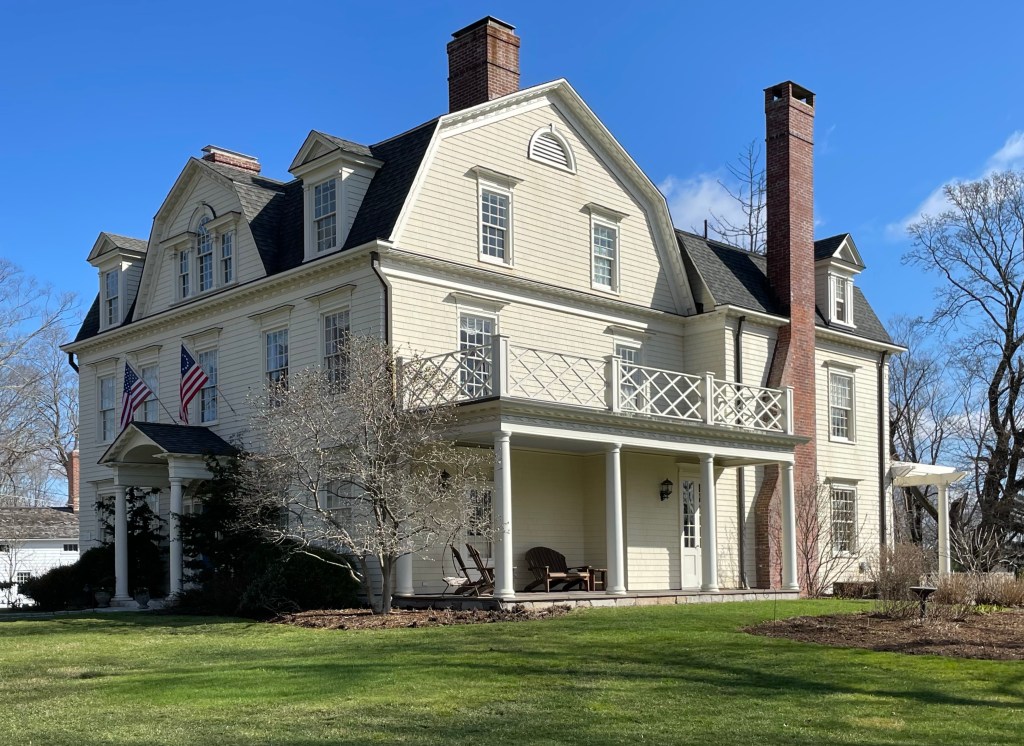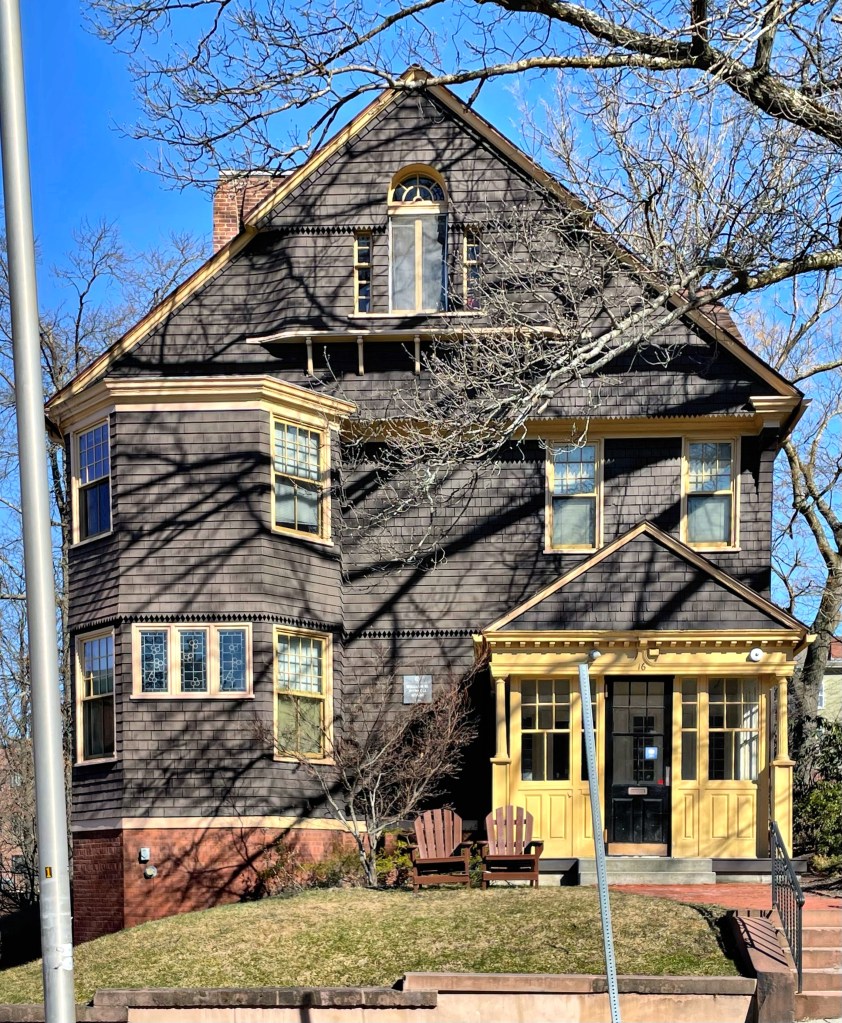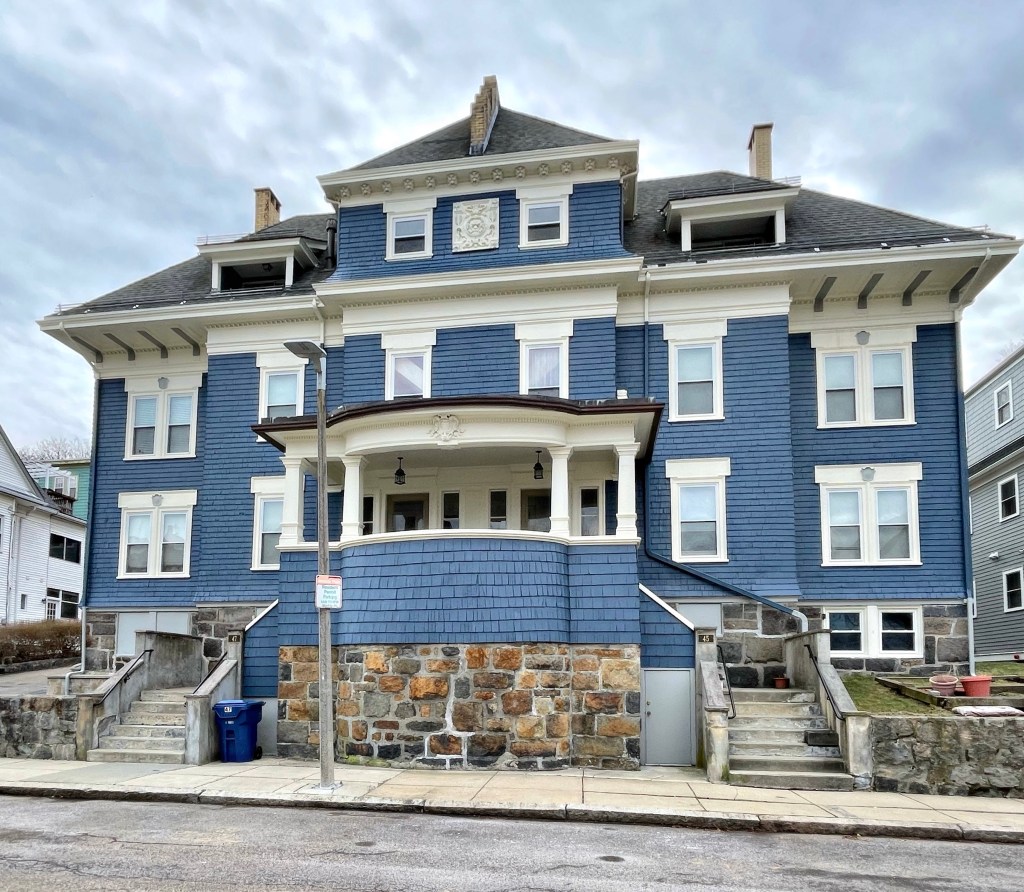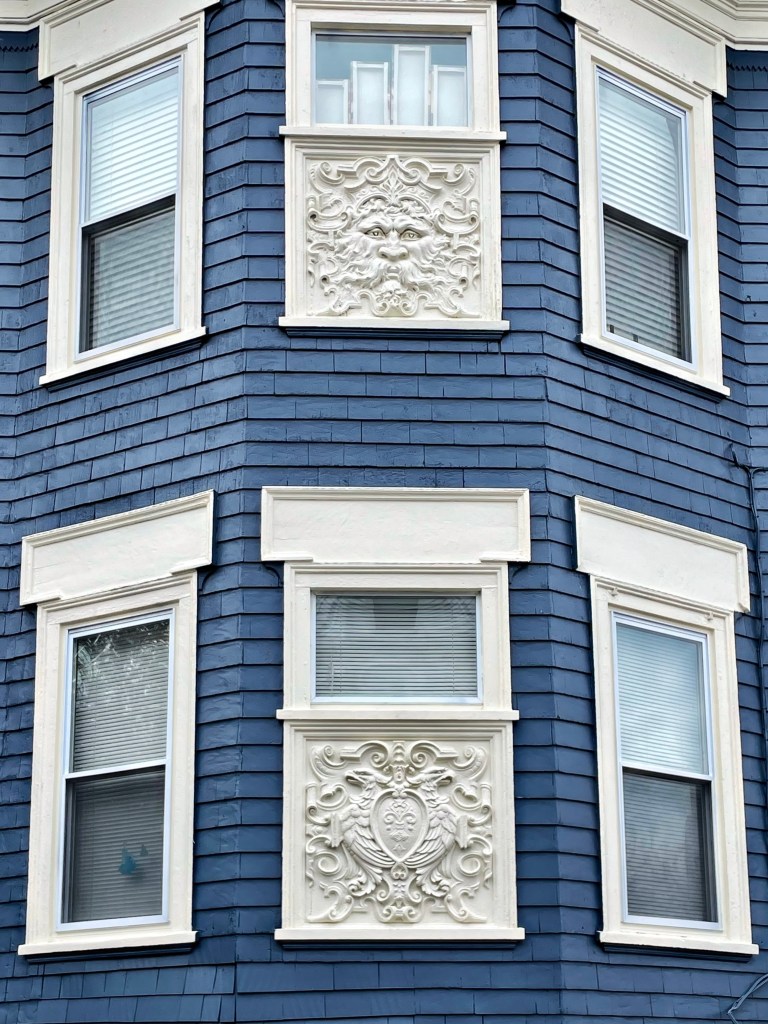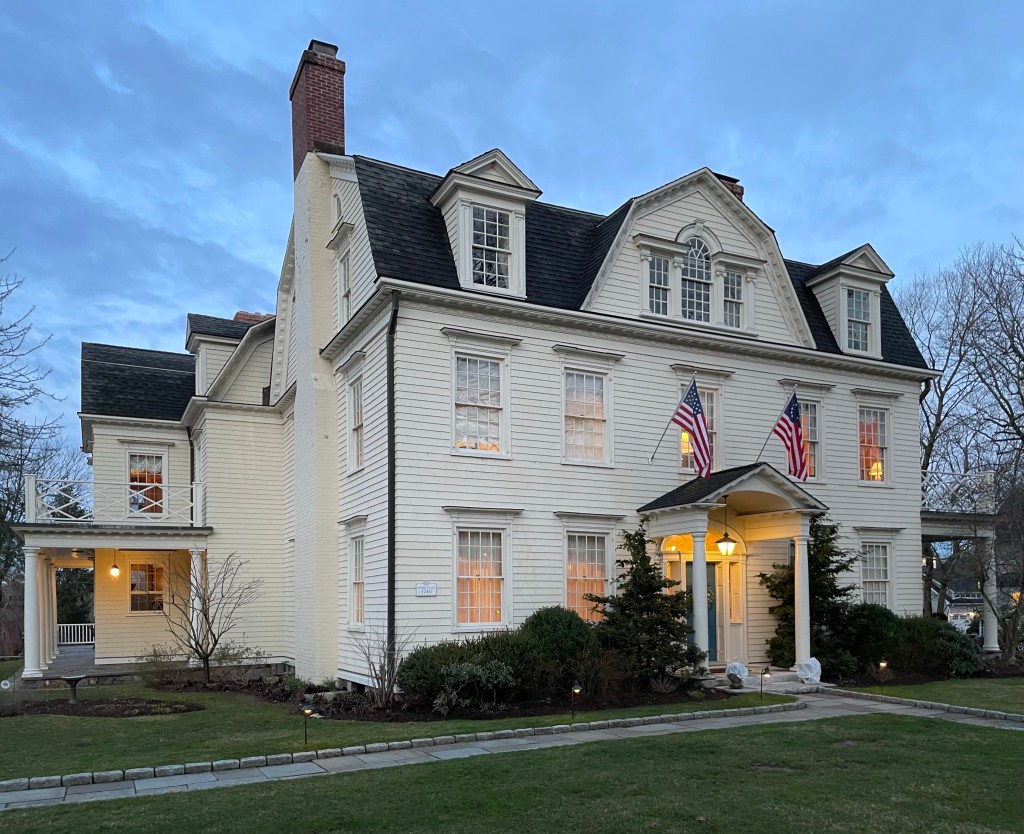
Located on “Millionaires Row” in Hopedale, MA, a street of homes formerly owned by factory owners and managers, sits “Urncrest” a stunning Queen Anne mansion. The home was built around 1875 for William Lapworth (1844-1937) an English-born weaving expert, who worked at Hopedale Elastics Co. and patented certain weaving processes for suspenders, boot webbing, and garters. Hopedale Elastics was absorbed by the Draper Corporation in 1890, and Lapworth was given a large pay increase. With his new salary, he “modernized” his home to what we see today, adding a corner tower, wrap-around porch, and many Colonial Revival details. Additionally, he had the detached 1870s carriage house updated with a full basement, heating, four horse stalls, and a coachman’s apartment with a bedroom and bathroom. The owners today maintain the home and carriage house beautifully! I can’t even imagine how gorgeous the interior is!
Buildings of New England travels! Welcome to Schenectady, a great city in upstate New York, with an hard to spell and pronounce name! The name “Schenectady” is derived from the Mohawk word skahnéhtati, meaning “beyond the pines”. Schenectady was founded on the south side of the Mohawk River by Dutch colonists in the 17th century, many of whom were from the Albany area. In 1664 the English seized the Dutch New Netherland colony and renamed it New York. They established a monopoly on the fur trade around Albany, and issued orders to prohibit Schenectady from the trade through 1670 and later. The town grew mostly as an inland agricultural town until the Erie Canal was built in 1825, creating a navigable water route from New York City and the Atlantic Ocean to the Great Lakes, cutting through Schenectady. The town grew and became an industrial center, attracting a very diverse population of immigrants in the 19th century and African Americans as part of the Great Migration out of the rural South to northern cities for work. The community struggled (like many) in the mid 19th century but has seen a large resurgence as of late!
This building is the Schenectady City Hall, a massive architectural landmark which made my jaw drop when I saw it! The City of Schenectedy outgrew their old City Hall, and in the late 1920s, held a nationwide contest to select designs for a new City Hall. The contest was won by the prominent architectural firm McKim, Mead, and White. It appears that the designs were furnished by James Kellum Smith of the firm, the often overlooked genius of the MMW practice. The exorbitant cost of the project, which was undertaken during the Great Depression, caused the building to be dubbed “Fagal’s Folly” after Mayor Henry C. Fagal, who allowed all the cost increases while the city’s future was uncertain. He was not re-elected after this building was completed. The building is a pleasing mixture of Colonial and Classical Revival styles and features bold pilasters and a towering cupola
Located across the Town Green from the Tewksbury Town Hall (1920), this Colonial Revival style church with Classical elements, perfectly compliments the design motif seen here. The Tewksbury Congregational Church was established in 1734 by some 34 resident families who, after leaving the church in Billerica, established the new town of Tewksbury. Their first church was erected in 1736, and was replaced in 1824. The second church edifice (and much of the town center) suffered a catastrophic fire in 1918, destroying both structures, and resulting in a rebuilding campaign. Architect Curtis W. Bixby of Watertown, furnished designs for the church, which stands boldly beyond a large front lawn.
The town of Tewksbury, Massachusetts was colonized in 1637 and was officially incorporated in 1734 from the town of Billerica. The town was historically home to at least two raids by native peoples during the infamous King Phillip’s War, which killed dozens of men, women and children settlers. The town is named after Tewkesbury, England, likely inspired by some of the original settlers. The town grew as a rural village until it became a suburb of adjacent Lowell and Andover, Massachusetts. The town’s older Town Hall building burned in 1918, and funding was quickly acquired to erect a new, suitable building for the town. The Boston-based architectural firm of Kilham & Hopkins was hired and they designed this gorgeous Colonial Revival building. The symmetrical building features a main two-story block with a rear and side wings. The facade features three entrances with recessed fanlights above. A slate roof is capped by a towering cupola, which adds an additional flair to the building. The structure was so well-designed, it was featured in the Architectural Record in 1919, a national publication.
In the 1930s, America was in the throes of the Great Depression, and towns and cities struggled to provide services for the ever-growing populations, all the while suffering from lower tax revenues. The New Deal was enacted as a result, which provided a series of programs, public work projects, financial reforms, and regulations enacted by President Franklin D. Roosevelt between 1933 and 1939. One of these programs was the Public Works Administration (PWA), which funded and built large-scale public works projects such as dams, bridges, hospitals, and schools, to provide jobs and bolster local economies. In Newton, the developing Oak Hill Village required a new public school, and the town received funding for the Oak Hill Middle School in 1935. Architects Densmore, LeClear, and Robbins were hired to provide designs for a new school, and builders completed the building the next year. The Georgian Revival building is constructed with red brick with cast stone trim. The 16-over-16 windows and cupola also work to showcase the beauty of the design.
The historic Omni Bretton Arms Inn, adjacent to the Omni Mount Washington Hotel in the White Mountains of New Hampshire, was built as a private home in 1896. The home was designed by, and occupied by architect Charles Alling Gifford, while he oversaw the design and construction of the iconic Gilded Age hotel. After the hotel nearby was opened, the interior was converted to hotel rooms, and opened to guests in 1907. The Colonial Revival building features a central mass with two wings. The building was occupied in 1944 as the headquarters for the Conference Secretariat during the 44-nation Bretton Woods Monetary Conference. The Inn was granted National Historic Landmark designation in 1986 and has recently undergone a $1.4 million renovation focused on bringing the outdoors in. Part of the Omni Mount Washington Resort, this property offers more seclusion and less crowds compared to its larger neighbor. Just down the road from the Bretton Arms is the equally stunning Bretton Woods Stable, likely built at the same time.
Chesterwood is the former summer home, studio and gardens of American sculptor Daniel Chester French (1850–1931), who is best known for creating two of our nation’s most powerful symbols: the Minute Man(1871–75) at the Old North Bridge in Concord, Massachusetts, John Harvard in Harvard Yard, and Abraham Lincoln (1911–22) for the Lincoln Memorial in Washington, D.C. Daniel Chester French was one of the most successful artists of the late 19th and early 20th centuries, producing more than 100 works of public sculpture. In the fall of 1895, he and his wife drove by horse and buggy and discovered the resort town of Stockbridge. They returned the next summer and purchased the Marshall Warner farm from the family who had purchased the land from Mohican Native Americans. The French family and two maids moved into the white clapboard farmhouse the next summer. To ensure that his summer would be productive as well as restful, he improvised a studio in the barn. He asked his friend and colleague, architect Henry Bacon, to design a studio for him (Bacon would later work with French on the Lincoln Memorial). Soon, in spite of renovation, the original farmhouse was deemed inadequate and French commissioned Bacon to design a residence, completed in 1901. The family owned the home for decades, even after Daniel Chester French’s death. Much of the credit for Chesterwood’s preservation and metamorphosis from summer retreat to public site belongs to Margaret French Cresson (1889–1973), the sculptor’s daughter. After her parents’ death, she maintained the property and began to use it year-round, assembled the work of her father, and established the estate as a historic site of the National Trust for Historic Preservation.
The largest building on Main Street in Stockbridge has to be the Red Lion Inn, a regional institution and one of the best places to rest your head in New England. The inn got its start just before the Revolutionary War. According to tradition, Silas Pepoon established a small tavern on the corner of Main Street in 1773, under the sign of a red lion. A year later, angry citizens gathered at the tavern to boycott English goods and to pass resolutions protesting the oppressive Acts of Intolerance levied against the colonies. Since its earliest days, the inn was a vital gathering place for locals and has continued to play an important role in the life of the community ever since. In 1862, the inn was owned by Mr. and Mrs. Charles Plumb, avid collectors of rare and fine items, who became renowned for their impressive compilation of colonial antiques. A fire in 1896 destroyed the building but its remarkable array of collectibles was saved and the inn was rebuilt within a year by designs from Harry E. Weeks, a Pittsfield-based architect.
At a time when many public school buildings around Boston were designed in the Art Deco or early Modern styles, the Edith C. Baker School in South Brookline went back to basics and represents a nod back to Colonial era design. The whitewashed red brick building was designed and built in phases as the neighborhood surged in population, tied in with the re-emergence of the economy after the Great Depression. The opening of the West Roxbury Parkway in 1919 and the Hammond Pond Parkway in 1932, both precipitated subdivision of the farms in South Brookline for residential development. The first section was completed in 1937 (what is shown in the photo) by plans from the local architecture firm of Kilham, Hopkins and Greeley, who also designed an addition just a year later for the un-forecasted growth in the neighborhood. More additions were added in the decades following WWII, thankfully just as additions and not a scraping of the site which seems to be all the rage now. The school was named as a tribute to Edith C. Baker, a longtime member of the Brookline School Committee from 1900 to her death in 1942.
Located in South Brookline, a neighborhood of mostly early-mid 20th century architecture, you can find amazing residential designs for middle-class suburban families in the Boston area. This home was built in 1935 for Max and Rebeccah Webber in the Garrison Colonial Revival style. The home, designed by architect Harry Morton Ramsay, is characterized by a second-story shingled overhang with decorative pendants reminiscent of 17th century American homes. Adding some extra flair, an eyebrow dormer can be found at the roof, as well as a glazed projecting entry porch with a broad pediment and corner pilasters.