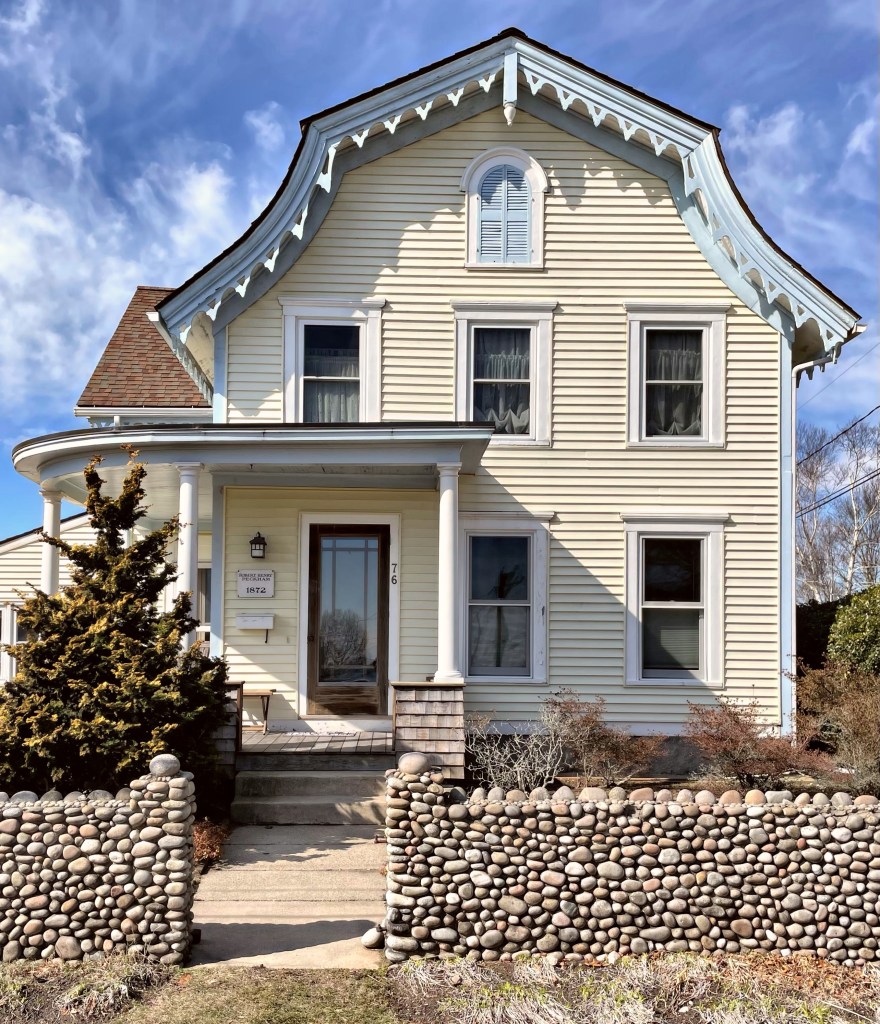
Another of Noank’s stunning Victorian-era seaside cottages is the 1872 Robert Henry Peckham house which is located across the street from the village’s most ornate cottage, the Deacon Robert Palmer House (featured previously). The house exhibits a gambrel roof which reads as a mansard roof at the side elevations. A round arched window is set into the gable end. Decorative cut bargeboards add much complexity to the design. It appears that in the early 20th century, as Noank was re-establishing itself as an artist colony, the owners added the small wrap-around porch and stone garden wall.
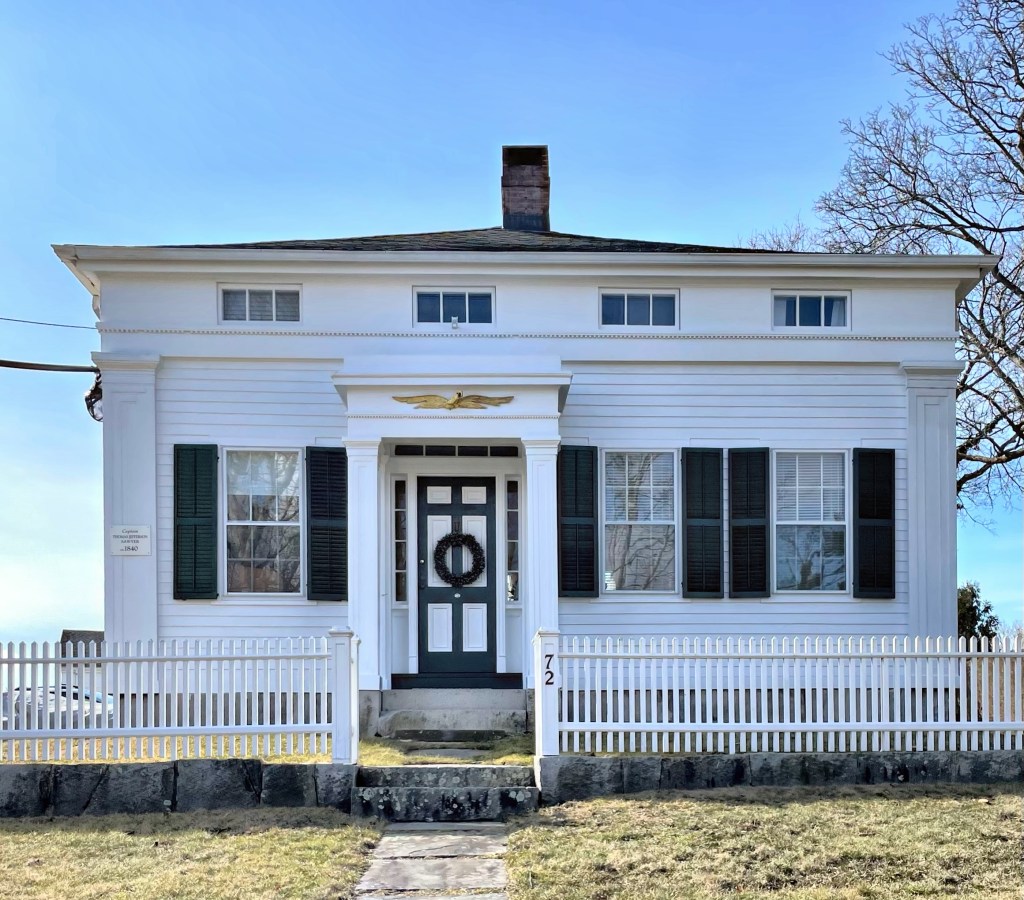
Thomas Jefferson Sawyer was born in 1807 in Groton, Connecticut as the tenth of 13 children of William and Prudence Sawyer. It appears that his parents were running out of names by the time they had ten children, so they named number ten after the then President of the United States, Thomas Jefferson. Thomas Jefferson Sawyer moved to Noank’s coastal village in 1840 and built this interesting Greek Revival house with an atypical hipped roof. Sawyer was a sea-captain who remained in Noank until his death and he was a very active member of the local Baptist church. The Sawyer House remains as a unique example of the Greek Revival style captains house, which the village is known for.
Robert Palmer Jr. (1856-1914) was born in Groton, Connecticut as the son of Robert Sr., a prominent businessman and Deacon in Noank’s seaside village (his house was featured previously). Robert Sr. established the Palmer shipyard, which became the largest business enterprise in Noank. Jr. would later join his father’s business and did well for himself financially, eventually marrying and building this Neo-Classical mansion on Church Street in town. The company, under Sr. and Jr.’s leadership, built many seafaring vessels that were internationally renowned until the company closed in 1914 after the death of Robert Jr. This house is unique in town for the monumental two-story portico, Palladian windows at the first floor, and a projecting entry vestibule.
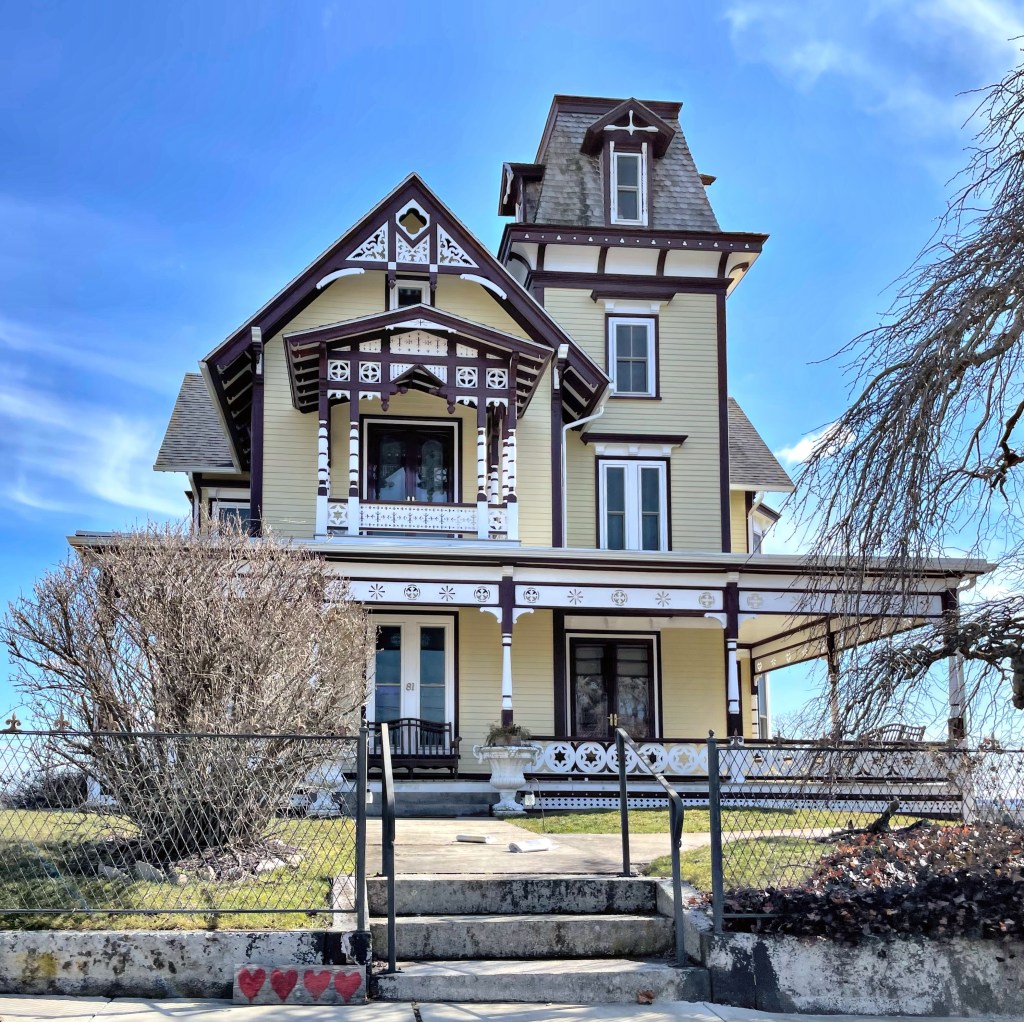
Perched on the highest hill in the coastal village of Noank, Connecticut, you will find this absolutely enchanting gingerbread Victorian mansion. The house was built in 1884 for Deacon Robert Palmer (1825-1913), a wealthy man who wasn’t only deacon of the village’s Baptist church, he was the owner of a flourishing shipyard, and it was his shipyard workers who built him, with loving care, a house he could be proud of! Robert ran the shipyard in town first with his brother, and then with his son. During the late nineteenth and early twentieth centuries the shipyard was the largest facility for building and repair of wooden vessels in southern New England, employing over 300 men. The yard specialized in building railroad car floats, schooner barges, and dump scows as well as fishing smacks. Robert Palmer and Son went out of business in 1914 with the passing of the Robert. The Stick style mansion with mansard roofed tower remained in the Palmer family until the early 2000s when it sold and was restored to her former glory. The residence features exposed rafters, a pagoda-like second story balcony, a frieze with geometric cut-outs, and a wrap-around porch which provides sweeping views of the ocean. I can only imagine how beautiful this old Victorian is on the inside!
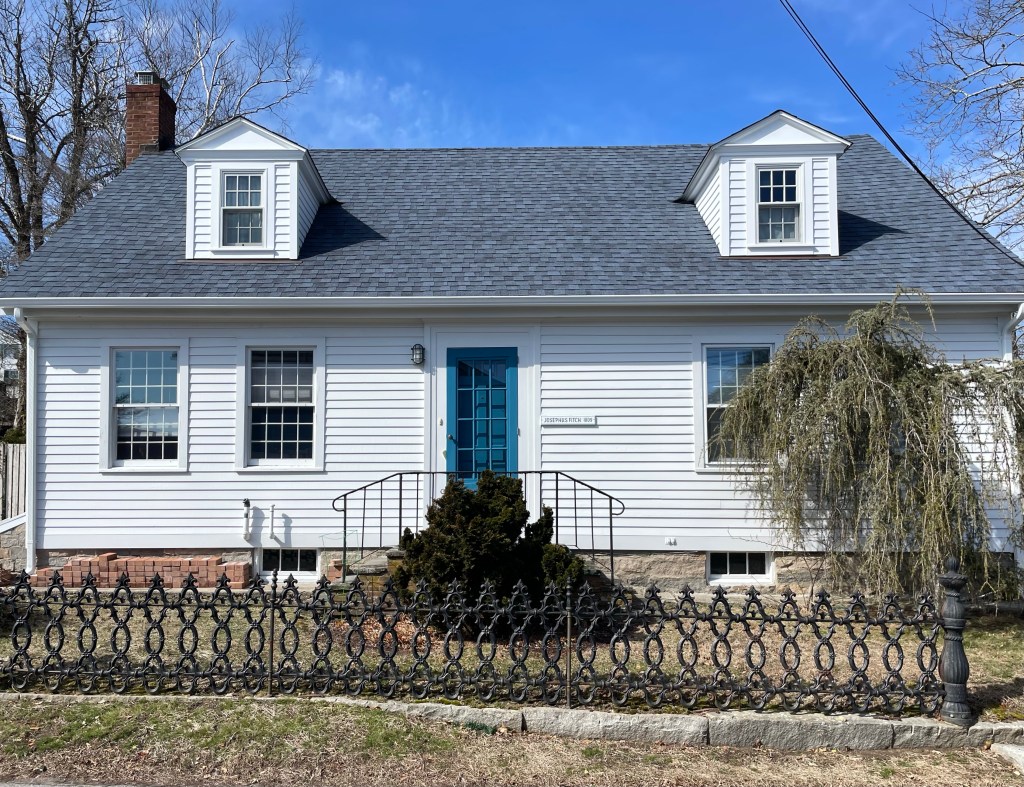
Not far from the Pelatiah Fitch House is this charming Federal Cape house in Noank, CT, built for Pelatiah’s grandson, Josephus (there are a lot of great names in this family)! Pelatiah’s eldest son Josephus was born in 1745 and was equipped for service in the American Revolution by his father. He survived the war, but in 1778, he perished at sea aboard a whaling vessel. Josephus Fitch Jr., his mother and siblings remained in Noank and tried to re-establish a life after losing their father who was just 32 years old. He grew up and married, and eventually purchased land in town, building this cape house in 1809. The house is vernacular with modest trim surrounding the door, 12-over-12 windows, and two small dormers at the roof.
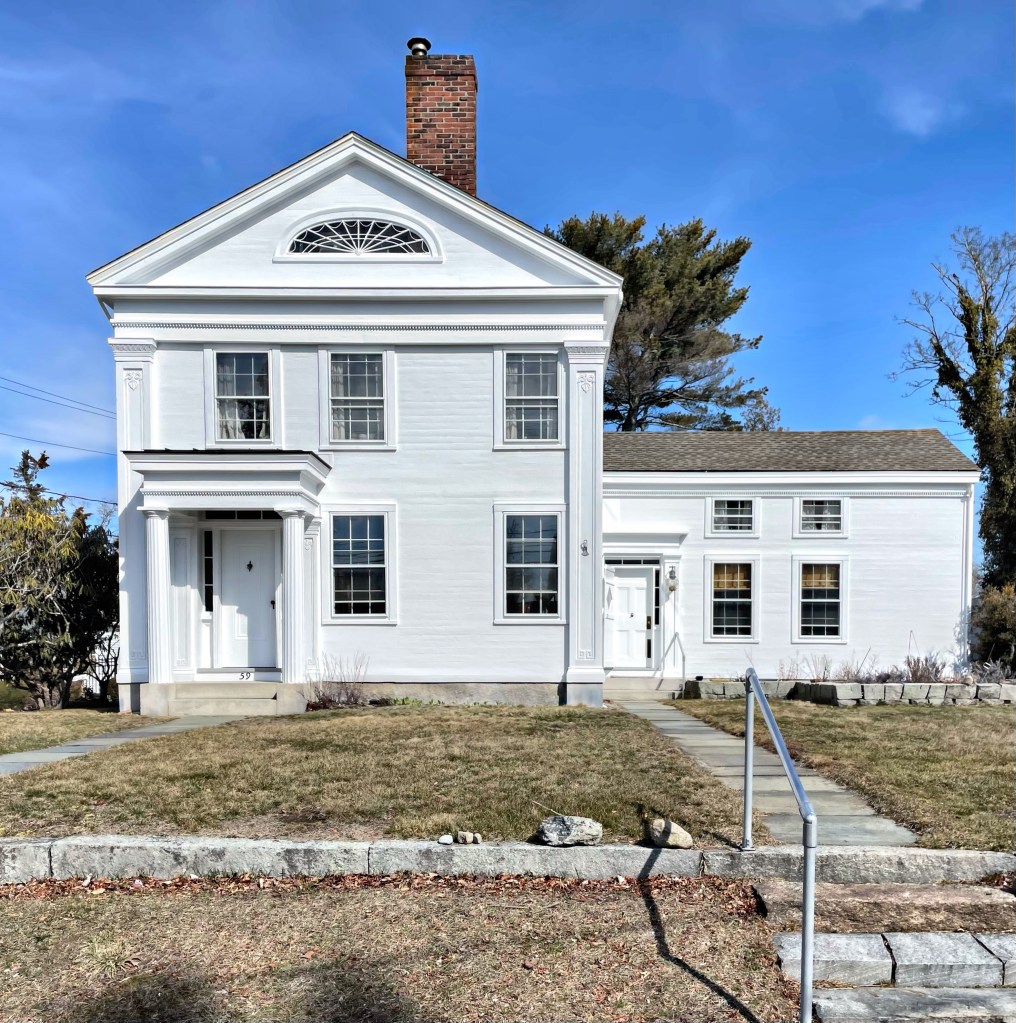
Noank is a charming seaside village within the town of Groton that is centered on a peninsula at the mouth of the Mystic River where it spills out into the Long Island Sound. Historically, the area was known as Nauyang (meaning “point of land”) and was a summer camping ground of the Pequot people, but they were driven out in 1655 following the Pequot War. White settlement was slow here until the mid-19th century, when the shipbuilding and fishing economy took off here. As a result, houses, stores, churches and industries were built, and an entire village was formed. Most extant homes here were constructed starting in the 1840s as the village (and nearby Mystic) saw economic growth from the maritime trades. This house, the Moses Latham House, was constructed for Mr. Latham in about 1845. The house is Greek Revival in style with flush-board siding, a fan light in the gable which reads as a pediment, and a simple portico supported by fluted Doric columns.
This old gambrel-roofed home sits on the beginning of Pautipaug Hill Road just outside the industrial village of Baltic, in Sprague, Connecticut. The house’s history is a little unclear, but it shows up on historic maps as being owned by W. Giddings. This appears to have been Walter Giddings (1788-1854). Walter may have built or inherited this property from his father Nathaniel, who died in 1809. Walter married Laura Lucretia Fillmore in 1811 and they had four children. Laura died in 1827 at just 37 years old and Walter remarried within a year to Lydia Lathrop Ladd. The property remained in the Giddings Family at least into the second half of the 19th century. It was later “Victorianized” with two-over-two windows, side and front porches, and a octagonal bay window. The home has been suffering from deferred maintenance for over 15 years (as far back as Google maps goes) and was listed for sale, so here’s to hoping this old beauty survives!
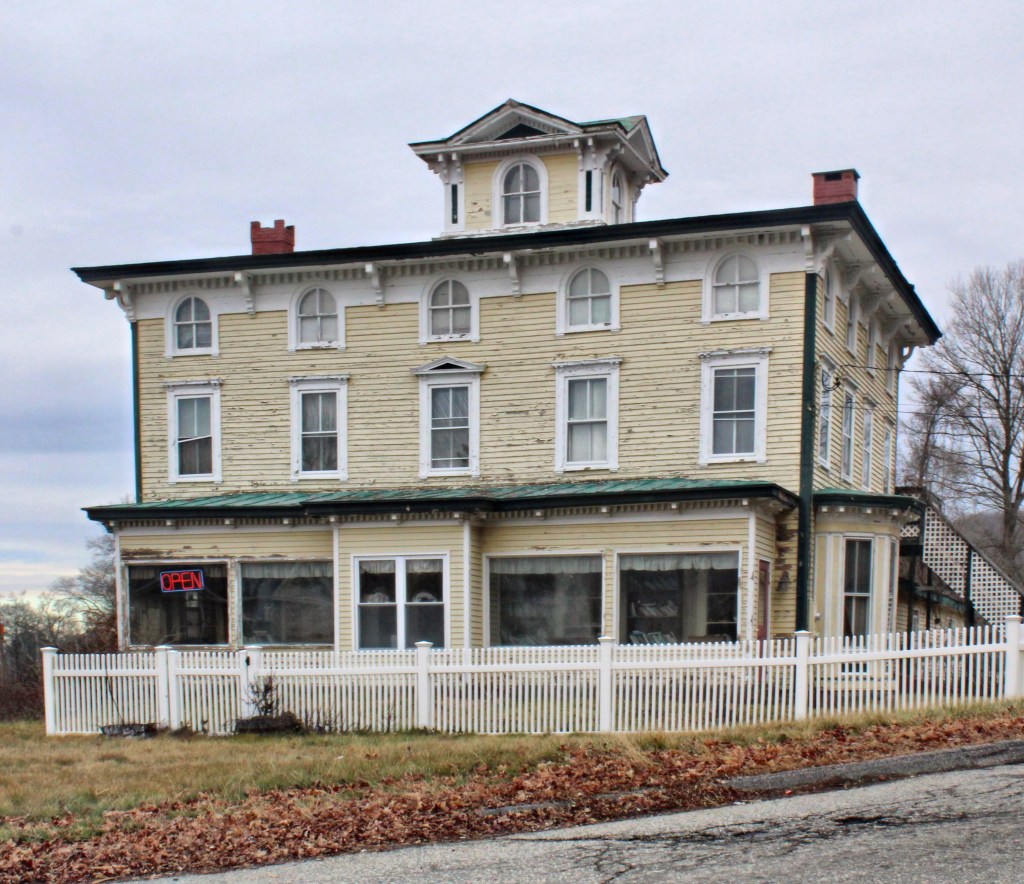
One of the largest and most stunning buildings in the town of Franklin, Connecticut is this Italianate style structure along the Hartford-Norwich Turnpike. The building appears to have been built soon after the conclusion of the American Civil War by brothers John Owen Smith (1819-1896) and Prentice Orrin Smith (1817-1898) who possibly operated the building as a tavern or inn along the route between Hartford and Norwich. The three-story, five-bay facade structure featured round arched windows at the top floor, a raised belvedere at the roof, bracketed cornice with overhanging eaves, and later storefronts at the facade. The building is occupied today by Victorian House, a furniture store.
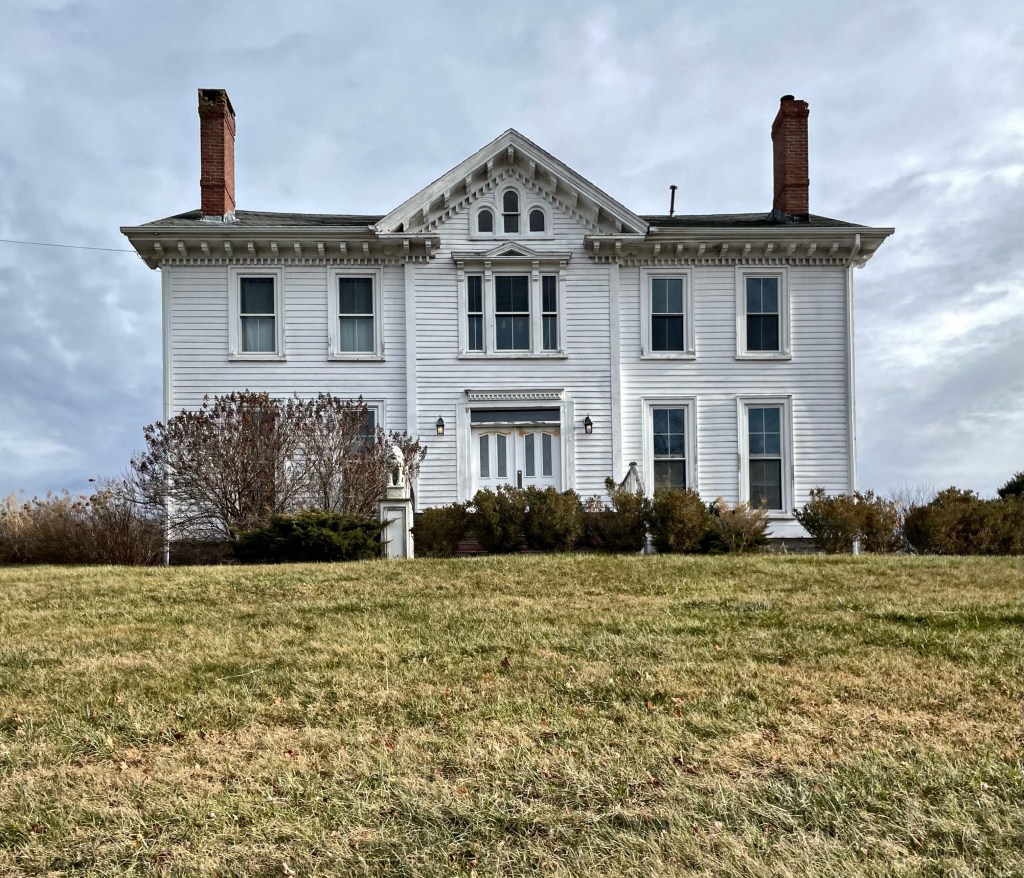
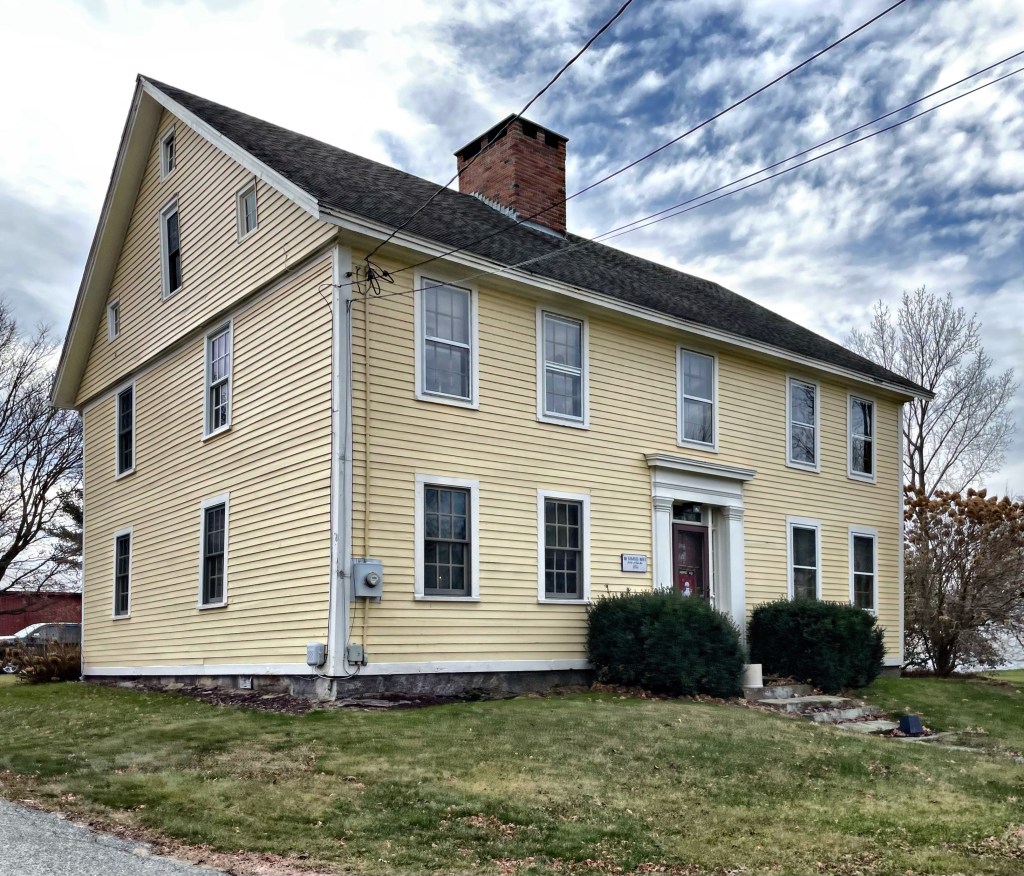
Jacob Kingsbury was born in Norwich, Connecticut on July 6, 1756, to Nathaniel and Sarah Hill Kingsbury. On July 11, 1775, at the age of 19, he enlisted in the 8th Connecticut Regiment, which was part of the Continental Army in the Siege of Boston. Kingsbury remained in the Continental Army when it was reorganized in 1776, and he was promoted to sergeant and then was commissioned an ensign in Webb’s Additional Continental Regiment on April 26, 1780. He served until the Continental Army was disbanded on November 3, 1783. At this time, Jacob moved back home and appears to have had this house built, or moved back into his father’s home. He would later serve with the United States military on campaigns against British allies and Native tribes. During the War of 1812, Kingsbury was appointed to command the defenses of Newport, Rhode Island. He served as Inspector General for Military District No. 2 (comprising the states of Connecticut and Rhode Island) from April 8, 1813, to October 31, 1814. He was discharged in 1815, and moved back to Franklin to live out his final days. The original vintage of this house in unclear, but it appears to have been built before or shortly after his return to Franklin in 1815. After his death in 1837, the property was inherited by his son, Col Thomas Humphrey Cushing Kingsbury, who updated the old homestead with Italianate detailing including the replacement double doorway, bracketed and dentilled cornice, tripartite window in the gable, and 2/2 windows. What a cool blending of styles here!
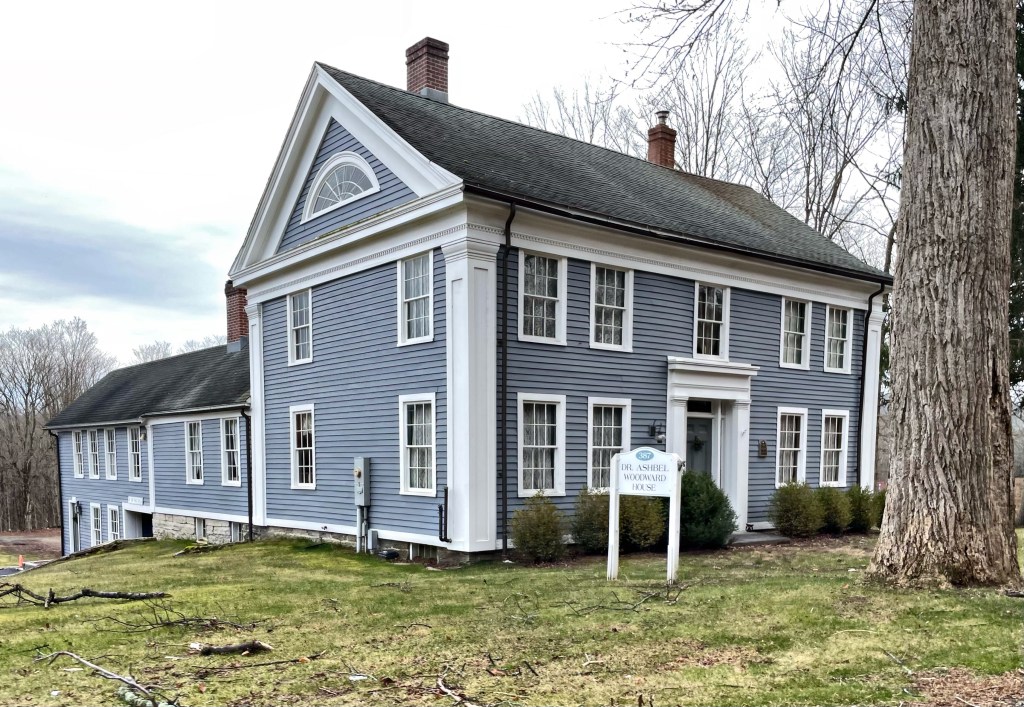
The Ashbel Woodward House in Franklin, Connecticut was built in 1835, on land purchased by Doctor Ashbel Woodward, a prominent local physician, a year prior. Woodward, was a graduate of Bowdoin College, and he began practice in Franklin in 1829, serving as the town’s primary medical practitioner until his death in 1885. Though in his 60s at the outbreak of the Civil War, Woodward perhaps lent his greatest service to his country when he served as a battlefield surgeon and medical facilities inspector for the Union army. Besides his work in medicine, Woodward collected literature and numerous artifacts pertaining to Franklin’s past and eventually wrote a book detailing the town’s history. The Ashbel Woodward House is an excellent example of the Greek Revival architectural style in a five-bay form. Interestingly, there are semi-elliptical windows in the pediment gable ends on the side elevations, seemingly a nod to the Federal style that was waning out of style at the time. The property is in use today as a museum, documenting the life of Dr. Woodward and the people of Franklin, Connecticut.
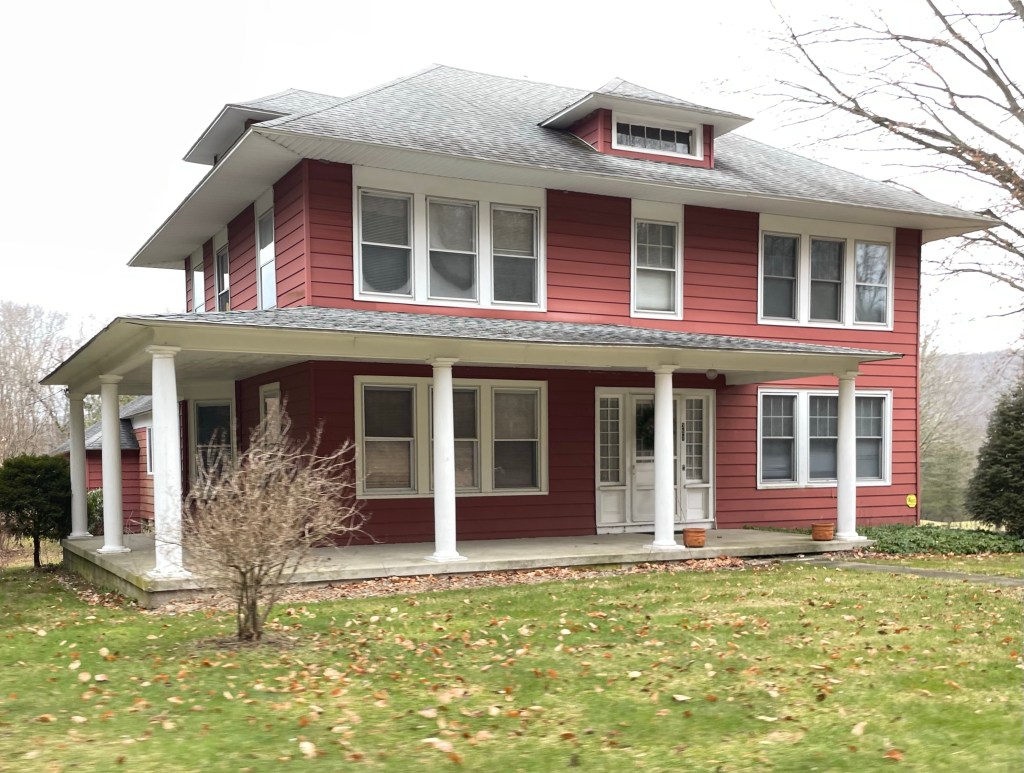
Prairie style architecture is not nearly as common in New England as it is in the Mid-western United States. The style was almost always seen in early 20th century residential designs and is characterized by horizontality, low slope roofs, overhanging eaves, and open interior floor plans. This New England vernacular version of the Prairie style employs some Arts and Crafts influence with Tuscan columned porch and wood frame construction, rather than the more bulky and bold use of brick and stone. This residence sits on a busy state route in the sleepy town of Franklin, Connecticut. This house appears to have been built for Oliver Johnson who was about seventy by the time the house was built. Do you know of any other Prairie Style houses in New England?
Reverend Samuel Nott (1754-1852) was born in Saybrook, Connecticut and did not have an easy beginning. When he was young, the family home burned, destroying all family possessions. Some years later on a business trip, he was beaten and robbed. At twelve years old, he began working for his father, later becoming a blacksmith by 16. For a while, young Nott lived with a Rev. Dr. Welsh of Mansfield. The older man had a profound religious influence on the young lad. At age 23, Nott entered Yale, but the college closed when British troops entered New Haven. In 1782, he married Lucretia Taylor and passed his examination for the ministry. A year before his marriage, he was invited to serve a parish in West Farms, now Franklin. He was apparently anxious to accept the position at the rural village, as the farmers attending the congregational church had fired their previous two pastors, he accepted the call regardless. During his tenure, he prepared more than 40 young men for college and schooled as many as 300 boys and girls in his home, some as boarding students. He was regarded as one of the most successful educators of the day. Education ran in his family as Samuel’s brother, Eliphalet Nott, would become President of Union College in Schenectady, NY for 62 years, from 1804-1866. Towards the end of Samuel’s life, in his 70s, his wife Lucretia, became an invalid, requiring care and finally passed in 1834. Three of his children also died. Nott passed away at 98 years old in this house, as a result of burns sustained from his own fireplace.
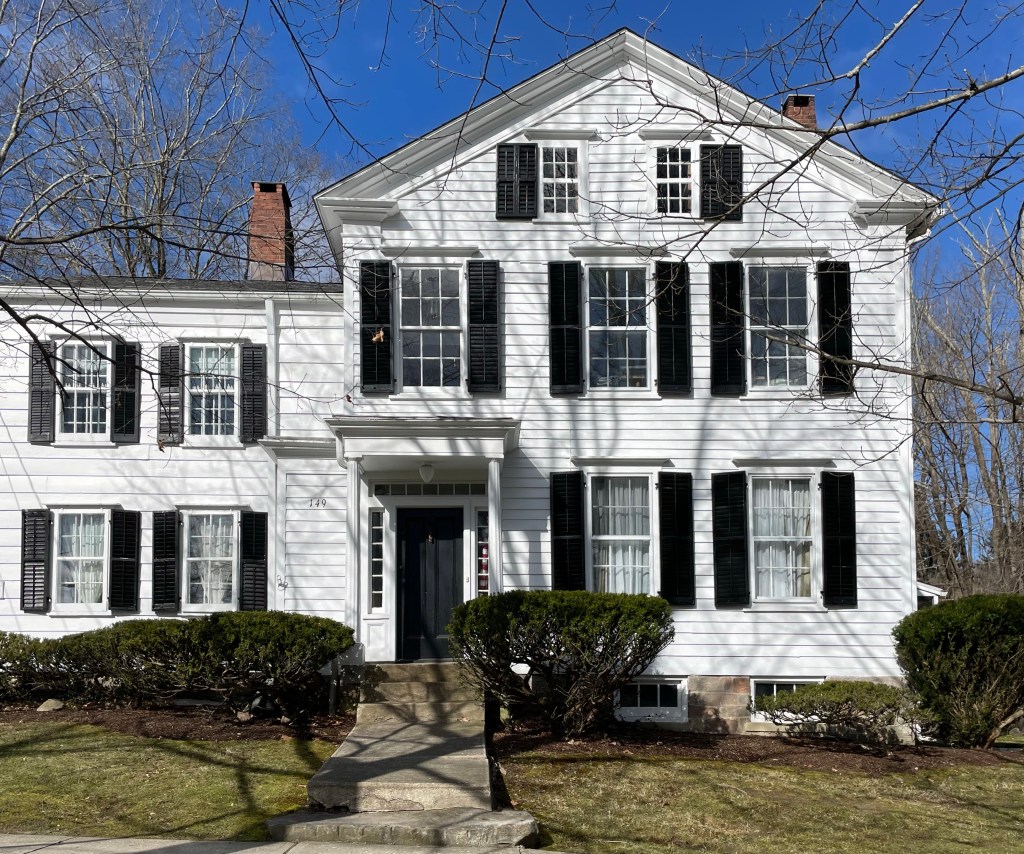
Connecticut has some of the most stately early 19th century homes in New England, from the larger cities to rural towns like this beauty in little Franklin, Connecticut. This dwelling was built in the 1840s for Dr. Stephen Sweet (1798-1874) a physician near the town green. It was built after his second marriage, after his first wife’s death. His second wife, Matilda, died in the home during childbirth at age 44, along with their son just days later. The house is an excellent example of the Greek Revival style, with a gable roof running parallel to the main street, central entrance and corners framed with pilasters and frieze band at the cornice. At the side of the house, which also fronts a street, the stately home commands the corner with a second entry (maybe for in-patients), and a pair of quarter-round windows in the pediment.
Welcome to Franklin, Connecticut, which frankly (pun intended) I had never heard of before driving through it not long ago! The town is located in New London County and was originally a part of Norwich, Connecticut and was called West Farms village. The town incorporated in 1786, creating its own town at that time, and the citizens decided to name their new town after Benjamin Franklin. I wonder if there are more place names in the United States after Benjamin Franklin or George Washington…
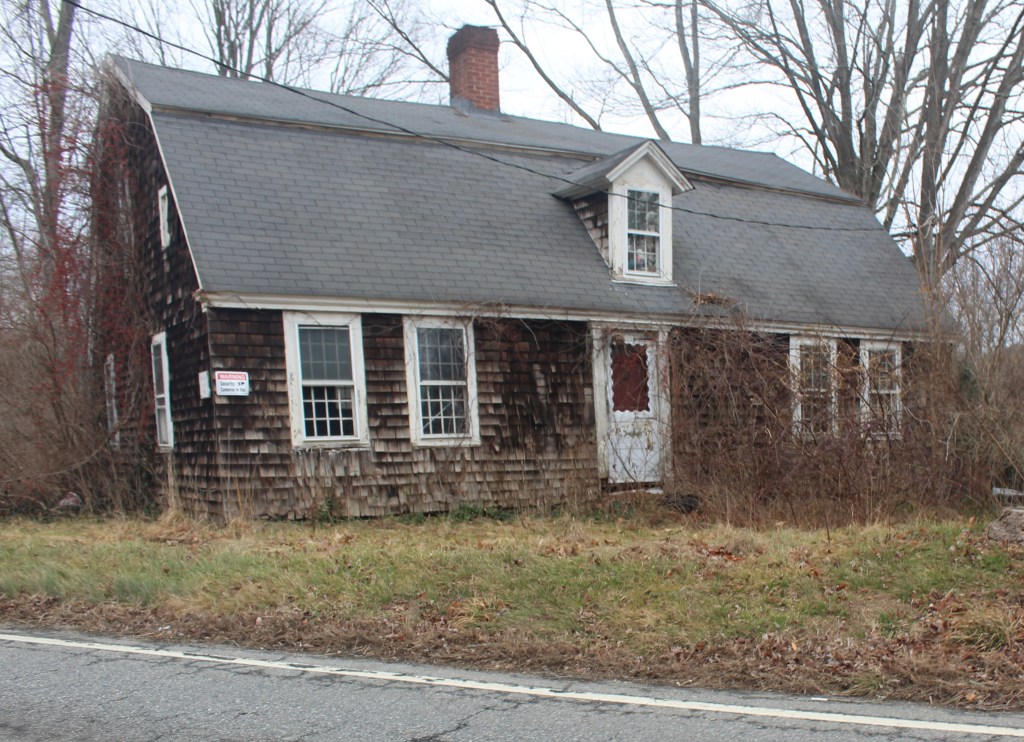
This is one of the oldest houses in the sleepy town of Franklin, and it was built around 1702 by Nathaniel Backus, about the same time he was married to his wife, Elizabeth. The Georgian Cape house features a large gambrel roof and a small gabled dormer. The house is representative of many of the earliest homes which once existed in this landscape in the early 18th century. The home appears to have been vacant for some time, and in 2022, was auctioned off. Its future is unclear at this time sadly.
While this house appears to have been built in the mid-1800s as a Greek Revival home, it was actually built nearly a century earlier as one of the oldest extant properties on Main Street in Ridgefield, CT! Located on proprietors lot #20, the original building lots laid out for the new town of Ridgefield, this house appears to have been constructed in 1760 for Matthew Seymour (Seamore) and consisted of what is now the ell of the home (left side). Seymour operated one of the trade posts in town that engaged in trade with a nearby native Ramapo Tribe. The home was likely re-oriented and added onto with a more formal Greek Revival wing with its gable roof facing the street before the Civil War, a configuration it retains to this day.