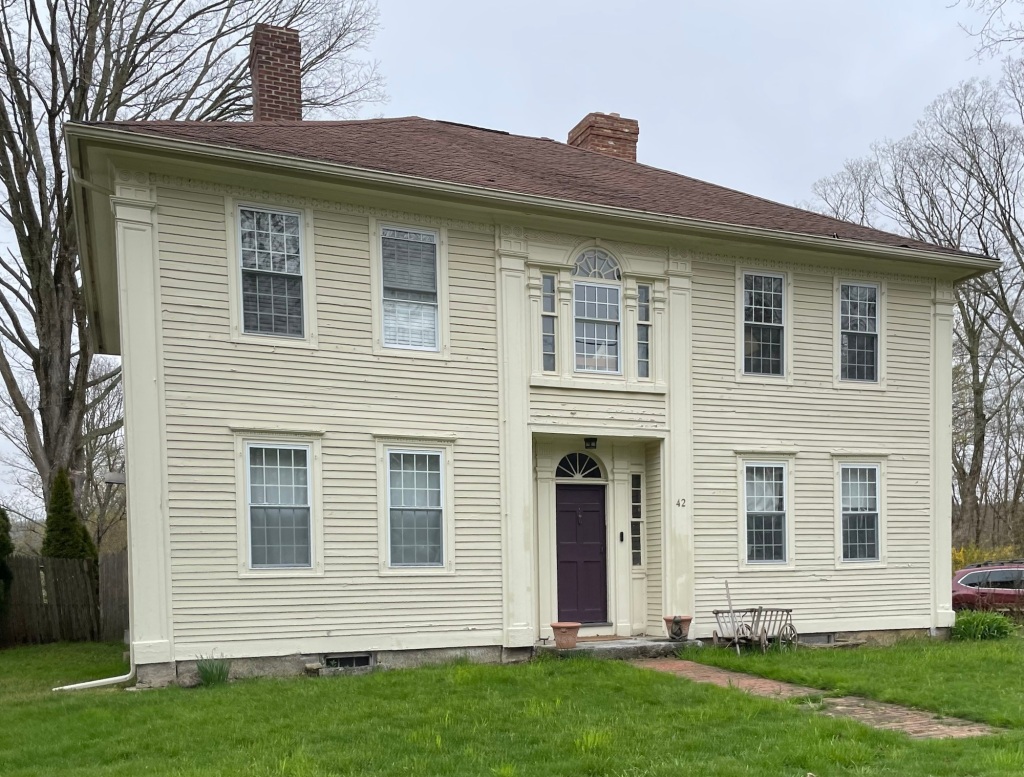
Stebbins-Tremko House // 1773

Ashford, Connecticut is located in a part of Windham County at the northeast part of the state which is sometimes referred to as the Quiet Corner, due to its limited access to larger cities and more bucolic scenery. Formerly known as New Scituate, Ashford was settled in 1710 and incorporated as a town in October of 1714. One of the town’s early houses is this cape style dwelling, built around 1773 for Thomas Stebbins (1748-1826). By the 20th century, the small house was owned by George Tremko (1907-1981) who worked as the town’s postmaster for some years in the post office just nextdoor. After Tremko’s death, the town acquired the property through eminent domain, with the hopes of redeveloping the prominent site for a new library. Luckily, the local historical society advocated for its preservation, and grants were acquired, which helped to restore the 1770s house.

The Congregational Church of Union // c.1841

The small town of Union, Connecticut was established in 1734 and as with many towns at the time, religion and community were some of the first things to be codified when settling in a new area. The town’s publicly supported religion, Congregationalism permeated everyday life in Union. Even after disestablishment in 1818, the Congregational church continued as Union’s predominant religious organization well into the twentieth century. By 1841, the members built this edifice, the congregations second, on a hill overlooking the town’s modest green. The vernacular church features a Gothic lancet window, classical belfry, and later pent roof porches over the entrances on the primary facade.

“Good Cheer Estate” // c.1820

Originally built as a Federal period farmhouse, this gorgeous estate is the epitome of what happened to Ridgefield… city money! By the end of the 19th century, wealthy New Yorkers were flocking to small towns every summer for clean air, rest, and relaxation. Ridgefield, Connecticut became an obvious option for its close proximity to New York and bucolic setting of farmlands bounded by old stone and rolling hills. As a result, wealthy summer residents purchased older estates and either demolished or renovated the homes there. Aaron Lockwood Northrop was raised in Ridgefield and was educated in its private schools before moving to New York as a young man, being awarded an apprenticeship as a dentist. Dr. Northrop went on to establish a prominent dental practice and would serve as President of the American Dental Association. As a wealthy adult, he acquired a circa 1820 house on this lot and renovated it, doubling its size and giving the residence its current Victorian flair. The summer house was affectionately named “Good Cheer”. Aaron died unexpectedly in 1908 while overseas in Paris, France. His widow, Caroline, resided at Good Cheer until her own death in 1927.

Branchville Railroad Tenement // c.1853

The Branchville Railroad Tenement in Ridgefield, Connecticut was built in three phases between around 1853 and 1905 and is one of the towns significant vernacular landmarks. Its earliest incarnation was as a storage facility for the railroad station, to which two stories of residences were added to houses workers on the railroad. Following completion of the railroad, the building was converted into a hotel in 1880, at which time the two-story porch was built and the interior was redecorated. This was apparently an unsuccessful venture, and in 1905 it was converted to a saloon and multifamily residence. Today, the old railroad tenement is home to a small business with housing above.

Ashton Croft Mansion and Carriage House // c.1892

Tucked behind the Jesse Lee Memorial Church on Main Street in Ridgefield, you will find this stately Queen Anne/Tudor Revival estate. The ‘Ashton Croft’ Manor House, now called Wesley Hall, is part of the Jesse Lee Memorial United Methodist Church complex and it has been modified several times blending two distinct styles into a single, pleasing composition. This house was originally constructed by Henry and Elizabeth Hawley circa 1892 in the Queen Anne style. The house was later sold to Electa Matilda Ziegler, a wealthy New York City widow in 1912, who reconfigured the structure to include half-timbering on the gables and upper story walls in the Tudor Revival style. She spent summers at a mansion in Darien, Connecticut, and would sell her Ridgefield property to Sanford H.E. Freund, a New York City attorney. The local order of Odd Fellows bought the estate from the Freund family in 1956. Three years later, the organization sold most of the property — retaining the carriage house for its lodge — to Jesse Lee Methodist Church, which planned to eventually build a new church there to replace the old one at Main and Catoonah Streets. Today, the entire former Ashton Croft estate is owned by the local Methodist Church and is known as Wesley Hall.

Ridgefield Train Depot // 1870

In 1870, the Ridgefield Branch branch line of the Danbury and Norwalk Railroad and later the New York, New Haven and Hartford Railroad was built connecting the sleepy village of Ridgefield to Branchville train station via the main line. The line was an early risk, built to offer service to the wealthy New Yorkers who began arriving to spend their summers in Ridgefield. Many of these “summer people” had their own private railroad cars, with chauffeurs meeting them as they arrived, driving horse and buggies to bring them and their luggage to their estates located throughout the town. As travel shifted to personal automobile, ridership dropped in the early 20th century, and the branch was replaced by bus service in 1925. Freight service was scarce, and lasted longer, to 1964. The depot was sold to the Ridgefield Supply Company, who used the 1870 building as storage for decades until it was disassembled, moved and rebuilt by the Ridgefield Supply Company in 2015, as part of their expansion. The historic station today provides an important link to Ridgefield’s past.

Yale University – Warner House // 1887

Originally known as Cloister Hall, this ornate building on Hillhouse Avenue in New Haven, Connecticut is one of the most interesting I have seen. The building was constructed in 1887-8 as a residence hall for members of the Book and Snake, a secret society at Yale University. Architect H. Edwards Ficken designed the ornate brownstone Cloister which was completed in 1888. At the time, it was considered “one of the most picturesque buildings on the Yale campus.” The society added a matching rear addition in 1915, which is a heavier mass, but compliments the original structure. Yale University would eventually acquire the building after the society no longer needed a separate lodging house for members. Today, the building is called Warner House, and Yale does a great job at maintaining this beauty.

Yale University – Kirtland Hall // 1902

Yale has such great architecture. Walking around the campus, you can find examples of buildings of every time period and architectural style, it is like a living museum of architecture in that sense. Located on Hillhouse Avenue, Kirtland Hall is arguably Yale’s best example of Beaux Arts/Neo-Classical architecture, but it stands out for its use of local East Haven and Longmeadow sandstone. The building was the first laboratory to be built at Yale in the 20th century and was named after Jared Potter Kirtland (1793-1877), the first medical student enrolled at Yale. After graduation, Dr. Kirtland practiced medicine throughout Connecticut until 1823, when his wife died and he moved to Ohio. During his life, Dr. Kirtland also developed an interest in natural history and assisted in the first geographical survey of Ohio. In the early 20th century, Lucy Hall Boardman, a philanthropist and niece of Dr. Kirtland, not only donated funds for scholarships at Yale, but also donated a building, Kirtland Hall. As part of her gift, Ms. Boardman stipulated that her nephew, architect Kirtland Cutter, would be commissioned to design the building, and of course, Yale obliged. The building originally housed the Geology Department and became an integral part of the Sheffield Scientific School.

Berzelius Tomb // 1910

Yale, like other Ivy League colleges, has a long and complex history of secret societies. The secret societies all are headquartered at their own buildings, called “tombs”. These are massive, very impressive structures without windows or signage and all share an unmistakable message with their architecture: “Private; keep out.” One of the lesser-known tombs at Yale is the Berzelius Tomb, completed by 1910 from plans by architect Donn Barber. The Berzelius was established in 1848 as a secret society and formerly was located in Berzelius Hall, a Romanesque style building. The tomb is sited on an difficult lot at the convergence of three main roads but holds its own architecturally as a highly ornamented box. This austere tomb is built of limestone, with a balustrade and detailed cornice at the roof, but the main attraction is the entrance, which is a double brass door with floral panels, all surrounded by a Classical surround. Above the entrance, a limestone panel showcases the Society’s insignia with fruit and flower swags.

New Haven Museum // 1929

New Haven, Connecticut is known for its Gothic and Modernist architecture, but as it is located in New England, some good Colonial Revival architecture is not hard to find! The New Haven Museum building on Whitney Avenue was built for the New Haven Colony Historical Society, which was established in 1862 to collect, preserve, and publish historical matter related to the history of the greater New Haven community. The Society was housed in various locations around the city throughout the 19th century until 1929 when it relocated to its present building designed by J. Frederick Kelly, a noted colonial revival architect. The symmetrical building with its eleven-bay facade is notable for its arched recessed portico and rooftop cupola. The building remains occupied by the New Haven Museum to this day.