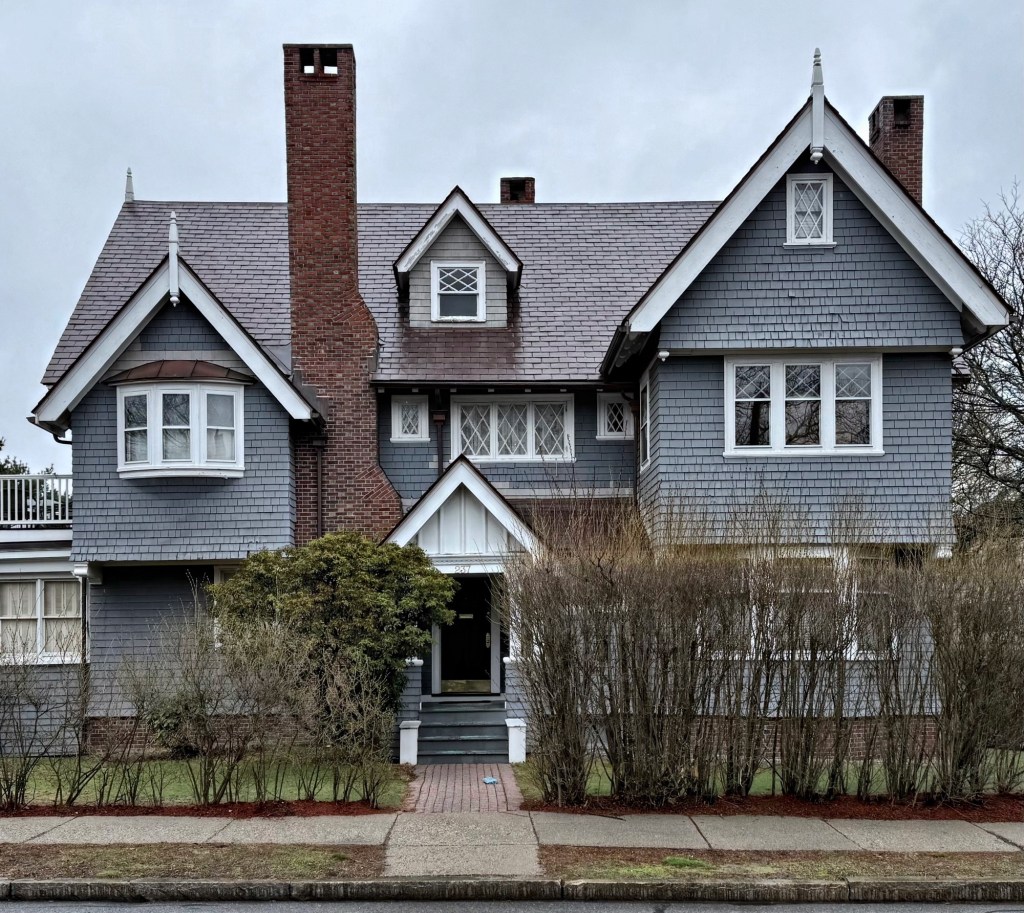
By the end of the 19th century, Brookline’s connection to Boston via the streetcars opened the town up to suburban development unlike anything seen before. From this, Boston businessmen could move to the suburbs for more land and live in larger single-family homes while commuting to the city for work. This large house in the Cottage Farm neighborhood was built in 1899 on speculation and purchased by George and Annie Andrews, who two years later, built a stable on the adjacent lot. Architect Robert Coit, specialized in large suburban houses, primarily in the Boston-area suburbs, and showcased his design talents for this Tudor Revival home. Tudor Revival style ornament include the second story over-hangs supported on brackets, the diamond pane sash and casement windows, vergeboard with finials, and portico with steep gable.
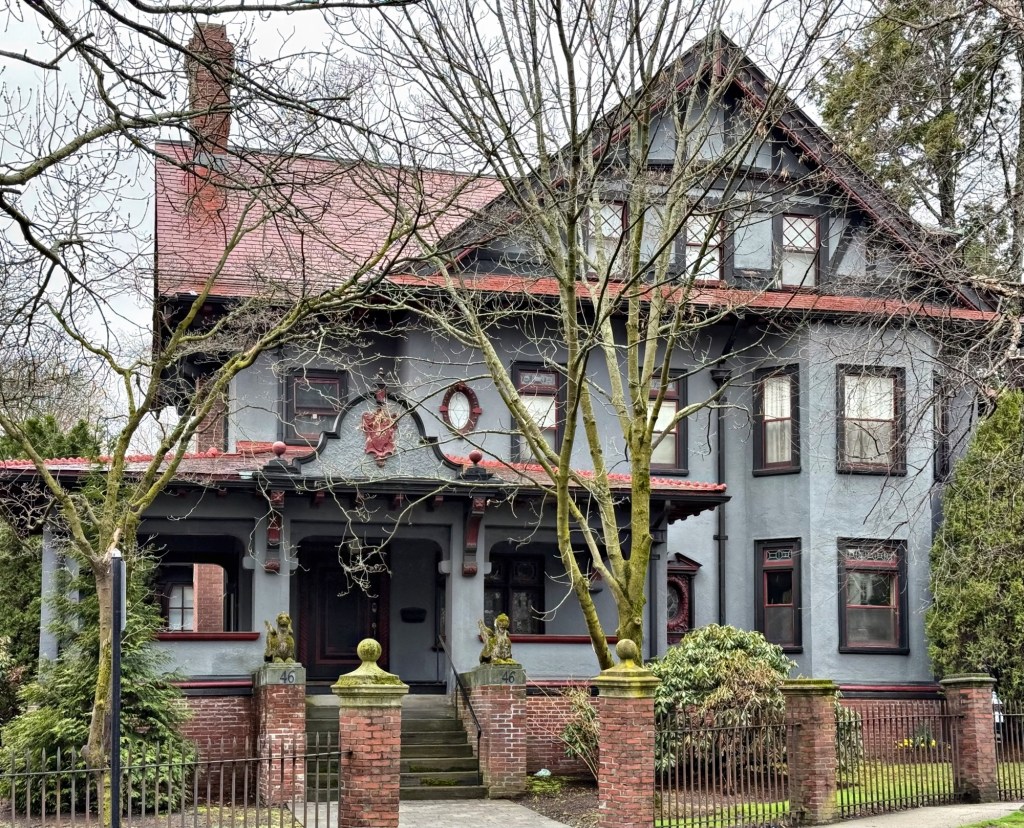
Eclectic houses of the late 19th and early 20th centuries are my favorite as they showcase how architects of the time blend features and break the strict mold of academic styles. This example is found in the Cottage Farm neighborhood of Brookline and dates to 1905. Designed by relatively unknown architect, Alfred Lyman Darrow, who studied at MIT, before opening his own practice. The house was first owned by Hugh G. Brown, who founded the Brown’s News Company and the Hotel & Railroad News Company. The house exhibits half-timbering in the gable ends and decorative corbelled chimneys that derive from the Tudor Revival; the front porch parapet appears to derive from the Spanish Mission style; along with stucco siding and unique windows typical of the Arts and Crafts movement.
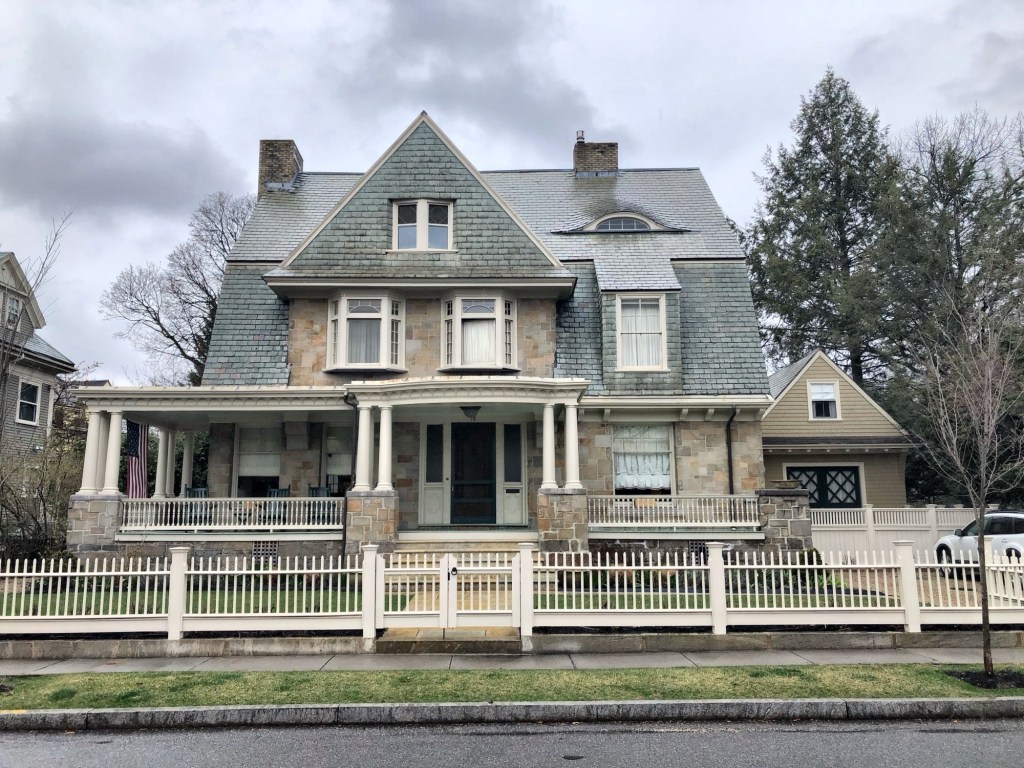
One of five houses built by developer Albert Jewell along Powell Street in the Cottage Farm neighborhood of Brookline, this residence stands out for its materiality and stately design. The house was designed by J. Williams Beal, an architect who trained at Massachusetts Institute of Technology and then worked for McKim, Mead & White before opening his own business. The house was first purchased from Mr. Jewell by Grace and Edwin Kramer, who worked as superintendent for R. H. White & Co., the large dry goods store in Boston. The next long-term owner was Harry B. Duane, a wealthy grocer. The Kramer-Duane House is unique for the stone veneer at its facade, gambrel roof covered in slate, and varied window styles including: bay windows, dormer windows, and an eyebrow dormer window at the roof.
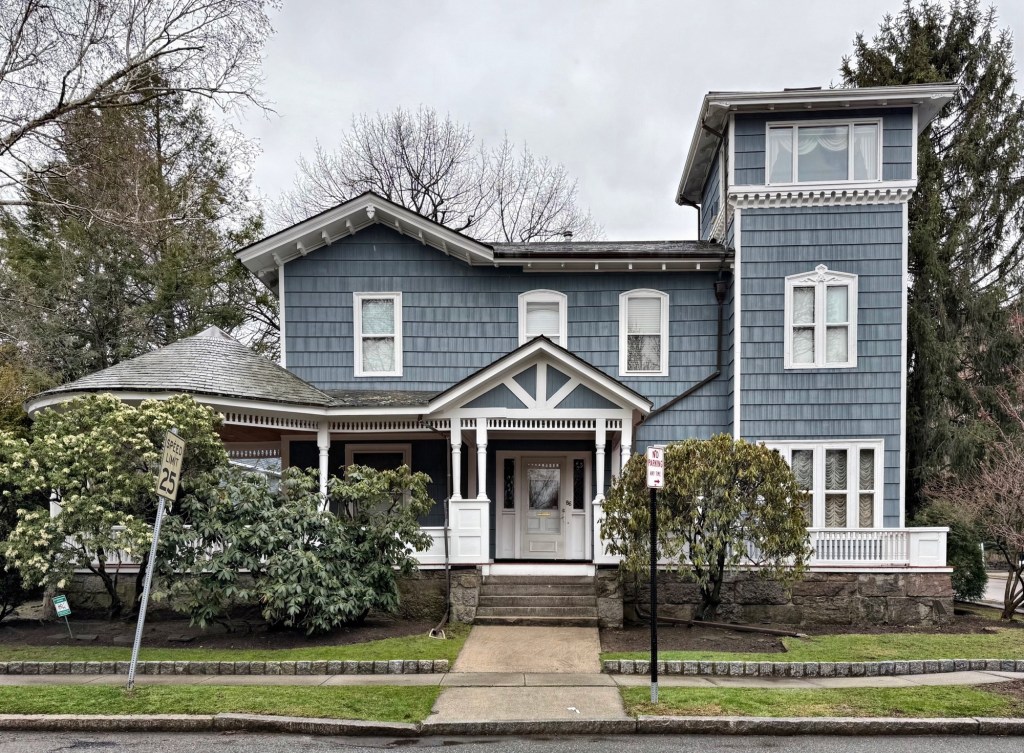
This house at the corner of Freeman and Powell streets in the Cottage Farm area of Brookline, Massachusetts, was one of the first to be built on Sears family land in the years following the death of the family patriarch, David Sears. In 1871, Dennison Dean Dana (1827-1899) purchased land here from the Sears heirs and constructed this Italianate house with three-story square tower. Dana owned the house through the 1880s, and by 1893 it had been acquired by Albert L. Jewell, a real estate developer who added the large veranda and a two-story addition to the house, and would subdivide the property, developing fashionable houses along Powell Street to the south. The house (while clad in asbestos shingles since the 1960s) is an important early residence in the neighborhood which is today, dominated by late 19th and 20th century architecture.
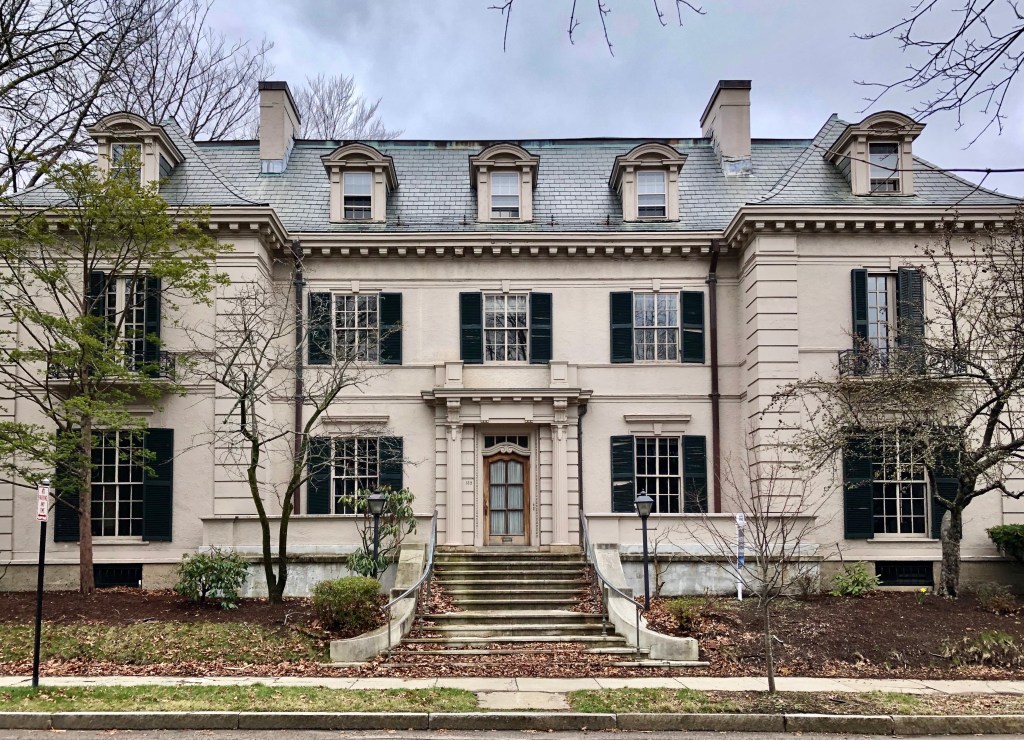
This stunning home in Brookline’s Cottage Farm neighborhood was built in 1908 for Bernard Jenney, the assistant treasurer of the Jenney Oil Company. Stephen Jenney, had founded Jenney Oil Company in Boston in 1812, as a kerosene, coal and whale oil producer. By the 1860s, Bernard Sr. and his brother Francis took over the company which became known as the Jenney Manufacturing Company. The newly established company focused primarily on production and distribution of petroleum products for factories and businesses. The Jenney Manufacturing Company took off in the early 1900s due to the proliferation of personal automobiles in Boston and they expanded a new manufacturing center in City Point, South Boston, which had a capacity of 500 barrels of oil a day. Jenney auto oil and gasoline became a major supplier and after Bernard Sr.’s death in 1918, under Bernard Jr.’s leadership, the company began to develop gas stations in New England. The company continued into the 1960s when it was acquired by Cities Service, later rebranding as Citgo. Jenney resided here until his death in 1939. According to the 1935 Brookline street list, the occupants included his daughter’s family Mary & Francis Brewer, three maids and a laundress. The house was acquired by Boston University in 1963 and has long served as the home of former president John Silber.
The architectural firm of Kilham & Hopkins was hired to design the home, which is French Renaissance Revival in style. The home itself is an architectural landmark. When it was published in ‘The American Architect’ in 1910, the house was described as, “A Study in French design of the Louis XVI period”. Additionally, the home (of course) featured a vehicle garage as the family must have had some cars based on the line of work. The home is now listed for sale for a cool $4,888,000 price tag!
 Buildings of New England