Old New Ipswich Center Schoolhouse // 1829

Presently owned and occupied by the New Ipswich Historical Society, this handsome brick building was originally constructed in 1829 as a schoolhouse for young students in town. The structure is located on Main Street and replaced wood-frame school that was located on the other side of the road. Almost immediately after it was built, the building and its location were heavily criticized as early as 1847. There were up to 92 pupils in its two rooms, both of which were accessed by a central entrance, causing those entering and leaving to disrupt both classrooms. Additionally, the closeness to the road caused noise and dust to enter the classrooms. The school closed in 1860 and was used for a time as a blacksmith shop before it was acquired by the New Ipswich Historical Society in 1939.

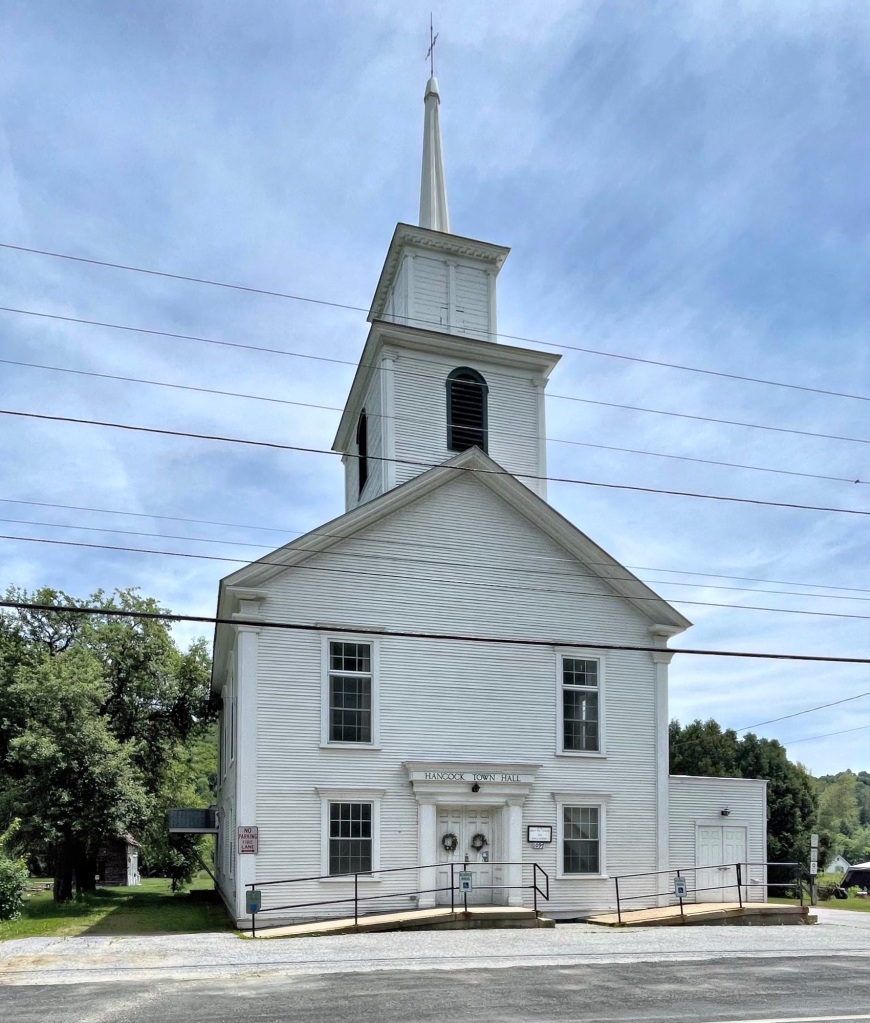
Hancock Town House // c.1850

Hancock, Vermont is located in Addison County, and sits on the east side of the Green Mountains. The land here was granted November 7, 1780 and chartered July 31, 1781 by Governor Chittenden, to Samuel Wilcox and 129 associates. Hancock grew as pioneers sought new land and opportunity after the Revolutionary War with some taking up farming and others engaging in the lumber trade. The population in the rural town reached its peak of 472 residents in 1830, a number it has never seen again – the current population is 359. As the town saw its largest growth in the early decades of the 19th century, the town officials decided to erect a joint Town House and Union Church to serve multiple uses. This structure, built in the Greek Revival style by around 1850, has two stories, with the ground floor historically housing town offices, and the second floor formerly housing a meeting space and church hall. The classically designed building has a box cornice, frieze, and molded corner pilasters. The double entrance doors have pilaster and entablature surround and the three-stage steeple has a clapboarded base with corner pilasters. The structure has survived generations and natural disasters and is a testament to this small, but proud town in rural Vermont.

Spot Pond Gatehouse // 1900

The Middlesex Reservoir and Spot Pond are located just north of Boston and have long been a little piece of the outdoors near the heart of New England’s largest metropolitan area. In 1894, the Massachusetts Legislature established the Metropolitan Parks Commission, which was endowed with the authority to acquire, maintain, and make recreational spaces available to the public. By 1900 the new commission had acquired 1,881 acres for the reservation. Part of this reservation, Spot Pond, is a natural water feature that for a number of years was integrated into the Boston area public drinking water supply, servicing the towns of Stoneham, Melrose, and Malden with drinking water. As part of this, gatehouses were built with hardware to open and close the pipes delivering the water to the adjacent towns. This gatehouse is in Stoneham was built in 1900 by the architectural firm of Shepley, Rutan & Coolidge, to not only protect the machinery inside, but to beautify the parkland, then maintained by the Metropolitan Parks Commission. The Renaissance Revival style building is today surrounded by a tall chain link fence, which really diminishes its presence in the landscape (but it does help prevent graffiti).